Check Engine Light On? An Evidence-Led OBD-II Workflow

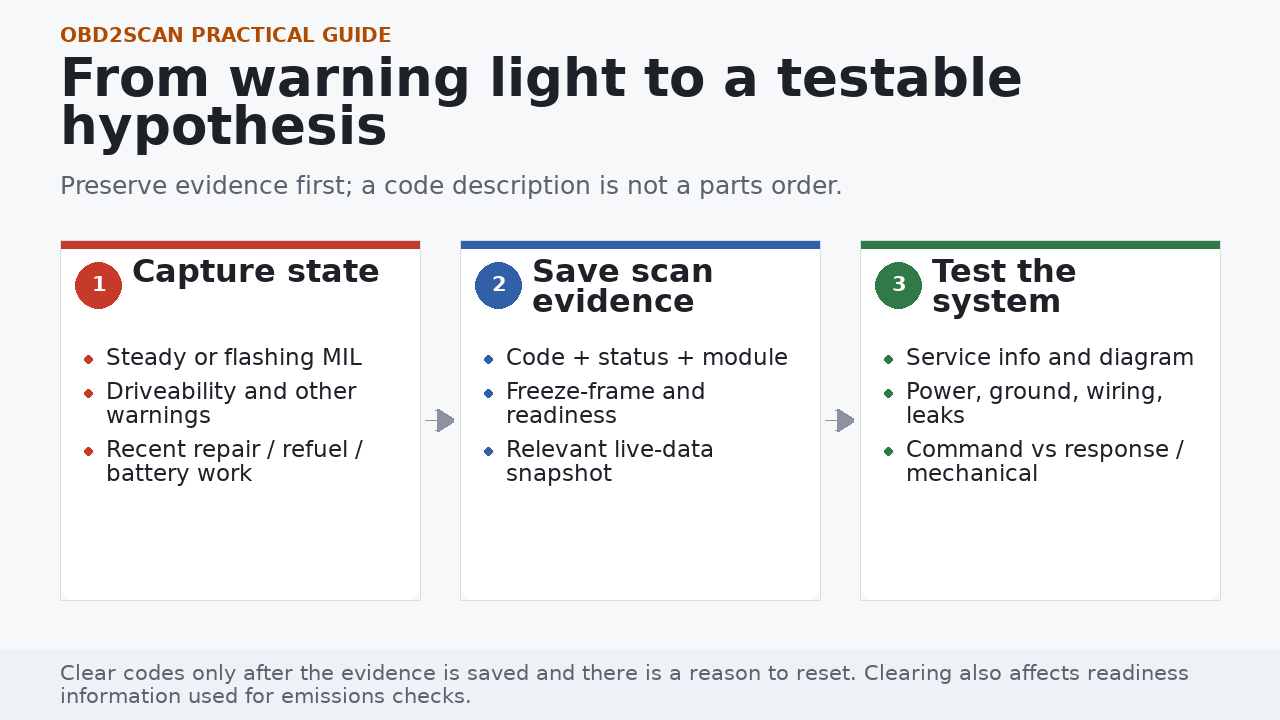
A diagnostic trouble code identifies a monitored condition, circuit, or system; it does not certify which part failed. Before clearing anything, record whether the check-engine light is steady or flashing, how the vehicle runs, every code status, freeze-frame data, and readiness monitors.
What to do first
- If the light is flashing, the engine is shaking badly, power is severely reduced, temperature or oil-pressure warnings appear, or the vehicle is unsafe, reduce load and follow the owner’s manual; do not continue a routine test drive.
- Read and save current, pending, and permanent codes, freeze-frame, monitor readiness, and relevant module codes before clearing or disconnecting the battery.
- Treat the code description as the start of a test plan. Verify power, ground, wiring, leaks, mechanical condition, and data plausibility before replacing a sensor or actuator.
In this guide
1. Triage the vehicle before connecting a tool
Record every illuminated warning, not just the check-engine light. An oil-pressure, coolant-temperature, brake, or charging warning can change the safe action. Note hard starting, smoke, fuel smell, unusual mechanical noise, reduced power, and whether the light appeared immediately after refueling, a repair, or a battery event.
A flashing light is not a prompt for a long drive cycle
If the MIL flashes or the engine misfires heavily, avoid high load and follow the owner’s manual. Continuing can increase emissions and may damage the catalyst or engine, depending on the fault.
2. Save the first scan before changing the vehicle
- Confirm adequate low-voltage battery condition so a communication problem is not created by unstable supply.
- Connect at the data link connector without forcing pins. Identify the vehicle accurately.
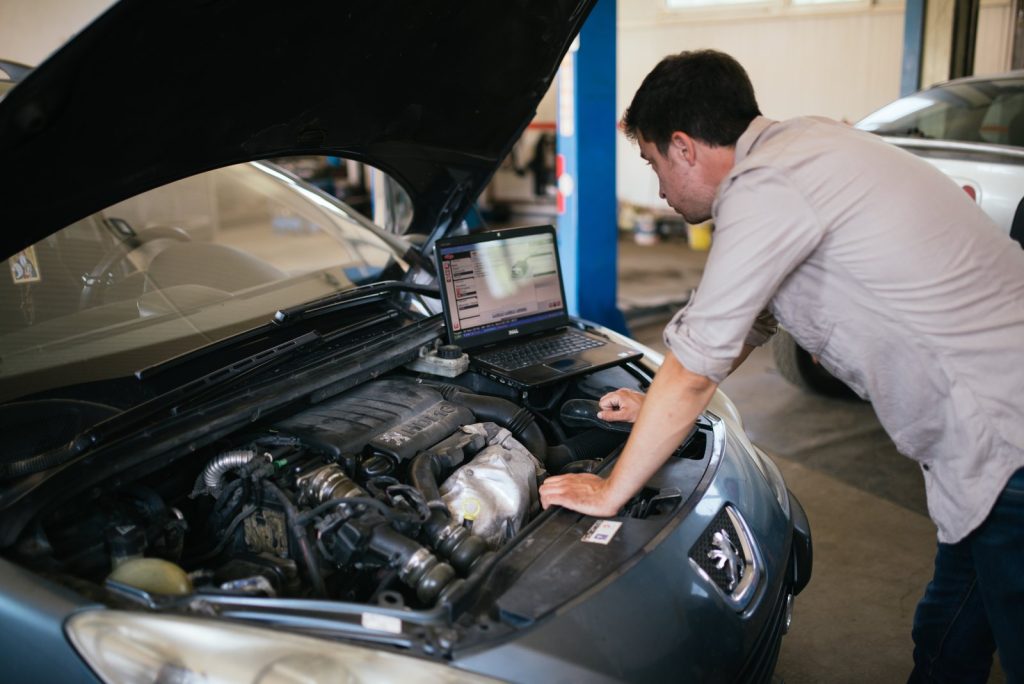
- Run a complete vehicle scan if the tool supports it; do not stop at generic powertrain codes.
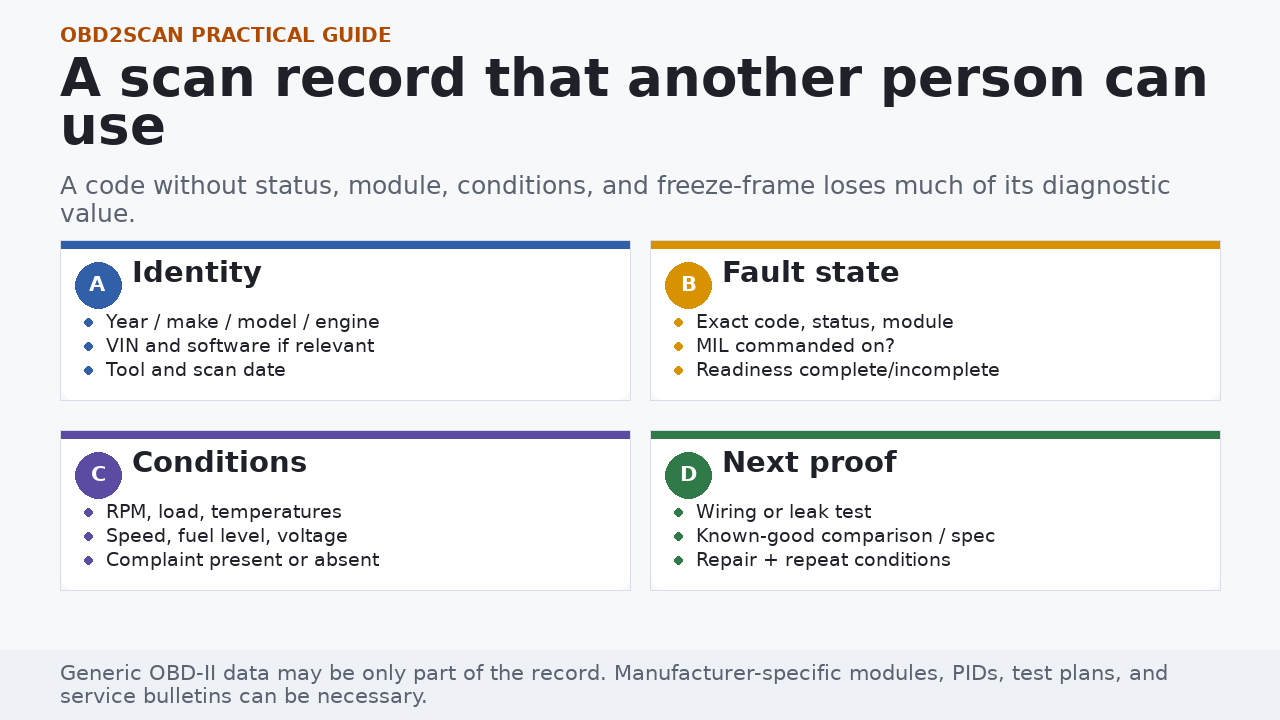
- Save exact codes with module and status: current/confirmed, pending, history, and permanent are not interchangeable.
- Save freeze-frame and monitor readiness. Photograph or export the report before clearing anything.
- Check service information for code-setting criteria, enabling conditions, related codes, and the manufacturer’s test order.
If a scan tool will not communicate, the AUTOOL OBD2 Breakout Box Premium can provide a quicker first-pass view of DLC power, ground, and protocol activity before the fault is blamed on the scanner or a control module.
3. Turn the code into tests, not a component guess
A code that names an oxygen-sensor circuit can result from sensor, wiring, connector, power, ground, exhaust leak, mixture, or control faults. A misfire code can involve ignition, fuel, air, compression, timing, wiring, or operating conditions. Start with the service test plan and the least intrusive checks that can prove or disprove the fault.
| Evidence | What it tells you | What it does not prove |
|---|---|---|
| DTC description | Which monitor detected a condition | The named component must be replaced |
| Freeze-frame | A snapshot near code storage | Every moment the fault occurs |
| Live PID | What the module reports under current conditions | The sensor itself is accurate without plausibility testing |
| Code clears | The memory was reset or monitor later passed | The root cause is permanently repaired |
4. Verify the repair under the original conditions
After an evidence-based repair, clear codes only when the procedure calls for it. Recreate the recorded load, temperature, speed, or idle condition safely. Re-scan for current and pending codes and confirm the affected monitor can run. California BAR notes that battery disconnection or repair resets readiness and that some monitors require specific conditions.
Do not manufacture a drive cycle in traffic
Use an OEM drive cycle only where legal and safe. If the required speed, temperature, load, or coast condition cannot be achieved safely, allow normal driving or use an equipped facility.
Official references
Use these sources for the principles in this guide, then use the owner’s manual and current service information for your exact vehicle.
- EPA: On-Board Diagnostic Regulations and Requirements Q&A (nepis.epa.gov)
- California BAR: On-Board Diagnostic Test Reference (bar.ca.gov)
The useful outcome
You should finish the first session with a saved scan record, an urgency decision, and one or more testable hypotheses. That record is useful even if the repair is handed to a shop; a cleared code with no freeze-frame is not.


Comments 0
Questions, fixes, and real-world diagnostic notes from readers.
Be the first to share a diagnostic result or ask a follow-up question.