Fisker Ocean Battery Systems: Where AUTOOL EM Support Fits

AUTOOL EM equipment belongs on the Fisker Ocean’s low-voltage side only when the battery fitted to the vehicle and the current service procedure permit it. It does not charge the traction battery, communicate with vehicle modules, or replace a diagnostic tool. That boundary is the starting point for every useful EM equipment decision for the Ocean.
On this page
Three electrical paths—not one kind of charging
The Ocean’s traction battery stores energy for propulsion. It receives charging energy through the vehicle’s charge-port system and the charging equipment designed for that job. A workshop power supply connected to the low-voltage system is not an alternative route into the traction pack.
The auxiliary battery has a different role: it supports the vehicle’s low-voltage electronics and the control systems that allow the vehicle to wake and operate. Fisker’s published Ocean 12V battery information discusses this system separately from traction charging and includes its own battery-safety cautions.
A third path carries information. Diagnostic equipment communicates with vehicle modules, reads faults, and performs supported service functions. A low-voltage supply can support electrical conditions during a documented workshop task, but it does not become the scanner, programming interface, or software source.
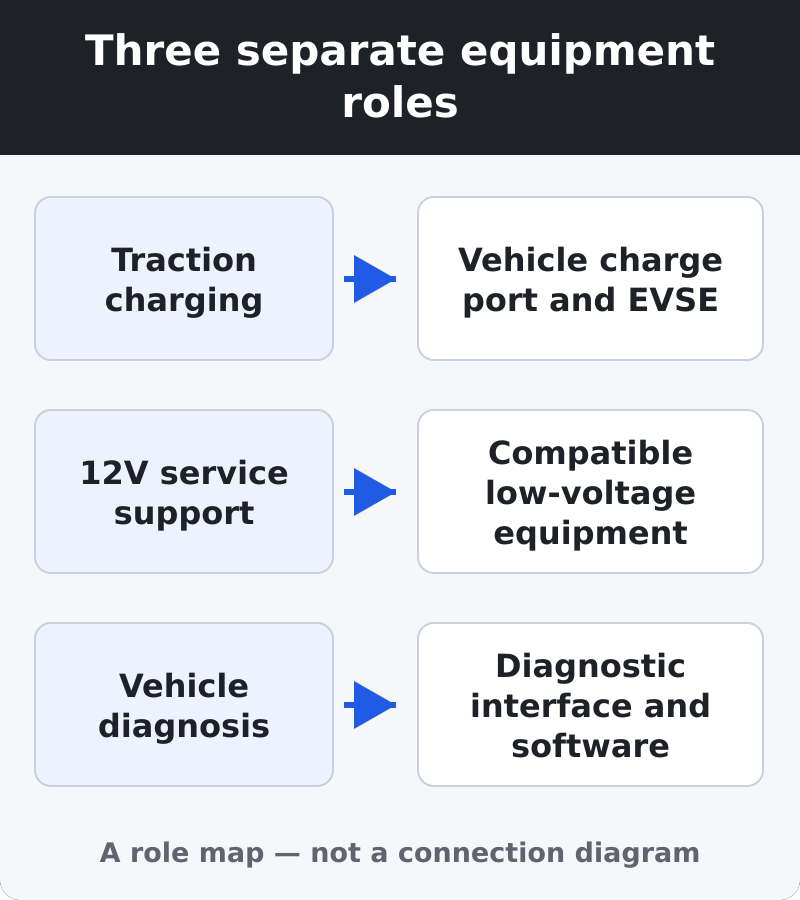
Keeping those paths separate prevents two costly assumptions: that any device called a “charger” can serve every battery, or that stable low-voltage power can diagnose the vehicle.
Check the low-voltage identity before the equipment
Fisker’s original 12V technical specification identifies a 12V, 50Ah, AGM lead-acid battery with negative ground. That describes the original specification. It does not prove that the battery currently fitted to a particular Ocean is still the original one.
Read the accessible battery label and service history first. Confirm the chemistry, capacity marking, polarity, manufacturer and model, then compare those facts with the current vehicle and battery instructions. “12V” alone is not enough: it says nothing about the correct charging program, the battery’s condition, or whether an installed-battery procedure is allowed.
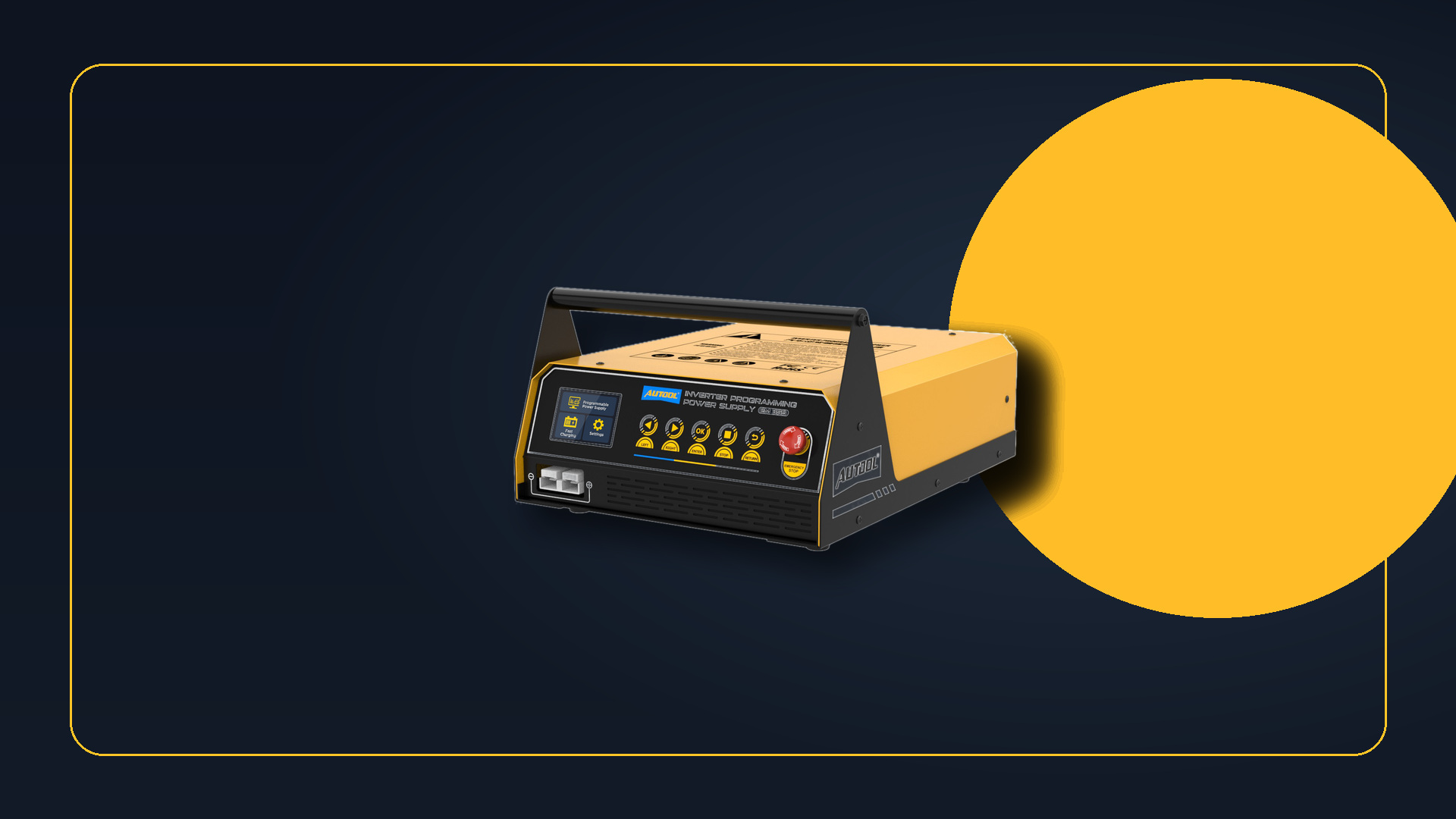
The AUTOOL EM355 offers documented low-voltage charging and service-power functions through physical controls. That makes it a practical candidate to evaluate after the job and battery have been identified—not evidence of automatic Ocean compatibility.
Different low-voltage jobs need different tools
Battery charging, steady service power, monitoring and diagnostic communication are separate workshop roles. A technician should name the role before choosing a device. For example, a supervised charging session begins with battery chemistry and the applicable charging instruction. A long service session begins with the procedure’s required voltage, expected load, duration and interruption rules.
The AUTOOL EM365 provides a display-oriented workflow that can make equipment voltage, current and status easier to observe during an authorized task. Those readings describe the supply’s operation; they do not identify a weak battery, a module fault or the cause of a recurring low-voltage event.
The AUTOOL EM385 adds touch control and a documented adjustable DC-supply function. Adjustability is useful only when a current procedure supplies the target and the technician understands the load. It is not permission to invent an Ocean setting.
All three are low-voltage equipment, not EVSE. None provides high-voltage access, Fisker software, diagnostic communication or proof that a repair succeeded. The safety instructions in the EM355 manual, EM365 manual and EM385 manual require constant supervision during operation, so none should be treated as an unattended storage maintainer.
Questions that expose a complete service plan
Before equipment is connected, ask the workshop to answer these questions:
- What battery is physically fitted now, and which label or record confirms it?
- What exact job is being performed: charging, service power, testing, programming support, or something else?
- Which current Ocean procedure governs that job?
- Does the procedure require external support, or does it require electrical isolation?
- What voltage, load, duration and interruption limits does that procedure specify?
- Which connection points and shutdown conditions does it name?
- Is the delivered EM unit the correct mains-voltage version for the workshop?
- Who will supervise the session, and what alert or deviation ends it?
If any answer is missing, the sensible next step is to obtain the current procedure or hand the task to an Ocean-capable workshop—not to guess from a front-panel rating. If an EM model remains appropriate after those checks, coupon code HCM6E4GZ can be entered at checkout; confirm that it is accepted and review the final total before paying.
That sequence keeps the equipment in its proper role: providing a documented low-voltage function while the vehicle procedure, battery identity and qualified technician control the job.









Comments 0
Questions, fixes, and real-world diagnostic notes from readers.
Be the first to share a diagnostic result or ask a follow-up question.