
Clunk Over Bumps? A Condition-Based Suspension Noise Map

A clunk over a sharp edge, a knock while turning, and a thud during braking are different test conditions. Start by removing loose cargo and checking tires and wheel fasteners. If steering changes, the vehicle wanders, a spring is broken, a wheel is loose, or the noise follows an impact, stop driving and arrange inspection.
What to do first
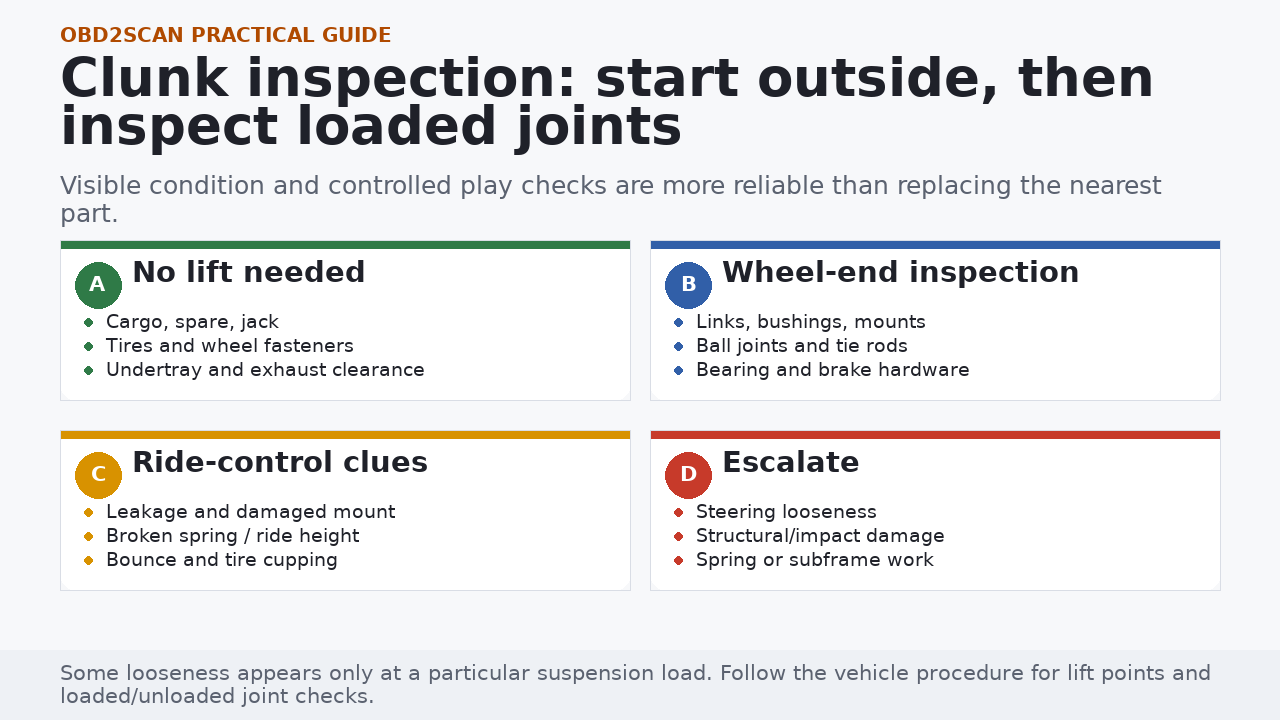
- First rule out loose cargo, the spare/jack, wheel covers, undertrays, exhaust contact, and wheel-fastener problems.
- Describe the trigger: one wheel or both, small sharp bump or long wave, braking, acceleration, steering angle, temperature, and vehicle load.
- Do not work beneath a vehicle supported only by a jack or handle a loaded coil spring without the specified equipment and training.
In this guide
1. Screen urgent conditions before a road test
- Check every tire for damage and obvious pressure loss.
- Confirm the wheel appears seated and fasteners are present; use the correct torque procedure if recent wheel work is suspected.
- Look for a broken or displaced spring, a hanging component, fluid loss, fresh impact damage, or a visibly shifted wheel.
- If steering is loose, the vehicle will not track safely, or any component can contact the tire, do not road-test it.
A jack is a lifting device, not the support for an inspection
Use rated support at the specified vehicle support points on a firm surface. If those requirements are uncertain, leave the under-vehicle inspection to a qualified shop.
2. Build a noise map on a safe, low-speed route
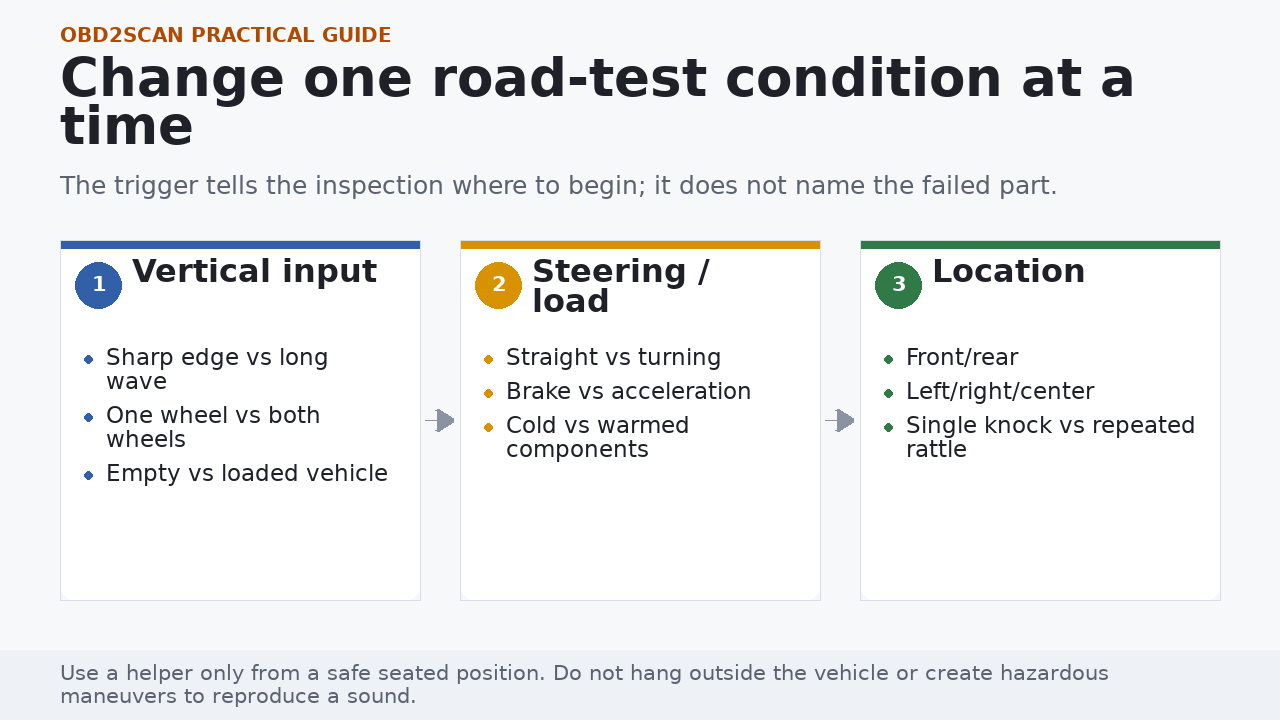
Use an ordinary route and normal inputs; do not swerve or strike potholes intentionally. Record a single knock versus repeated rattle, whether one-wheel bumps are worse than both-wheel bumps, and whether light brake or steering load changes the sound. A phone recording can preserve rhythm, but location estimates inside a body shell can be misleading.
Temperature and load are evidence
Rubber, grease, exhaust clearance, and cargo movement can change with temperature or vehicle load. Record the condition rather than dismissing an intermittent noise.
3. Inspect in a useful order
Monroe notes that a metallic clunk after shock or strut replacement often comes from loose or worn mounting hardware, while a turning-related noise can direct attention to an upper bearing assembly. That supports checking the installation and neighboring parts—not assuming a new damper is defective.
- Empty the cabin and luggage area; secure the spare, jack, tools, seat latches, and cargo cover.
- Check accessible shields, undertrays, exhaust hangers, and contact marks with the vehicle off and cool.
- Inspect links, bushings, mounts, boots, springs, and fasteners for separation, polish marks, rust movement, or deformation.
- Use the vehicle’s specified loaded or unloaded play checks for ball joints, tie rods, bearings, and control-arm bushes.
- Match any found play or contact mark to the same side and condition recorded on the road test.
4. Repair by evidence and verify the original trigger
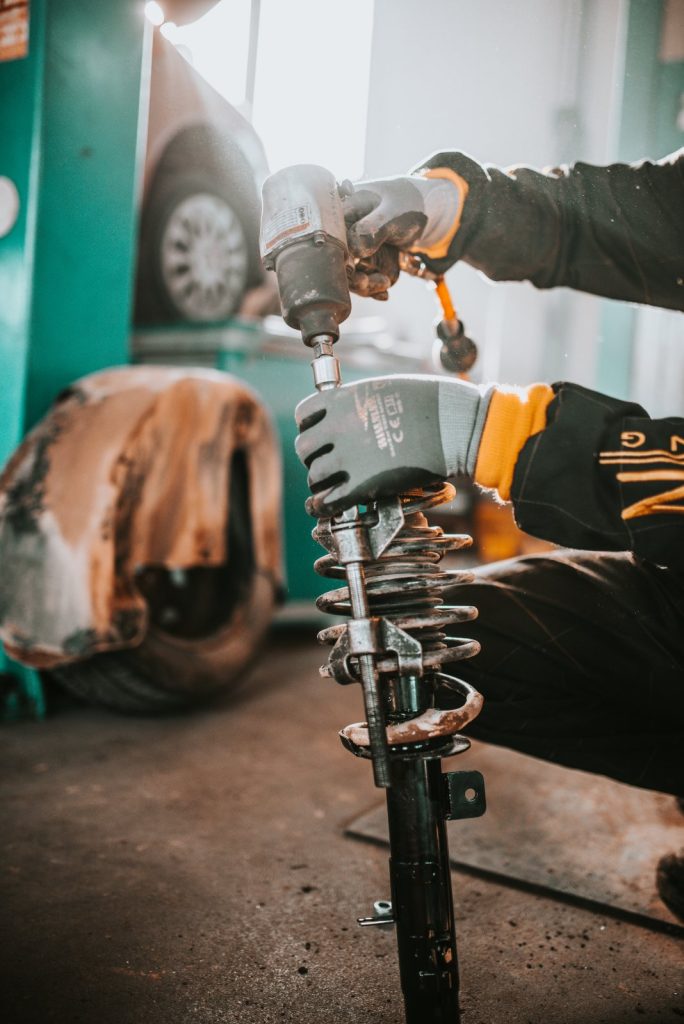
Fastener torque and tightening position matter: some bonded rubber bushings must be tightened at the specified ride position, and some hardware is single-use. Spring and strut work can require special containment, alignment, or calibration procedures. Use the exact service information.
Repeat the same condition
After the repair, repeat the original safe low-speed trigger, then verify steering, braking, fastener marking, and any required alignment. A different quiet route is not a valid comparison.
Official references
Use these sources for the principles in this guide, then use the owner’s manual and current service information for your exact vehicle.
- Monroe: Diagnosing Noise With New Shocks and Struts (monroe.com)
- Monroe: Signs of Bad Shocks and Struts (monroe.com)
The useful outcome
The useful deliverable is a trigger map plus an inspection finding at the same corner and load condition. That is enough to approve a focused repair or ask a shop for a loaded-joint inspection instead of buying a set of parts by sound association.


Comments 0
Questions, fixes, and real-world diagnostic notes from readers.
Be the first to share a diagnostic result or ask a follow-up question.