
Rough Idle Diagnosis: Separate Air, Fuel, Ignition, and Mechanical Causes

Start by deciding whether the whole engine is unstable or one cylinder is contributing less. Then compare cold versus warm, Park/Neutral versus Drive, accessories off versus on, and idle versus a small RPM increase. Those patterns are more useful than a universal “normal” fuel-trim number.
What to do first
- Stop the test if oil pressure, coolant temperature, fuel leakage, severe mechanical noise, or a flashing MIL makes continued running unsafe.
- Save codes, freeze-frame, misfire data, commanded and actual idle information, fuel trims, airflow/load, temperatures, and system voltage under the same condition.
- Do not spray flammable cleaner around a running engine to hunt for vacuum leaks, and do not clean a sensor unless its manufacturer permits the exact method.
In this guide
1. Define the idle complaint precisely
- Record cold start, warm restart, fully warm idle, and the transition into closed-loop operation if available.
- Compare Park/Neutral with Drive while holding the brake only if the vehicle can be secured safely.
- Switch large loads one at a time: A/C request, rear defogger, headlights, and steering input where applicable.
- Note rhythmic single-cylinder shake, random stumble, hunting RPM, stalling, exhaust smell, and whether a small RPM increase smooths the engine.
Ventilation and moving parts
Do not idle in an enclosed space. Keep clothing, tools, probes, and hands away from belts, fans, hot exhaust, and high-voltage components; electric cooling fans can start unexpectedly.
2. Save data and find the fault scope
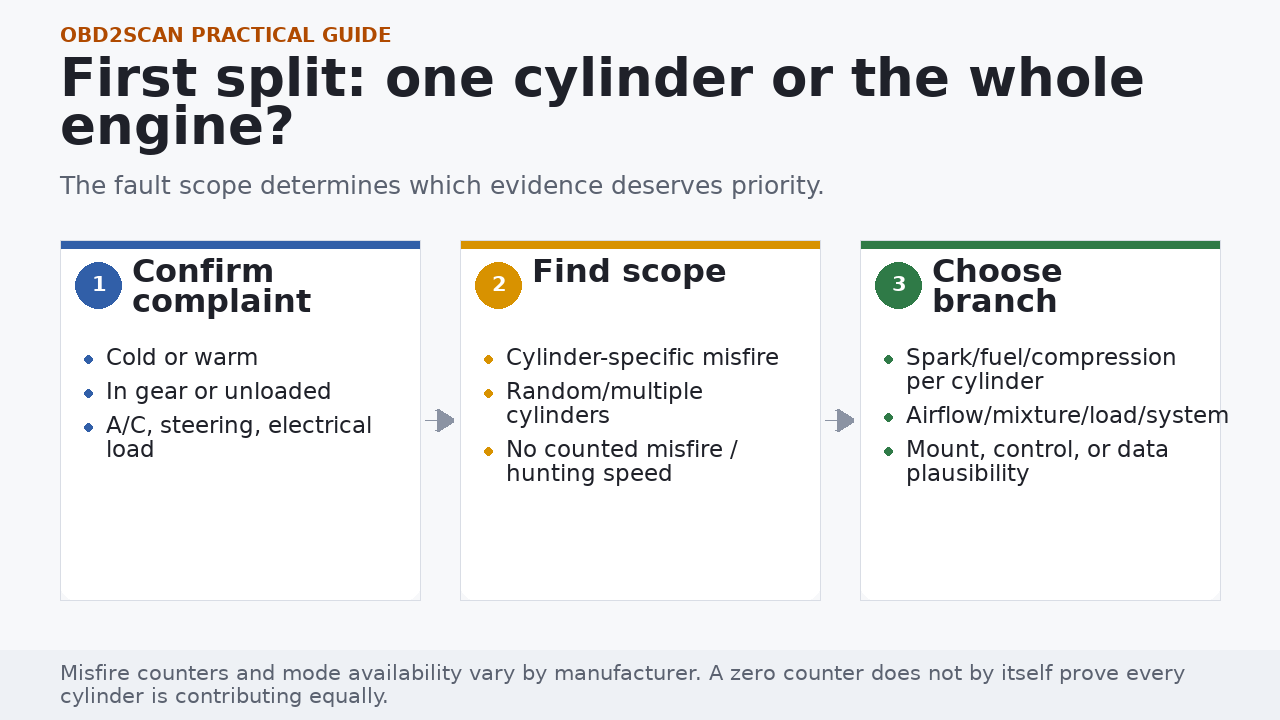
Scan all relevant modules because charging, transmission, throttle, network, or accessory-load faults can affect idle quality. Save code status and freeze-frame before clearing. If enhanced misfire data identifies one cylinder repeatedly, keep the investigation cylinder-specific until evidence says otherwise.
If multiple cylinders or the whole engine are involved, compare trims, load, airflow, manifold pressure, temperatures, commanded throttle/idle, purge/EGR state, and voltage. The meaningful clue is how values move when the symptom appears or when RPM is raised slightly—not whether one generic internet number is crossed.
3. Test one branch at a time
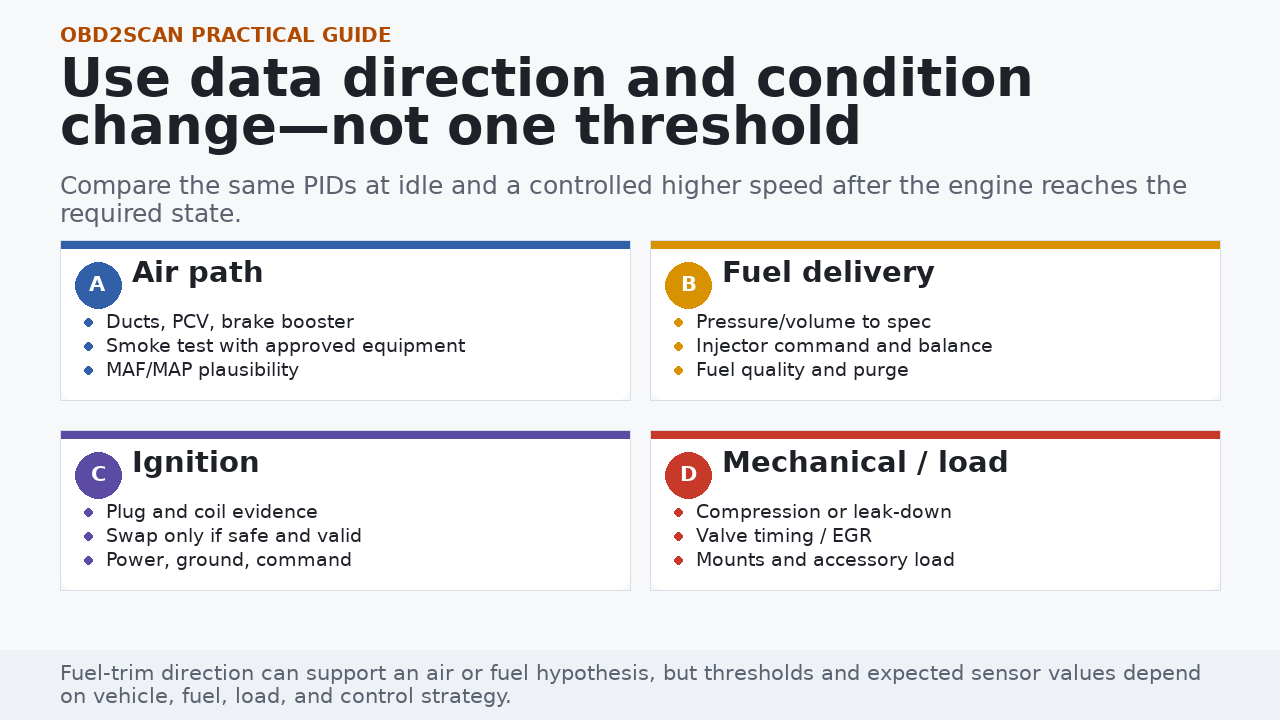
- Inspect the complete intake duct, clamps, vacuum hoses, PCV connections, brake-booster line, and connectors before disturbing them.
- Use an approved smoke test and vehicle procedure for unmetered-air leaks; account for valves that are normally open or vented.
- For a cylinder-specific fault, compare plug, coil, injector command, wiring, and mechanical contribution. A component swap is valid only when parts are interchangeable and no damage or coding risk exists.
- Measure fuel pressure, volume, and residual behavior only with the specified equipment and safety procedure.
- If ignition and fuel evidence do not explain the cylinder, use compression, relative compression, leak-down, or valve-timing tests as the service information directs.
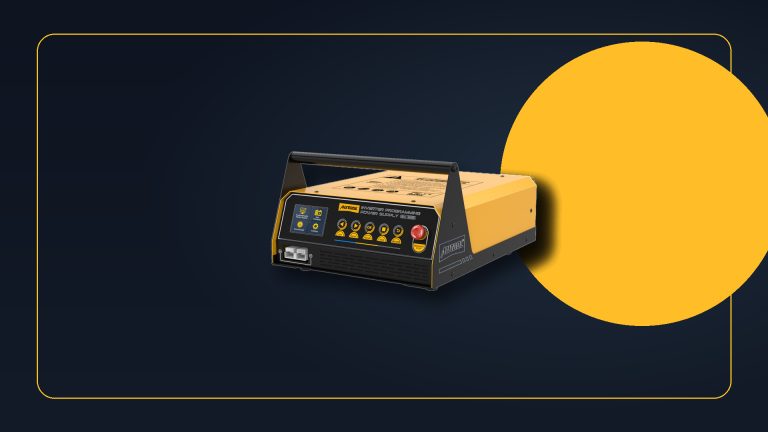
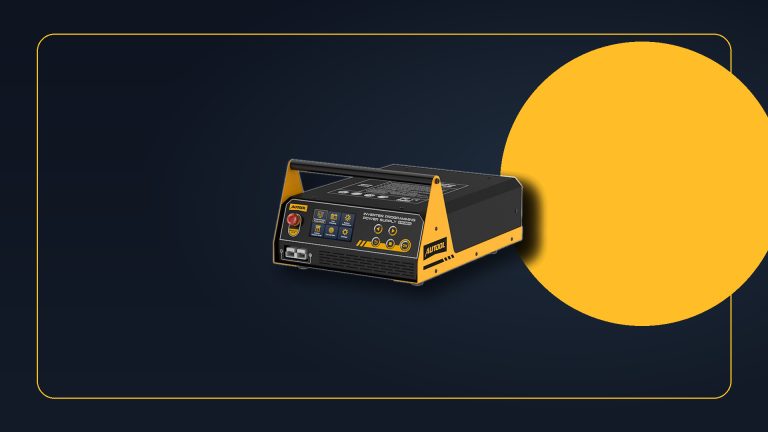
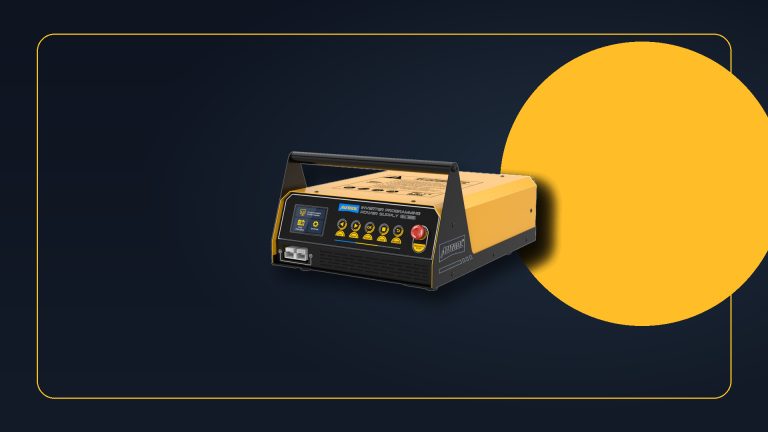
When the evidence points to an intake or vacuum leak and the system is safe to test, the FXTUL automotive smoke leak detector can make a small leak path easier to see before parts are replaced.
Sensor cleaning is not diagnosis
Bosch warns that removing an air-mass sensor from its housing or cleaning it with solvents can change or damage it. Test the sensor in its installed airflow path and compare with model-specific information.
4. Verify the original condition and watch what changed
After repair, repeat the same cold/warm state, gear selection, and accessory load. Compare idle stability, misfire counts, trims, airflow/load, and voltage with the before record. Recheck pending codes after a suitable monitor run.
A smooth idle is necessary but not sufficient
Confirm that the repair did not merely hide the symptom by raising idle speed, disconnecting a load, or clearing learned values. The measured cause and the original condition both need to be resolved.
Official references
Use these sources for the principles in this guide, then use the owner’s manual and current service information for your exact vehicle.
- Bosch: Lambda and Air Mass Sensor Diagnosis (boschaftermarket.com)
- Bosch: Lambda Sensors — Diagnoses (boschaftermarket.com)
The useful outcome
You should finish with a clearly defined condition, a whole-engine or cylinder-specific scope, and a test result in one branch. That is enough to select the next proof without changing three systems at once and losing the cause.


Comments 0
Questions, fixes, and real-world diagnostic notes from readers.
Be the first to share a diagnostic result or ask a follow-up question.