
Brake Fluid Tester Turns Red? Separate Fluid Condition from a Hydraulic Fault

Fluid Result ≠ Pedal Diagnosis
A red brake-fluid result can reject a sample under the selected screening method. It cannot explain a sinking pedal, external leak, trapped air, hose expansion, master-cylinder bypass, or ABS hydraulic fault. Those are separate cases with different evidence and, importantly, different stop-driving consequences.
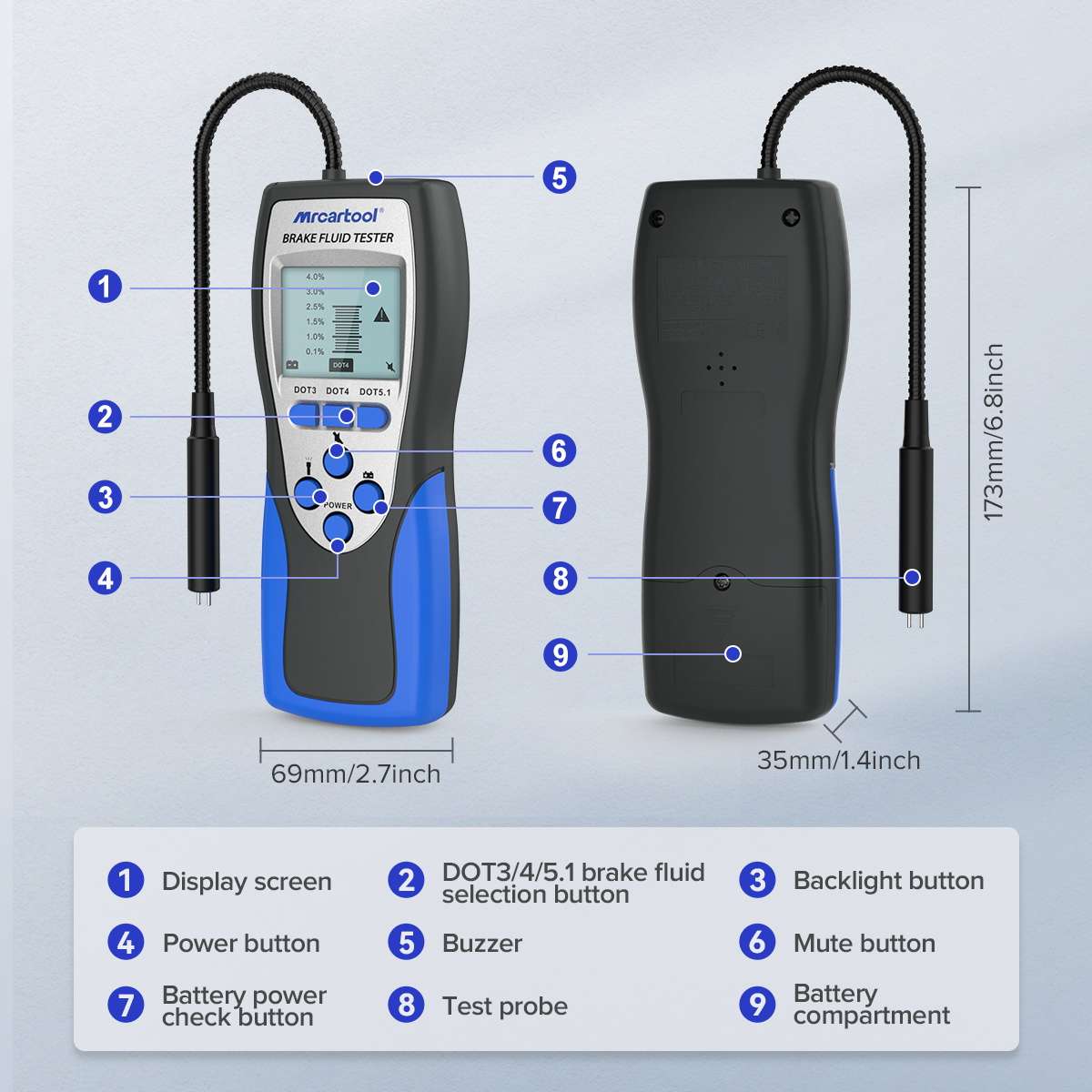
For routine fluid-condition screening, use a tester whose method and selectable fluid specification match what the vehicle actually requires. A handheld example is the MRCARTOOL F60 brake fluid tester, which provides separate DOT 3, DOT 4, and DOT 5.1 screening selections and a flexible probe for sample access. It can help decide whether a clean reservoir sample should be repeated, confirmed, or serviced under the controlling schedule; it cannot pressure-test the hydraulic system or turn one screen color into a universal moisture percentage.
This article acts as an arbitration hearing. Fluid specification, sample condition, tester method, pedal complaint, service history, and manufacturer guidance each get a vote—but no witness answers outside its competence. A soft, sinking, or suddenly changed pedal, visible leak, or impaired braking is a stop-driving condition until evaluated.
Quick answer: A red screen can reject a correctly selected sample under that tester’s method; it cannot diagnose the pedal. Stop driving for leakage or a soft/sinking pedal, verify fluid specification and sample technique, decide fluid service from controlling guidance, and diagnose hydraulics separately.
In this guide
- Decide which question the red result answered
- Stop for pedal or leakage danger
- Confirm the fluid selection and sample
- Repeat the screen without contaminating the reservoir
- Compare conductivity and boiling-point methods
- Keep hydraulic diagnosis on its own track
- Choose service timing from controlling guidance
- Compare tester routes
Decide which question the red result answered
Identify the instrument’s method and selected fluid before interpreting color. Many compact electronic testers infer fluid condition from conductivity, which can vary with formulation, contamination, temperature, probe state, and calibration. A boiling-point tester heats a controlled sample and answers a different question. Test strips may screen copper or other markers. None is interchangeable merely because all produce a green/yellow/red outcome.
Write the narrow result: “Reservoir sample screened red using the tester’s DOT 4 mode after the probe was cleaned and the test repeated.” Do not write “the brakes are bad” or “there is exactly this percentage of water throughout the system.” Reservoir fluid may not represent fluid trapped near calipers, and a screen does not examine pressure generation or containment.
| Question | Appropriate evidence | Red electronic screen can answer? |
|---|---|---|
| Is the selected reservoir sample outside this tool’s band? | Correct mode, clean probe, repeat result | Yes, as a screen |
| Does the fluid meet exact boiling requirements? | Approved boiling-point/laboratory method | Not directly |
| Why is the pedal soft or sinking? | Hydraulic inspection and specified tests | No |
| When must this vehicle’s fluid be serviced? | OEM schedule, condition, regulation, history | One input only |
Stop for pedal or leakage danger
Before opening the reservoir, ask whether braking performance has changed. A low fluid level, warning lamp, wet caliper, wheel cylinder, line, hose, master cylinder, or ABS unit requires hydraulic diagnosis. A pedal that sinks under steady pressure, feels suddenly soft, travels farther, pulls, or loses assist is not made safe by a green fluid screen. Do not road-test an unsafe vehicle.
Brake dust, fluid, and cleaner require appropriate personal protection. Fluid damages paint and absorbs contamination; cover surfaces and clean spills by the approved method. Do not top up repeatedly without finding why level fell. Pad wear can lower reservoir level gradually, while a leak can do so dangerously. Keep these physical facts ahead of the instrument color.
Confirm the fluid selection and sample
Read the reservoir cap and vehicle information. DOT 3, DOT 4, and DOT 5.1 are glycol-based categories with specification differences; silicone DOT 5 is not simply the next number and must not be mixed. Vehicles may require a specific low-viscosity or manufacturer-approved fluid within a category. The cap, manual, and applicable specification control.
Inspect appearance and history without relying on color alone. Darkening can come from age, rubber, corrosion products, or contamination; clear-looking fluid can still have degraded performance. Ask when the system was opened, whether the correct sealed container was used, and whether petroleum, silicone, or other fluid could have entered. Suspected cross-contamination is a specialist service decision, not a cue to dip more tools into the reservoir.
Repeat the screen without contaminating the reservoir
Follow the F60 instructions for power, fluid mode, probe immersion, stabilization, and cleaning. Wipe the reservoir cap area before opening it. Avoid dropping lint or dirt inside. If practical and allowed, use a clean disposable sample container rather than repeatedly inserting a probe into the master cylinder. Never return a removed sample to the reservoir.
Rinse or clean the probe exactly as directed and avoid touching the sensing area. Repeat the result on a fresh sample or after confirming correct selection. If the instrument offers a self-check or reference fluid procedure, use it. Large disagreement between repeats is evidence of technique, contamination, or instrument condition—not a reason to average until a preferred color appears.
Compare conductivity and boiling-point methods
Conductivity testers are compact and fast, which makes them useful for triage. Their inference depends on the chemistry represented by the selected mode. A boiling-point instrument directly assesses a sample’s boiling behavior but requires controlled heating, maintenance, and safe handling. Laboratory analysis can characterize contamination more deeply but is rarely a routine shop step.
FMVSS 116 defines brake-fluid performance requirements in the United States, but a field screen is not the regulatory test suite. The vehicle manufacturer may specify time-based replacement, condition-based service, or a particular fluid. Use the screen to decide whether more evidence or service review is warranted, not to create a universal legal threshold.
| Method | Practical strength | Important limit |
|---|---|---|
| Conductivity screen | Fast, compact, low sample volume | Formulation- and method-dependent inference |
| Boiling-point test | Direct sample boiling behavior | Equipment, handling, maintenance, sample representation |
| Test strip | Simple marker screen | Marker-specific, storage and reading sensitivity |
| Laboratory/OEM procedure | Highest control for unusual contamination | Cost, time, specialized process |
Keep hydraulic diagnosis on its own track
For a pedal complaint, inspect the full system before assigning fluid as the cause. Check level, leaks, pads/shoes, adjustment where applicable, hoses, lines, calipers/wheel cylinders, master-cylinder behavior, booster/assist, and ABS faults using the service sequence. Air can enter after a leak or repair; flexible hoses can expand; mechanical travel can be excessive. Old fluid may coexist with any of these without causing the particular pedal symptom.
Bleeding is not a generic cure. Some ABS units require scan-tool procedures, a sequence, pressure/vacuum equipment, or specific ignition state. Opening bleeders can introduce air, break corroded hardware, or release contaminated fluid. If brake service competence, disposal, or equipment is missing, outsource the hydraulic work and keep the fluid screen as intake evidence.
Choose service timing from controlling guidance
Check the maintenance schedule, service bulletin, fluid label, and local requirements. Consider age, climate, duty, track/towing use, repeated high-temperature braking, system opening, and trustworthy test results. A red screen strengthens the reason to service or confirm when the selected method is appropriate; it does not override a more conservative OEM interval or authorize a longer interval by itself.
Use a sealed container of the exact required fluid. Brake fluid absorbs moisture after opening, so an old workshop bottle can undermine a correct service. Do not mix brands or specifications unless compatibility is explicitly allowed. Collect used fluid separately and dispose of it according to local rules.
Compare tester routes
Public data does not support a credible model-level sales ranking for brake-fluid testers. Bosch and ATE provide professional workshop/fluid routes; Phoenix Systems offers strips and electronic approaches; Laser Tools and Sealey cover value workshop testers; specialist boiling-point instruments occupy a higher evidence band. The no-buy route—follow a conservative service interval and outsource testing—is valid for low-volume owners.
| Route | Best fit | Tradeoff |
|---|---|---|
| Compact conductivity tester | Fast intake and maintenance screen | Chemistry/selection sensitivity |
| Test strips | Simple fleet or visual marker workflow | Shelf life and marker-specific evidence |
| Boiling-point tester | Shops selling measured fluid-condition evidence | Higher cost, maintenance, handling |
| Interval-only/no tester | Conservative scheduled service | May miss unusual contamination context |
| Outsource | Hydraulic complaints or rare specialty fluids | Less in-house speed |
Choose the instrument by the question still open. If the question is whether a correctly identified DOT 3, DOT 4, or DOT 5.1 reservoir sample falls inside the selected handheld screening band, a conductivity-style tester such as the F60 can provide a quick repeatable check. Select the fluid named by the vehicle, keep the probe and sample clean, and compare repeated results with the service schedule. If the shop’s decision specifically depends on measured boiling behavior, use a maintained boiling-point method instead.
Neither route explains a soft or sinking pedal, a leak, trapped air, hose expansion, master-cylinder bypass, or an ABS hydraulic fault. When the user’s problem is braking behavior rather than maintenance timing, stop screening the fluid and move to the appropriate hydraulic diagnosis or professional service.
Use a two-file service record
Keep a “fluid” file with specification, tester mode, sample location, repeat result, service history, and replacement decision. Keep a “hydraulic” file with pedal symptom, leak inspection, fault codes, pressure/bleed/mechanical tests, and safety release. Linking the files is helpful; merging them is dangerous. A red sample may justify fluid service while the leaking wheel cylinder independently grounds the vehicle.
Customer language should preserve the same boundary: “The reservoir sample screened outside this tester’s selected band, so we recommend service or confirmation according to the manufacturer schedule” is defensible. “Your brakes contain a measured universal percentage of water and will fail” is not supported by a conductivity screen.
Audit the new-fluid baseline
If the tool is used for routine shop screening, test a small clean sample from a newly opened, correctly specified container according to the instrument procedure. This is not calibration unless the manufacturer calls it that; it is a shop plausibility check. Record the fluid identity and never dip a contaminated probe into the source container.
If fresh known fluid repeatedly alarms or different testers conflict, stop making customer decisions with that device until selection, cleaning, batteries, reference method, and support are resolved. The ownership value of a fast tester comes from stable process, not from producing a color on every car.
Verify fluid and pedal separately
After fluid service, confirm correct fill level, cap/seal condition, absence of leaks, and a repeat screen only if the method makes sense on the new known fluid. Record container specification and lot/service details as the shop procedure requires. Dispose of every sample and clean the probe so residue does not bias the next vehicle.
After hydraulic repair, verify pedal reserve and feel using the OEM procedure, perform required ABS bleed or calibration, scan relevant modules, and road-test only when the vehicle is safe and under controlled conditions. The final record should contain two lines: fluid condition/service outcome and hydraulic complaint/repair outcome. If one was never a problem, say so. That separation is the difference between a useful red warning and a red herring.
The arbiter’s short rulings
Can I test fluid at a caliper instead of the reservoir? A caliper sample may better represent local heat/moisture but requires opening the hydraulic system, safe collection, and proper bleed/repair procedure. Do not open a bleeder merely to satisfy a compact screening test unless the service workflow authorizes it.
Does flushing fluid cure a soft pedal? Not automatically. Correctly bleeding air may change pedal feel, but leaks, hose expansion, mechanical adjustment, master-cylinder bypass, ABS faults, and other causes remain. Diagnose the safety complaint independently.
Can a green result extend the OEM service interval? A compact screen alone should not overrule the controlling schedule or specification. Green means the sample remained inside that tool’s selected band during that test; it is not a lifetime certificate for every part of the system.
A safe intake sequence
- Ask about pedal change, warning lamps, leaks, and braking performance before testing fluid.
- Ground the vehicle from driving when any hydraulic safety sign is present.
- Identify the exact required fluid from the cap and service information.
- Clean the sampling area and probe; select the matching supported fluid mode.
- Repeat the screen on a controlled sample and record the method—not only the color.
- Decide fluid service from OEM guidance, history, and valid condition evidence.
- Diagnose the pedal/leak complaint on a separate hydraulic work order.
This sequence also improves customer communication. The owner can approve fluid maintenance without being told it repairs a sinking pedal, and can approve hydraulic diagnosis without being sold an unsupported moisture percentage. If the fluid type is uncertain or petroleum/silicone contamination is suspected, stop routine screening and use a specialist recovery decision; adding correct fluid to an unknown mixture is not correction.
Decision rule: Let fluid evidence decide fluid service and hydraulic evidence decide vehicle safety. When those decisions disagree, follow the more conservative safety path while obtaining the missing confirmation. A handheld tester earns its place by making routine screening consistent; it loses authority the moment its fluid selection, sample, method, or repeatability is uncertain.
For fleet consistency, document who may interpret the screen and what action each result triggers. The policy should name exceptions for unknown fluid, unsafe pedal complaints, contamination, and conflicting repeats. Consistency comes from a written boundary, not from assuming every red light means the same repair.



Comments 0
Questions, fixes, and real-world diagnostic notes from readers.
Be the first to share a diagnostic result or ask a follow-up question.