
JCB Telehandler VGT Fault Looked Like a Network Problem: The Actuator Was Losing Position

Vgt Network Code? Watch The Actuator Sweep
A JCB telehandler carried an intermittent VGT fault with wording that could send a technician into the J1939 harness. Communication faults deserve respect, but a code that travels over a network is not proof that the network is broken. This case turned on a more precise contradiction: position feedback was smooth by hand and unreliable when the actuator tried to move itself.
An automotive meter/scope can support identified actuator power, ground, feedback and accessible network-line checks. The AUTOOL DM303 is one example for that bounded electrical layer before a full JCB-capable scan and multi-channel test. DM303 can support identified power, ground, position-sensor and accessible network-line checks within its ratings; it is not a full J1939 scan platform, cannot load the turbo mechanism safely or condemn an actuator without commanded-motion and mechanical evidence.
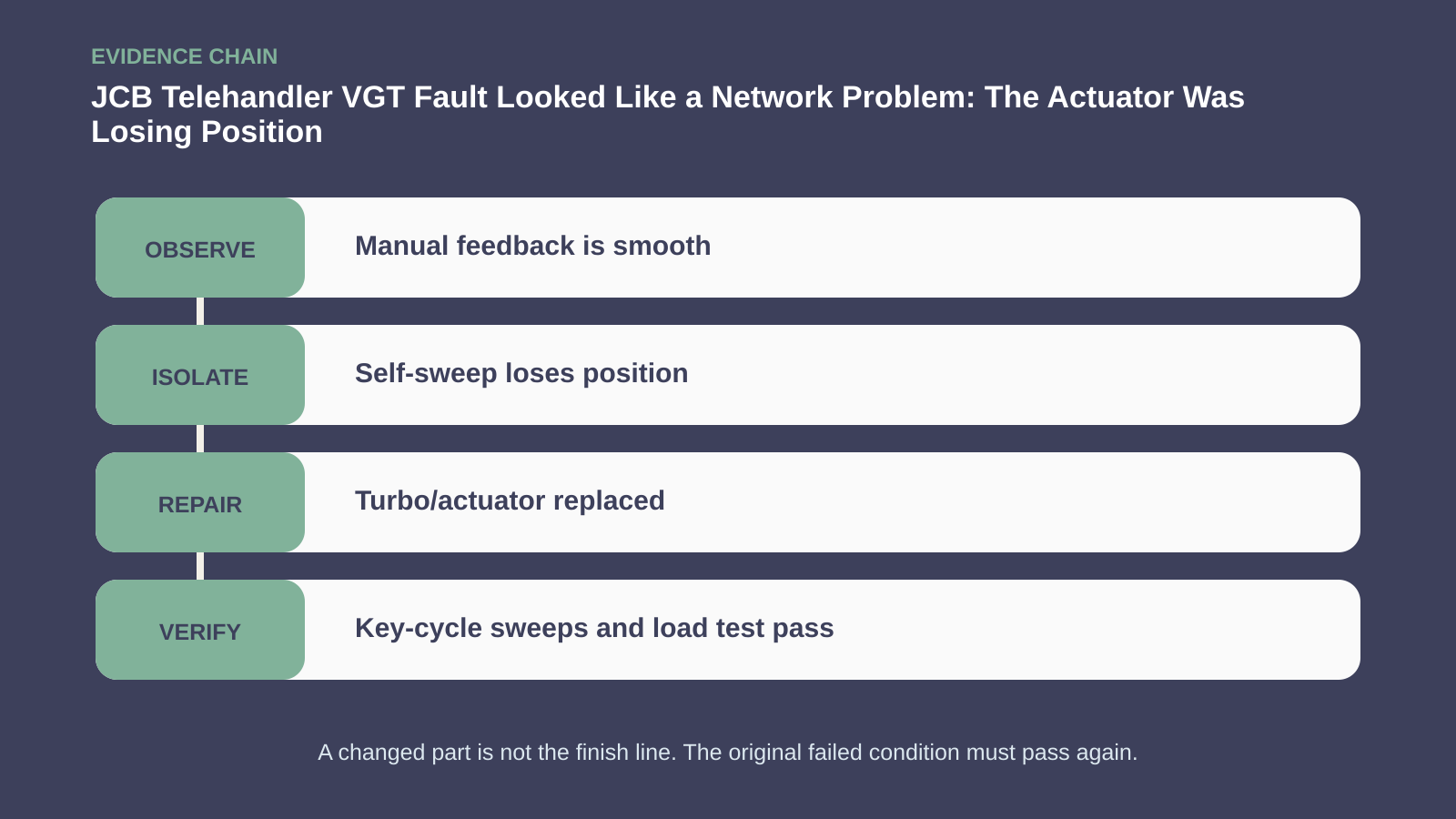
Manual travel showed that the vane mechanism and position sensor could move smoothly. Automated key-cycle sweeps were sporadic and sometimes lost position. That separated a generally healthy communication path from an actuator unable to execute its command. Turbo/actuator replacement restored repeatable sweeps and removed the fault.
Quick answer: J1939 remained usable and manual travel gave smooth feedback, but automatic VGT sweeps lost position. Turbo-actuator replacement restored repeatable motion.
In this guide
- Read the code description without accepting its verdict
- Check J1939 health before replacing harnesses
- Separate mechanical travel from electronic control
- Compare manual motion with automated sweeps
- Watch command, position and current together
- Replace the assembly only after the mismatch repeats
- Commission the actuator to JCB procedure
- Verify key-on, key-off and loaded operation
Read the code description without accepting its verdict
Save the exact code number, description, status and operating condition. Does it appear at key-on self-test, idle, load or after heat soak? Record boost request, actual boost, actuator command and position if available. Inspect intake and exhaust plumbing before repeatedly loading the machine. Secure the boom and attachment, keep people outside the articulation and crush zones, and stop for uncontrolled boost, heavy smoke or unsafe power loss. A telehandler is not a stationary car; hydraulic and machine-movement risks govern every test.
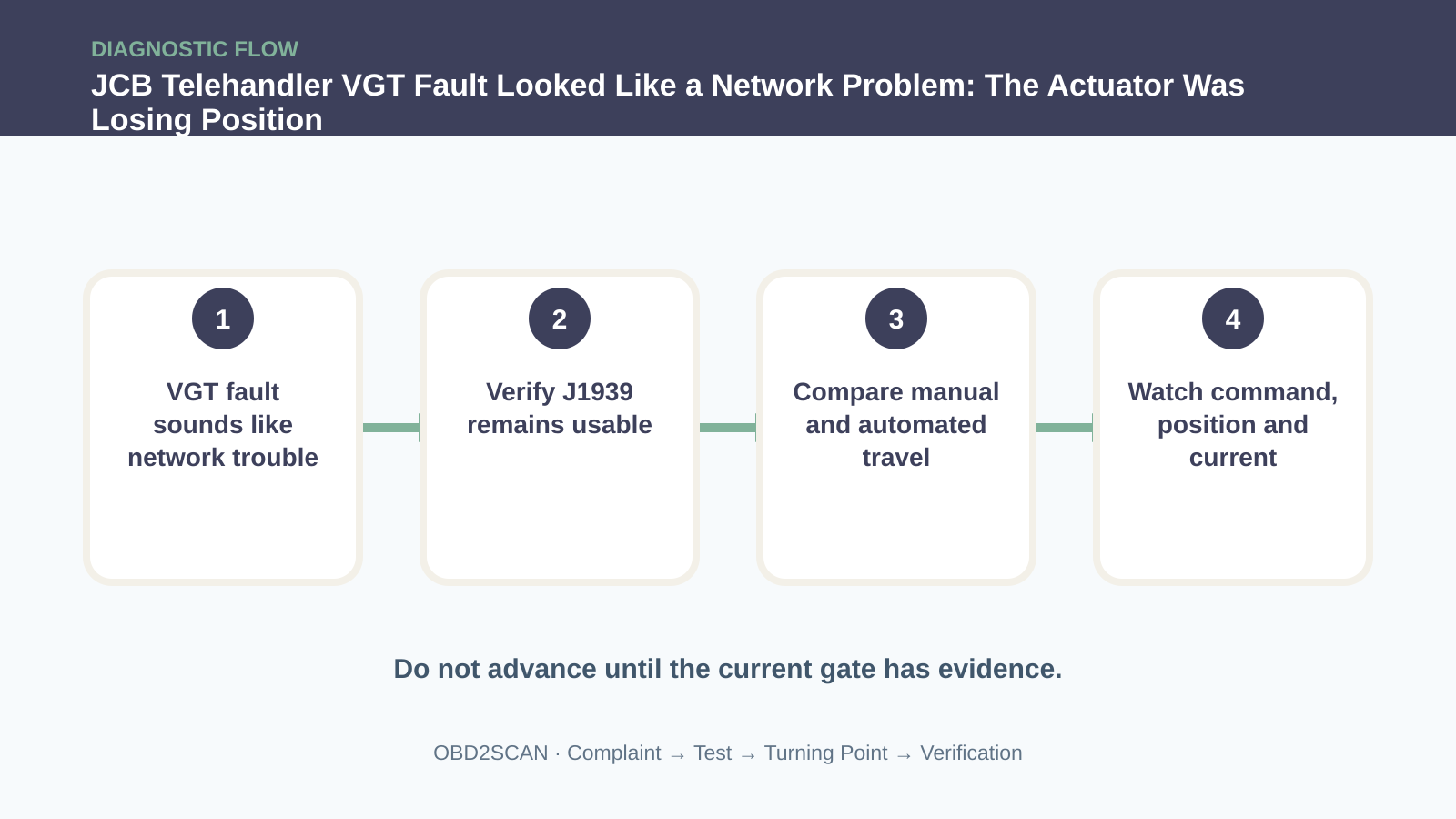
Check J1939 health before replacing harnesses
Check the physical layer before blaming it. With correct breakout and termination methods, compare network voltage and waveform at approved points, inspect harness routing and look for corrosion, chafing or water. Confirm other J1939 modules communicate consistently. A healthy-looking bus at one location does not prove every branch, but stable communication during the failed actuator event lowers the priority of a broad network repair. Avoid piercing insulation or unplugging terminators merely to make a trace easier.
Separate mechanical travel from electronic control
Separate the turbo vanes, linkage, position sensor and actuator motor. With power isolated and JCB procedure followed, assess mechanical movement without forcing stops. If the mechanism binds by hand, electrical replacement alone may fail again. In this case manual movement produced smooth feedback, showing that the position sensor could report travel and the mechanical path was not simply seized. That result did not certify the motor or gear train that had to create the movement automatically.
Compare manual motion with automated sweeps
Now command or observe the automatic sweep. Compare requested position, actual position, motor current and supply voltage from the beginning to the end stop. The fault was intermittent: some sweeps worked, others became erratic or lost position. A static resistance check could miss that. Repeat only enough cycles to capture the mismatch; a failing actuator can overheat or damage the linkage when hammered against its stops. Key-on and key-off sequences often provide a safer controlled event than full-load provocation.
| Test state | Position behavior | What it suggests |
|---|---|---|
| Manual actuator travel | Smooth feedback across range | Sensor and mechanical travel can work |
| Automated sweep | Sporadic/lost position | Self-driven actuator function fails |
| J1939 during event | Communication remains usable | Broad network fault moves down list |
| New assembly sweep | Clean repeatable end-to-end motion | Replaced assembly contained the cause |
Watch command, position and current together
If supply and ground remain stable while the command is valid, current behavior helps distinguish an open motor, mechanical stall and internal control loss. Network messages should be decoded by an appropriate platform, not inferred from two voltage levels alone. The evidence here converged on the actuator/turbo assembly because the same mechanism that moved smoothly under external control could not move reliably under its own drive. That is a functional failure, stronger than a label containing the word communication.
Replace the assembly only after the mismatch repeats
Follow JCB procedure for turbo removal, oil and coolant handling if applicable, fasteners and actuator commissioning. Some VGT actuators are calibrated to the turbo and are not interchangeable as casual bolt-on parts. Inspect the oil feed, drain, intake cleanliness and foreign-object risk so the new assembly is not blamed for an upstream issue. Do not bench-power unknown actuator pins. The low-voltage tool mention belongs before the repair; the final decision rests on commanded motion, position evidence and correct mechanical inspection.
Commission the actuator to JCB procedure
After installation, observe multiple key-on and key-off sweeps. Position should travel smoothly to expected stops without dropouts or abnormal current. Complete required learn or calibration functions, clear codes and rescan. Then reproduce the original load in a controlled work cycle while comparing requested and actual boost. Watch exhaust smoke and engine temperature. One clean self-test proves the actuator can move once; repeated cycles plus loaded control prove the original intermittent window has been challenged.
Verify key-on, key-off and loaded operation
Record the distinction that saved time: the network delivered information about a failed function, while the physical network remained serviceable. Include the pre- and post-repair position captures and the conditions that caused the fault to return. If any U-code persists after the VGT repair, diagnose it on its own evidence rather than forcing it into the actuator conclusion. A precise close protects both the machine owner and the technician from an overly broad repair claim.
The word network described how the fault was reported, not necessarily where it lived. Manual-versus-automatic motion exposed the actuator, and matched post-repair sweeps turned that diagnosis into a closed case.








Comments 0
Questions, fixes, and real-world diagnostic notes from readers.
Be the first to share a diagnostic result or ask a follow-up question.