
2015 Porsche Panamera A/C Stayed Warm After Condenser Repair: The Compressor Still Needed Permission

Recharged, But The Compressor Stays Off?
The condenser repair was mechanically complete and the refrigerant mass was correct, yet the Panamera still blew warm. The remaining job was to ask whether the controller had accepted the repair.
When this diagnostic path reaches a measurement question, the useful machine type is one that answers only that question. For that supporting role, the AUTOOL LM708 A/C Service Station is one practical option. A refrigerant station can recover, evacuate, leak-check and recharge a compatible system by specified mass. It cannot perform Porsche compressor reset/run-in, guarantee scan coverage, or prove control permission from gauge readings.
<strong>Quick answer:</strong> The sealed-system repair was complete, but compressor operation remained inhibited by a retained protection state. The specified reset and run-in restored control. This article follows one documented vehicle. It explains the evidence chain, not a universal failure rate or a direction to replace the same part on every similar car. Stop whenever the test would involve overheated brakes, high current, moving parts, refrigerant handling or an uncontrolled road condition.
Quick answer: The sealed-system repair was complete, but compressor operation remained inhibited by a retained protection state. The specified reset and run-in restored control.
In this guide
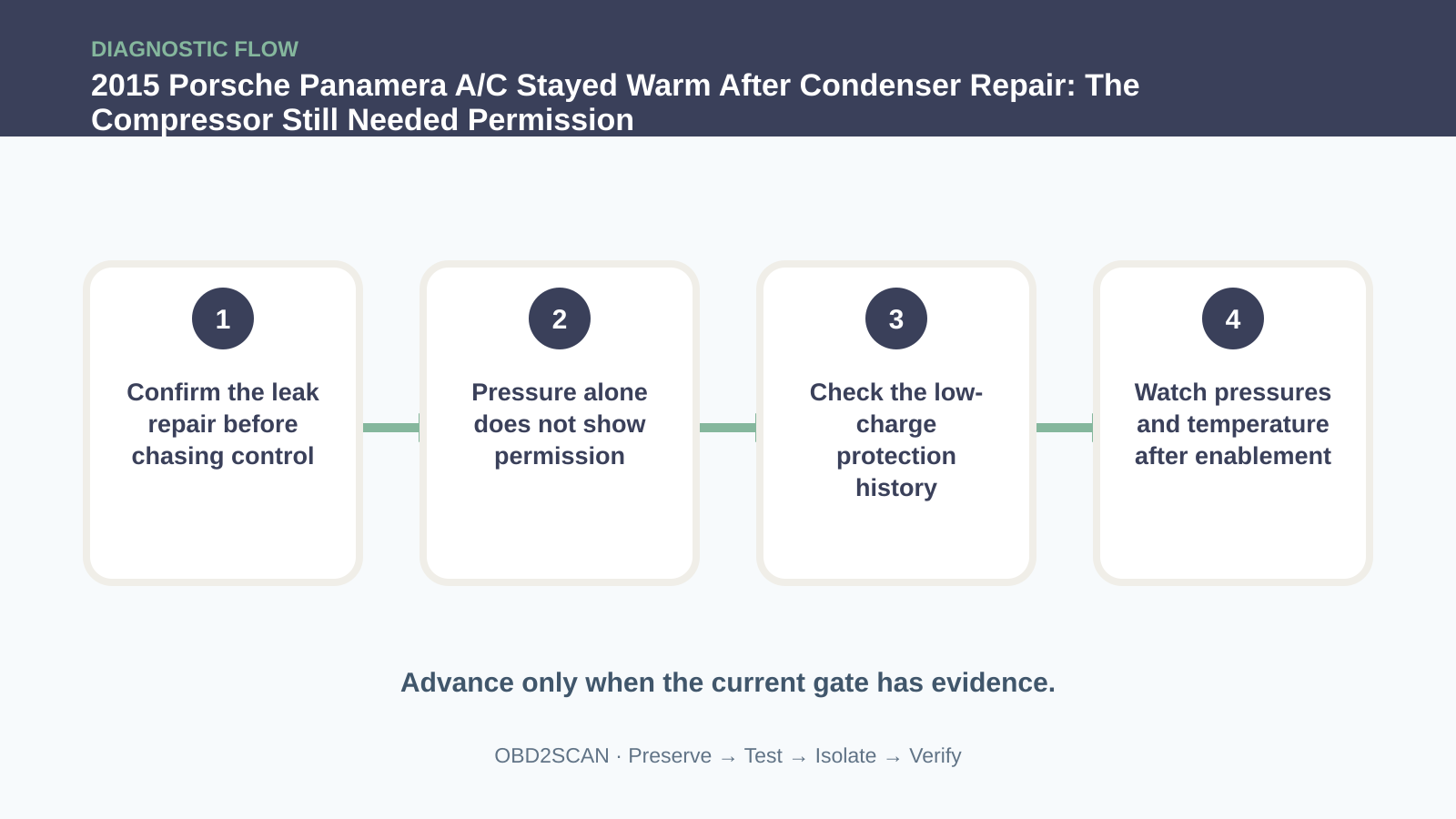
- Confirm the leak repair before chasing control
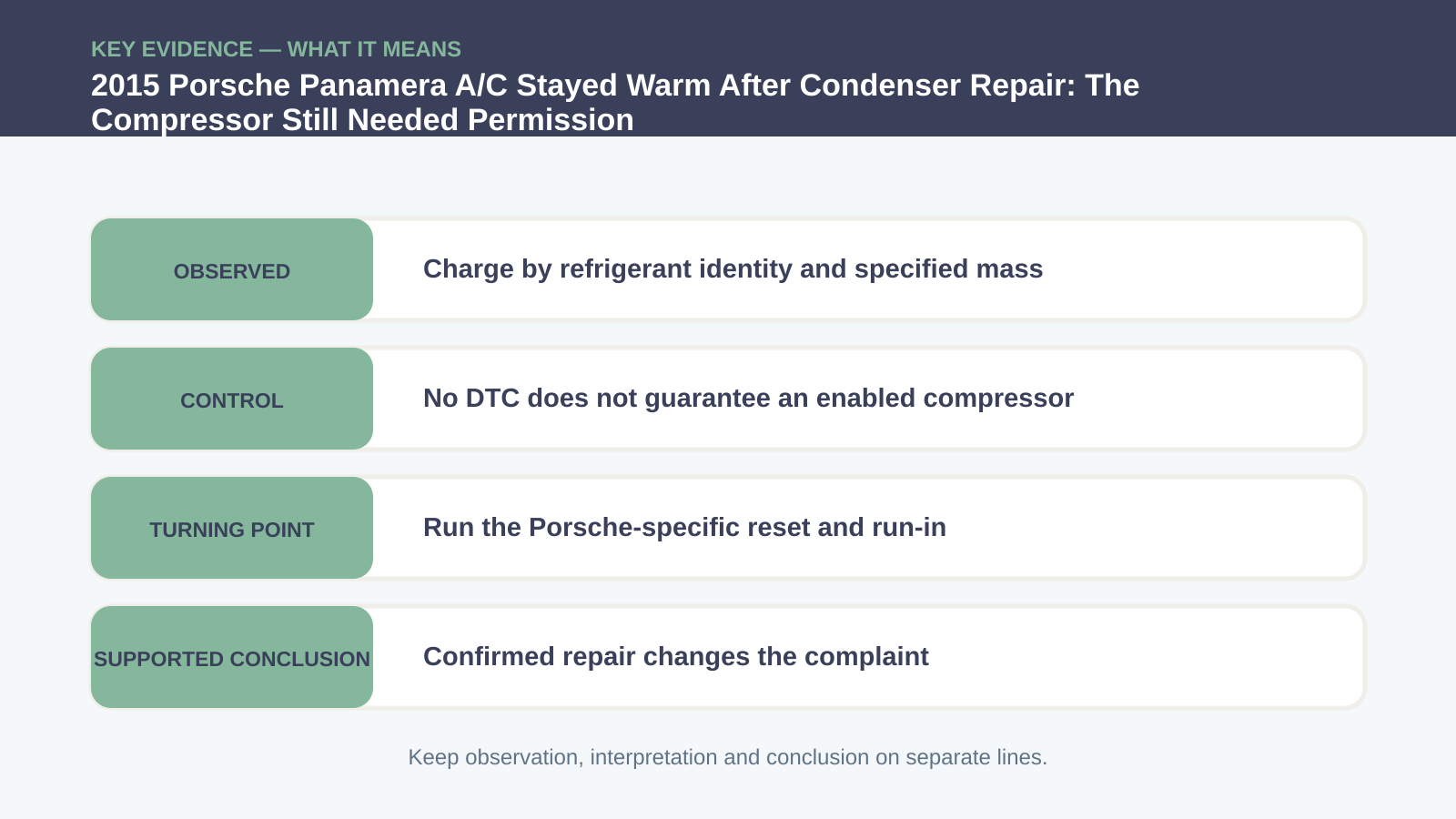
- Charge by refrigerant identity and specified mass
- Pressure alone does not show permission
- No DTC does not guarantee an enabled compressor
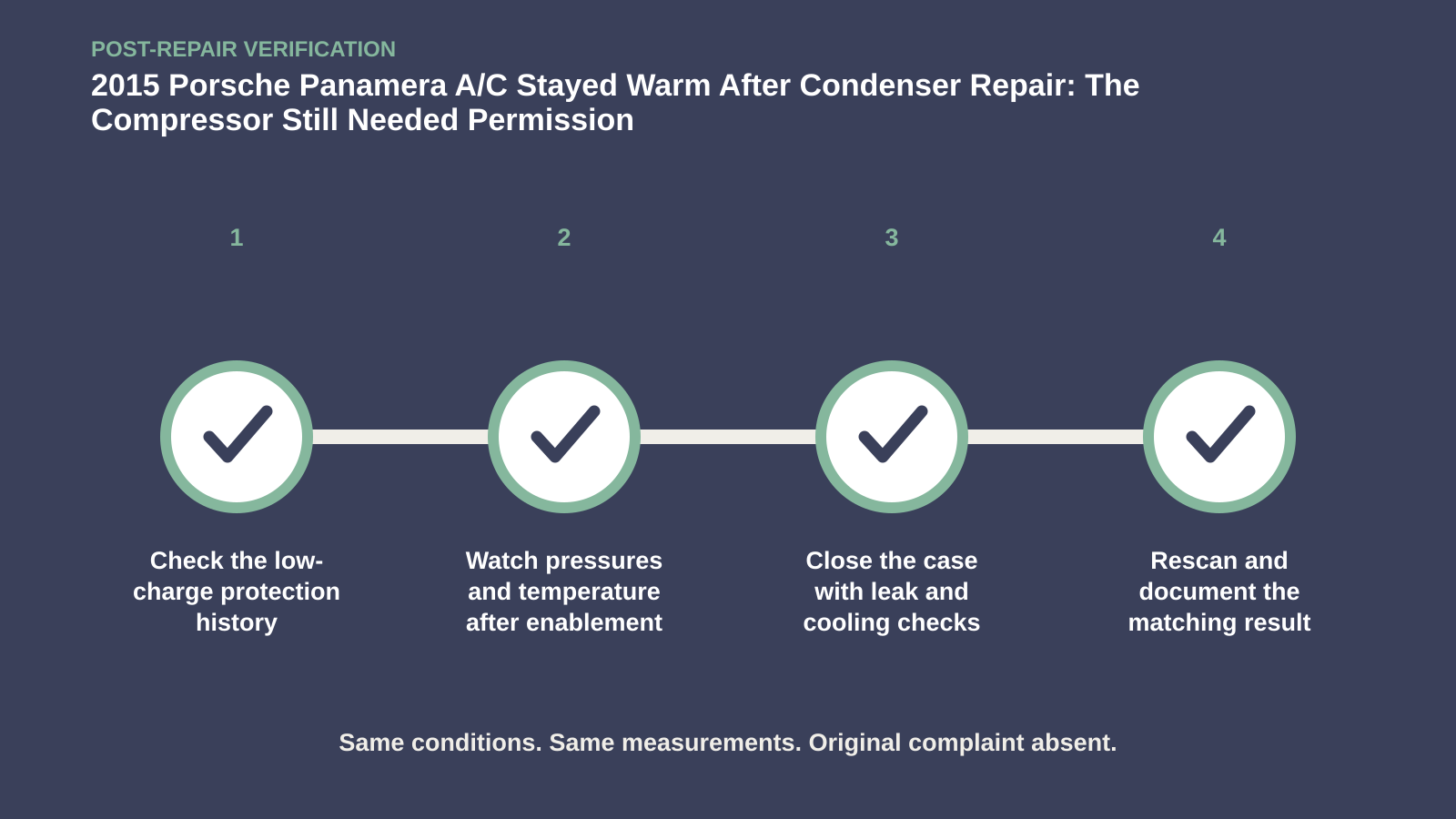
- Check the low-charge protection history
- Run the Porsche-specific reset and run-in
- Watch pressures and temperature after enablement
- Close the case with leak and cooling checks
Confirm the leak repair before chasing control
Begin by separating two questions: is the sealed refrigerant system correct, and has the controller allowed the compressor to operate? A new condenser answers neither alone. Confirm refrigerant identity, leak repair, oil handling and the specified charge mass before interpreting pressures. Preserve the original condition before changing it. The first observation is the control sample against which every later test must be compared.
Charge by refrigerant identity and specified mass
Recover and recharge by the Porsche procedure rather than adding until a gauge “looks right.” Air, undercharge and overcharge can all distort pressure relationships. Record ambient, vent and line temperatures with the high- and low-side readings so the service result is reproducible. Use service information for the exact engine, build date and options. A correct method on the wrong terminal can create a precise but useless result.
Pressure alone does not show permission
With the specified charge installed, the compressor still did not engage. Static or near-equal pressures show that it is not pumping, but not why. Check command, permissions, relevant sensors, fans and power paths without assuming another hardware fault. Treat prior work as evidence, not blame. A repair that made no change can narrow the case when its installation and test conditions are verified.
No DTC does not guarantee an enabled compressor
No DTCs were stored. A controller can intentionally inhibit a compressor because of remembered low-charge protection without classifying the state as a present component fault. Review event history and actual values with equipment that supports the exact Panamera. At this stage, separate what was observed from what is inferred. The observation should remain true even if the current theory is later rejected.
| Observation | What it supports | What it does not prove |
|---|---|---|
| Correct charge installed | Refrigerant mass is controlled | Compressor has permission |
| Compressor remains off | System is not pumping | Compressor is failed |
| No DTCs | No reportable fault stored | No inhibit exists |
| Reset/run-in restores cooling | Protection state was causal | Leak repair is automatically sound |
Check the low-charge protection history
The prior refrigerant loss provided the state-change clue. Porsche’s procedure required a compressor reset and run-in after the sealed-system repair. Coverage must be confirmed by VIN and software version; a generic code reader or refrigerant station cannot perform this authorization step. This is the decision point in the documented case. Its value comes from changing one bounded condition while leaving the rest of the system intact.
Run the Porsche-specific reset and run-in
With stable support voltage and correct charge, carry out the factory reset and run-in while monitoring pressures and temperatures. Stop if pressure, noise or fan behavior becomes unsafe. The procedure should enable a healthy system, not be used to force a questionable compressor. A confirmed component still needs a repair that restores sealing, support, torque, routing or terminal fit—the physical conditions that keep the fault from returning.
Watch pressures and temperature after enablement
Once enabled, evaluate pressure separation, vent temperature and compressor sound through the specified operating range. Inspect the new condenser and every opened joint for leaks. Cooling that returns briefly without a tight system is not a successful handoff. Reassemble protective covers and retainers before declaring success. A diagnostic shortcut must not become the next failure mechanism.
Close the case with leak and cooling checks
Repeat a cold start and heat-soaked restart, verify commanded and actual A/C states, and scan again. The documented Panamera cooled normally after reset/run-in. Mechanical repair, correct charge and accepted controller state were all necessary parts of one complete job. Use the customer’s original complaint as the final specification. A cleared code, quiet bay or one good key cycle is not equivalent to reproducing and passing that condition.
If you are bringing a similar symptom to a shop, arrive with the useful conditions rather than a requested part: whether the vehicle was cold or hot, the exact speed or switch position, which warning lamps appeared, what changed after a restart, and a chronological list of earlier repairs. A short video can preserve an intermittent sound or lamp pattern, but record it only while parked or with a passenger handling the camera. Ask the technician to retain the pre-repair scan and measurements, explain the test that separated the failed path from the alternatives, and show how the original complaint was repeated afterward.
For the owner or service adviser, a useful repair explanation has three parts: what was observed, why the decisive test narrowed the fault, and which original condition passed after the repair. It should also say what the test did not prove. That boundary prevents a memorable case from becoming an automatic parts recommendation.
The sealed-system repair was complete, but compressor operation remained inhibited by a retained protection state. The specified reset and run-in restored control. The reusable lesson is narrower and more valuable: Treat mechanical completion and electronic authorization as two separate repair gates.








Comments 0
Questions, fixes, and real-world diagnostic notes from readers.
Be the first to share a diagnostic result or ask a follow-up question.