
2002 Isuzu NPR-HD Lost All Power: The 80-Amp Fuse Was Protecting It From the Alternator

80-Amp Fuse Blows Key Off?
When an 80-amp fuse opens with the key removed, it is doing serious work. The case becomes safer and faster when the fuse is treated as the boundary of a shorted circuit, not as another consumable.
When this diagnostic path reaches a measurement question, the useful machine type is one that answers only that question. For that supporting role, the AUTOOL BT360 Battery Tester is one practical option. A 12-volt battery tester can document battery, cranking and charging condition after the short is made safe. It cannot locate a high-current short, replace current-limited protection, or justify repeated fuse installation.
<strong>Quick answer:</strong> The alternator had a key-off short on the main feed. Isolating it stopped the correct fuse from opening, and replacement restored the truck. This article follows one documented vehicle. It explains the evidence chain, not a universal failure rate or a direction to replace the same part on every similar car. Stop whenever the test would involve overheated brakes, high current, moving parts, refrigerant handling or an uncontrolled road condition.
Quick answer: The alternator had a key-off short on the main feed. Isolating it stopped the correct fuse from opening, and replacement restored the truck.
In this guide
An 80-amp fuse is a fire boundary
FL-1 is a high-current safety device, not a reset button. Disconnect the battery by the manufacturer procedure before touching main cables, protect tools from chassis contact and never fit a larger fuse. If the correct 80-amp link opens again, stop energizing the circuit and isolate it. Preserve the original condition before changing it. The first observation is the control sample against which every later test must be compared.
Charge and assess the battery first
The battery had been discharged, so charge and assess it separately before judging the truck. A damaged battery can confuse later voltage readings, while repeated short-circuit events can overheat connections. Confirm polarity and cable condition before installing any replacement protection. Use service information for the exact engine, build date and options. A correct method on the wrong terminal can create a precise but useless result.
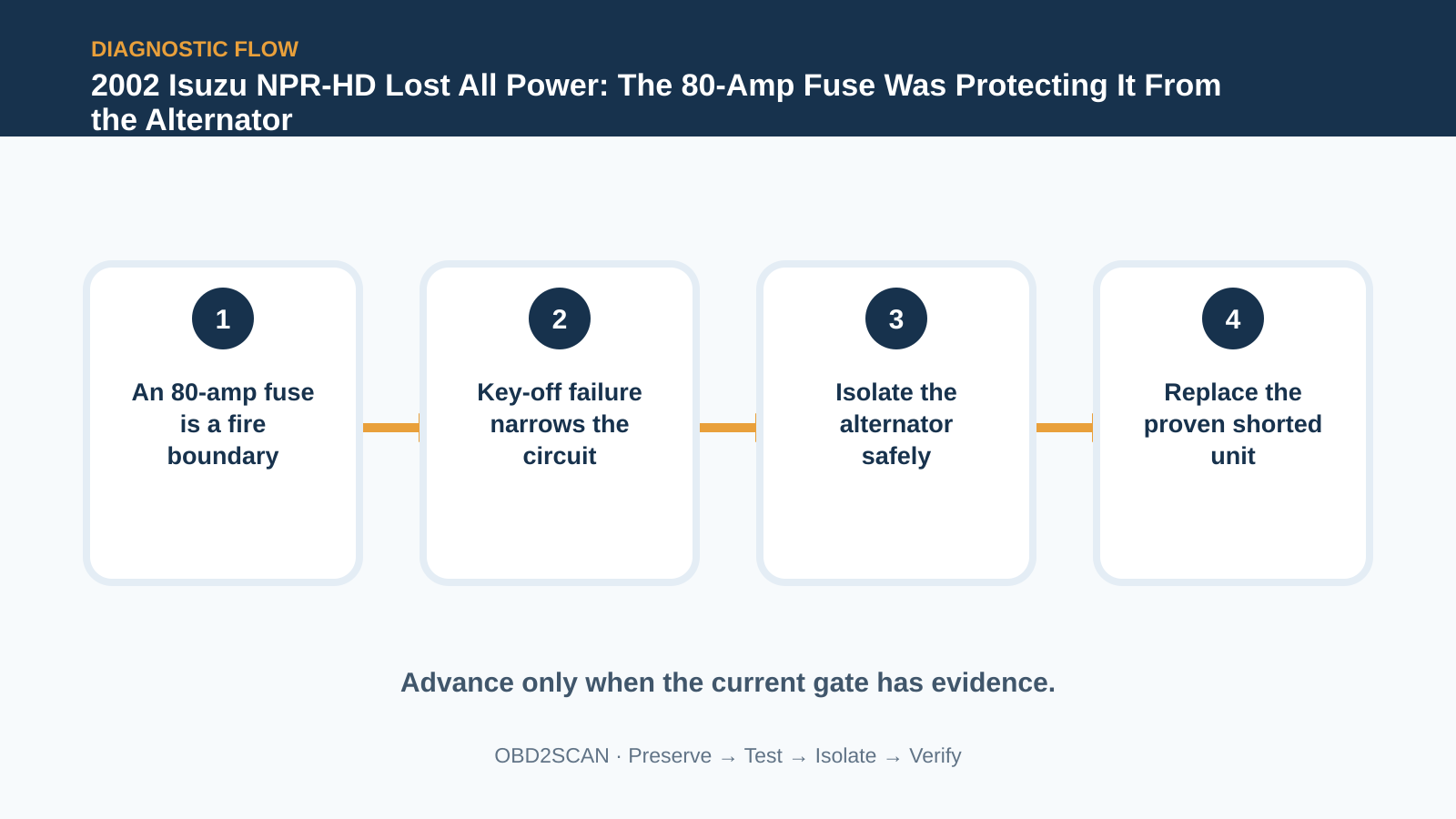
Key-off failure narrows the circuit
The fuse failed with the ignition off. That observation moves switched loads down the list and increases attention on always-hot paths. Write down whether failure is immediate, whether cables warm and what recent charging or alternator work occurred; do not keep sacrificing fuses to learn the same fact. Treat prior work as evidence, not blame. A repair that made no change can narrow the case when its installation and test conditions are verified.
Map every branch downstream of FL-1
Use the Isuzu distribution diagram to list every conductor fed by FL-1 and note which downstream branches have their own protection. The alternator B+ path remained a prominent direct branch. A diagram turns one large cable network into a finite isolation plan. At this stage, separate what was observed from what is inferred. The observation should remain true even if the current theory is later rejected.
| Observation | What it supports | What it does not prove |
|---|---|---|
| FL-1 opens key off | Always-hot path is suspect | Install a larger fuse |
| Other branches separately fused | Direct feed deserves focus | Alternator is proved |
| Fuse holds unplugged | Alternator branch is causal | Cable is undamaged |
| Replacement passes charging test | Shorted unit was cause | Battery is automatically healthy |
Isolate the alternator safely
With the battery disconnected and the cable secured against accidental contact, isolate the alternator according to the service procedure. Reinstall the correct protection and energize through a safe current-limited method where applicable. In this case, the fuse held only after the alternator was disconnected. This is the decision point in the documented case. Its value comes from changing one bounded condition while leaving the rest of the system intact.
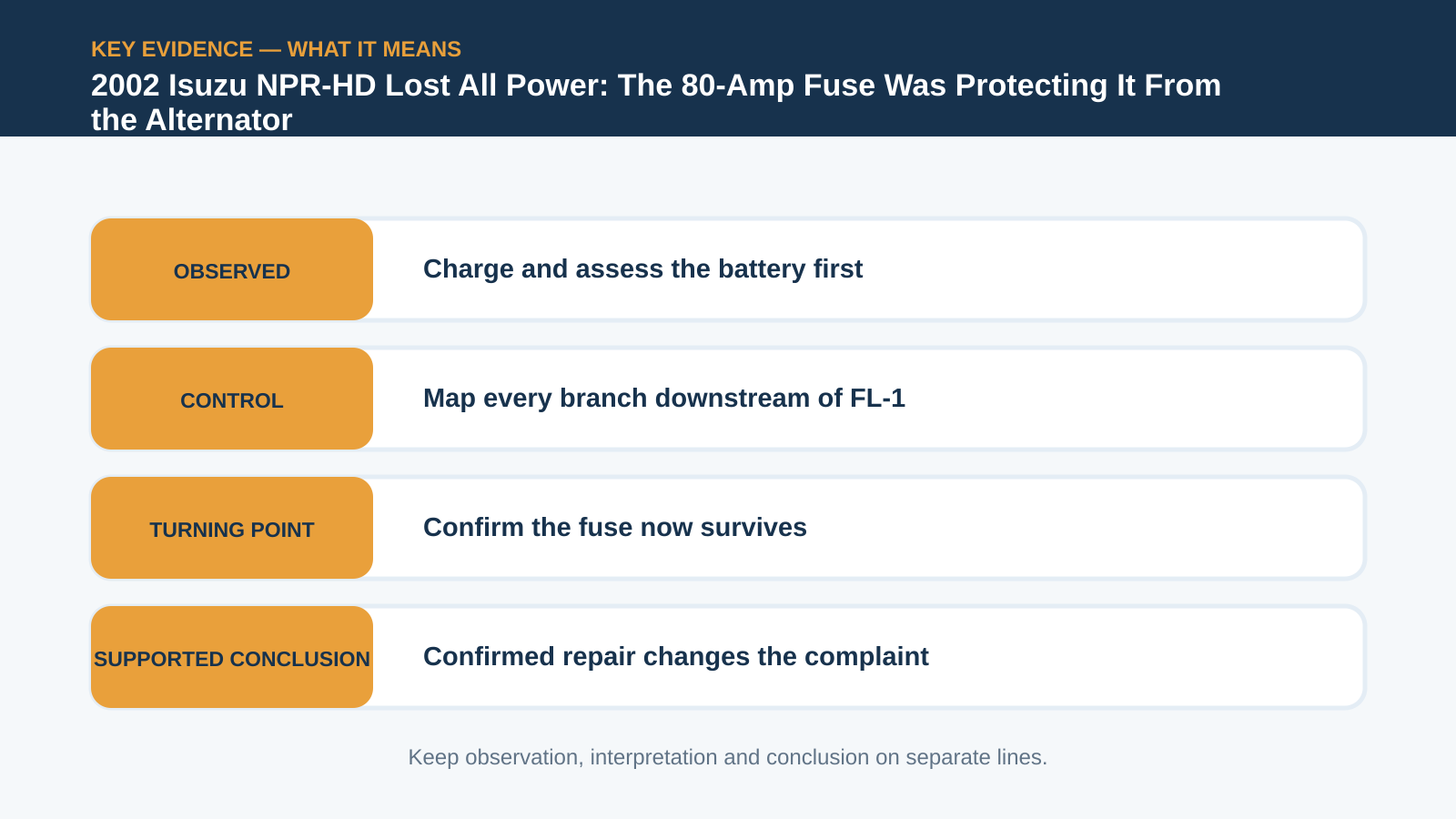
Confirm the fuse now survives
That A/B result identified the alternator branch, but inspect the cable for chafing and terminal contact before condemning the unit. A shorted cable can mimic an internal alternator fault. The documented inspection supported alternator replacement, which restored the truck’s main power. A confirmed component still needs a repair that restores sealing, support, torque, routing or terminal fit—the physical conditions that keep the fault from returning.
Replace the proven shorted unit
Install the correct alternator and fuse, clean and torque the high-current connections, and route the B+ cable away from edges and heat. Reconnect the battery safely. A post-repair tester can assess starting and charging, but it should never be used as the short-isolation device. Reassemble protective covers and retainers before declaring success. A diagnostic shortcut must not become the next failure mechanism.
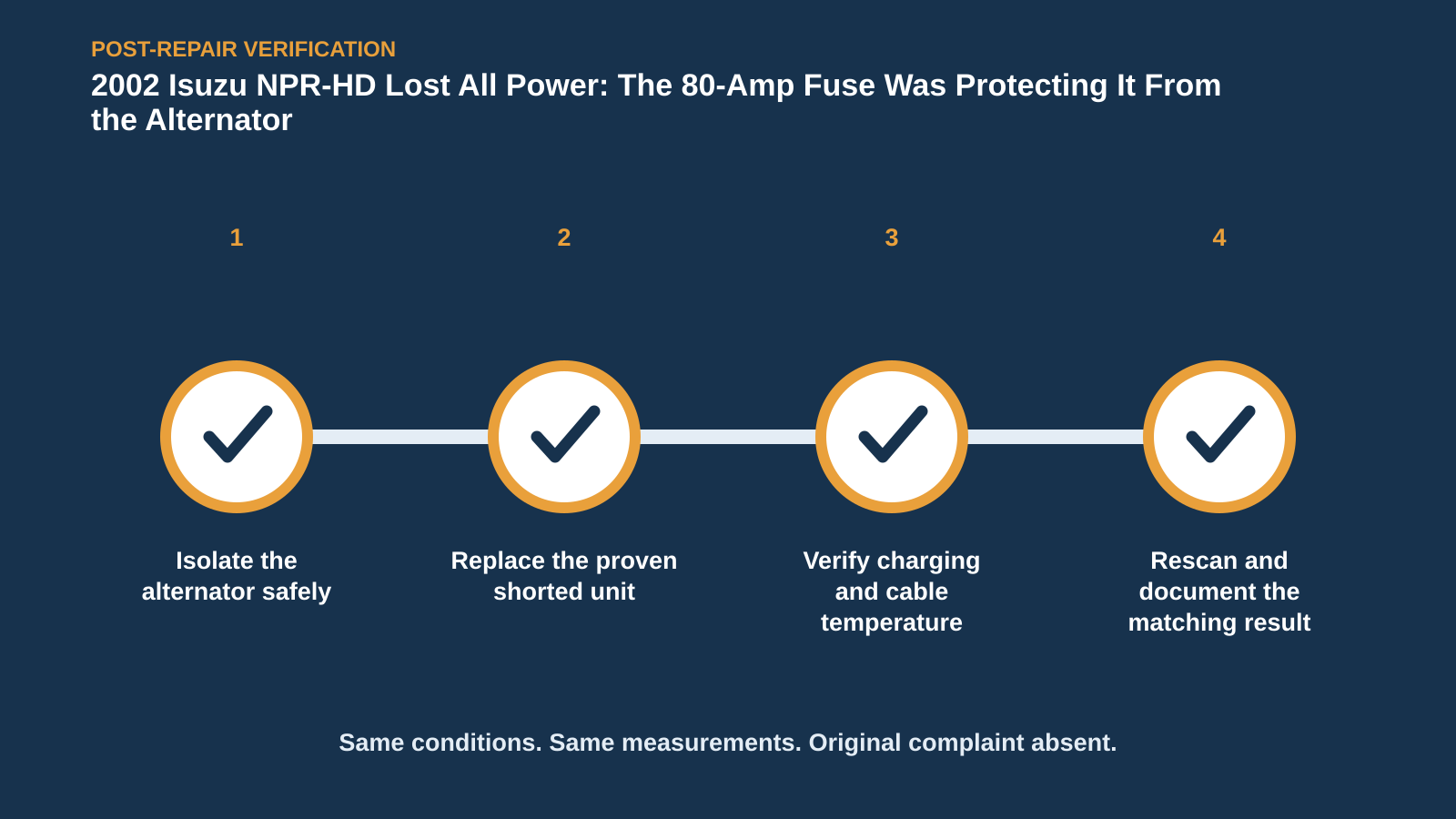
Verify charging and cable temperature
Verify key-off fuse survival first, then engine start, charging voltage under specified loads and cable temperature. Check for excessive ripple with appropriate equipment and retest the battery. Several heat cycles without another open fuse provide better closure than one successful crank. Use the customer’s original complaint as the final specification. A cleared code, quiet bay or one good key cycle is not equivalent to reproducing and passing that condition.
If you are bringing a similar symptom to a shop, arrive with the useful conditions rather than a requested part: whether the vehicle was cold or hot, the exact speed or switch position, which warning lamps appeared, what changed after a restart, and a chronological list of earlier repairs. A short video can preserve an intermittent sound or lamp pattern, but record it only while parked or with a passenger handling the camera. Ask the technician to retain the pre-repair scan and measurements, explain the test that separated the failed path from the alternatives, and show how the original complaint was repeated afterward.
For the owner or service adviser, a useful repair explanation has three parts: what was observed, why the decisive test narrowed the fault, and which original condition passed after the repair. It should also say what the test did not prove. That boundary prevents a memorable case from becoming an automatic parts recommendation.
The alternator had a key-off short on the main feed. Isolating it stopped the correct fuse from opening, and replacement restored the truck. The reusable lesson is narrower and more valuable: Use the distribution diagram to isolate one unfused high-current branch without normalizing repeated fuse failures.










Comments 0
Questions, fixes, and real-world diagnostic notes from readers.
Be the first to share a diagnostic result or ask a follow-up question.