
2011 Jeep Grand Cherokee P0302: Exhaust Pressure Found the Missing Cam Lobe

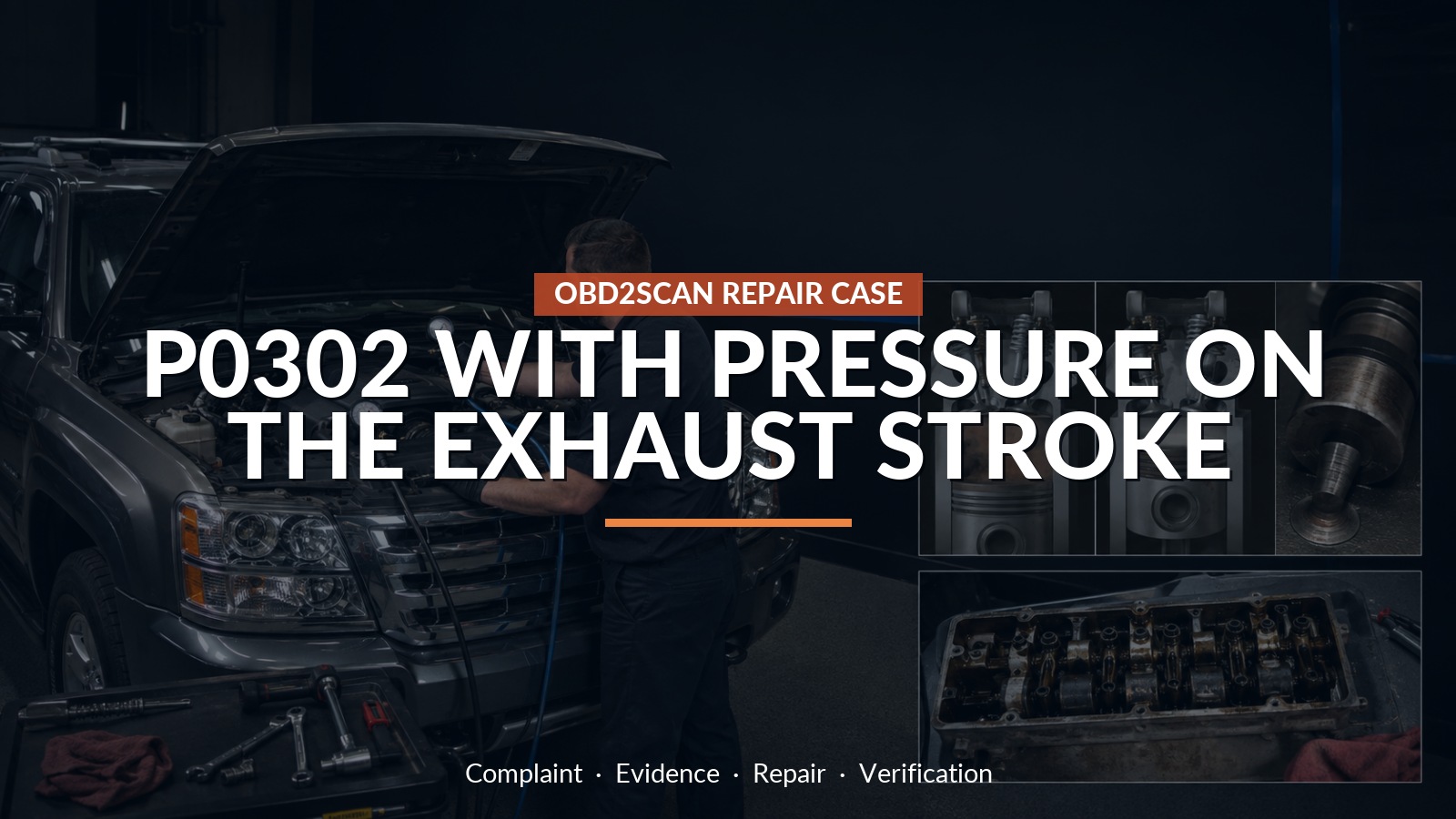
P0302 With Pressure On The Exhaust Stroke
The Jeep already had a cylinder-two coil and two spark plugs, yet P0302, rough running and a tapping noise remained. Relative compression did not show a dramatic dead hole. The breakthrough came when pressure was measured during the stroke most quick tests ignore: exhaust.
After pressure evidence justifies safe valve-cover removal, an articulating camera such as the MRCARTOOL N180 can help document restricted valvetrain surfaces. N180 can visually document an accessible cam lobe and valvetrain after safe disassembly. It cannot measure valve lift, prove exhaust-stroke pressure or replace oil-system and related-lifter inspection.
Cylinder two reached a roughly comparable compression peak but built nearly 50 psi late in the exhaust plateau at idle and more than 130 psi when revved. A companion cylinder did not. With the cover removed, the intake valve moved about half an inch while exhaust lift was under one-eighth inch. The cam lobe was worn away; the source stops before repair and post-repair proof.
Quick answer: Cylinder two built pressure during its exhaust stroke because a worn cam lobe barely opened the exhaust valve.
In this guide
- P0302 names a cylinder, not a coil
- Listen to the tapping without guessing
- Use relative compression as a screen
- Compare companion cylinders at the same moment
- Pressure should not rise on an open exhaust path
- Valve lift confirmed the waveform
- Inspect the whole failure chain before repair
- Keep the case open until the same evidence normalizes
P0302 names a cylinder, not a coil
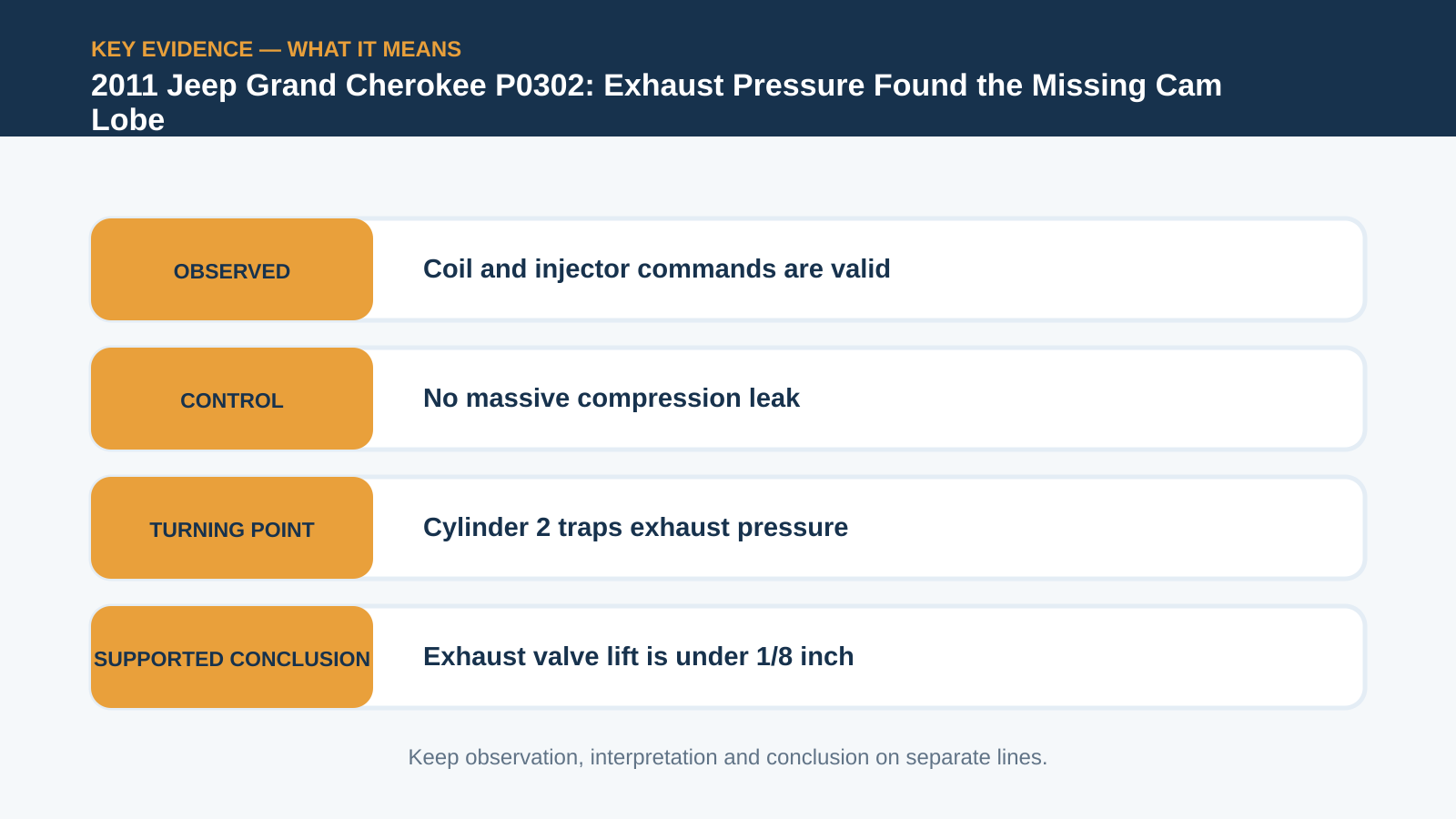
P0302 tells you where crank acceleration was abnormal; it does not tell you why. Verify the roughness and flashing lamp, save freeze-frame and misfire counts, and limit running because unburned fuel can damage the catalyst. The earlier coil and plug replacements are history, not evidence that those systems are now perfect. Swap or test only under matched conditions and record whether the misfire moves. In this case, coil command and injector drive were credible, so replacing another easy part would have added cost without addressing the tapping sound.
Listen to the tapping without guessing
A tapping noise narrows the probability toward valvetrain or rotating contact, but sound travels through an engine. Note whether it is half engine speed, whether it changes warm, and where it is strongest. Do not place hands or improvised listening tools near belts and fans. The noise agreed with a mechanical direction, yet the team still screened compression first. That protected the decision to open a 5.7-liter V8: disassembly should follow converging evidence, not simply the confidence of a familiar sound.
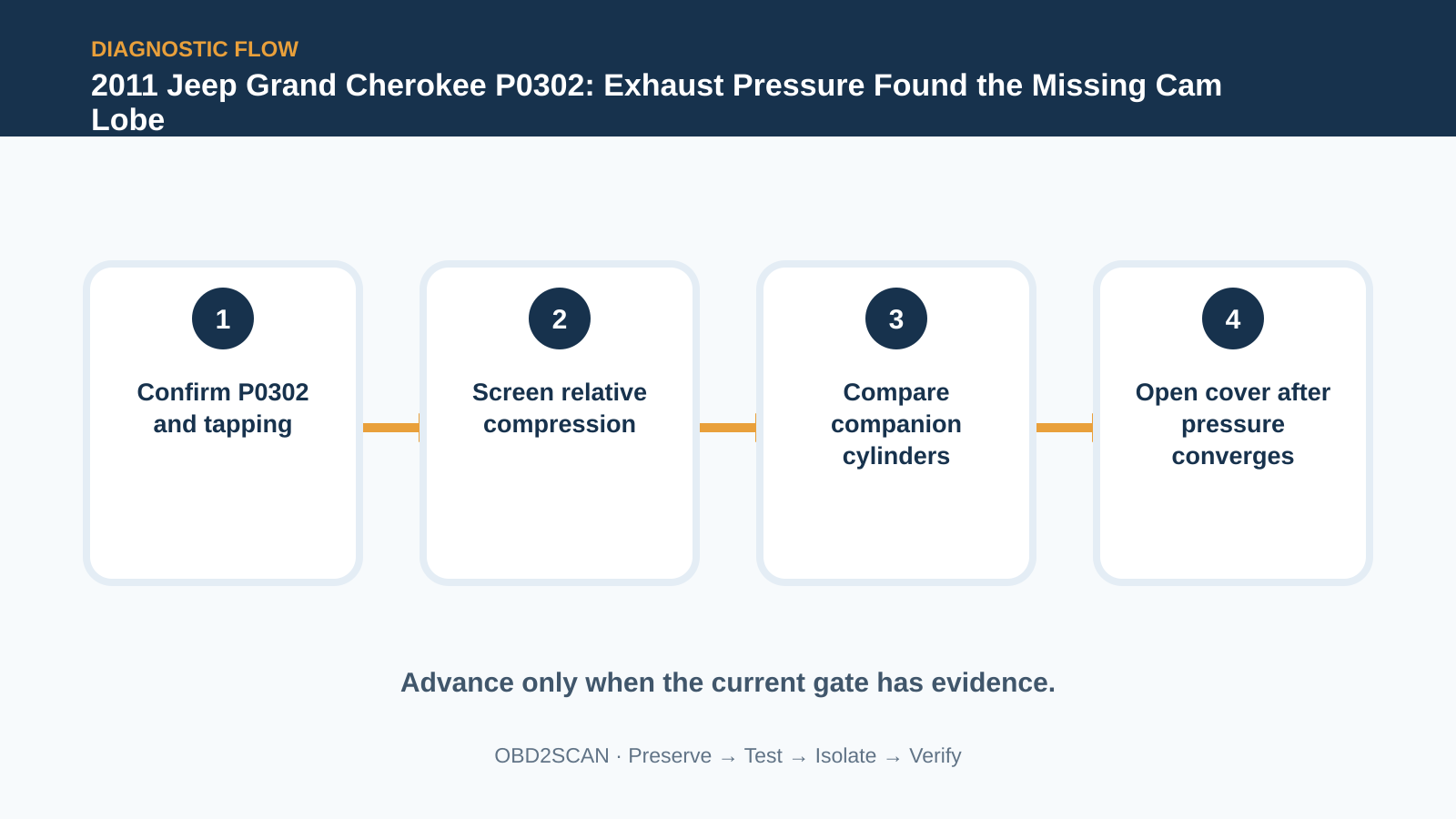
Use relative compression as a screen
Relative compression compared starter loading across cylinders. The pattern was stable enough to rule against a massive, permanent compression loss, but it did not make cylinder two healthy. A cylinder can seal on its compression stroke and still breathe poorly on intake or exhaust. That is the key limitation. If a misfire, noise and DTC remain after plausible ignition and injector commands, add a test that sees gas movement or valve timing instead of asking the same compression question more loudly.
Compare companion cylinders at the same moment
Cylinders two and three are companions in this engine’s firing order, allowing two pressure transducers to observe suspect and comparison cylinders simultaneously. Engine speed, throttle position and temperature affected both traces at the same moment, reducing comparison noise. During cranking, the cylinder-two trace began rising where an exhaust path should have been open. At idle, that unwanted rise reached nearly 50 psi. When the engine was briefly revved, trapped exhaust pressure exceeded 130 psi. That is not a normal emptying cylinder.
| Test | Cylinder 2 | Companion cylinder | Meaning |
|---|---|---|---|
| Relative compression | No massive loss | Similar overall rhythm | Compression screen alone is incomplete |
| Ignition/injector drive | Commands present | Commands present | Electrical actuation moves down the list |
| Idle exhaust plateau | Pressure rises near 50 psi | Exhaust path releases normally | Cylinder 2 cannot empty correctly |
| Brief rpm increase | Exhaust pressure exceeds 130 psi | No matching trap | Restriction grows with gas flow |
Pressure should not rise on an open exhaust path
Pressure should fall as the exhaust valve opens and the piston pushes gas out. The cylinder-two rise showed the piston working against a path that never opened far enough. A blocked runner could also create backpressure, but the synchronized comparison and tapping sound favored a valve-lift problem local to that cylinder. This is where a waveform supports disassembly; it still does not name cam, lifter, rocker or valve until the mechanism is inspected. Keep causation one step behind the evidence.
Valve lift confirmed the waveform
With the cover removed and engine rotated by the approved method, the intake valve moved roughly half an inch while the exhaust valve moved less than one-eighth. Visual inspection confirmed that the exhaust cam lobe had been worn away. Measure lift rather than relying only on appearance, and inspect the associated lifter, rocker, oil feed, journal and debris path. A camera can preserve the surface condition for the estimate, but a photograph alone cannot establish why the lobe failed or whether metal circulated through the engine.
Inspect the whole failure chain before repair
The public source confirms the mechanical fault but does not document camshaft replacement, related-part decisions or a post-repair pressure trace. A responsible plan would follow Jeep service data, correct the cause of lost lift, change contaminated lubricants as required and verify oil supply before extended running. It would also inspect other lobes rather than assuming cylinder two is isolated. Any statement that the Jeep returned to service would go beyond the published record.
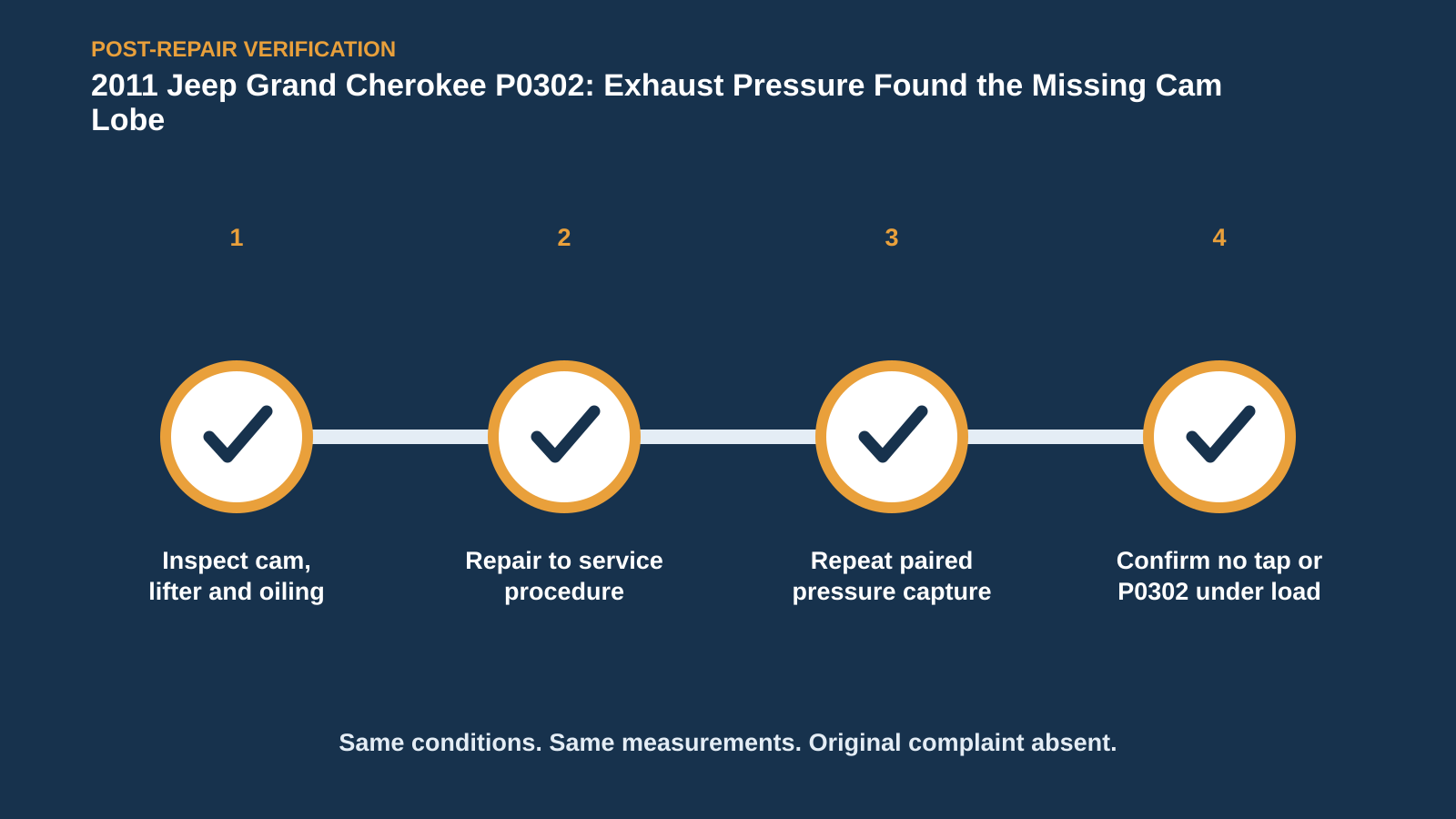
Keep the case open until the same evidence normalizes
Closure requires the same evidence in reverse. Repeat the paired in-cylinder test with identical connections and operating conditions; the exhaust plateau should no longer rise abnormally. Confirm measured valve lift, stable oil pressure, quiet operation, balanced cylinder contribution and no returning P0302 during a loaded drive. Recheck pending codes after a cold start and warm restart. Until those results exist, this is a well-proven diagnosis with an explicit repair boundary—not a completed repair claim.
The cylinder was able to squeeze its charge, which is why a compression screen looked reassuring. It was the inability to empty that exposed the missing exhaust lift and earned the valve-cover removal.








Comments 0
Questions, fixes, and real-world diagnostic notes from readers.
Be the first to share a diagnostic result or ask a follow-up question.