
2010 Caliber Turn Signals Fail With Headlights On: Record the Combination, Inspect Beyond the Front

Quick answer: A lamp that works in one switch combination and fails in another needs a complete state comparison. Do not restrict inspection to the front lamp when the shared lighting system may have damage elsewhere.
Begin with a switch-state comparison and a complete lamp inspection. An AUTOOL DM301 can support passive low-voltage checks at appropriate circuit points; a reading still needs the wiring information and operating state. Do not bridge socket terminals to make a lamp illuminate.
In this guide
Describe both switch states before replacing bulbs
Turn signals that fail only with another lighting function selected need a more precise report than intermittent indicators. Observe the lamps while the vehicle is parked safely, using assistance if needed, without touching hot bulbs or exposed connections. If signaling is unreliable, arrange repair before normal traffic use.
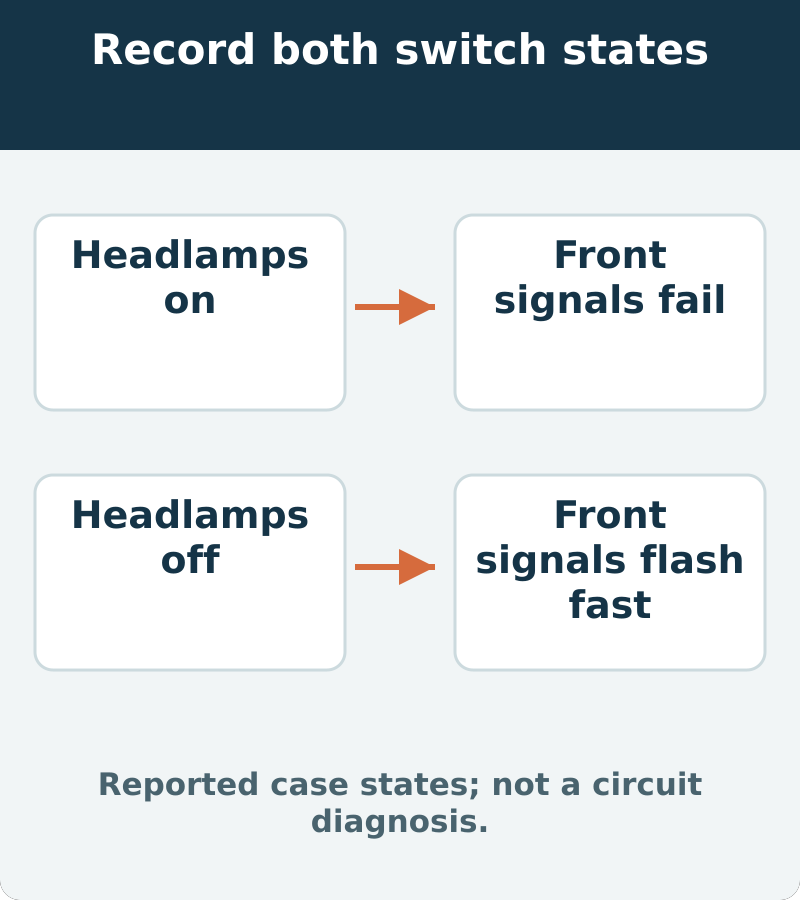
The two reported states can be summarized compactly:
| Headlamps | Front signal behavior |
|---|---|
| On | Failed to operate |
| Off | Flashed rapidly |
For your own car, record each side separately and distinguish what the outside lamps do from what the dashboard indicator shows. Do not assume a sound or dashboard flash fully describes the exterior result. The combination is the clue that the repairer needs to compare, not a ready-made diagnosis of a particular bulb.
Why the rear of the car belongs in the inspection
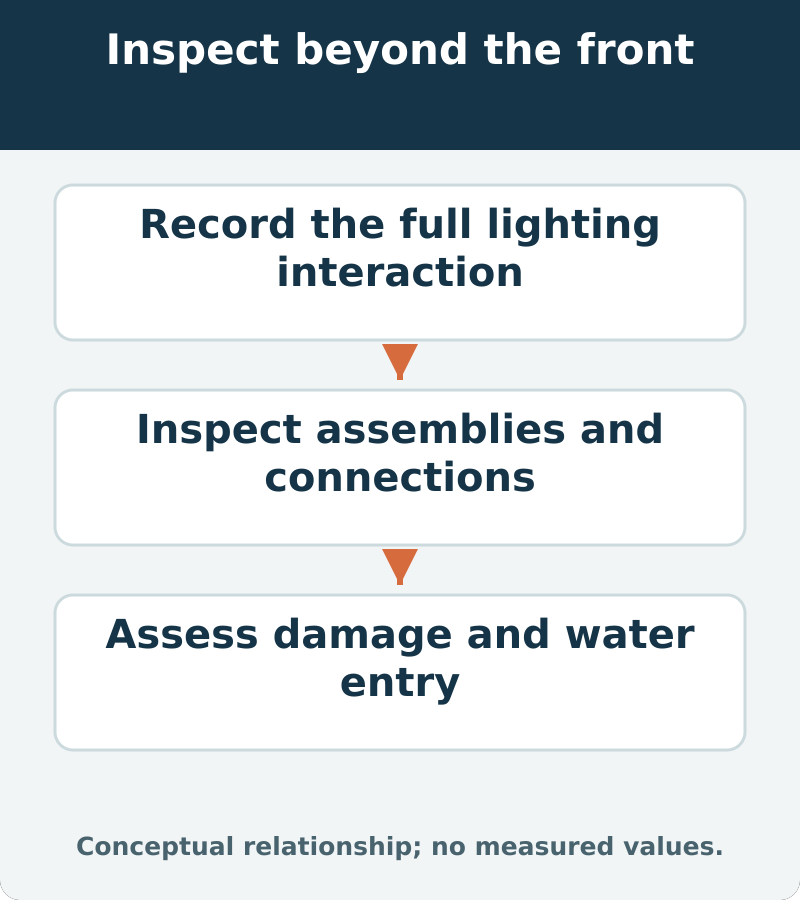
A front-lamp symptom does not make the rest of the lighting system irrelevant. The correct circuit information and a whole-vehicle inspection can reveal damage outside the location where the complaint is most visible.
That does not mean a rear lamp should be replaced whenever a front signal behaves strangely. It means the inspection boundary should follow the system, not stop at the owner’s first observation. Ask whether the relevant rear assemblies, sockets and connections were included and what was found.
A useful report identifies the actual condition at each location. That is more informative than a broad statement that all lights were checked, and it prevents one obvious defect from hiding lesser damage elsewhere that may also need attention.
In the ALLDATA published case, the Caliber front signals failed with headlamps on and flashed rapidly with them off. Inspection found water damage and heavy corrosion at the right rear lamp, plus lesser socket corrosion elsewhere. Lamp-assembly replacement, socket attention and new bulbs restored the reported exterior-light operation.
Corrosion is a condition to assess, not a complete circuit explanation
Water and corrosion are tangible findings, but they do not by themselves describe the exact electrical path behind a switch-dependent symptom. The technician still needs to connect the observed damage with appropriate circuit assessment.
Avoid attaching a precise backfeed explanation to this case without supporting measurements and wiring evidence. The source does not publish those details or isolate one decisive item within the combined repair. The result therefore supports the documented repair scope, not a universal internal mechanism.
Ask what the inspection establishes about contact condition and whether affected parts can be restored appropriately or need replacement. A new bulb in a damaged socket may leave the connection problem unresolved; equally, not every discolored surface justifies replacing an entire assembly. The actual condition and applicable repair method govern that choice.
A replacement lamp needs protection from renewed water entry
If water damage is part of the finding, the estimate should address the condition of the assembly and the reason moisture reached vulnerable areas, as far as inspection can establish it. Replacing a damaged part without considering the environment can leave a recurrence question unanswered.
Ask how the fitted assembly and its relevant seals, connections and retention were assessed. Do not improvise drilled drains, extra sealant or altered wiring from a general internet suggestion; those changes need vehicle-specific justification.
Also keep the repair description accurate. If the work includes an assembly, several sockets and bulbs, the final result should be attributed to that combined work unless separate tests establish which item was decisive. This makes a later recurrence easier to investigate and avoids an oversimplified replace-the-right-rear-lamp rule.
Finish with a whole-vehicle lighting check
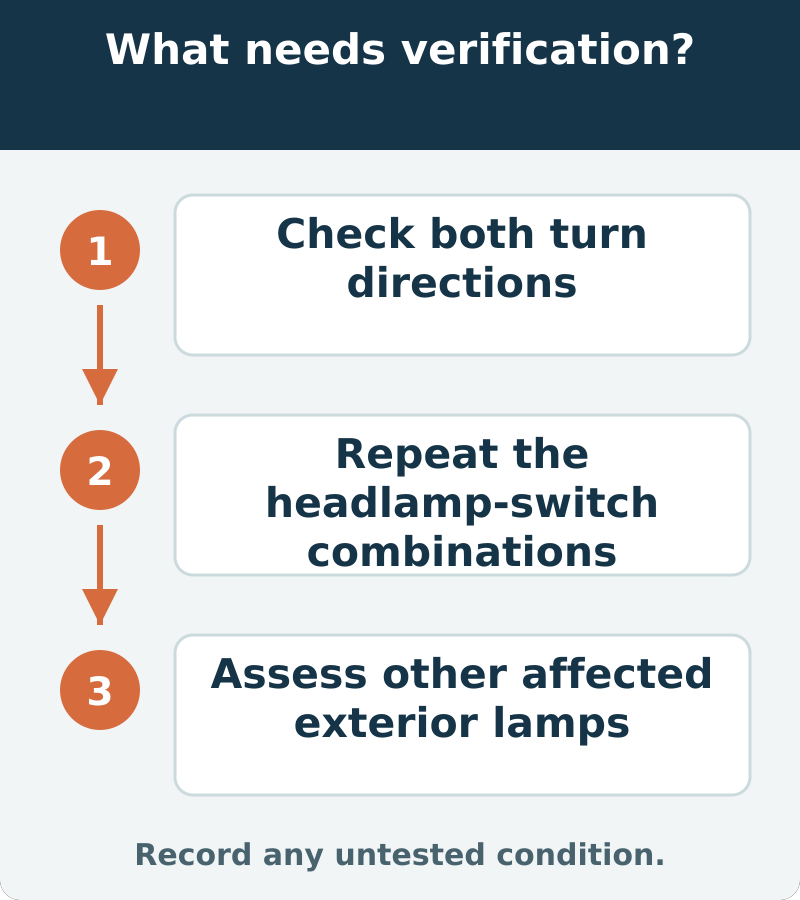
At completion, repeat the relevant switch combinations through the normal controls with the workshop. Include both turn directions and the other exterior-light functions relevant to the repair, rather than checking only the front lamp with the headlamps off.
The final comparison should show that the original interaction is no longer present under the assessed conditions. Ask whether all affected sockets and assemblies were included and whether any water-entry concern remains. Clearing a warning, where present, is not a substitute for observing the actual lamps.
Keep the original state table with the repair record. If the fault returns, describe the new combination just as carefully. The value of this case is the method of reporting and checking interacting functions, not an assumption that every fast flash or lighting interaction has the same cause.





Comments 0
Questions, fixes, and real-world diagnostic notes from readers.
Be the first to share a diagnostic result or ask a follow-up question.