
BMW 325 Intermittent Shudder: Worn Spark Plugs and Separate Fuel-Filter Service

This BMW 325 at 120,000 km had an intermittent idle shudder and slight hesitation during acceleration, yet no current diagnostic trouble code was present. Six removed spark plugs showed severe center-electrode wear and reported gaps above 1.3 mm, supplying direct evidence of degraded ignition performance. The plugs were replaced, a long-unserviced fuel filter was handled as a separate maintenance item, and an all-condition road test found no returning shudder.
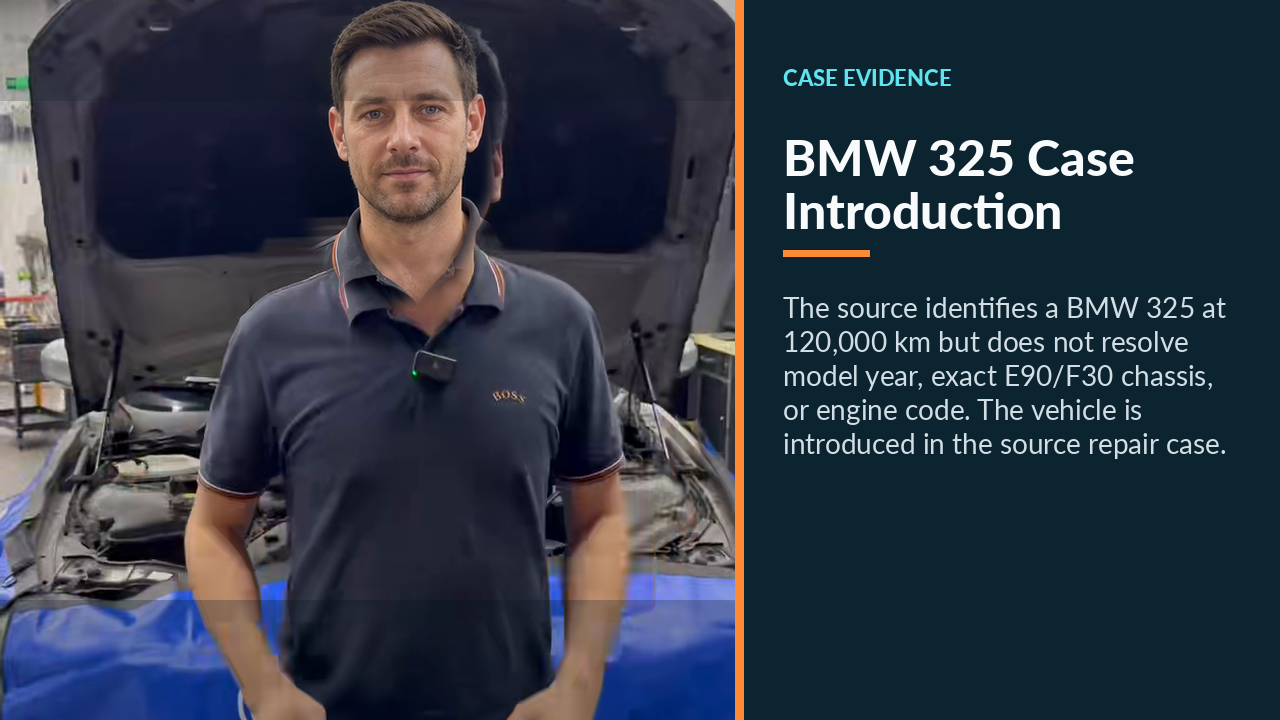
The case record calls the vehicle E90/F30 and its powertrain inline-six/four-cylinder without resolving the actual chassis, model year, or engine code. It describes cylinders 1–6 and the video shows six plugs, but exact VIN data is still required for parts and specifications.
Case at a glance
| Item | Case detail |
|---|---|
| Vehicle | BMW 325, 120,000 km; year and exact E90/F30 chassis not reported |
| Engine | Exact code not reported; the case record describes cylinders 1–6 and shows six plugs |
| Driver complaint | Intermittent idle shudder and slight acceleration hesitation |
| Current DTC | None reported |
| Confirmed ignition finding | Six plugs with severely worn center electrodes and reported gaps above 1.3 mm |
| Confirmed repair | All six spark plugs replaced to the selected application |
| Separate maintenance work | Fuel filter replaced and connections cleaned from service history and observed condition |
| Restoration | Historical light misfire counts cleared; fuel-trim behavior observed |
| Verification | All-condition road test, including low-speed/high-load acceleration, with no shudder and restored response |
A missing code did not clear the ignition system
An intermittent physical shudder can occur before a current DTC is stored or retained. The workshop did not treat the blank current-code result as proof that every cylinder was healthy. It moved to direct inspection of the consumable ignition parts and preserved the difference between current codes and historical light misfire counts.
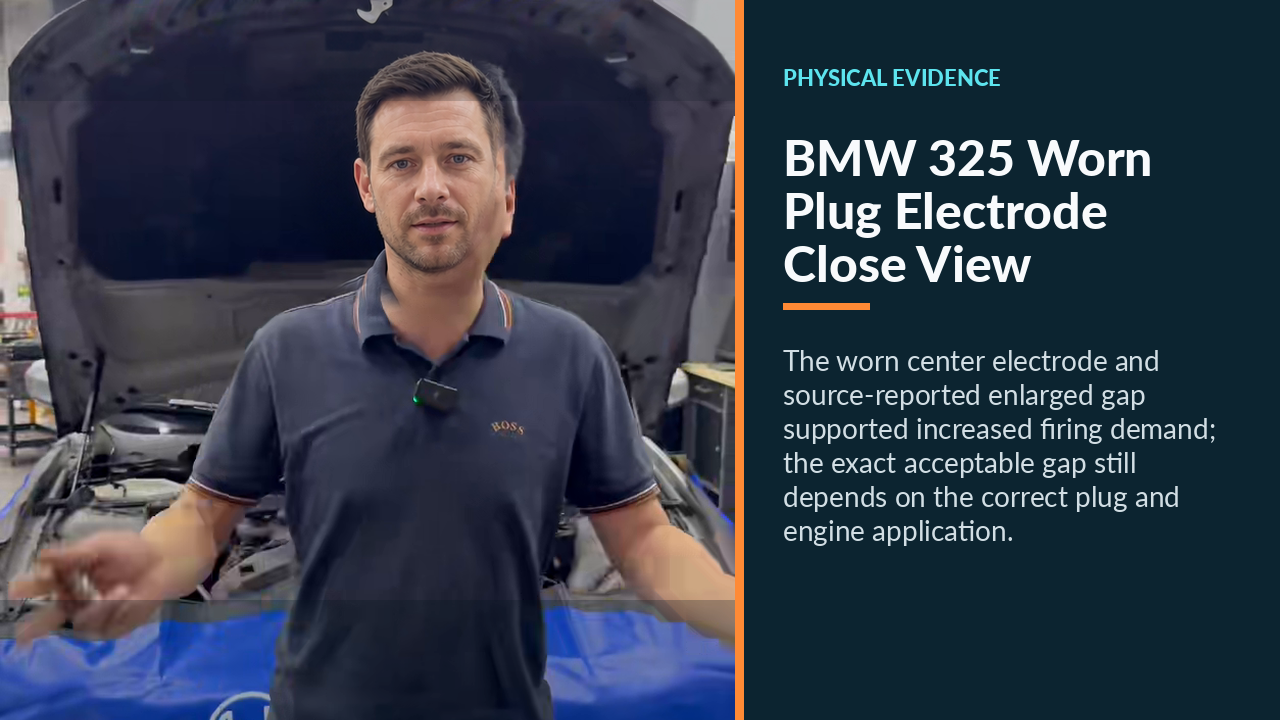
Six removed plugs were laid out together. Their center electrodes were visibly worn, and the case record reports measured gaps above 1.3 mm. An enlarged, worn gap can require greater firing voltage and reduce ignition margin, especially under load, but the acceptable specification depends on the exact engine, plug, and test method. the record’s generic comparison range is not republished as a VIN-safe specification.
Physical wear confirmed the repair scope
The shared wear pattern and measured enlargement supported replacing all six plugs used by this engine. This was component evidence, not a rule that every BMW at 120,000 km shudders from plugs. After the worn plugs are removed and kept in cylinder order, the MRCARTOOL H90 spark-plug tester can add a quick bench comparison of firing behavior, while the no-code shudder still requires coil, fuel, compression, and road-test confirmation.
Exact plug part number, factory gap policy, removal temperature, thread inspection, tightening method, and coil handling require the correct VIN and current BMW procedure. BMW’s official owner-manual lookup provides the exact-vehicle owner-information route; it does not resolve the missing build data or replace workshop service information.
Why the fuel filter remained a separate service item
Maintenance records reportedly contained no previous fuel-filter replacement, and the opened filter showed retained contamination. That evidence justified replacing the filter and cleaning its connections during the visit. It did not prove that the filter produced the shudder.
The case record discusses pressure fluctuation, but publishes no pre-repair pressure, load-specific pressure trace, or controlled before/after comparison. Therefore the confirmed failure statement stays with the physically worn plugs. The filter is recorded as actual maintenance/condition work, not promoted into a second confirmed root cause. On another car, fuel-pressure evidence would be needed before diagnosing restriction, and fuel-system opening requires correct depressurization, fire control, part application, connection inspection, and leak checking.
Restoration did not stop at installing parts
After the plugs and filter were installed, the workshop connected the diagnostic system, cleared historical light misfire counts, and observed fuel-trim behavior. The case record describes the trims as returning to the normal assessment range but supplies no numbers, so this article does not invent values or use them to retroactively prove a filter restriction.
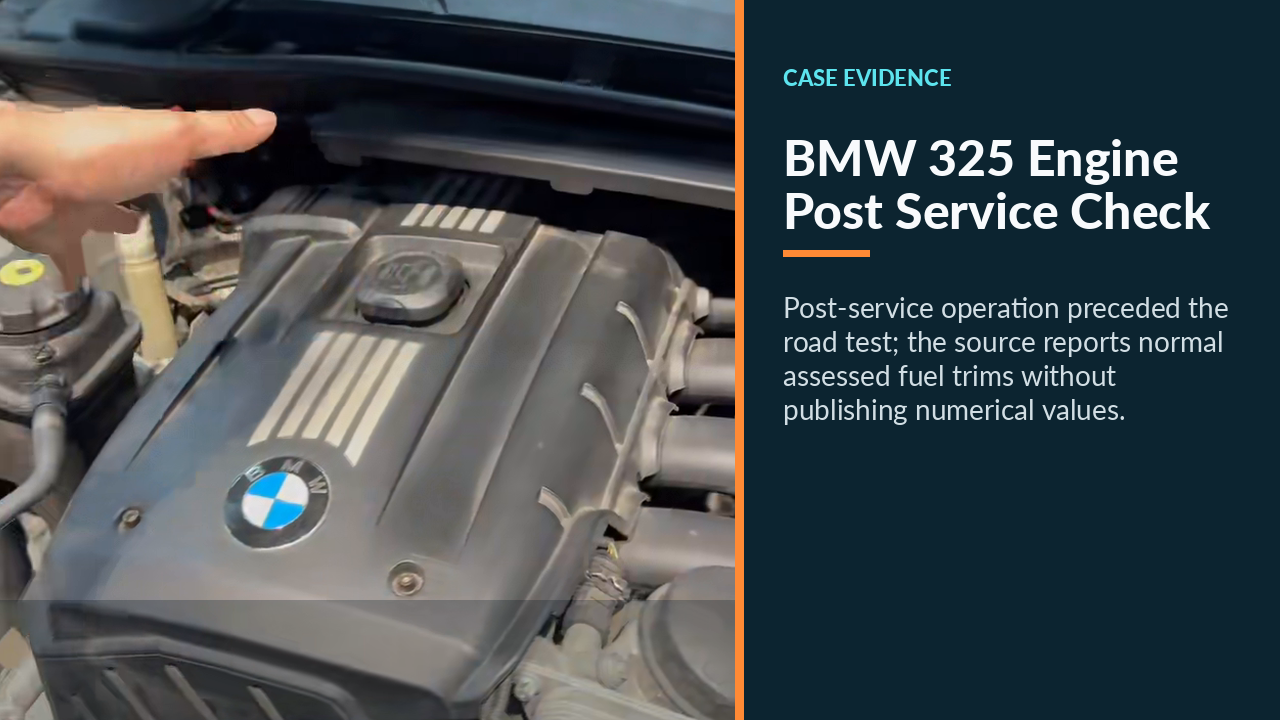
Every disturbed fuel connection also needs the exact procedural leak check before operation. A smooth idle in the bay was useful, but the original complaint included acceleration hesitation, so static operation alone could not close the case.
The road test challenged the original complaint
The case record reports testing across operating conditions, including low-speed, high-load acceleration. Engine response was reported restored and the intermittent shudder did not recur during that road test. Route, duration, live misfire counters, and exact trim values are not published, so the result is not expanded beyond the recorded checks.
That verification directly addresses the complaint and supports Q10=2. It does not establish that the fuel filter caused the original event, nor does it rule out another intermittent fault forever. If shudder returns, record operating conditions and inspect live cylinder misfire behavior, ignition coils, air/fuel control, measured fuel pressure, injectors, mechanical condition, mounts, and other evidence rather than repeating parts from this case.
What transfers to another no-code shudder
Do not let the absence of a current code end diagnosis, and do not let mileage begin it. Reproduce the trigger, inspect ignition components, compare measured condition with exact application data, and separate confirmed faults from overdue or condition-based maintenance. After repair, restore diagnostic state, verify every opened fuel connection, watch relevant data, and road-test under the original load. This case is useful because the worn plugs and matched road result form a closed chain while the fuel-filter service remains honestly bounded.







Comments 0
Questions, fixes, and real-world diagnostic notes from readers.
Be the first to share a diagnostic result or ask a follow-up question.