
2017 Infiniti Q50 Would Not Start After a Crash: The Missing TCM Led to the Second Battery

One Module Missing After A Crash? Check Its Power Story
<strong>Quick answer:</strong> The visible crash damage did not explain the communication pattern. Testing the trunk-mounted second battery found it dead; replacement restored TCM communication and allowed the engine to start and run. This article follows one documented vehicle. It explains the evidence chain, not a universal failure rate or a direction to replace the same part on every similar car. Stop whenever the test would involve overheated brakes, high current, moving parts, refrigerant handling or an uncontrolled road condition.
After the battery location and chemistry are confirmed, a conductance tester designed for automotive 12-volt batteries can document its voltage and rated-capacity condition; FXTUL BT50 Motorcycle & Car Battery Tester supports that narrow battery question. It cannot determine crash safety, diagnose a CAN network from two static voltage readings, register a battery, or prove that wiring and restraint-system damage are absent.
A stolen and crashed Q50 offered dozens of dramatic explanations for a no-start. The scan simplified the picture: nearly every module answered except the TCM, so its overlooked second power source deserved attention before the network was dismantled.
Quick answer: The visible crash damage did not explain the communication pattern. Testing the trunk-mounted second battery found it dead; replacement restored TCM communication and allowed the engine to start and run.
In this guide
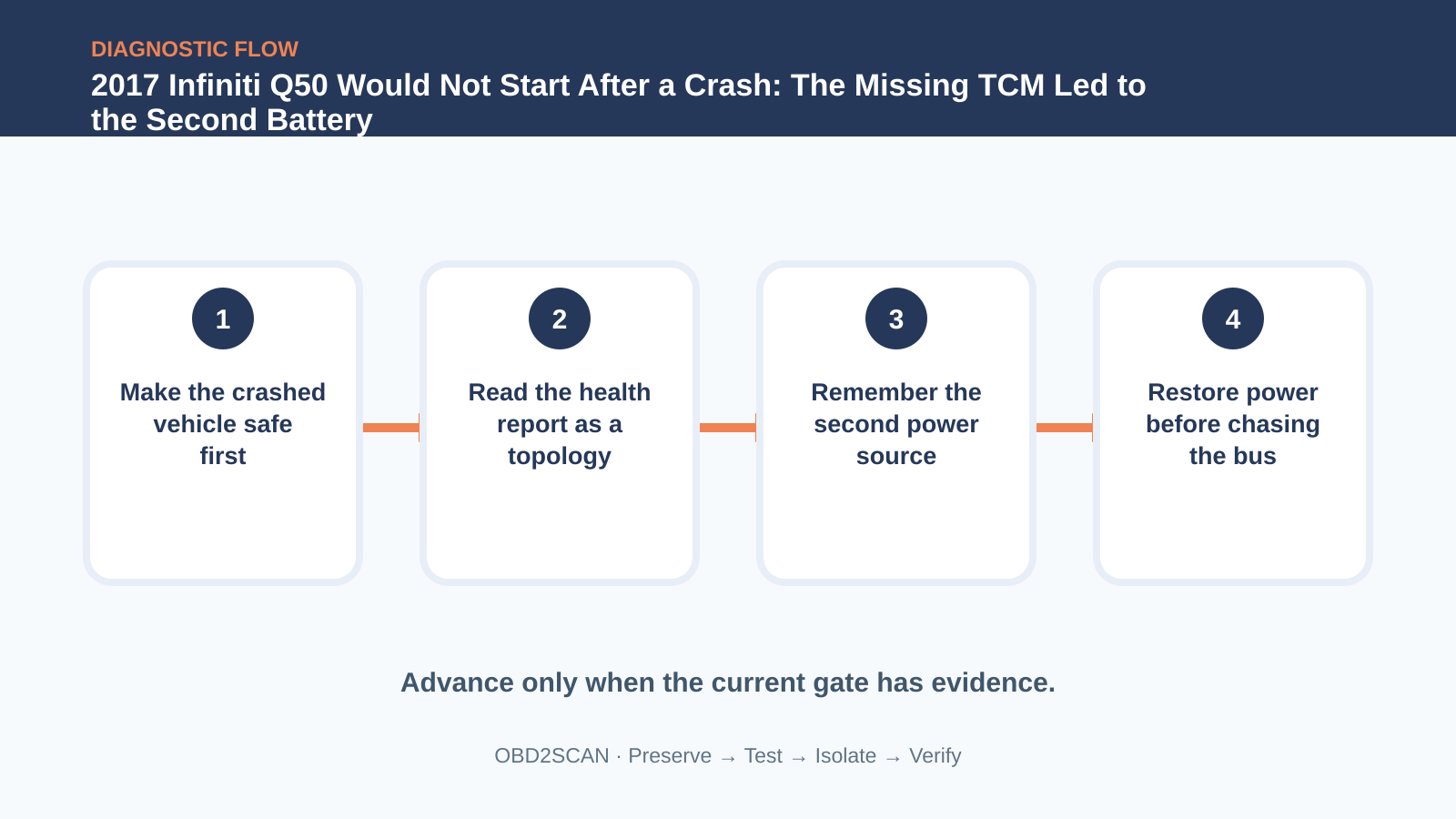
- Make the crashed vehicle safe first
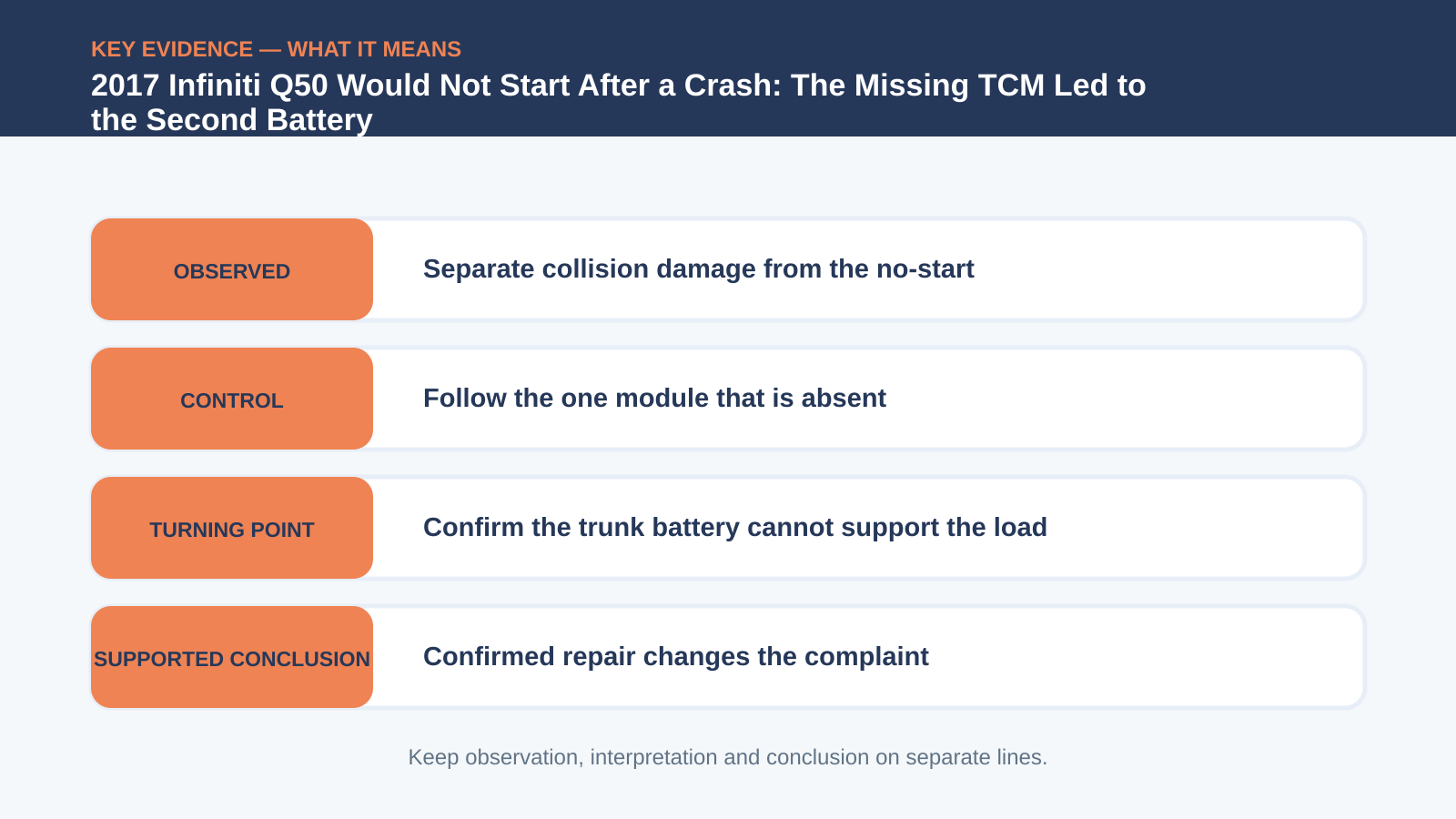
- Separate collision damage from the no-start
- Read the health report as a topology
- Follow the one module that is absent
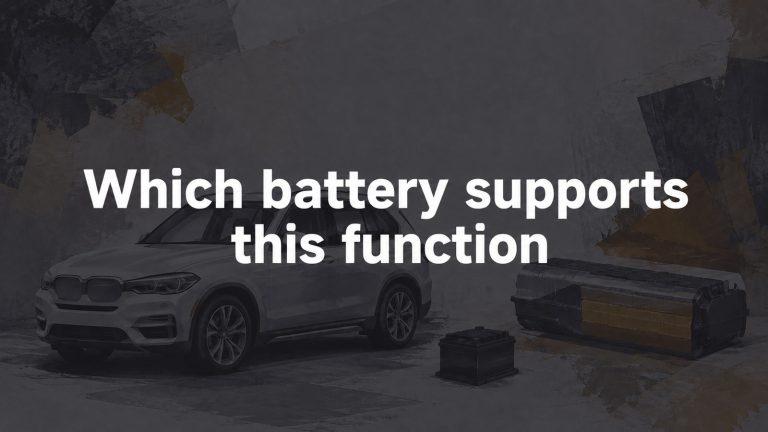
- Remember the second power source
- Confirm the trunk battery cannot support the load
- Restore power before chasing the bus
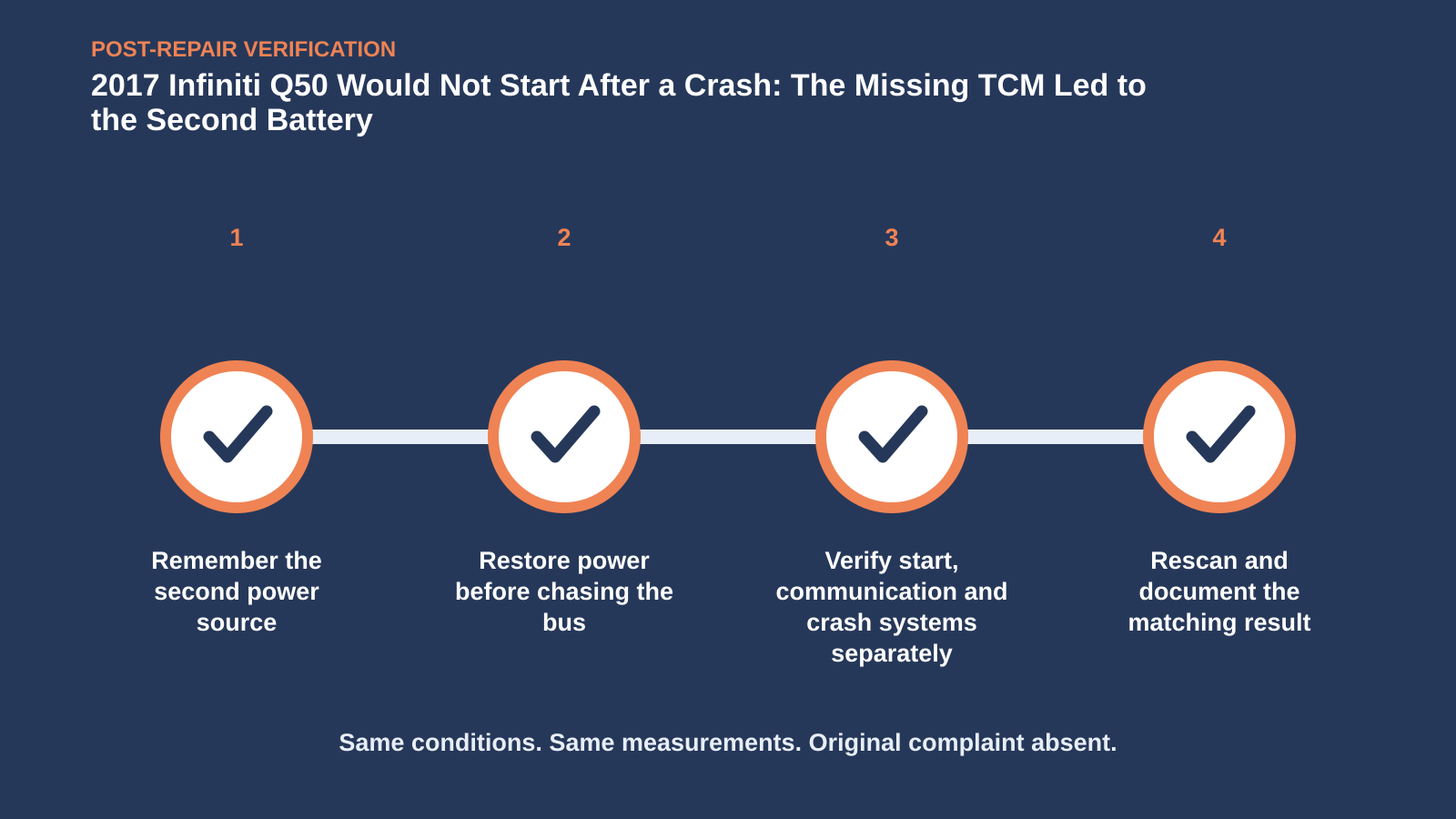
- Verify start, communication and crash systems separately
Make the crashed vehicle safe first
A stolen and crashed vehicle carries hazards beyond a no-start: deployed restraints, broken glass, damaged steering, possible fluid leaks and unknown modifications. Stabilize it and follow high-risk collision procedures before powering systems or attempting to start it. Preserve the original condition before changing it. The first observation is the control sample against which every later test must be compared.
Separate collision damage from the no-start
Visible damage on the right side was dramatic, but inspection found no corresponding door/fender wiring damage that explained the network pattern. Treat crash geography as one hypothesis. Do not let it eclipse an electrical prerequisite elsewhere in the car. Use service information for the exact engine, build date and options. A correct method on the wrong terminal can create a precise but useless result.
Read the health report as a topology
The health report showed most modules communicating while the TCM alone was absent, with other controllers reporting lost-message codes. That topology is more useful than counting codes. Start with the missing node’s power, ground and network environment rather than replacing every module that complained about it. Treat prior work as evidence, not blame. A repair that made no change can narrow the case when its installation and test conditions are verified.
Follow the one module that is absent
CAN high and low each measured about 2.50 volts in the documented case. Static midpoint readings are only a coarse observation; a network can sit near those values and still fail to exchange valid messages. Do not call the bus healthy without activity, resistance and topology tests as applicable. At this stage, separate what was observed from what is inferred. The observation should remain true even if the current theory is later rejected.
| Observation | What it supports | What it does not prove |
|---|---|---|
| Most modules communicate; TCM does not | Start with TCM prerequisites | Main CAN bus is healthy |
| CAN lines read about 2.50 V | Static bias is present | Messages are valid |
| Trunk battery is dead | A TCM power dependency is missing | No crash wiring is damaged |
| Battery restores start and TCM | Battery was causal here | Collision systems are safe |
Remember the second power source
The Q50 configuration included a second battery in the trunk. Service information turns that easily missed fact into a test point. Confirm battery identity, isolation and safe access before clamping a tester; collision damage or incorrect polarity can make routine battery work hazardous. This is the decision point in the documented case. Its value comes from changing one bounded condition while leaving the rest of the system intact.
Confirm the trunk battery cannot support the load
The trunk battery was dead. Test voltage under the appropriate load and inspect terminals, fusing and hold-down condition. A dead auxiliary battery can explain the missing TCM in this case, but the cause of discharge and any damage to its circuit still deserve attention. A confirmed component still needs a repair that restores sealing, support, torque, routing or terminal fit—the physical conditions that keep the fault from returning.
Restore power before chasing the bus
Replacing the battery restored communication and starting. Before ordering a controller, power the node correctly and repeat the network scan. Follow any registration or initialization required for the installed battery and vehicle configuration; do not assume replacement alone completes every platform. Reassemble protective covers and retainers before declaring success. A diagnostic shortcut must not become the next failure mechanism.
Verify start, communication and crash systems separately
Close three tracks separately: the engine starts and remains running, the TCM communicates with no returning lost-message faults, and collision/restraint/chassis repairs are safe. One successful start does not certify bent steering, deployed airbags or water entry from the broken sunroof. Use the customer’s original complaint as the final specification. A cleared code, quiet bay or one good key cycle is not equivalent to reproducing and passing that condition.
If you are bringing a similar symptom to a shop, arrive with the useful conditions rather than a requested part: whether the vehicle was cold or hot, the exact speed or switch position, which warning lamps appeared, what changed after a restart, and a chronological list of earlier repairs. A short video can preserve an intermittent sound or lamp pattern, but record it only while parked or with a passenger handling the camera. Ask the technician to retain the pre-repair scan and measurements, explain the test that separated the failed path from the alternatives, and show how the original complaint was repeated afterward.
For the owner or service adviser, a useful repair explanation has three parts: what was observed, why the decisive test narrowed the fault, and which original condition passed after the repair. It should also say what the test did not prove. That boundary prevents a memorable case from becoming an automatic parts recommendation.
The visible crash damage did not explain the communication pattern. Testing the trunk-mounted second battery found it dead; replacement restored TCM communication and allowed the engine to start and run. The reusable lesson is narrower and more valuable: Open with the noisy crash story, then deliberately reduce the scan to one missing module and one overlooked power source.







Comments 0
Questions, fixes, and real-world diagnostic notes from readers.
Be the first to share a diagnostic result or ask a follow-up question.