
The Key Fob Transmits but the Car Still Will Not Unlock? Follow the Authorization Handshake

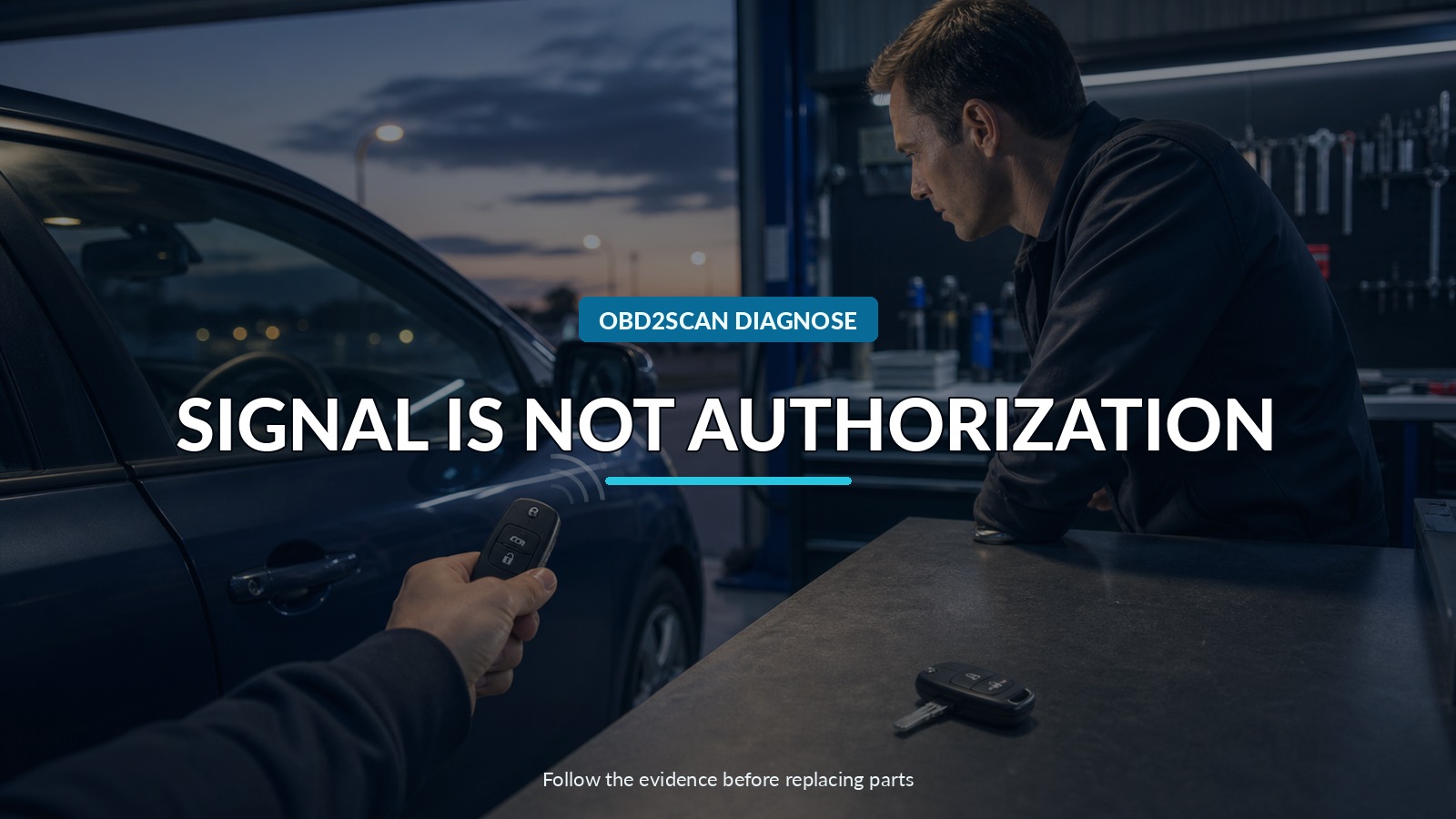
Signal Is Not Authorization
A key fob can light its indicator, transmit a radio signal, and still fail to unlock the car. That is not a contradiction. Transmission is only the opening message in a longer exchange that may involve vehicle wake-up, antenna reception, control-module communication, stored key authorization, and a final lock or start command.
A remote-frequency tester can separate a silent key from one that emits RF or infrared energy and help compare two keys. The AUTOOL RE110 remote-key frequency tester is one portable route, but it cannot validate a rolling code, program the key, test every antenna, or prove immobilizer authorization.
The diagnosis follows the exchange in order. First prove what the key emits. Then ask whether the vehicle receives it, whether the security system recognizes it, and whether the requested output operates. Jumping from “signal detected” to “bad receiver” skips several handshakes and can turn a small power or synchronization problem into unnecessary programming.
Quick answer: Separate the problem into key output, vehicle wakeup and reception, stored authorization, and the final lock or start output. A detected signal proves only that the opening message exists.
In this guide
- Define which handshake is failing
- Layer one: prove the key’s output
- Layer two: see whether the vehicle wakes and hears
- Layer three: check recognition and authorization
- Layer four: prove the requested output
- Use a comparison key without letting it fool you
- Avoid the common false conclusions
- Verify the full authorization path
Define which handshake is failing
Do not bundle every key-related symptom into “the remote does not work.” Record each function separately: active lock and unlock buttons, passive entry at each door, trunk release, panic function, ignition recognition, and engine starting. A car that unlocks with the button but does not detect the key inside has a different failure boundary from one that remains completely asleep.
Note whether the metal emergency key operates the door and whether the interior switch controls the locks. If the interior switch also fails, the problem may be downstream in a fuse, body controller, lock circuit, or latch—not in the remote handshake. If the car unlocks but reports “key not detected” during starting, focus on the interior detection and immobilizer path.
Also preserve when the failure began. A key-battery replacement, vehicle-battery discharge, water exposure, dropped remote, windshield work, door repair, module coding, or the addition of electronic accessories can all change the evidence.
Layer one: prove the key’s output
Inspect the key case, buttons, battery contacts, and signs of moisture. Measure the coin cell correctly and remember that open-circuit voltage can look acceptable while the voltage collapses during transmission. If possible, monitor battery voltage while a button is held or compare with a known-correct new cell installed with clean contacts and correct polarity.
Test every button and compare the signal with a working spare key. Record whether the unit detects radio frequency, infrared, or both, and whether the displayed frequency is plausible for that vehicle and market. A signal that appears only when the case is twisted suggests a contact or circuit-board problem. A stable signal from every button moves the boundary toward the vehicle, but it still does not validate the encoded message.
Passive-entry keys deserve an extra distinction. The button transmitter and passive transponder or low-frequency wake-up path are related but not identical. A key may actively unlock the vehicle yet fail passive entry, or start only when held at an emergency pickup location. Use the owner information to identify that backup location rather than improvising.
Layer two: see whether the vehicle wakes and hears
Check the vehicle battery before blaming a receiver. Low system voltage can disable convenience functions, reduce antenna performance, or leave modules asleep. Verify fuses and power supplies using the current wiring information. Look for any recent battery or body work that disturbed grounds, antennas, handles, or interior trim.
Walk around the vehicle and test passive entry at each handle under the same conditions. One failed door with the others working suggests a local handle, antenna, wiring, or request-sensor branch. Failure everywhere points toward common power, communication, configuration, or key authorization. Remove other keys, phones, metallic cases, charging devices, and suspected interference sources for a controlled retest.
A scan tool that supports the relevant body or access module may show door-handle requests, key-detection states, antenna faults, and communication codes. Watch whether the request input changes when the handle is touched or the button is pressed. A changing input with no unlock response advances the investigation; a dead input keeps attention upstream.
Layer three: check recognition and authorization
Reception does not equal authorization. Modern systems may compare key identity, rolling-code state, security counters, key location, and vehicle status before granting access or starting. Read the exact fault descriptions and live states for the installed system. Do not clear them before recording freeze data, occurrence counts, or status words that show where the exchange stopped.
Compare all registered keys. If one works and one does not, shared vehicle antennas and actuators become less likely. If every key fails after a vehicle-battery event or module replacement, vehicle-side state, synchronization, configuration, or power deserves more weight. If a newly purchased key transmits at the expected frequency but has never been learned to the car, the transmission test has done its job—it has not completed authorization.
Programming and security access should follow the manufacturer’s supported procedure, proof-of-ownership rules, and regional requirements. Repeatedly trying random synchronization sequences can erase useful state or create a second problem. Some owner-level resynchronization procedures exist, but they are not interchangeable across vehicles.
Layer four: prove the requested output
Once the module reports a valid unlock request, follow the output. Listen for relay, latch, or actuator activity. Test interior lock switches. Check whether one door fails or every door remains locked. A single slow or silent latch can be mechanical or local electrical; a global failure may involve a shared supply, network command, body module, or vehicle state.
For a no-start complaint, separate crank authorization from engine operation. Does the cluster recognize the key? Is the steering lock released? Does the starter operate? Are immobilizer or engine-control codes present? A remote that will not unlock the doors and a transponder that will not authorize the engine can coexist, but they should not be treated as one assumed failed part.
Use output tests only when the scan tool and service information support them. An actuator that responds to an active test but not to the remote proves the physical output can work and moves attention back toward request or authorization. An output that never responds still needs circuit and mechanical testing before a controller is condemned.
Use a comparison key without letting it fool you
A known-working spare is one of the most powerful controls in this diagnosis. Test both keys at the same distance, location, and vehicle-battery condition. Compare button response, passive entry, starting, signal type, and frequency. This can quickly split key-specific and vehicle-wide faults.
But a spare key is not always a perfect control. It may have a different battery age, may not support every feature, or may have been registered differently. Document the exact difference. “Spare works” is useful; “spare unlocks actively but also fails passive entry at the driver door” is much better.
If neither key works, test them away from the vehicle with the same signal method. Two transmitting keys plus a completely unresponsive vehicle suggests a shared vehicle condition, but only after vehicle battery, fuses, wake-up inputs, and interference have been checked.
Avoid the common false conclusions
A detected carrier does not prove that the key sends the correct encrypted data. A correct displayed frequency does not prove adequate range. A fresh coin cell does not prove clean contacts. A successful door unlock does not prove every interior antenna. And a security code does not automatically mean the key itself has failed.
Likewise, do not call a general RF detector a key programmer or immobilizer tester. Its value is narrower and useful: it tells you whether the first message exists and helps compare output behavior. Keeping that boundary clear prevents the instrument from being asked to answer a question that belongs to module data, circuit testing, or approved programming.
Verify the full authorization path
The repair is complete only when the original failing functions work repeatedly under the conditions that exposed the problem. Test every button, passive entry at the affected locations, trunk access, in-cabin key detection, emergency pickup behavior where applicable, and starting. Step away long enough for the vehicle to sleep, then repeat the wake-up test with both keys.
Record the final key-battery condition, transmitted signal, relevant module states, codes, and output response. The useful result is not merely “the fob sends now.” It is a completed handshake from the user’s request to the vehicle’s authorized action.







Comments 0
Questions, fixes, and real-world diagnostic notes from readers.
Be the first to share a diagnostic result or ask a follow-up question.