
2001 Ford Fiesta P0301: The Injector Clicked but Delivered No Fuel

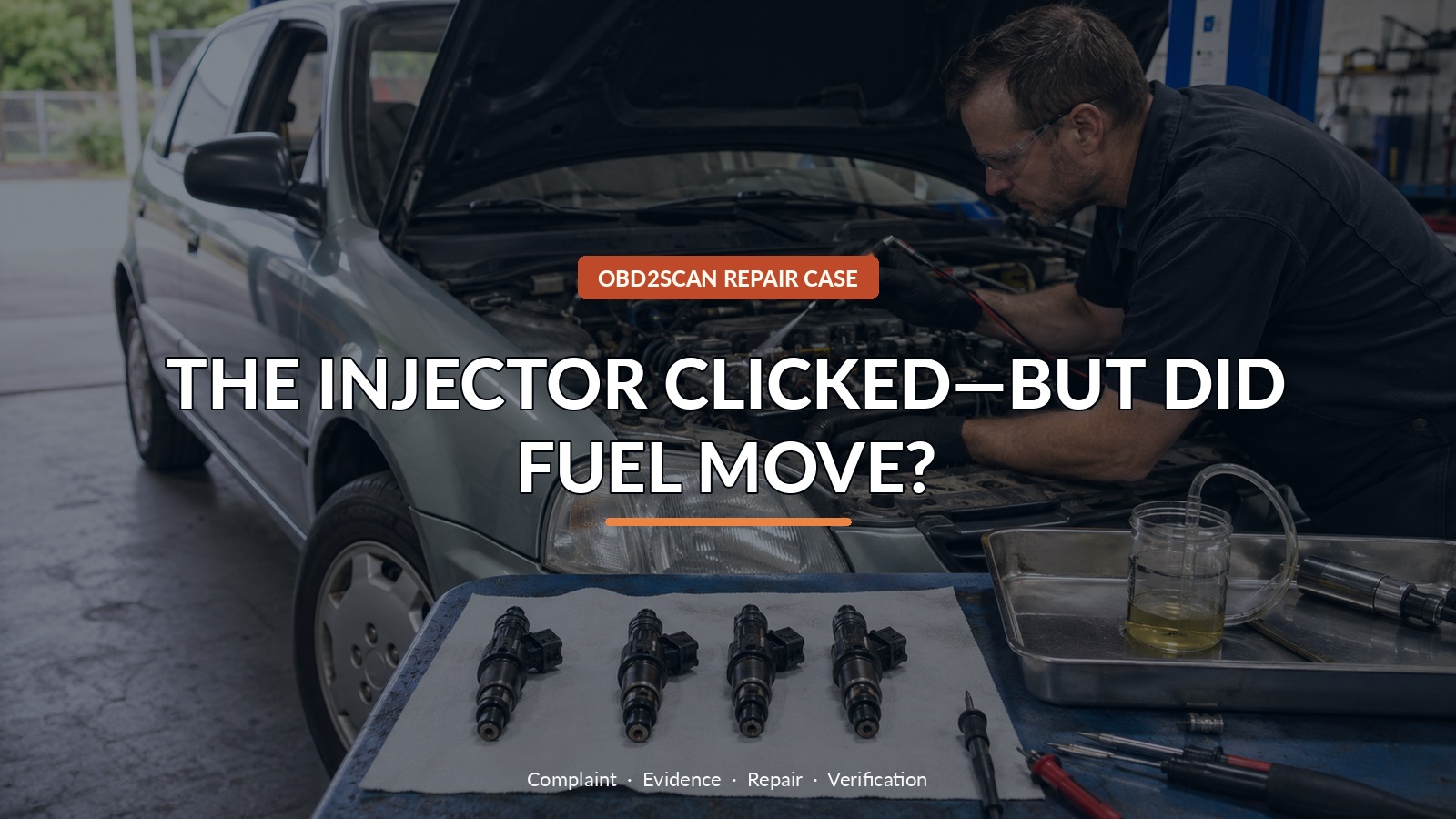
The Injector Clicked—But Did Fuel Move?
A 2001 Ford Fiesta 1.3 had a permanent cylinder-one misfire and P0301. Its injector clicked. Its current trace looked broadly similar to the others. Either observation could have ended the test too early. The stronger evidence was that the voltage trace lacked a recognizable pintle event and cylinder one produced no fuel-pressure contribution. The injector was electrically active but hydraulically ineffective.
If on-car evidence justifies removal, a compatible injector tester/cleaner can answer whether supported injectors differ in spray, leakage or delivered volume. The MRCARTOOL Fuel Injector Tester and Cleaner Range offers several machines rather than one universal solution, so the exact unit must be matched to the injector and fuel system. MRCARTOOL injector test-and-clean equipment can compare supported removed injectors for spray, leakage and flow only when the exact fuel type, pressure, connector, cleaning fluid and machine specification match; the category does not make every machine diesel-compatible, and bench results do not replace on-car circuit and pressure diagnosis.
This case is best understood as an evidence ladder. Each test answers a narrower question: code, spark, compression, sound, resistance, current, voltage movement, pressure contribution and finally bench flow. Replacing the failed injector restored the pintle event and cylinder contribution; the diagnosis did not depend on the click being absent.
Quick answer: The injector clicked and drew current, but its voltage trace lacked a pintle event and it produced no pressure contribution. Replacement restored cylinder one.
In this guide
- Do not let P0301 order an ignition part
- Use spark and mechanical checks to protect the diagnosis
- Know exactly what an injector click proves
- Compare current without overreading similarity
- Look for the pintle event in voltage
- Measure whether fuel pressure actually changes
- Bench-test only with compatible equipment
- Install, leak-check and verify cylinder contribution
Do not let P0301 order an ignition part
P0301 identifies where the controller detected uneven contribution, not why. Save misfire counts and freeze frame, then swap or test ignition components only with a plan. Confirm spark quality and inspect the plug for fuel, oil or coolant evidence. A coil that follows a swap is useful; a coil that does not should be returned to its cylinder. Do not let raw fuel accumulate during repeated cranking. A strong fuel smell, leaking rail or hot catalyst requires stopping and making the car safe before further tests.
Use spark and mechanical checks to protect the diagnosis
Protect the injector diagnosis with a mechanical baseline. Compare relative compression and, if needed, conventional compression or leak-down on cylinder one. Observe intake behavior and valve motion where appropriate. A dead cylinder with missing compression can leave an injector wet, dry or electrically normal, so fuel conclusions made first can be misleading. Also verify the engine ground and charging voltage because unstable system voltage can affect several waveforms. The quickest valid route is the one that eliminates entire systems without assuming the code’s favorite part.
Know exactly what an injector click proves
A stethoscope or screwdriver may reveal an injector click, but the sound proves only that something in the assembly or rail is striking. It does not prove full pintle travel, correct opening duration, clean spray or any delivered fuel. Compare all injectors at the same temperature and idle state. A missing click is valuable evidence for a circuit or mechanical problem; a present click is merely a reason to continue. This Fiesta is a useful reminder that audible activity can coexist with zero useful flow.
Compare current without overreading similarity
Current reveals coil energization and movement-related changes, but similar peak current does not guarantee similar hydraulic performance. Compare ramp slope, peak, duration and any movement feature using the same scale. Check voltage supply and driver control as well. An electrical winding can draw normally while the nozzle is blocked or the pintle fails to open far enough. Conversely, a wiring fault can distort current even when an injector is mechanically clean. One trace should narrow the question, not absorb every possible cause.
| Evidence level | Question answered | What remains unknown |
|---|---|---|
| P0301 | Which cylinder contributes unevenly? | Spark, fuel or mechanical cause |
| Audible click | Does something move or strike? | Flow, spray and full travel |
| Current ramp | Does the coil draw and change? | Actual delivered fuel |
| Voltage pintle feature | Is a movement event visible? | Spray quality and quantity |
| Pressure contribution/bench flow | Does the injector deliver relative fuel? | Combustion quality after installation |
Look for the pintle event in voltage
When the driver switches off, injector inductance creates a characteristic voltage event; a movement feature may be visible around pintle operation depending on circuit and equipment. Cylinder one’s trace lacked the feature seen on working cylinders. That comparison mattered more than a generic waveform picture. It suggested the coil was being commanded but the internal movement was not normal. Exact shapes vary, so use known-good cylinders on the same rail. A missing hump is supporting evidence, not permission to ignore fuel pressure or mechanical condition.
Measure whether fuel pressure actually changes
A controlled pressure-contribution test asks whether each injector’s actuation causes a comparable drop or recovery in rail pressure. Use the manufacturer-approved method and fire safety controls; do not loosen a pressurized rail to improvise a result. Cylinder one made no contribution in this case. If an injector is removed, choose bench equipment specifically compatible with its fuel, connector, resistance, pressure and construction. Port gasoline, GDI and diesel injectors are not interchangeable categories. Compare volume, leakage and pattern rather than admiring visible spray alone.
Bench-test only with compatible equipment
Install the confirmed replacement with correct seals, lubrication and torque. Inspect the rail and connector, prime the system and leak-check before starting. Fuel leakage is an immediate stop condition. Keep the old injector identified by cylinder and preserve test results; if contamination is suspected, examine the rest of the system instead of treating one new injector as immunity. Clear learned misfire data only after the physical repair is complete. A replacement that clicks still has to demonstrate delivery and combustion.
Install, leak-check and verify cylinder contribution
On restart, confirm the misfire counter stays quiet, idle becomes even and cylinder one’s ignition/firing behavior resembles its neighbors. Repeat the voltage or contribution test if practical so the evidence changes in the expected direction. Check hot restart and loaded acceleration, then inspect for leaks again. A clean code scan alone can lag behind a remaining weak cylinder. The repair is complete when electrical movement, fuel contribution and combustion all agree—not when the parts box is empty.
The injector’s click was true but incomplete evidence. By climbing from sound to movement and actual fuel contribution, the technician found a component that was energized yet did no useful hydraulic work.






Comments 0
Questions, fixes, and real-world diagnostic notes from readers.
Be the first to share a diagnostic result or ask a follow-up question.