
2017 Ford F-550 Stalled More When Warm: Connector C1415 Had Corrosion and Poor Pin Fit

Warm Diesel Stall? Test C1415 Under Movement
This F-550 had already received a low-pressure pump, an ECM reflash and a known-good fuel-pump control module. Warm stalls and long cranks remained. The surviving P027A, P064A and U0109 pattern did not ask for a fourth guess; it asked whether heat and movement were interrupting the circuit between known components.
One useful machine class at this stage is a bounded measurement tool, chosen only after the circuit or system question is defined. The AUTOOL 92-Piece Circuit Test Lead Kit is one route for that supporting task. The 92-piece lead kit can help a compatible meter access identified terminals with less risk of spreading them. It cannot measure pin drag, identify cavities, repair corrosion or carry pump current through undersized leads.
This article follows one documented vehicle. Its cause is a useful diagnostic pattern, not a failure-rate claim and not permission to replace the same part on a similar symptom. The goal is to show which evidence changed the decision and how the repair was verified.
Quick answer: C1415 lost continuity under heat and movement because of corrosion and poor terminal fit. Repairing its pins removed the stall and long crank.
In this guide
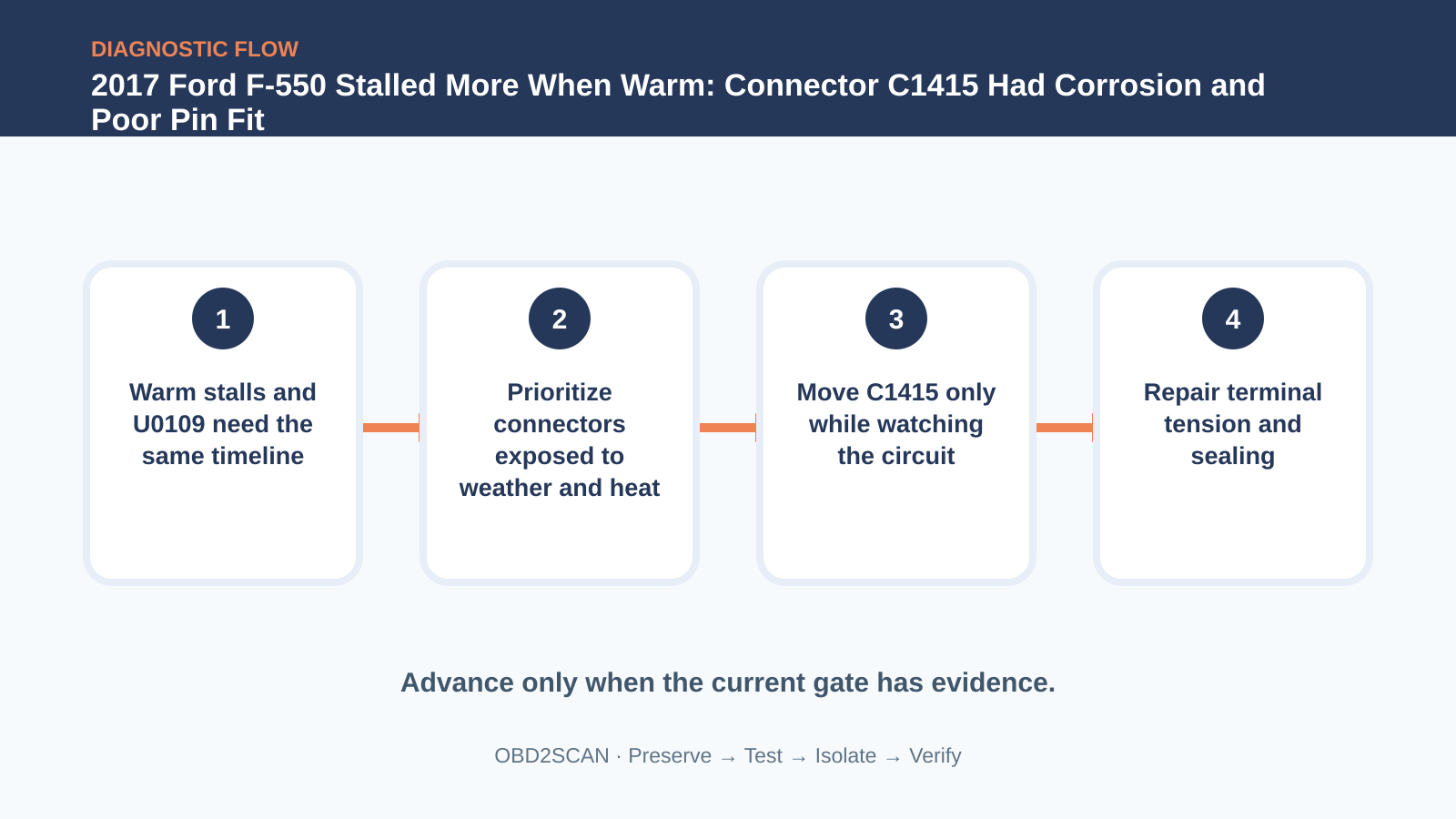
- Warm stalls and U0109 need the same timeline
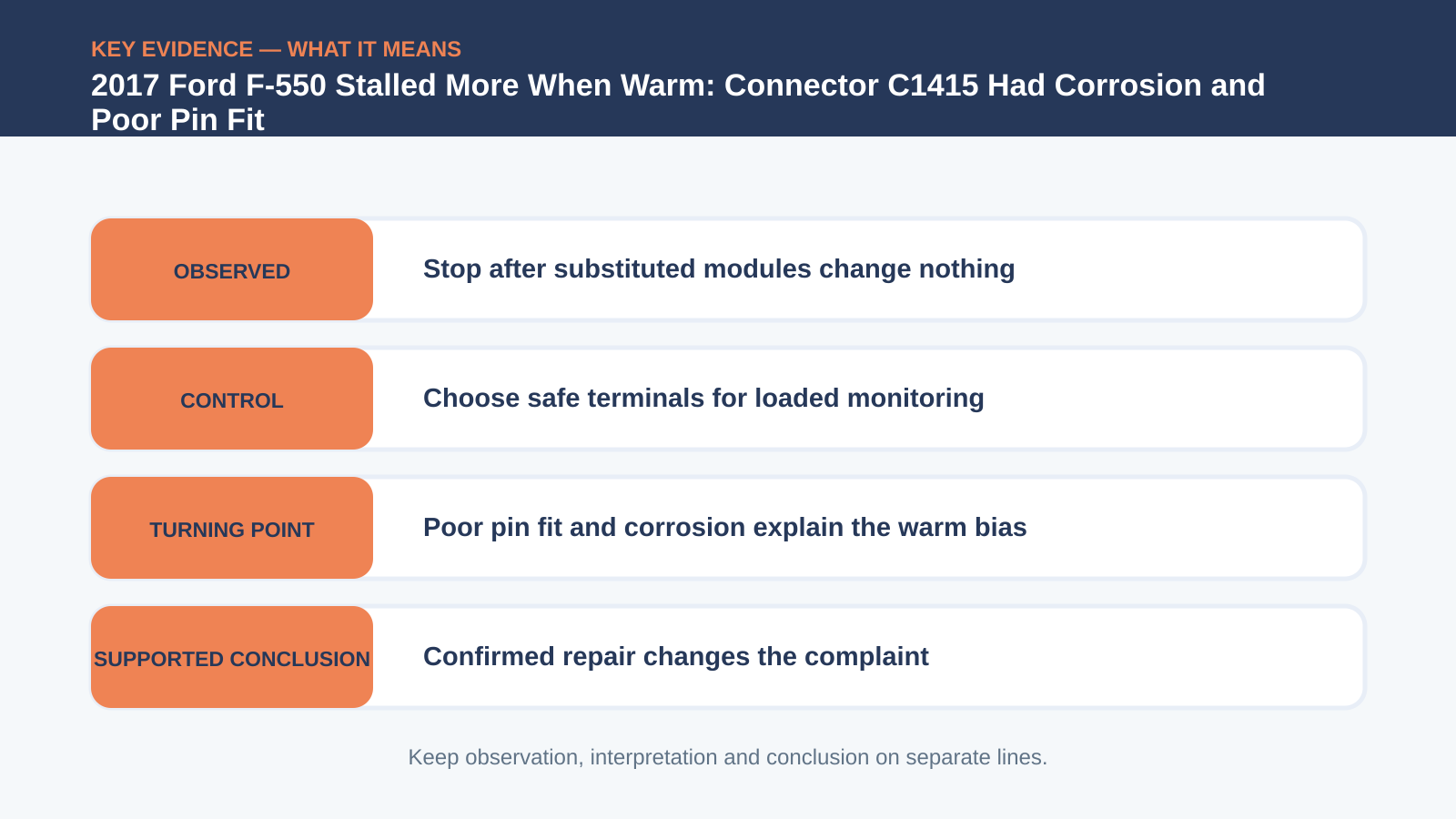
- Stop after substituted modules change nothing
- Prioritize connectors exposed to weather and heat
- Choose safe terminals for loaded monitoring
- Move C1415 only while watching the circuit
- Poor pin fit and corrosion explain the warm bias
- Repair terminal tension and sealing
- Repeat hot start, wiggle test and road load
Warm stalls and U0109 need the same timeline
Warm bias is a test condition. Record coolant temperature and time-to-stall, and avoid roadside reproduction where a sudden loss of power can endanger the driver or loaded truck. Keep the vehicle in the failed state long enough to capture evidence, but never extend a test beyond the point where a stall, brake event, refrigerant release or moving component creates risk.
Stop after substituted modules change nothing
The low-pressure pump, ECM reflash and known-good FPCM had not changed the problem. Treat that history as negative A/B evidence while verifying the installation has not introduced a new fault. Write down the conditions before disconnecting anything. That record is what lets a later change mean something instead of becoming another uncontrolled attempt.
Prioritize connectors exposed to weather and heat
FPCM and pump connectors live with weather and temperature change; C1415 sits near the master cylinder. Inspect seals, drainage, harness support and chemical exposure before another component substitution. Use service information for the exact engine, build and option set. A correct test on the wrong pin or configuration can produce a precise but useless answer.
Choose safe terminals for loaded monitoring
Use Ford cavity information and terminal adapters. Monitor loaded voltage or communication at both sides of the connector, avoiding oversized probes that can create the poor pin fit being investigated. This is the turning point in the documented case. It gains weight because earlier branches were tested and because the symptom changed with one controlled condition.
| Observation | What it supports | What it does not prove |
|---|---|---|
| Warm makes it worse | Heat affects the fault | Module is overheated |
| Known-good FPCM no change | Module is less likely | Circuit is good |
| Moving C1415 stalls | Connector path is causal | All nearby wiring is bad |
| Terminal repair passes hot test | Pin fit/corrosion caused it | One idle check is enough |
Move C1415 only while watching the circuit
Gentle movement of C1415 stalled the running engine. That is a powerful correlation only when the same event repeats and the monitored circuit changes; do not shake the entire harness and guess which branch moved. Separate observation from inference: record what moved, opened, failed or remained stable, then state only the component or path that result actually narrows.
Poor pin fit and corrosion explain the warm bias
Disassembly exposed corrosion and weak terminal contact. Heat can expand already marginal contact surfaces, explaining why the truck behaved worse warm without making temperature a diagnosis by itself. The repair must remove the demonstrated mechanism and restore mechanical support, sealing, torque or terminal fit—not merely make the symptom disappear once.
Repair terminal tension and sealing
Replace or repair approved terminals, restore tension, seals and strain relief, and address any fluid path. Cleaning green corrosion without restoring contact force leaves the failure mechanism in place. Reassemble to the original protection standard. Clear codes only after preserving the pre-repair record and confirming the relevant controller is online.
Repeat hot start, wiggle test and road load
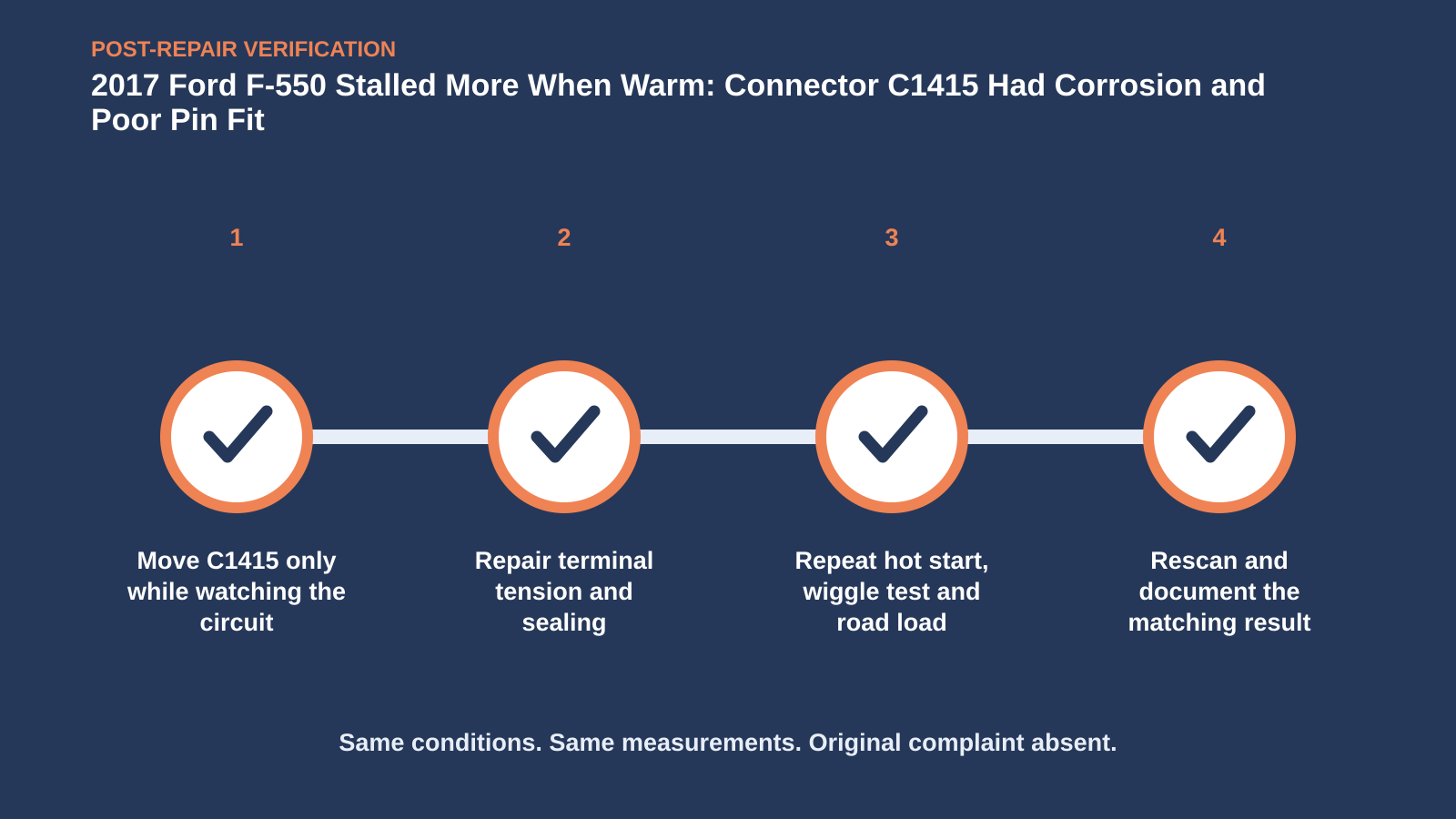
Reach operating temperature, repeat hot starts and the controlled movement test, then road-test under normal load. Clear codes only after saving them; none of the three should return after a credible repair. Use the customer’s original complaint as the final test specification. Matching conditions and a post-repair scan are stronger closure than a quiet bay or a cleared warning lamp.
For the owner or service adviser, the useful explanation has three parts: what was observed, why the decisive test narrowed the fault, and which original condition was repeated after repair. It should not promise that every similar vehicle needs the same component. This was one evidence chain on one vehicle, and the appropriate next step on another car may change with build data, prior work, safety condition and test results. That honest boundary makes the case easier to trust and more useful at the next diagnostic visit.
C1415 lost continuity under heat and movement because of corrosion and poor terminal fit. Repairing its pins removed the stall and long crank. The reusable lesson is narrower and more valuable: Use temperature and movement as controlled variables after documenting why substituted components changed nothing.









Comments 0
Questions, fixes, and real-world diagnostic notes from readers.
Be the first to share a diagnostic result or ask a follow-up question.