2009 Renault Clio DF007/DF885 After Start: The Pressure Regulator Was Not the Restriction

High Rail Pressure? Retest The First Repair
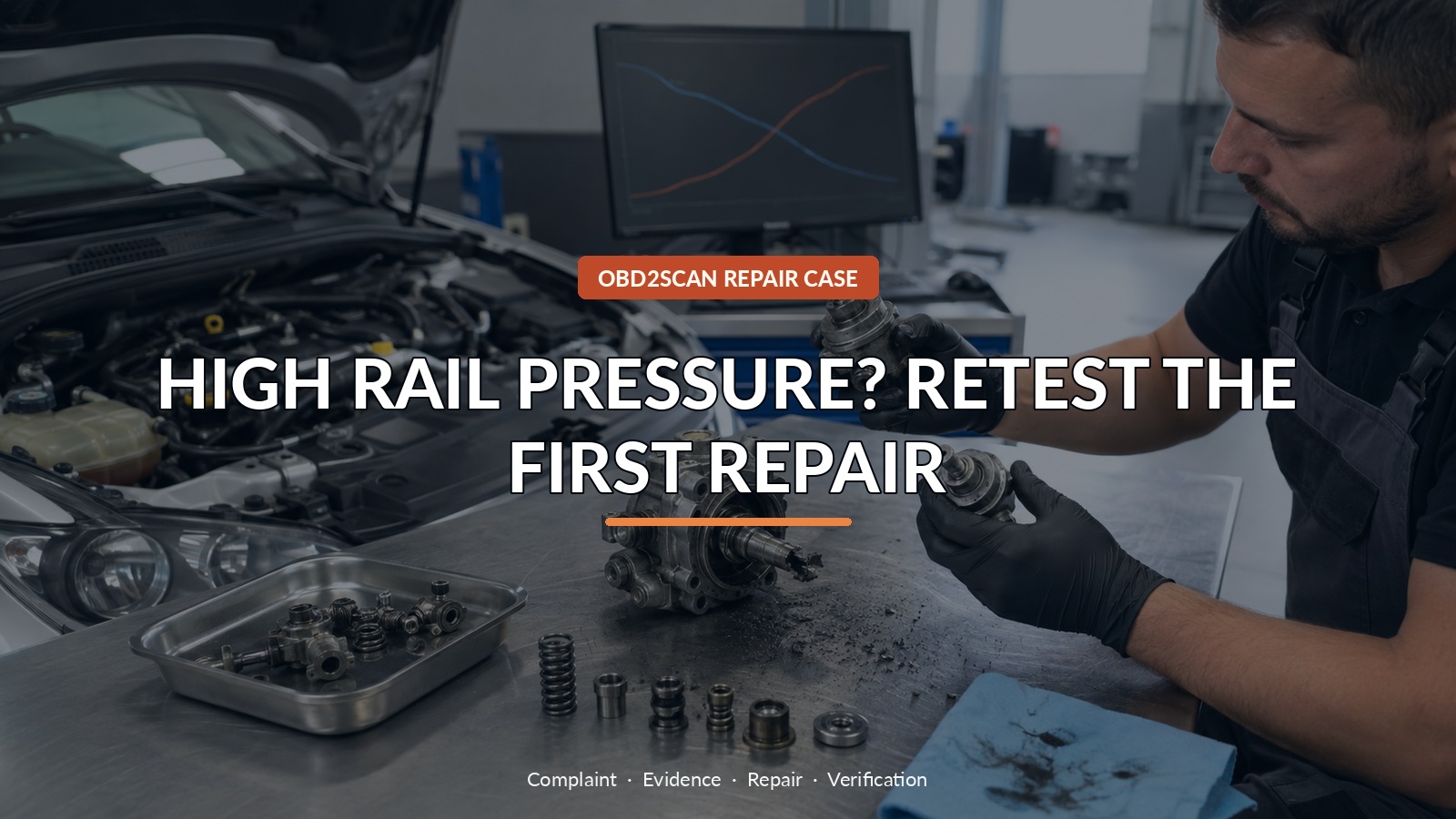
The 2009 Renault Clio 1.5 dCi started, knocked briefly, illuminated the MIL and entered limp mode. Rail pressure climbed to more than twice the requested value even while the ECU reduced its regulator command. An outlet pressure regulator looked like a reasonable suspect and was replaced. Nothing changed. That unsuccessful repair became the most useful test in the case because it forced the team to stop naming the commanded valve and follow fuel flow inside the high-pressure pump.
On the accessible electrical side, a meter/scope such as the AUTOOL DM303 can help compare regulator PWM, supply, resistance and a pressure-sensor signal when Renault pin data and safe breakout methods are available. DM303 can support accessible regulator PWM, voltage, resistance and sensor-signal checks with correct Renault data; it cannot connect to common-rail hydraulic pressure, certify a pressure sensor’s calibration, contain metal contamination, or replace a multi-channel command-versus-response capture.
This is a postmortem of a wrong first turn, not a story edited to make diagnosis look infallible. The unchanged trace after the new regulator is exactly what converted a plausible theory into evidence for a deeper mechanical restriction.
Quick answer: Rail pressure stayed above target after a regulator replacement. The unchanged retest led inside the pump, where a broken shaft, wear and metal contamination explained the restriction.
In this guide
- The knock arrived before limp mode
- Graph command and pressure in the same event
- A falling command with rising pressure changes the suspect list
- The unplugged-regulator test needed careful interpretation
- The first replacement did not fix the car
- Open the pump path only after the retest stays wrong
- Treat metal filings as a system problem
- Verify response after cleaning and pump replacement
The knock arrived before limp mode
The sequence began just after start: a harsh knock, then the warning lamp and reduced-power strategy. DF007 and DF885 were recorded with their Renault descriptions and status rather than translated through a generic list. The knock and rapid onset mattered because excessive common-rail pressure changes combustion behavior and creates a safety issue. No one should loosen a high-pressure pipe to ‘see whether fuel comes out’; residual diesel pressure can cause injection injury long after the engine stops.
Graph command and pressure in the same event
Requested rail pressure, measured pressure and both relevant regulator commands were graphed through the same start event. Actual pressure rose beyond twice target and remained high longer than expected. Viewing those channels together prevented a high sensor number from standing alone. The ECU was observing the overshoot and attempting a response, which meant the direction and timing of command could be compared with the hydraulic result.
A falling command with rising pressure changes the suspect list
As actual pressure climbed, the command to reduce it moved in the expected corrective direction. Yet pressure kept rising. That mismatch reduced the likelihood of a controller enthusiastically asking for the excess pressure and increased suspicion that fuel could not follow the intended relief or metering path. It did not, by itself, distinguish a stuck valve, blocked passage, incorrect feedback or internal pump damage. It simply described a control system losing authority over its output.
The unplugged-regulator test needed careful interpretation
An unplugged-regulator observation produced another data point, but fail-safe behavior and circuit design made simplistic interpretation risky. Depending on the valve and strategy, disconnecting it can drive pressure toward a mechanical default rather than a benign zero. The test was performed only within the documented method, with the engine stopped if limits were approached. Its role was to compare response, not to prove that any regulator with a changed unplugged reading must be faulty.
The first replacement did not fix the car
The outlet pressure regulator was replaced because the evidence appeared to point there. The post-repair graph was essentially unchanged: same overshoot, same slow decay and same driveability response. Instead of defending the purchased part, the diagnosis acknowledged that the hypothesis had failed. That is an important repair habit. A new part is not confirmation; the repeated measurement is. The unchanged trace sent the work downstream into the pump’s internal path.
| Stage | Rail-pressure behavior | What the retest said |
|---|---|---|
| Original fault | Actual exceeded more than twice target | Control response was not controlling pressure |
| New pressure regulator | Trace remained essentially unchanged | Regulator replacement did not address the restriction |
| Pump opened | Broken shaft, worn bushing and filings found | Mechanical damage explained lost flow control |
| Clean system plus pump | Actual followed target | Root condition and contamination were addressed |
Open the pump path only after the retest stays wrong
Pump examination revealed that fuel was not moving through the intended internal route. The central shaft was broken, bushing wear was severe and fine metallic debris was present. Those mechanical findings explained why an electrically commanded regulator could not restore control. Dismantling a common-rail pump belongs in the appropriate clean, specialist environment and generally follows—not precedes—external data, supply and contamination checks.
Treat metal filings as a system problem
Once filings appear, the job stops being ‘fit one pump.’ Metal can travel through lines, rail, regulators and injectors, then damage the replacement or hold another precision valve open. The system was treated as contaminated: affected components and passages were cleaned or replaced according to the repair plan, filters renewed and the source pump replaced. The exact scope depends on the amount and location of debris plus Renault guidance; blowing shop air through assembled high-pressure components is not an acceptable shortcut.
Verify response after cleaning and pump replacement
After cleaning and pump replacement, actual rail pressure followed the target and regulator behavior became coherent through start and running. The post-start knock, DF007/DF885 response and limp mode did not return. Verification included leak inspection and more than one operating transition. Because the first replacement had produced no improvement, placing all three traces side by side—original, regulator-only and final system repair—made the causal difference clear.
A failed first repair is not wasted if the same test is repeated honestly. Here it prevented the regulator theory from becoming a second and third guess. For owners, the practical question after a diesel pressure-control failure is not only ‘which part?’ but ‘was metal found, and what else must be cleaned before the new part is safe?’ That answer determines whether the fix lasts.






Comments 0
Questions, fixes, and real-world diagnostic notes from readers.
Be the first to share a diagnostic result or ask a follow-up question.