
2010 MINI Clubman EVAP Still Not Ready: More Miles May Not Supply the Missing Conditions

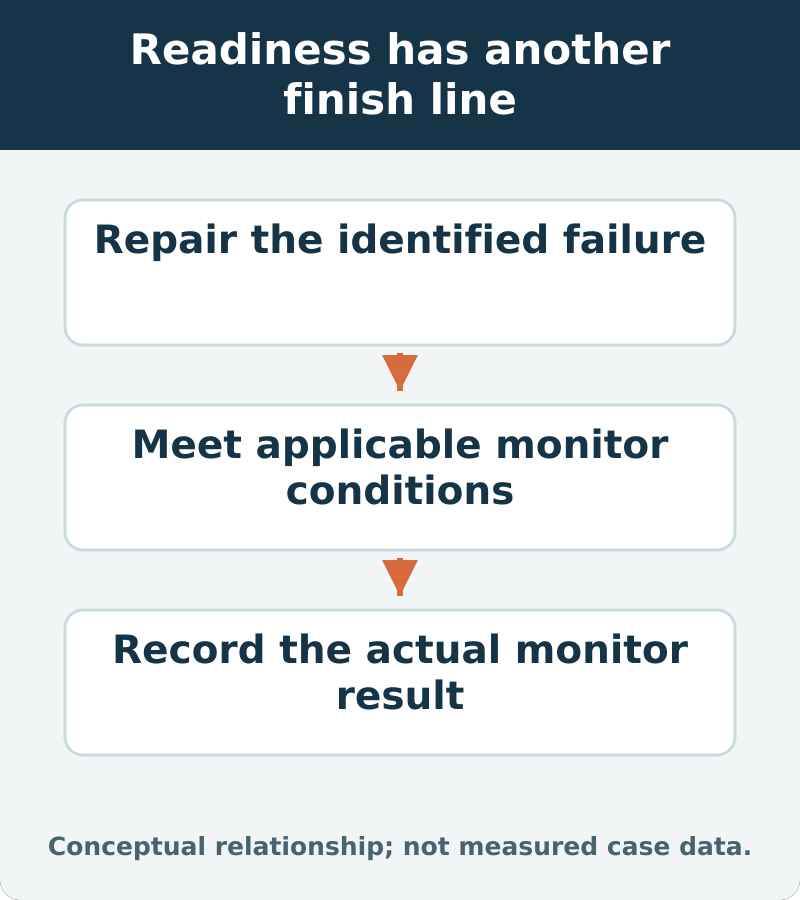
Quick answer: A completed repair and a completed emissions monitor are different events. Before adding miles, ask which prerequisites and assessment conditions remain unmet.
If the emissions appointment is approaching and the monitor still says incomplete, another aimless drive may not be the best next step. Ask for the current readiness report and a vehicle-specific plan. The job is to distinguish unfinished evaluation from an active fault, then establish what the vehicle still needs to assess.

In this guide
Does not ready mean the repair failed?
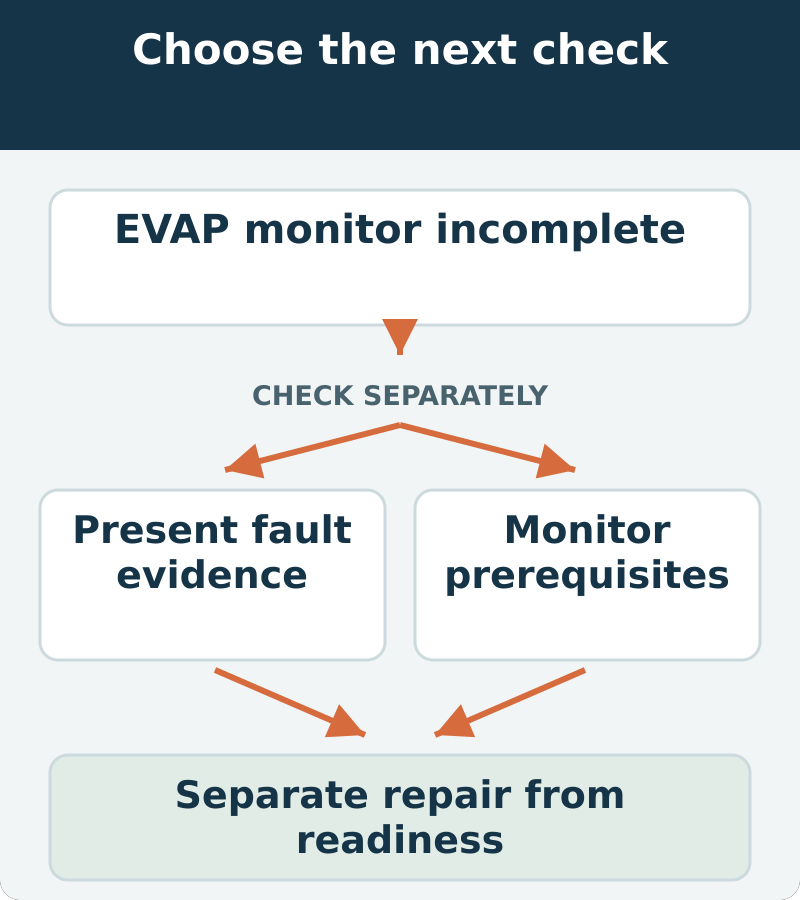
Not necessarily. A repair changes hardware or a fault condition; a monitor reports whether a particular evaluation has completed. Those events do not have to occur at the same moment. The wording on the scan report therefore matters.
Ask whether the concern is an incomplete monitor, a present fault, a pending fault or an inspection rejection for another reason. Treating all four as “the light is off but it failed” makes the next decision unnecessarily vague. If a warning or driveability problem is active, have that assessed rather than assuming more mileage will settle it. The readiness question should not conceal a remaining safety or operating concern.
Why mileage alone may not finish the monitor
Distance is only one description of a journey. It does not establish every condition a particular evaluation may require. Repeating the same kind of trip can leave the same prerequisite unmet even while the odometer increases.
That does not justify a universal timed road routine from an online case. The correct plan depends on the vehicle, its state and the applicable procedure. The illustration uses a condition checklist rather than a mileage target for this reason. A workshop can explain which condition is missing or uncertain; an owner should not try to satisfy a rigid speed sequence when traffic, weather or road safety makes it inappropriate.
In the published ALLDATA case, following catalyst replacement and fault clearing, the MINI EVAP monitor stayed incomplete despite substantial driving. The technician obtained a suggested evaluation sequence and began from a cold soak. The source reports that all monitors then completed. It does not establish a universal MINI drive cycle or inspection eligibility.
What should the readiness report actually show?
Request a report that makes the categories understandable:
| Report item | Why it matters |
|---|---|
| Supported monitor and current status | Identifies what remains incomplete. |
| Current or pending fault information | Shows whether another diagnosis is needed. |
| Relevant recent reset or repair history | Helps explain the starting state. |
This is a reading guide, not a legal pass standard. A report showing completed monitors is useful technical information, but inspection eligibility also depends on current local requirements and the vehicle. Do not assume that one published MINI outcome determines what an inspection station must accept today.
Why another reset can set you back
Clearing information can restart parts of the evaluation process. Before any reset, ask what problem it is intended to solve and what readiness information may be lost. Repeating resets because the monitor is incomplete can keep changing the very starting point you are trying to assess.
Keep the repair date, the last known reset and subsequent scan reports together. That history helps the technician distinguish lack of qualifying conditions from a recurring fault or another interruption. It is more useful than a rough total of miles driven since the first appointment. Do not disconnect power or clear codes as a last-minute attempt to improve an inspection result.
Plan the next assessment before driving farther
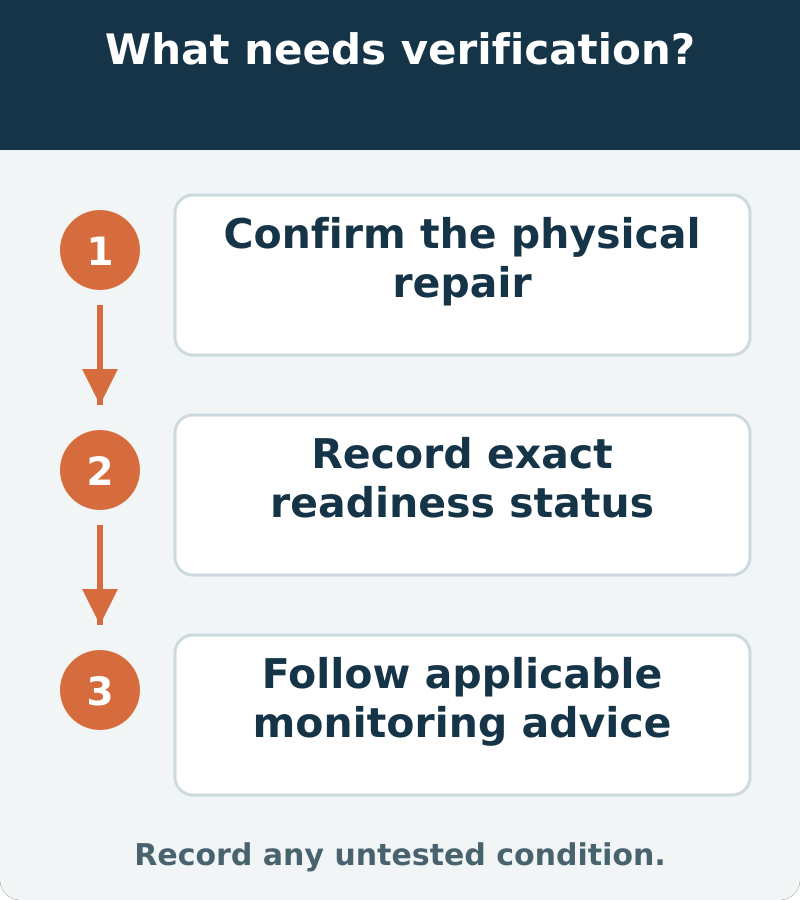
Ask the repairer to identify the applicable procedure and explain how it can be carried out safely. The plan may involve conditions before a journey as well as what happens during one. It should also specify when to reassess rather than continuing indefinitely.
There is no exact speed, fuel-level range, timed idle or guaranteed distance supplied here. Those details cannot be generalized from the historical case. If the required conditions cannot be established safely, the workshop should advise the next appropriate step. The owner’s objective is a completed, interpretable evaluation, not mileage accumulated at the expense of safety or a clear diagnostic record.
Check requirements before the inspection appointment
Confirm the current requirements with the relevant inspection authority or station before returning, and bring the updated readiness information. Ask whether any separate appointment or documentation condition applies. This article does not promise a legal pass in any jurisdiction.
If the monitor remains incomplete after the appropriate plan, return for diagnosis rather than buying a leak-testing machine without an indicated leak concern. A useful next visit begins with the actual status and what conditions were established. The central distinction is reassuring but limited: unfinished monitoring is not automatically failed repair, and completed mileage is not automatically completed monitoring.










Comments 0
Questions, fixes, and real-world diagnostic notes from readers.
Be the first to share a diagnostic result or ask a follow-up question.