
2014 BMW 730 Sagging Air Suspension: Low-Output Compressor Replacement and Height Check

This 2014 BMW 730 arrived with mileage, exact chassis, and engine not reported. Its rear suspension had dropped and a chassis-failure warning indicated insufficient air pressure. The workshop confirmed inadequate output from the air-suspension compressor, replaced the compressor and relay, raised and measured the car, and then left a several-hour no-drop check pending before delivery.
Case at a glance
| Item | Finding |
|---|---|
| Vehicle | 2014 BMW 730; exact chassis, engine, and mileage not reported |
| Driver-visible problem | Rear suspension dropped; chassis-failure/insufficient-pressure warning |
| Confirmed fault | Air-suspension compressor could not build sufficient pressure |
| Actual repair | Compressor replaced; relay renewed |
| Restoration | Suspension raised; rear wheel-center-to-fender baseline measured and marked |
| Recorded verification | The replacement system raised the chassis; several-hour static no-drop result was still pending |
Rear sag was a symptom, not a leak diagnosis
The BMW came in after the rear had settled down and the chassis system reported inadequate pressure. That combination put the pneumatic suspension at the center of diagnosis, but it did not identify which component had failed. A leaking air spring, line, fitting, valve block, weak compressor, relay or power-supply fault, height-sensor error, wiring fault, or control problem can produce a similar stance.
The technician said the rear dampers or air-spring area had previously been tested without finding a leak. The available record does not show that earlier test, its duration, the vehicle loading, or a measured loss, so it is only an initial clue. It narrows attention but cannot establish that every pneumatic component was leak-free.
The pressure finding changed the diagnosis
The turning point was the workshop’s finding that the installed compressor could not generate sufficient pressure. That finding explains why the chassis could not return to its intended position more directly than appearance alone. No exact pressure, current draw, build time, diagnostic trouble code, or BMW test threshold is published, so none is supplied here. When the rear remains low and compressor output is in question, the AUTOOL PT680 air-suspension pressure tester can measure the pressure side directly, helping separate weak output from a line leak, valve problem, or height-control issue.
This distinction matters because a compressor may run yet still fail to move enough air. Conversely, a healthy compressor can be overworked by a downstream leak. In this car, inadequate compressor output was confirmed; a leak was not presented as the confirmed root cause. The later static hold was therefore still necessary rather than assumed unnecessary after changing the pump.
What was replaced and what was not proved
The failed compressor assembly was removed and replaced. The case record also reports renewing the compressor relay, a high-current switching component in the circuit. That records the repair actually performed without claiming that welded relay contacts caused the original sag; the video does not publish an electrical test proving that failure mode.
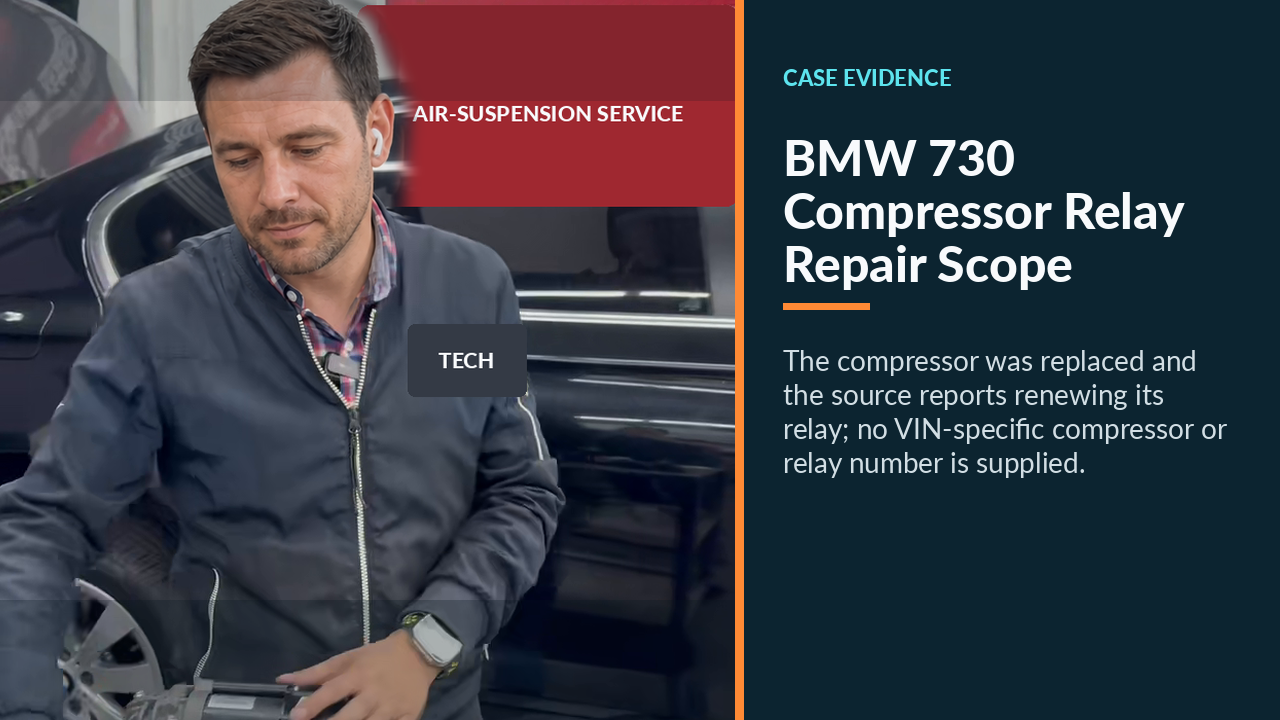
Compressor work is not a generic parts swap. The exact vehicle must determine the compressor and relay application, electrical isolation, pneumatic depressurization, line and seal inspection, mounting, connector handling, and scan-tool functions. The air suspension also changes vehicle height, so anyone working underneath must use approved support procedures and never rely on the pneumatic system to hold the body up.
Height restoration created a testable baseline
After installation, the suspension rose from its dropped condition. That immediate movement proved an important first stage: the replacement system could build enough pressure to lift the chassis. It did not yet prove that the vehicle would remain level after the compressor stopped.
The technician then aligned a ruler between the wheel-center region and rear fender, recorded the restored position, and applied a physical reference mark. Measuring from a repeatable point turns “looks level” into a comparison that can reveal settling. The exact number visible in a moving frame is not treated as a BMW calibration target, and the case record provides no VIN-specific height specification or input procedure.
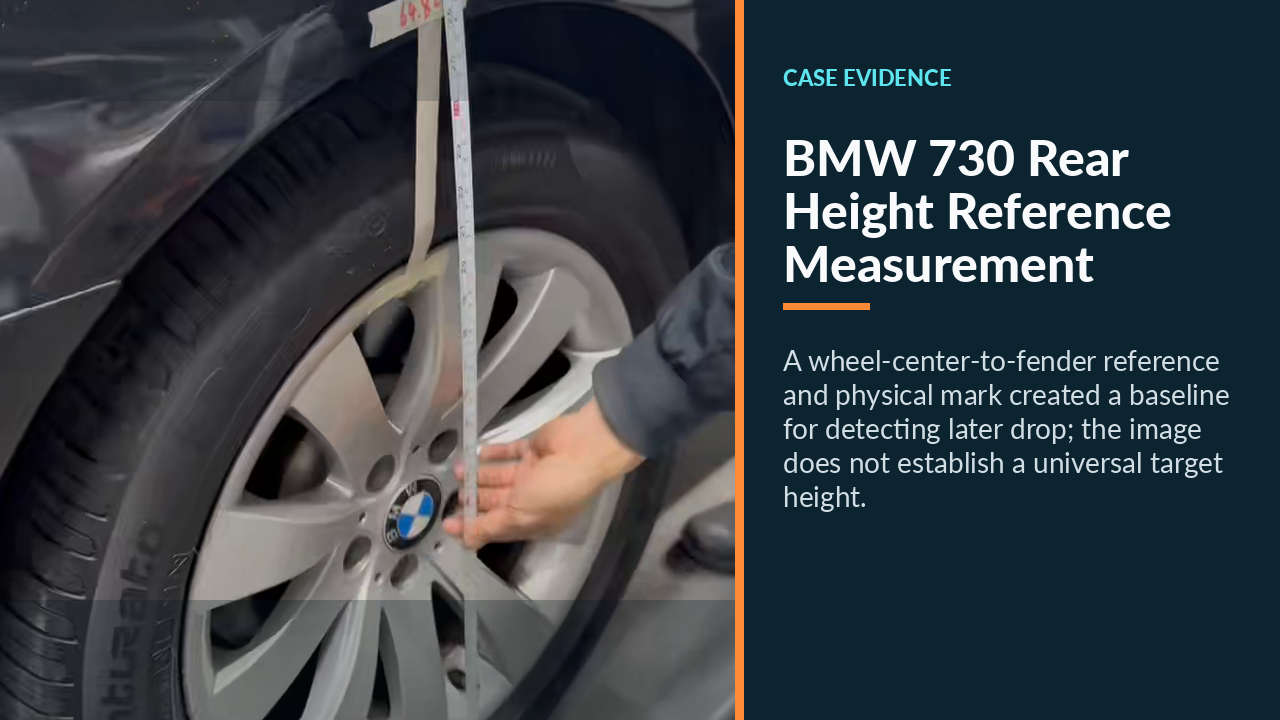
Level ground, controlled loading, tire condition, selected suspension mode, and the correct BMW reference points all matter when calibration is actually performed. Those details belong to current service information for the identified VIN. This case supports the logic of recording a baseline; it does not supply a transferable measurement or calibration recipe.
The honest endpoint was a staged verification
The video closes before the full leak-hold decision. The technician says the BMW must sit for several hours and can be delivered only if the marked height does not fall. Therefore the verified result is deliberately split: chassis lift function was restored, while long-term static height retention and final delivery were still pending.

The written page describes stronger completion claims, including an extended hold and road operation, but the case video presents the no-drop comparison as future work. The narrower, directly recorded endpoint is used here. A completed check would compare the same marked points after the stated wait, investigate any side that fell, confirm expected raise/lower response, rescan the chassis system, and challenge the original warning under appropriate driving conditions before release.
A first-check sequence for another dropped BMW
Begin with stance, warning text, and scan results, then record whether one corner, one axle, or the whole vehicle is low. Check compressor power, relay command, current behavior, pressure generation, and build time using exact model information. If pressure is available, isolate the air springs, lines, fittings, reservoir, and valve block with a controlled leak test; also validate height-sensor data and wiring before choosing a part.
After a repair, restore required control functions, confirm the chassis can raise and level, mark repeatable height points, and let the vehicle stand long enough to challenge the original drop. Only then complete a rescan and matched functional or road check. This BMW supports a low-output-compressor diagnosis because pressure generation was found inadequate and lift returned after replacement, but another sagging BMW should not receive a compressor until its own pneumatic, electrical, sensor, and control evidence points there.








Comments 0
Questions, fixes, and real-world diagnostic notes from readers.
Be the first to share a diagnostic result or ask a follow-up question.