
Rover 100 Felt Normal for Its Age Until Vibration Was Measured Across the Mounts

Old Car Vibration? Measure Across The Mounts
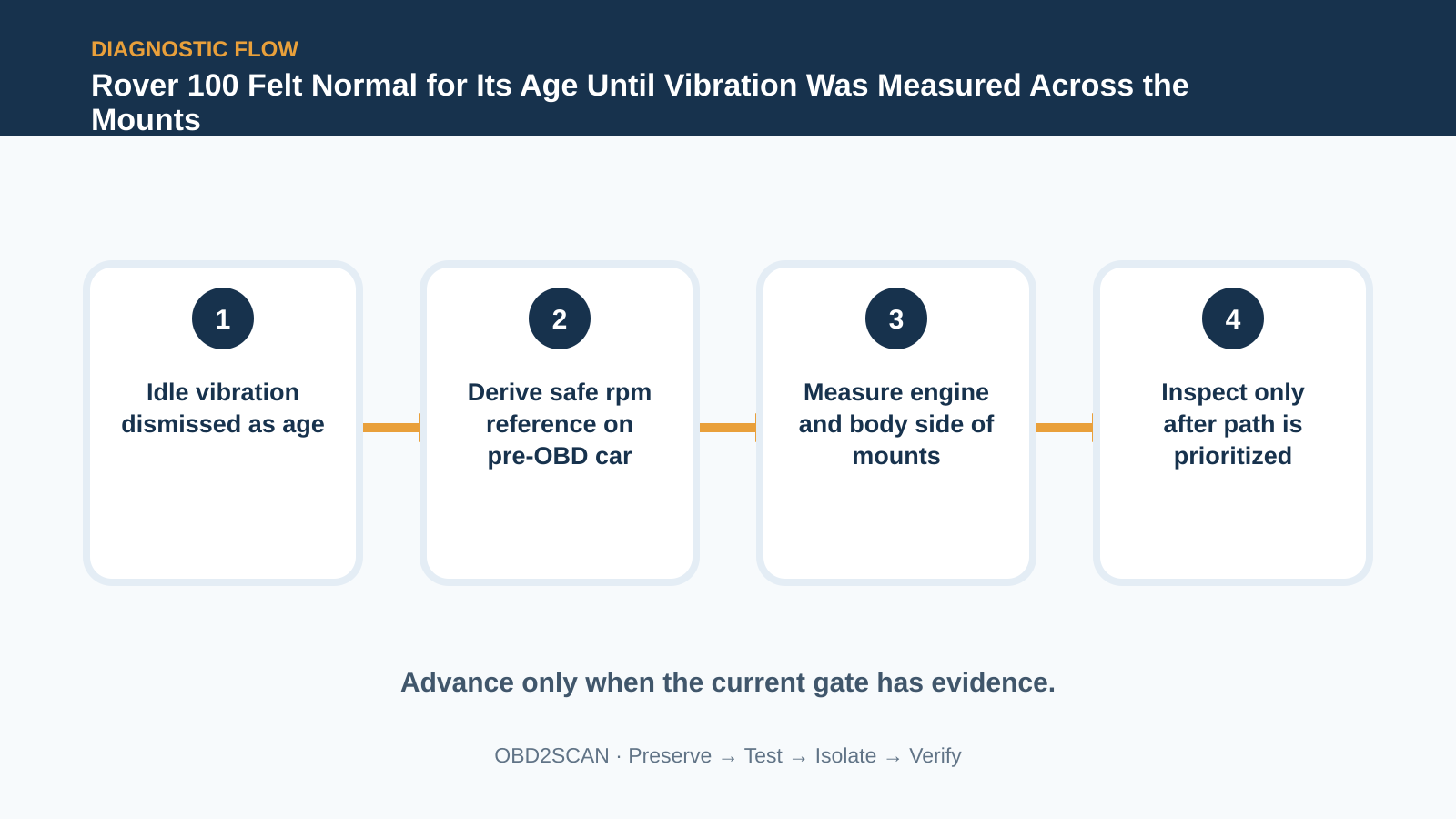
A 1996 Rover 100 had no dramatic knock or visibly broken engine support. It simply vibrated at idle in the way owners often excuse as “normal for an old car.” Measuring both sides of the mounts changed that assumption: the engine support removed only about half the vibration, and the gearbox support was no longer mechanically whole.
On a pre-OBD vehicle, a compatible low-voltage circuit tool may help obtain an identified ignition-derived rpm reference when service information permits. The MRCARTOOL B550 is one possible supporting option for that bounded reference check. B550 can support low-voltage feed, ground and continuity work on compatible road vehicles, but it does not measure NVH or diagnose a mount. In this case its role would be limited to obtaining a safe identified rpm-related circuit reference where service data permits; the mount decision still requires vibration or physical evidence.
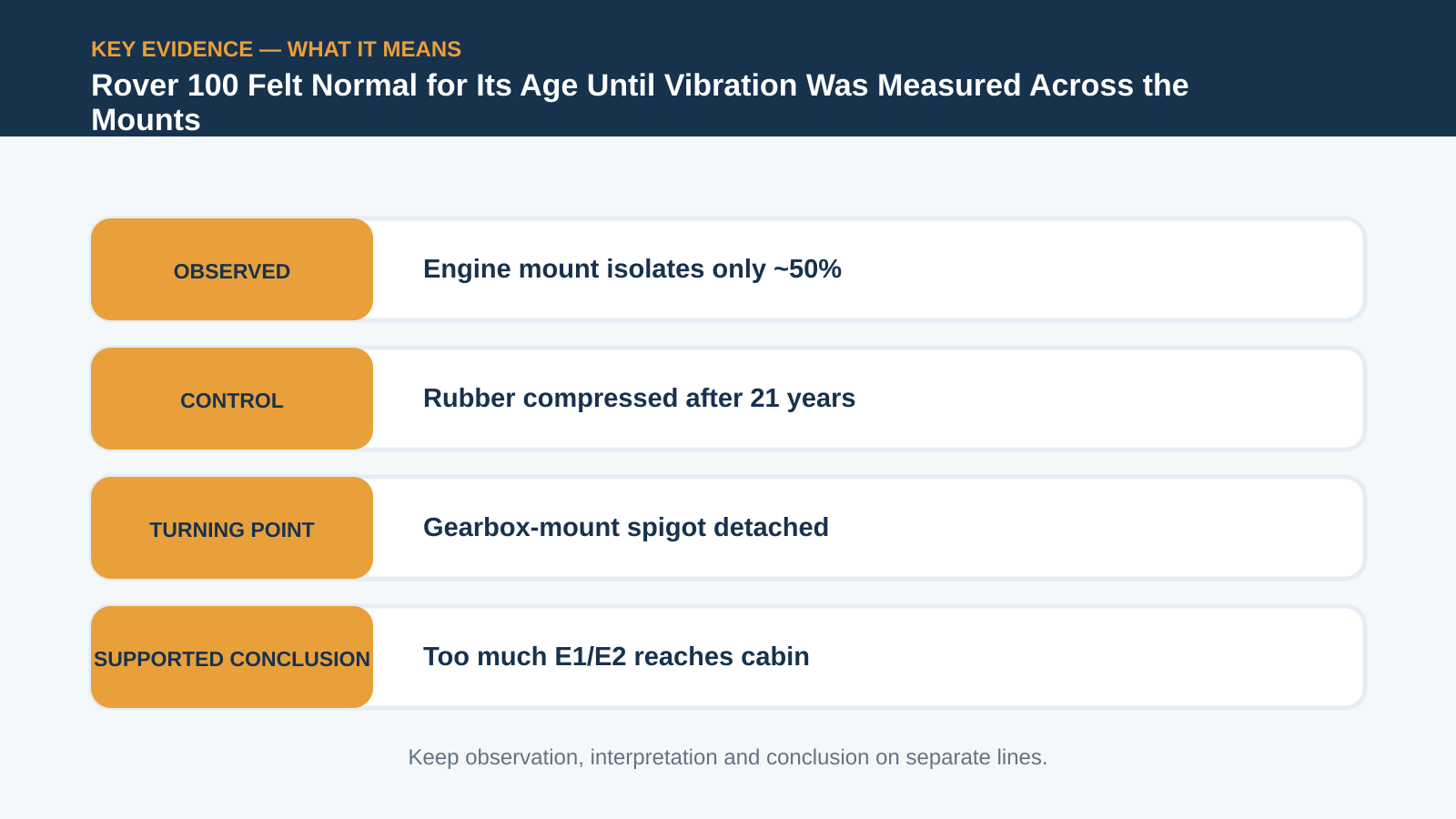
Removal revealed engine-mount rubber compressed by 21 years and about 107,000 miles, while the gearbox mount’s center spigot had detached. Replacing both under matched warm-idle conditions substantially reduced first- and second-order vibration reaching the passenger compartment. The car had not suddenly failed; its isolation had quietly aged out.
Quick answer: The engine mount isolated only about half the vibration and the gearbox-mount spigot had detached. Replacing both sharply reduced cabin E1/E2 vibration.
In this guide
- Old-car vibration is still allowed to have a cause
- Create an rpm reference on a pre-OBD vehicle
- Measure both sides of each mount
- Interpret isolation instead of raw engine vibration
- Inspect rubber only after the path is prioritized
- Replace the failed engine and gearbox supports
- Match temperature and idle speed for the retest
- Keep the new trace as a future aging baseline
Old-car vibration is still allowed to have a cause
Start with the person inside the car. Note whether the steering wheel, seat rail, mirror or pedals carry the vibration; record engine temperature, idle speed, electrical load, gear and whether touching the throttle changes it. Check for misfire, abnormal noise, exhaust contact and unsafe movement before treating the complaint as comfort only. Secure the Rover on level ground for stationary tests. A car can be old and still deserve a specific explanation for a worsening vibration.
Create an rpm reference on a pre-OBD vehicle
This pre-OBD Rover did not offer a convenient serial engine-speed channel, so an ignition signal supplied the rpm reference. Identify a safe low-voltage pickup from the wiring diagram and keep equipment away from secondary ignition voltage and moving belts. Confirm the derived speed against the tachometer or another known state. Frequency analysis only becomes useful when the reference is trustworthy; a wrong cylinder count or noisy trigger can label every vibration order incorrectly.
Measure both sides of each mount
Measure on the engine side and body side of each support with the same axis, mounting method and time window. Raw engine vibration can be entirely normal; isolation is judged by how much reaches the chassis. Capture at fully warm stabilized idle and repeat enough samples to see normal variation. One raw amplitude does not prove a mount is bad. The engine mount in this case reduced the signal by only about 50 percent, a poor result for a component whose main job is to separate source from body.
Interpret isolation instead of raw engine vibration
Engine orders translate frequency into mechanical context. First-order vibration occurs once per crank revolution, second order twice, and each can excite different structures. Avoid using one peak as a universal failure threshold; compare across the mount and against the cabin response on the same vehicle. The relevant question is whether the support attenuates the source. Here, too much E1 and E2 energy continued into the passenger compartment.
Inspect rubber only after the path is prioritized
Only after the path was prioritized were the mounts removed and examined. The engine-mount rubber had compressed over 21 years and roughly 107,000 miles. The gearbox mount’s center spigot had separated, a clearer physical failure hidden in the assembly. Inspection cameras can help document cramped faces and interference, but loaded condition may not be visible with the car hanging on a lift. Support the powertrain correctly before loosening any mount.
| Evidence point | As found | Interpretation |
|---|---|---|
| Across engine mount | Only ~50% reduction | Weak isolation |
| Engine-mount rubber | Heavily compressed | Age/load changed geometry |
| Gearbox-mount spigot | Detached | Support no longer intact |
| Cabin E1/E2 after repair | Significantly reduced | Mount repair improved comfort |
Replace the failed engine and gearbox supports
Replace confirmed supports with parts suited to the vehicle, inspect brackets and threads, and align the powertrain before final torque. If one mount has collapsed, check exhaust, hoses, shafts and wiring for contact created by the shifted position. Avoid tightening rubber mounts with the assembly twisted or hanging incorrectly. The documented repair addressed both engine and gearbox supports because evidence showed both had lost function, not because all old mounts must automatically be replaced as a set.
Match temperature and idle speed for the retest
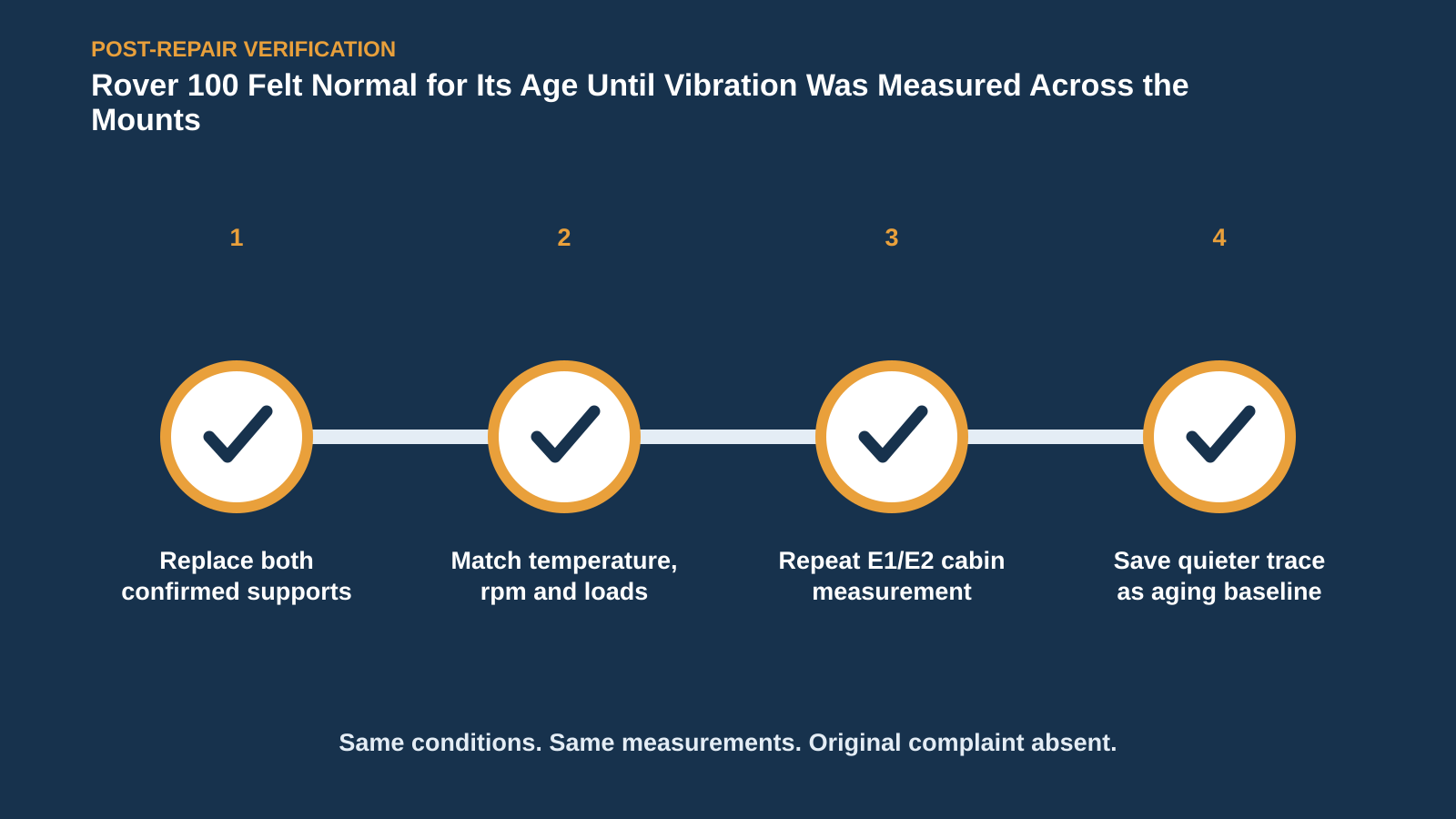
To verify the repair, match coolant temperature, idle rpm, electrical loads, sensor positions and the cabin measurement point. Compare the same E1 and E2 amplitudes rather than relying only on the owner’s first impression. After replacement, substantially less vibration reached the Rover’s passenger compartment and comfort improved. Also check start-up rock, clutch engagement and a short road drive for new preload or contact. A numerical reduction and a human comfort improvement should agree.
Keep the new trace as a future aging baseline
Save the post-repair traces as the vehicle’s own healthy baseline. They are more useful for future aging than a generic chart from another 1990s car. Explain that mount rubber changes gradually, so the former condition may have felt normal through adaptation. This case does not turn every idle tremor into a mount order—misfire, compression, pulley, exhaust and idle-control faults still require elimination. It shows how measuring across an isolator can make quiet deterioration visible.
Nothing had to break loudly for the Rover to lose refinement. Once the mounts were judged by how much vibration crossed them, age stopped being an explanation and became a measurable, repairable condition.








Comments 0
Questions, fixes, and real-world diagnostic notes from readers.
Be the first to share a diagnostic result or ask a follow-up question.