
Hitachi Zaxis 135 Would Not Raise RPM: Two Blank Readings Shared One Missing 5-Volt Feed

No Rpm Control? Follow The Missing 5 Volts
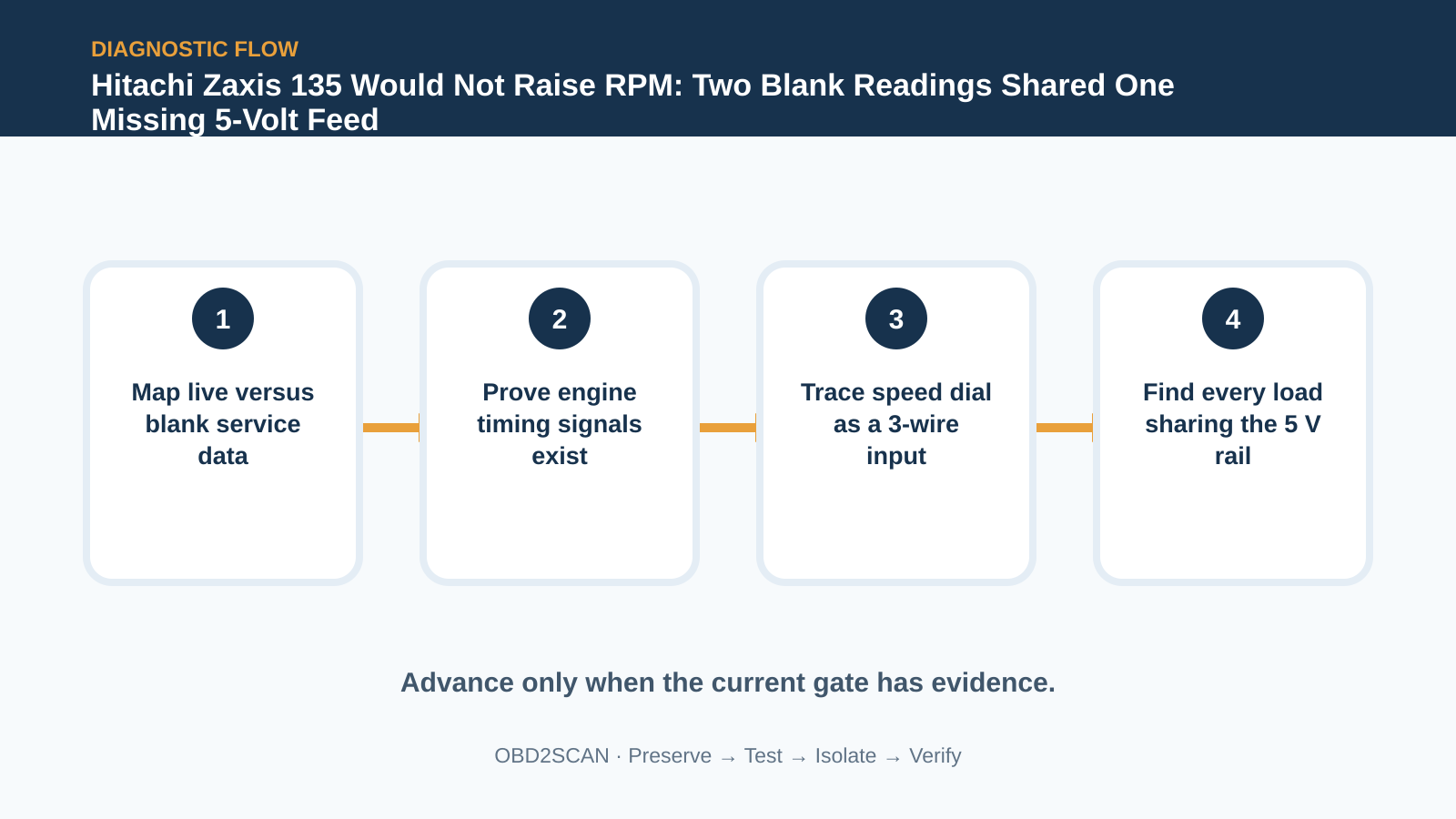
The Hitachi Zaxis 135 started and idled, but the operator could not raise engine speed. Its service screen showed temperatures while target rpm, actual rpm and hydraulic pump pressure were blank. Instead of treating every blank field as a separate failure, the diagnosis asked a simpler wiring question: what do these missing values share?
A digital meter with a basic scope channel can test an identified sensor supply, ground and signal before a controller is considered. The AUTOOL DM301 is one option for that supporting work. DM301 can measure an identified 5-volt reference, ground and sensor signal and display one waveform channel. It is not a Hitachi scan/programming tool, cannot monitor several signals synchronously and cannot prove the MCU failed until loads and wiring are excluded.
Cam, crank and injector signals confirmed that the running engine still generated useful timing information. The rpm dial and pump-pressure sensor both depended on the same five-volt output. That reference was absent even though MCU powers and grounds were sound. A replacement MCU restored five volts, brought the blank data back and returned rpm control. Corrosion was visible inside the old module, although the exact failure mechanism was not proven.
Quick answer: Blank rpm and pump-pressure values shared one missing 5 V supply. With MCU power and grounds intact, replacement restored the reference and rpm control.
In this guide
- Use the service screen as a symptom map
- Prove the engine can generate its own timing data
- Do not call an odd CAN trace a failed network
- Turn the speed dial into a three-wire circuit
- Find the second sensor on the same 5 volts
- Load-check MCU powers and grounds
- Replace the controller only after the reference stays missing
- Verify rpm, pressure data and fault state
Use the service screen as a symptom map
Use the machine’s service display before connecting anything. Record which fields are alive, which are blank and whether the value is zero, implausible or unavailable—those states are not interchangeable. Here, temperatures remained visible while both speed values and pump pressure did not. Photograph warnings and save operator history: did rain, washing, vibration or a battery event precede the fault? Secure the excavator against movement and keep leads away from hot, rotating and articulating components.
Prove the engine can generate its own timing data
Because the diesel engine started and ran, a crank signal was likely, but the team measured it rather than assuming. Cam and injector references were captured at the same accessible area, creating useful known-good data for future work. Their presence showed that the engine ECU could generate basic timing and injection activity. It did not explain why the machine controller could neither display speed information nor respond to the dial. That distinction kept the engine itself from absorbing the whole diagnosis.
Do not call an odd CAN trace a failed network
The CAN waveform looked unfamiliar, yet messages could be decoded and some service data arrived. Without a matched reference or full topology, “odd-looking” is not a diagnosis. Verify probe grounding, voltage range and network state; check whether other nodes communicate. A network can carry valid information while one analog supply is missing. The blank pressure value and failed rpm command deserved a circuit map before the entire CAN system was condemned.
Turn the speed dial into a three-wire circuit
The engine-speed dial was a conventional three-wire input: five-volt supply, ground and a variable signal. There was no five-volt reference. Test at the connector with it loaded, then at the controller pin, following Hitachi data. Check ground drop and signal-to-ground separately. Never feed five volts into an unidentified reference circuit; many sensors share it, and an external voltage can backfeed a controller. The missing supply creates two possibilities: an external short pulling it down or an internal source that no longer produces it.
Find the second sensor on the same 5 volts
The hydraulic pump-pressure sensor used the same reference and was also blank. Disconnect shared sensors one at a time only under the wiring procedure, watching whether the five volts returns. Inspect harness branches for abrasion, contamination and pin bridging. If removing a shorted sensor restores the rail, that sensor or branch is the cause; if the rail stays absent at an unloaded controller pin, attention moves inside the MCU. This shared-load test is essential before replacing an expensive module.
| Finding | Diagnostic value |
|---|---|
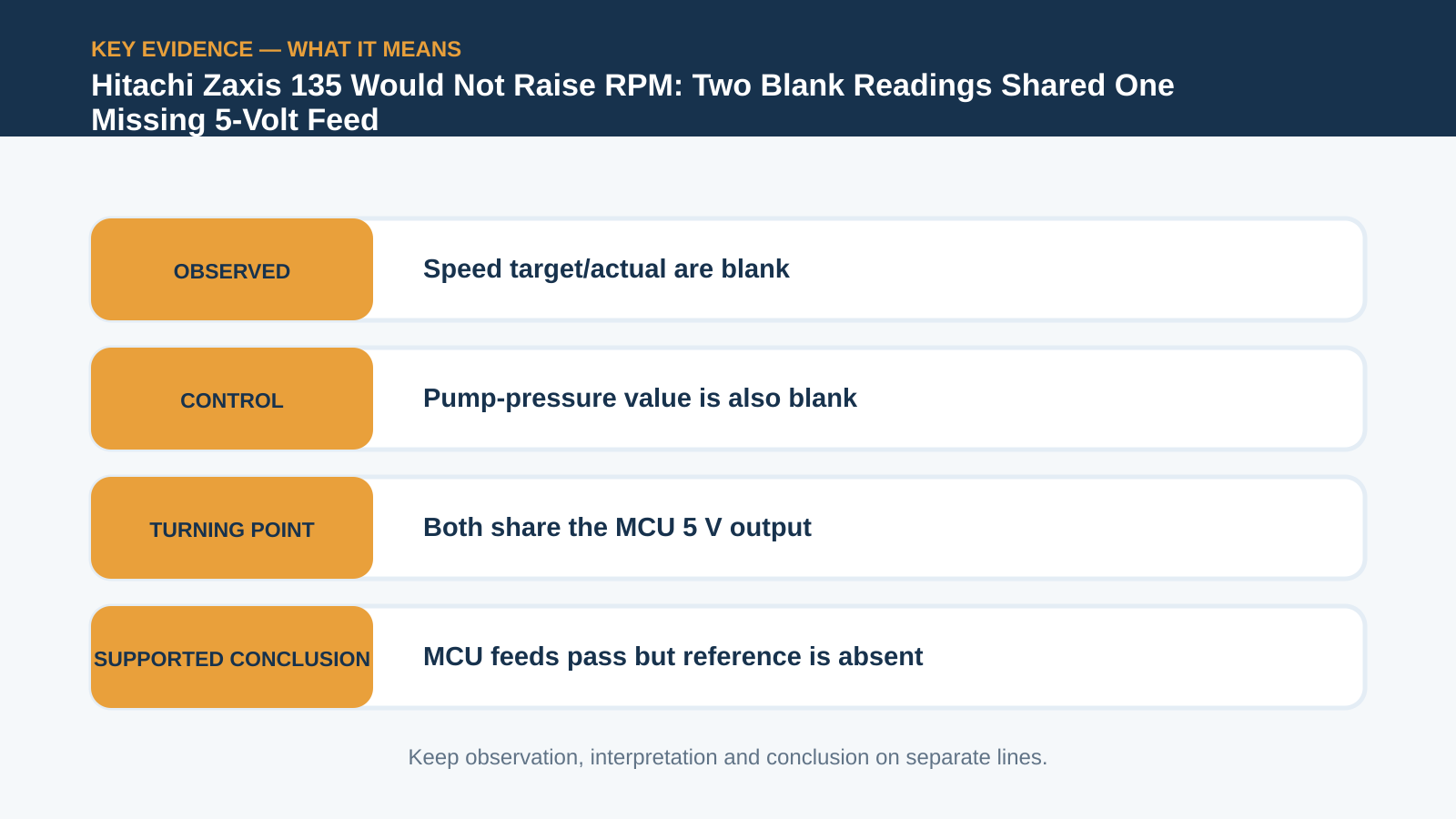
| Target and actual rpm blank | Speed-control information path is incomplete |
| Pump-pressure value also blank | A second affected input offers a shared-circuit clue |
| Both devices share MCU 5V | One reference fault can explain both symptoms |
| MCU power/grounds good; 5V absent | Controller output becomes suspect after external loads are cleared |
Load-check MCU powers and grounds
Power and ground were checked at the MCU and remained available. A fuse seen intact is not enough; load the supply and measure ground drop at the module while it is connected. Confirm ignition feeds and connector tension. Once external five-volt loads have been separated and the controller still cannot establish the reference, replacement becomes supported. Check part compatibility and whether setup or calibration is required. The documented MCU was plug-and-play for that machine, but that should not be assumed across Zaxis variants.
Replace the controller only after the reference stays missing
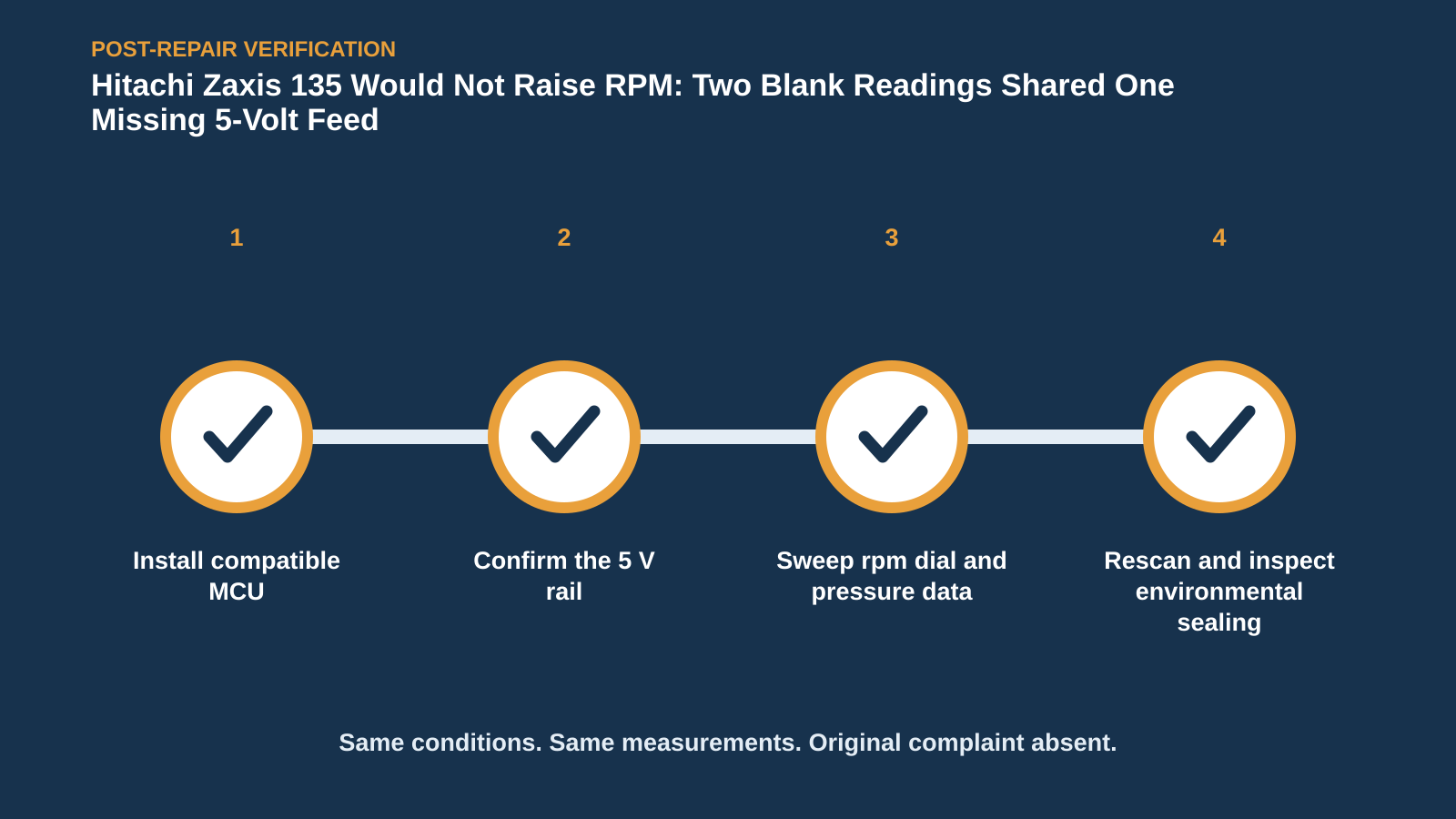
The new MCU restored the five-volt output, target and actual speed data, pump-pressure information and rpm-dial control. Stored codes cleared and the machine could be operated again. Verify through the entire dial range and under safe hydraulic load, watching that sensor values remain plausible. Wiggle-test the harness and inspect voltage after warm-up. A returned number is useful only if it follows real machine behavior rather than freezing at a believable value.
Verify rpm, pressure data and fault state
Opening the old controller revealed corrosion on an internal component. Report that as an observation, not a proven chain of causation: moisture source, electrical migration and exact failed component were not established. Inspect enclosure seals, mounting orientation and surrounding drains before the replacement inherits the same environment. Retain photos and part data. The repair result proved the MCU assembly was responsible for the missing reference; it did not prove precisely how corrosion created the internal failure.
Two blank values were more useful than one because they shared a supply. Once the five-volt reference became the common thread, an unfamiliar excavator stopped looking like a wall of proprietary electronics and started looking like a testable circuit.










Comments 0
Questions, fixes, and real-world diagnostic notes from readers.
Be the first to share a diagnostic result or ask a follow-up question.