
BMW 320d Steering Knock With the Engine Off: Trace the Sound to the Rack

Steering Knock: Sound Travels
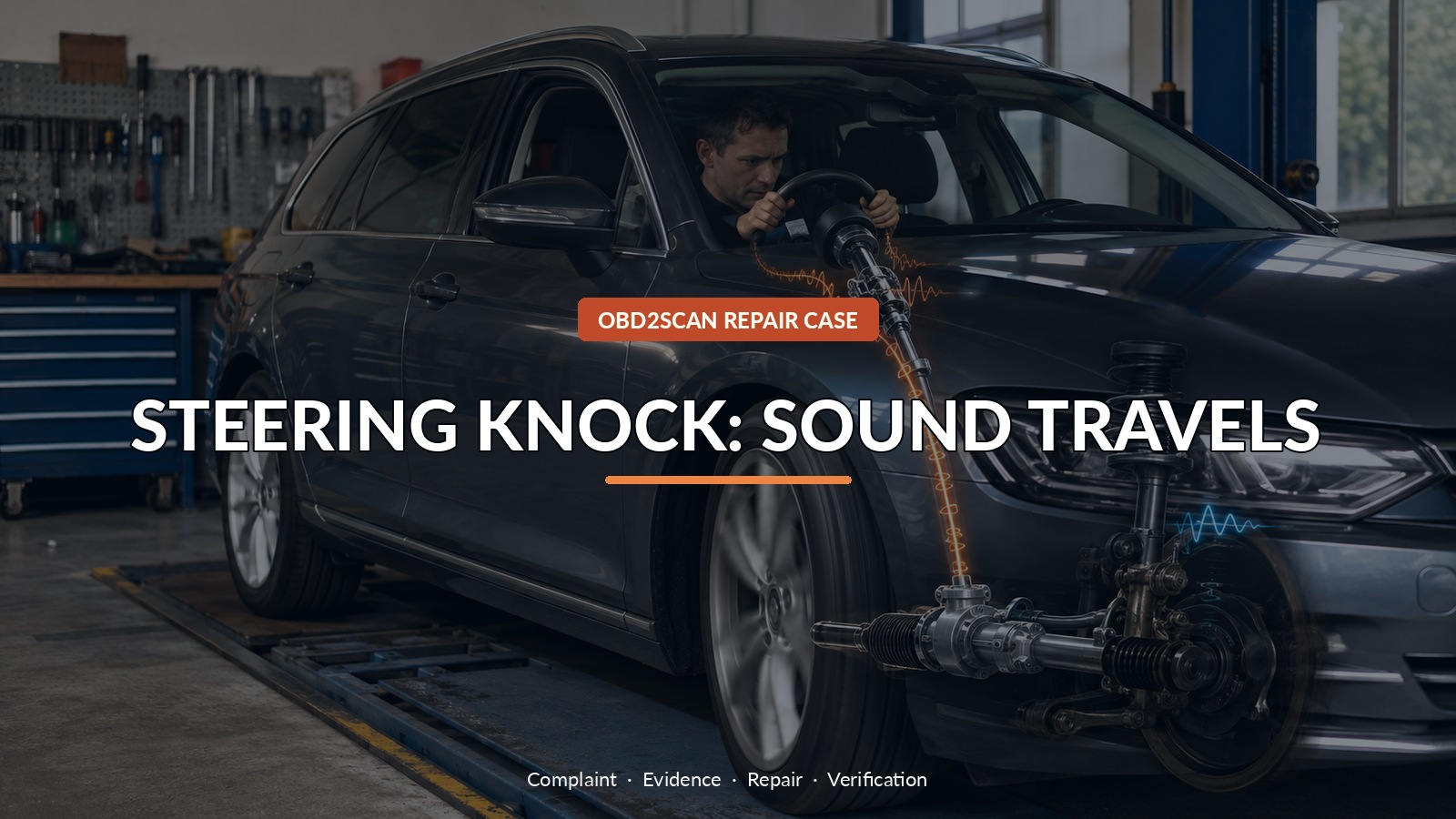
The knock sounded as if it came from this BMW 320d’s steering column, but structures carry sound remarkably well. With the engine and electric power steering off, response measurements followed the impact down to the steering-rack pinion housing. A loaded thrust-piece repair cured that steering-input knock while a separate speed-hump noise remained open.
After the noise path is localized and the car is safely lifted, an articulating camera such as the AUTOOL SVB308 can improve the view of accessible rack boots, fasteners, and surrounding contact points. SVB308 can improve visual access around boots, fasteners and the rack housing after safe lifting; it cannot locate a transmitted noise, measure backlash or prove a thrust piece has failed from appearance alone.
This article deliberately keeps two noises on two sheets. It challenges the idea that the loudest place is the failed place and refuses to turn a successful steering-rack repair into a claim that every chassis knock disappeared.
Quick answer: The knock sounded in the column but response measurements led to the rack pinion housing. A thrust-piece repair cured that steering knock while a separate bump noise stayed open.
In this guide
- Name the steering knock and bump knock separately
- Reproduce steering input with the engine off
- Do not let cabin loudness choose the column
- Compare response along the column and rack
- Localize the event at the pinion housing
- Inspect and load the replacement thrust piece
- Retest the steering knock before a road drive
- Keep the remaining speed-hump noise on its own job
Name the steering knock and bump knock separately
Give each sound a name and reproduction method before testing. Noise A occurs with small steering inputs while stationary; Noise B occurs over a speed hump. Record whether either changes with temperature, brake application, steering direction, or body load. Make separate audio or video clips. If steering binds, develops free play, fails to self-center, or shows a warning, stop driving and inspect for a safety fault. Combining two knocks into one complaint encourages a part that improves one event to be credited—or blamed—for both.
Reproduce steering input with the engine off
Switch the engine off so electric steering assist is inactive, secure the car, and move the steering only through the small range that produces the knock. This removes motor assist and road input while preserving column, joints, and rack movement. Feel for the event at the wheel without placing hands near pinch points. Confirm it repeats in both directions. A noise that exists only with assist active needs a different branch; one that remains with assist off supports a mechanical contact or clearance path.
Do not let cabin loudness choose the column
Sound at the steering wheel can originate at the column, an intermediate joint, the bulkhead, rack mounts, pinion, tie rods, or even an adjacent contact. Metal shafts and the body act as a transfer path. Inspect fasteners, trim contact, universal joints, boots, and visible rack movement, but do not replace the component closest to the ear. Tightening an accessible bolt as an experiment can alter evidence and create unsafe torque. Use response comparison to locate where the impact energy begins.
Compare response along the column and rack
Attach accelerometers or acoustic sensors at repeatable points along the column, bulkhead, rack body, pinion housing, and nearby subframe. Apply the same steering input and compare onset time, amplitude, and frequency. The largest cabin sound may be a resonant response rather than the source. In the documented 320d, the sharper response concentrated at the pinion housing. Repeat the setup and swap sensor positions if necessary to exclude mounting variation. Localization is strongest when multiple channels see the event propagate from one point.
| Complaint label | Reproduction | Closure test |
|---|---|---|
| Steering-input knock | Engine/EPS off, small stationary wheel movement | Repeat same input and compare rack/column response |
| Speed-hump knock | Controlled road bump at fixed speed | Repeat the same bump after steering repair |
| Binding or loss of assist | Steering effort and warning check | Safety diagnosis before routine noise work |
Localize the event at the pinion housing
Once the rack area leads, inspect its mounting, pinion preload region, boots, and connected joints through BMW’s procedure. Check whether the knock changes when the relevant housing is safely loaded. The thrust piece supports the rack interface and can create impact when clearance is excessive. That does not authorize arbitrary adjustment: too much load can produce binding, poor return, or accelerated wear. The measured response plus the prescribed test justified the repair kit, not the mere existence of a commonly discussed component.
Inspect and load the replacement thrust piece
Install the correct thrust-piece kit and apply BMW’s loading or adjustment procedure exactly, including one-time fasteners and lubrication. Maintain steering position and protect the rack from contamination. Confirm free movement through the required range before road use. An inspection camera can help see a cramped fastener or boot seating, but it cannot judge preload. Record the starting condition and final adjustment method. If the rack has corrosion, damage, or play outside the kit’s scope, follow the replacement branch instead.
Retest the steering knock before a road drive
With the engine still off, repeat the identical short steering movements and compare the pre- and post-repair sensor signatures. The target knock should be dramatically reduced or absent, steering effort should remain smooth, and no new bind should appear. Then start the engine, confirm assist and warning status, and turn lock to lock only as permitted. A successful stationary result closes Noise A provisionally. It says nothing yet about the separate bump input that required road motion.
Keep the remaining speed-hump noise on its own job
Drive over the same controlled speed hump at the same speed and direction. If Noise B remains—as it did in the documented case—write that result plainly and continue a separate suspension, mount, brake, or body branch. Do not keep adjusting the rack to chase a noise that was never reproduced by steering input. The repair can be successful and the vehicle can still have another complaint. That honesty helps the owner approve the next diagnosis without feeling that the first repair was misrepresented.
The rack thrust piece fixed exactly what the evidence said it would fix. The case is valuable because it stops there. Sound traveled up the column, sensors traced it back down, and the engine-off reproduction helped verify the steering event without road noise. Keeping the remaining bump knock separate is not an incomplete story; it is how trustworthy repair writing respects both the machine and the person paying for the next hour of diagnosis.







Comments 0
Questions, fixes, and real-world diagnostic notes from readers.
Be the first to share a diagnostic result or ask a follow-up question.