
2017 Chevy Express Would Not Go Past 25 MPH: The Brake Pedal Position Needed a Relearn

25-Mph Limit, No Mil—Check The Brake Pid
Quick answer: The engine could rev in Neutral, but the van’s brake input remained at 33 percent with the pedal released. Completing the specified brake-pedal-position relearn returned the PID to zero and removed the 25-mph limitation. This article follows one documented vehicle. It explains the evidence chain, not a universal failure rate or a direction to replace the same part on every similar car. Stop whenever the test would involve overheated brakes, high current, moving parts, refrigerant handling or an uncontrolled road condition.
This job needs a vehicle-capable scan platform that can show ABS/BCM data and run the exact relearn; the AUTOOL Used-Car Diagnostic Tester Range gives a current category to compare, but coverage must be confirmed for this model and function before connecting. A generic code reader or product-category listing does not prove Chevrolet relearn coverage, diagnose a binding brake, or replace base-brake and transmission safety checks.
The Express would not accelerate past 25 mph even though the brakes were physically released. One live-data value—33 percent pedal application at rest—showed why the controller was limiting torque.
Quick answer: The engine could rev in Neutral, but the van’s brake input remained at 33 percent with the pedal released. Completing the specified brake-pedal-position relearn returned the PID to zero and removed the 25-mph limitation.
In this guide
Confirm the 25-mph limit without taking risks
Verify the van’s limit on a safe route: it would barely exceed 25 mph and felt as though it started in a high gear, while the engine revved freely in Neutral. That contrast lowers the priority of a basic engine-output fault, but it does not make a public-road test safe when acceleration is severely limited. Preserve the original condition before changing it. The first observation is the control sample against which every later test must be compared.
Use Neutral response to split the symptom
Run a complete vehicle scan, not only an engine scan. The MIL was off, while ABS, airbag and BCM faults were stored. One BCM code stated that brake-pedal-position calibration was not learned; preserve all codes before deciding which ones could influence torque management. Use service information for the exact engine, build date and options. A correct method on the wrong terminal can create a precise but useless result.
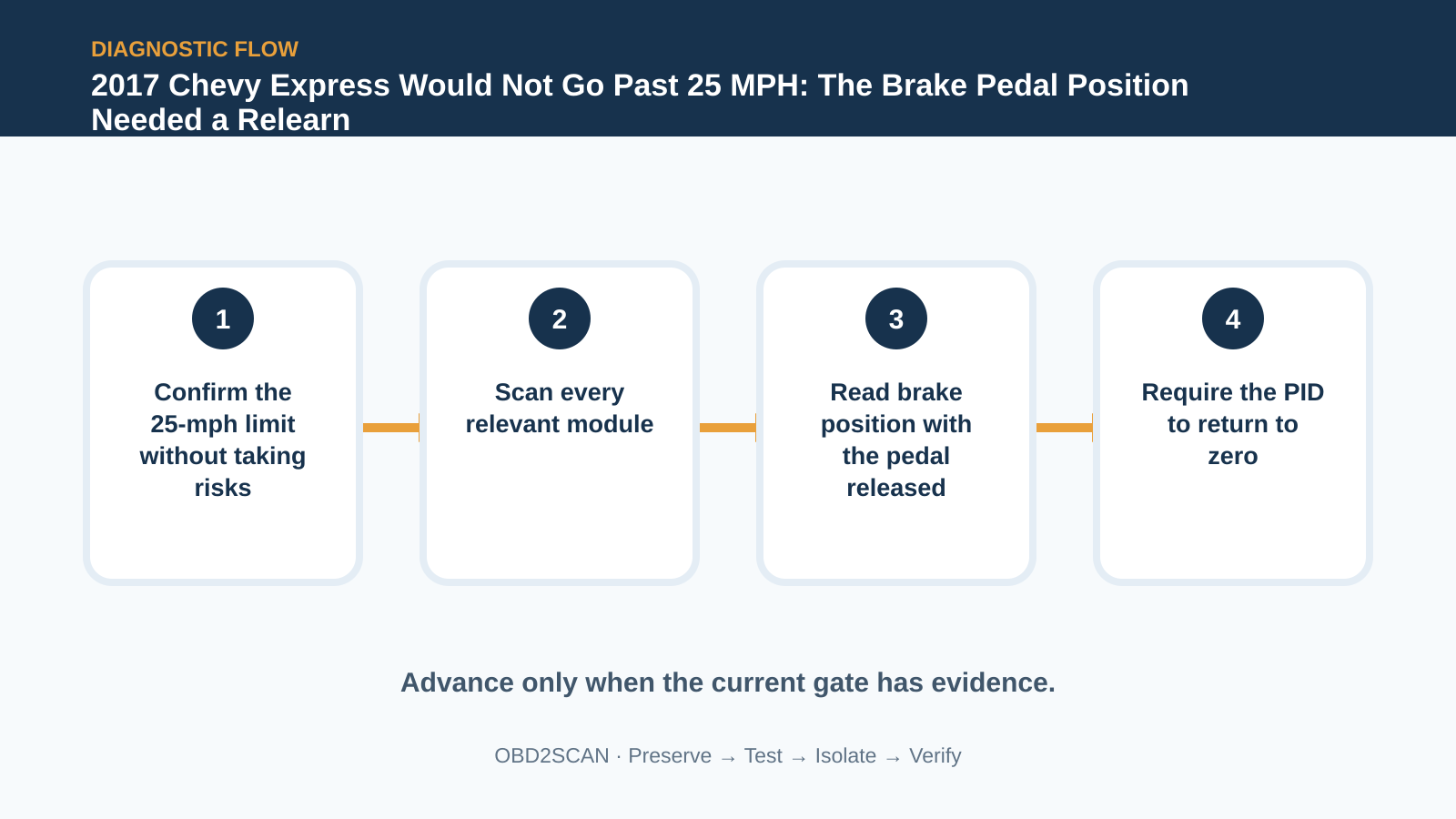
Scan every relevant module
Study live data with the pedal fully released and the floor mat clear. The brake-system PID read 33 percent in the documented case when it should have represented the released zero state. Confirm the physical pedal and brake lamps agree before treating the value as calibration rather than a binding mechanism. Treat prior work as evidence, not blame. A repair that made no change can narrow the case when its installation and test conditions are verified.
Find the calibration code that matters
A controller that believes the brake is applied can reduce torque or alter shift behavior even though the engine itself revs normally in Neutral. This is a data-state explanation, not proof of a failed sensor. Wiring, connector condition, sensor mounting and recent module or brake work still deserve inspection. At this stage, separate what was observed from what is inferred. The observation should remain true even if the current theory is later rejected.
| Observation | What it supports | What it does not prove |
|---|---|---|
| Engine revs in Neutral | Basic output is available unloaded | Transmission is healthy |
| Released brake PID reads 33% | Controller sees an applied input | Sensor hardware is failed |
| Relearn returns PID to zero | Calibration was causal here | Any scanner can perform the function |
| Road test regains power | Original behavior is resolved | Other ABS/airbag faults can be ignored |
Read brake position with the pedal released
Use a scan platform that explicitly covers the correct Chevrolet module and brake-pedal-position relearn. Maintain battery voltage, follow prompts and keep the vehicle secured. Do not choose a menu with a similar name from another model year or substitute a generic code clear. This is the decision point in the documented case. Its value comes from changing one bounded condition while leaving the rest of the system intact.
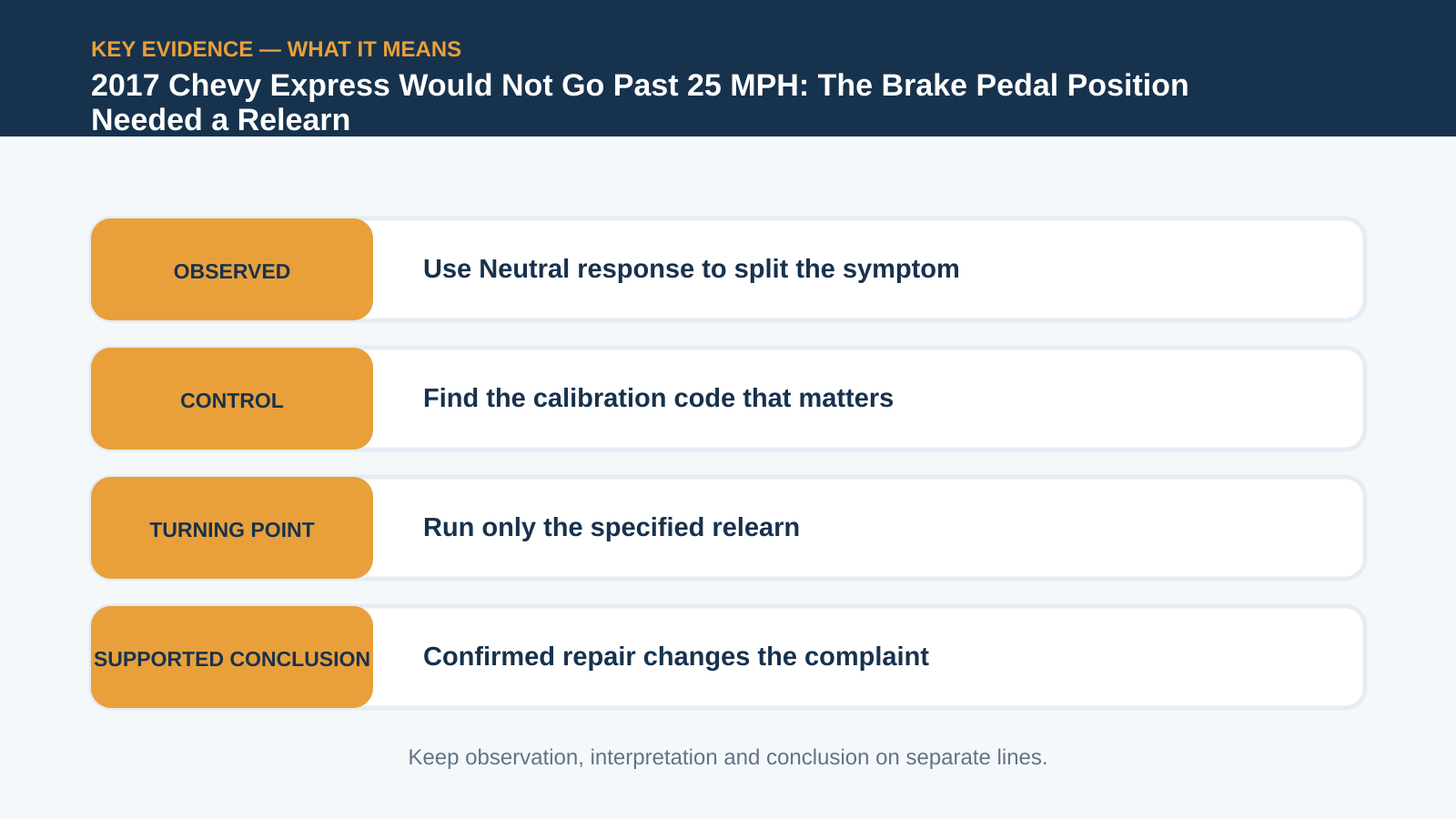
Run only the specified relearn
After the relearn, the released-pedal PID returned to zero in the source case. Sweep the pedal slowly and verify the value changes smoothly, returns consistently and agrees with brake-lamp operation. A completed-screen message without a correct resting value is not a completed diagnosis. A confirmed component still needs a repair that restores sealing, support, torque, routing or terminal fit—the physical conditions that keep the fault from returning.
Require the PID to return to zero
Repeat the controlled acceleration test and normal braking checks. Confirm the van no longer feels locked in a high gear, reaches speed predictably and stores no returning calibration code. Investigate unrelated airbag or ABS faults separately rather than hiding them behind the successful drivability repair. Reassemble protective covers and retainers before declaring success. A diagnostic shortcut must not become the next failure mechanism.
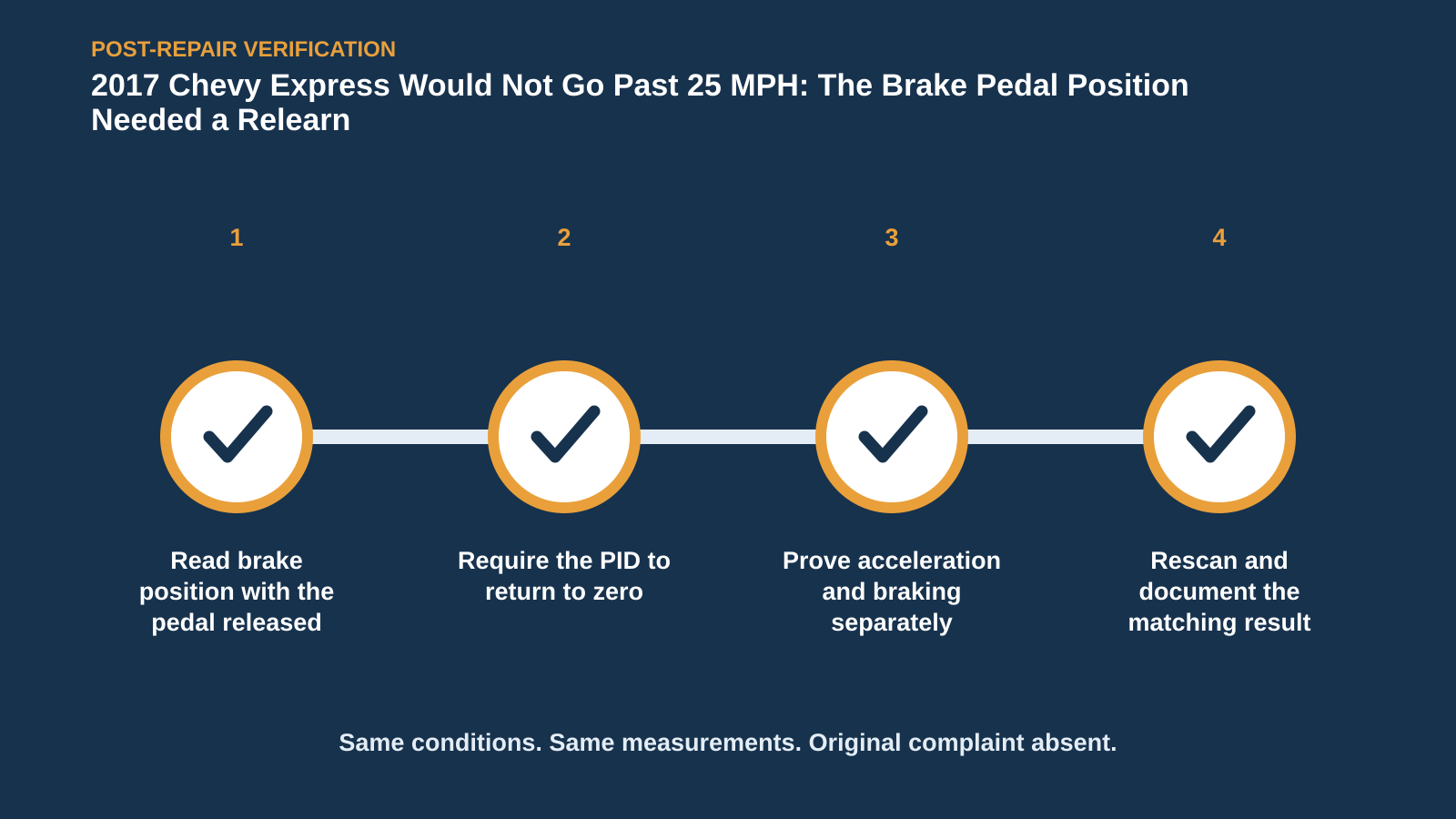
Prove acceleration and braking separately
The transferable habit is to look for impossible resting values. A 33-percent brake input with the pedal released explained more than the absence of an engine code. Calibration is a repair only when the input, behavior and post-test evidence all return to their intended states. Use the customer’s original complaint as the final specification. A cleared code, quiet bay or one good key cycle is not equivalent to reproducing and passing that condition.
If you are bringing a similar symptom to a shop, arrive with the useful conditions rather than a requested part: whether the vehicle was cold or hot, the exact speed or switch position, which warning lamps appeared, what changed after a restart, and a chronological list of earlier repairs. A short video can preserve an intermittent sound or lamp pattern, but record it only while parked or with a passenger handling the camera. Ask the technician to retain the pre-repair scan and measurements, explain the test that separated the failed path from the alternatives, and show how the original complaint was repeated afterward.
For the owner or service adviser, a useful repair explanation has three parts: what was observed, why the decisive test narrowed the fault, and which original condition passed after the repair. It should also say what the test did not prove. That boundary prevents a memorable case from becoming an automatic parts recommendation.
The engine could rev in Neutral, but the van’s brake input remained at 33 percent with the pedal released. Completing the specified brake-pedal-position relearn returned the PID to zero and removed the 25-mph limitation. The reusable lesson is narrower and more valuable: Build the narrative around one impossible resting value, then show why a calibration procedure must end with a measured zero and a repeat drive.










Comments 0
Questions, fixes, and real-world diagnostic notes from readers.
Be the first to share a diagnostic result or ask a follow-up question.