
1996 Chrysler Sebring Ran Rough After a Timing Belt: The Cam Timing Would Not Stay Put

Rough After A Timing Belt? Watch The Phase Move
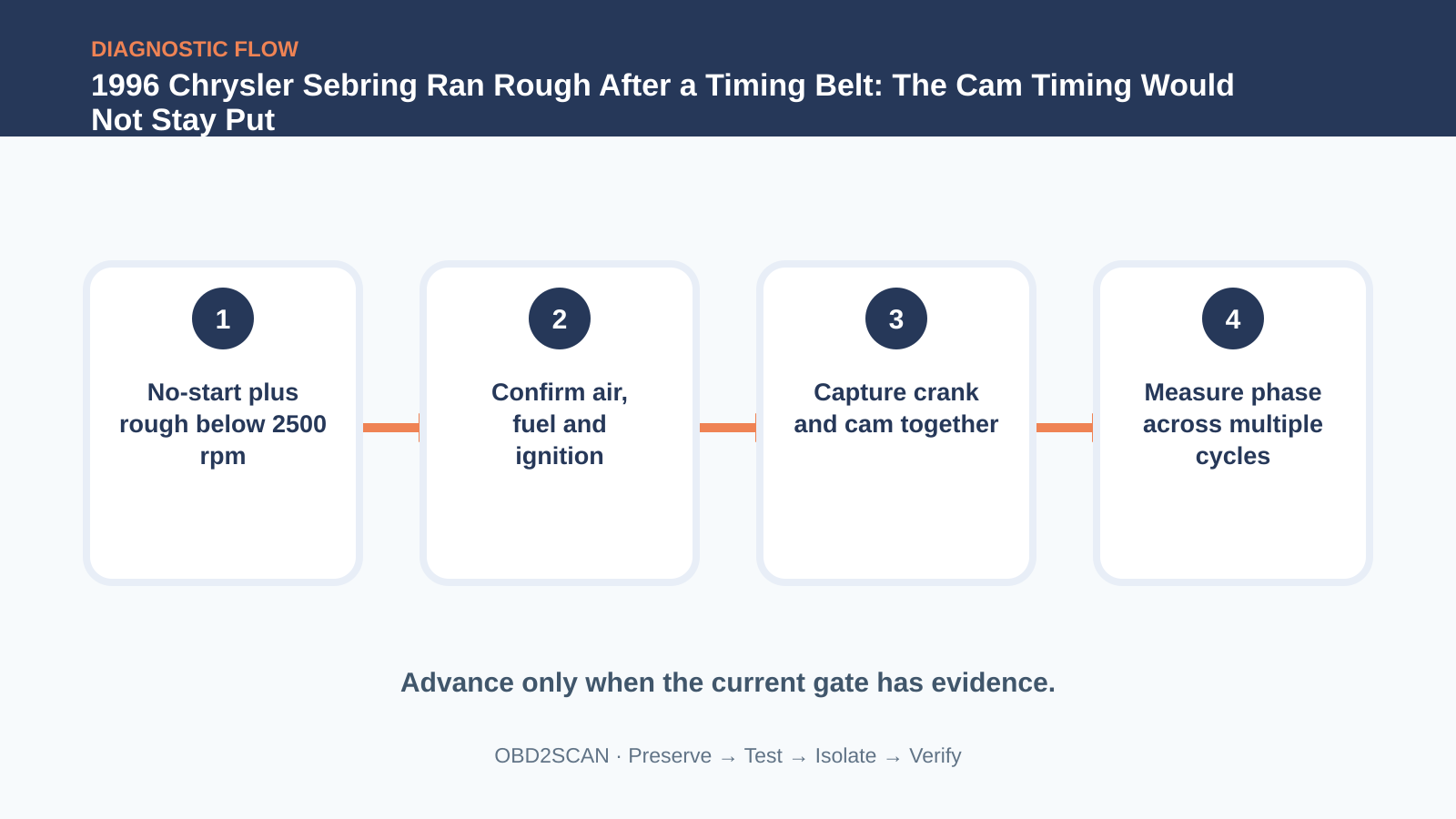
The 1996 Chrysler Sebring sometimes would not start and ran poorly below roughly 2,500 rpm. A tune-up and injector cleaning did nothing. A timing-belt replacement helped for about two weeks, then the symptoms returned. That short improvement was not proof that the new belt caused the fault; it was a clue that disturbing belt tension had temporarily changed something.
A scope-enabled multimeter can check one crank or cam sensor for signal integrity before mechanical access. The AUTOOL DM301 is one accessible example. DM301 can inspect one accessible crank or cam signal for basic integrity. Because it is a one-channel scope, it cannot directly reproduce the simultaneous cam-versus-crank phase comparison that made this diagnosis decisive.
The engine had air, fuel and ignition, so the case moved from missing ingredients to wrong timing. Viewed together, crank and cam signals would not keep a fixed relationship. The automatic belt tensioner was replaced according to service information, after which the car started and ran properly. A triggered post-repair capture held the crank reference steady and showed no continuing cam-phase wander.
Quick answer: Air, fuel and ignition were present, but crank-to-cam phase wandered. Replacing the automatic belt tensioner restored starting and stable correlation.
In this guide
- The two-week improvement belongs in the diagnosis
- Confirm air, fuel and ignition without repeating the tune-up
- Separate sensor presence from mechanical timing
- Capture crank and cam in the same timebase
- Watch the relationship move
- Inspect the tensioner under the service procedure
- Reassemble and establish a clean start
- Lock the post-repair phase on the same trigger
The two-week improvement belongs in the diagnosis
Write the symptom as two regimes: intermittent no-start and weak, rough operation below about 2,500 rpm. Ask whether it changes hot versus cold, after a bump or after recent service. Record the 128,000-mile history and the timing-belt work, including whether the tensioner, idlers and water pump were renewed. The two-week improvement matters because belt removal and retensioning changed the system. It does not make the last installer guilty or prove the belt jumped a tooth.
Confirm air, fuel and ignition without repeating the tune-up
Confirm the basic ingredients efficiently. Check intake restriction, fuel pressure or delivery, injector command and ignition output under the failing condition. Avoid repeating a tune-up merely because plugs and injectors are familiar. If all three exist but combustion is unstable, ask whether they arrive at the correct time and whether the engine can seal. Compression, vacuum and timing correlation become more useful than another bottle of cleaner.
Separate sensor presence from mechanical timing
A crank sensor can produce a clean-looking signal while the camshaft is mechanically late or moving. Likewise, a cam sensor can switch correctly but report a target whose relationship to the crank changes. Verify power, ground and amplitude for each sensor, then separate electrical integrity from phase. Static timing marks may look acceptable with the engine stopped. An intermittent tension problem needs a dynamic comparison through cranking or running, captured under the symptom.
Capture crank and cam in the same timebase
Use two isolated channels with the correct probes, grounds and sample rate to view crank and cam on one timebase. Mark a repeatable crank feature and measure to the same cam edge across several cycles. Account for normal chain or belt dynamics and sensor tolerance using service data or a known-good capture. The decisive feature is not that two traces look different; it is that their relative position changes when the mechanical relationship should stay stable.
Watch the relationship move
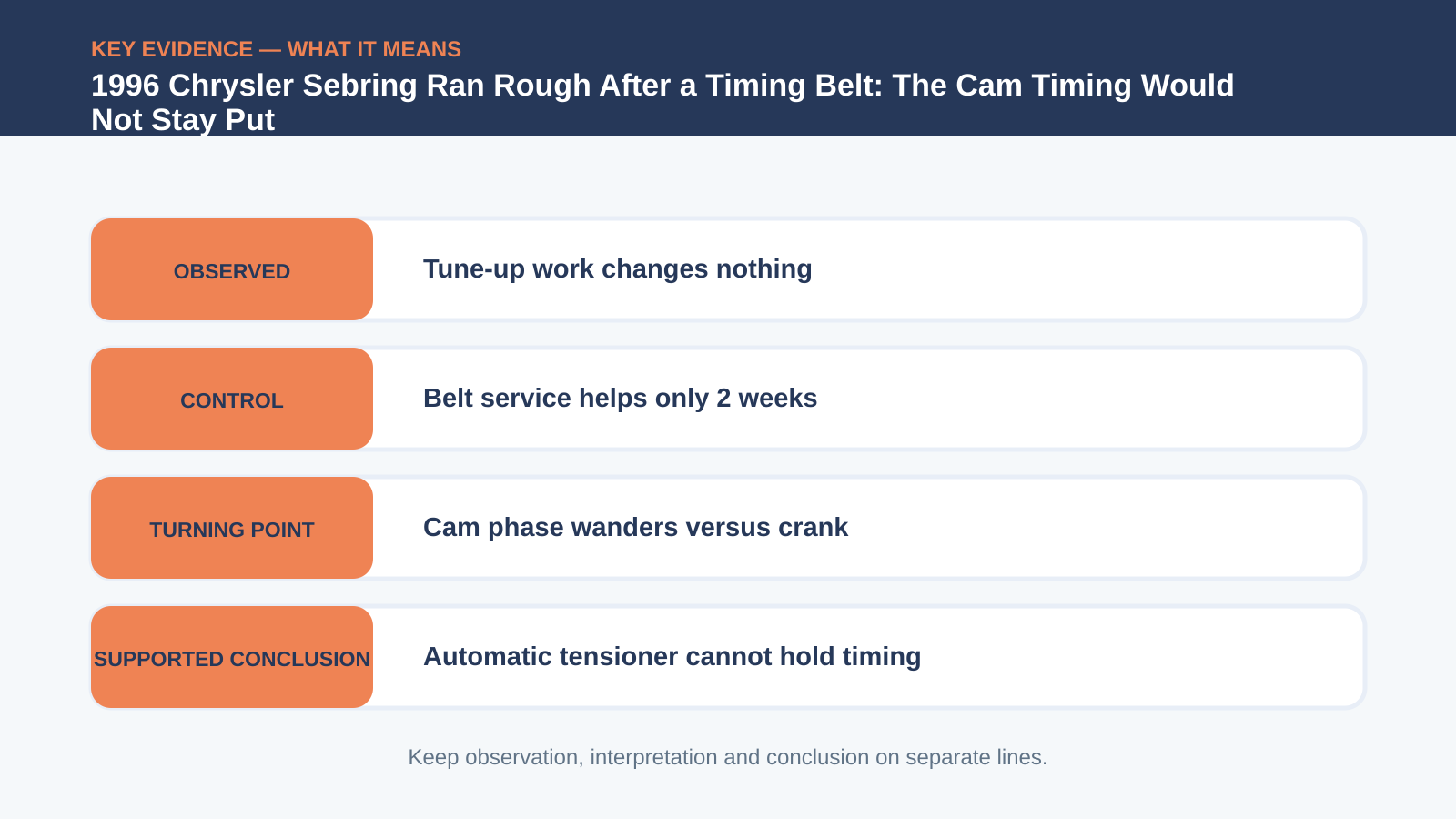
The pre-repair capture showed cam position moving relative to crank position. That rules out a fixed one-time offset as the whole story and points toward a belt-control component that cannot maintain tension. Compare during the no-start if possible, then during the rough low-rpm state. Do not infer a tensioner from correlation alone; inspect belt condition, sprockets, idlers, mounting and the correct automatic-tensioner setup. A damaged keyway or loose sprocket can create another moving relationship.
| Observation | Question answered |
|---|---|
| Air, fuel and ignition are available | The engine is not simply missing a basic input |
| Timing-belt service helped for two weeks | Belt tension or phase deserves renewed attention |
| Crank/cam phase wanders | Mechanical relationship is not being held consistently |
| Phase is stable after tensioner repair | The same failure mechanism is no longer present |
Inspect the tensioner under the service procedure
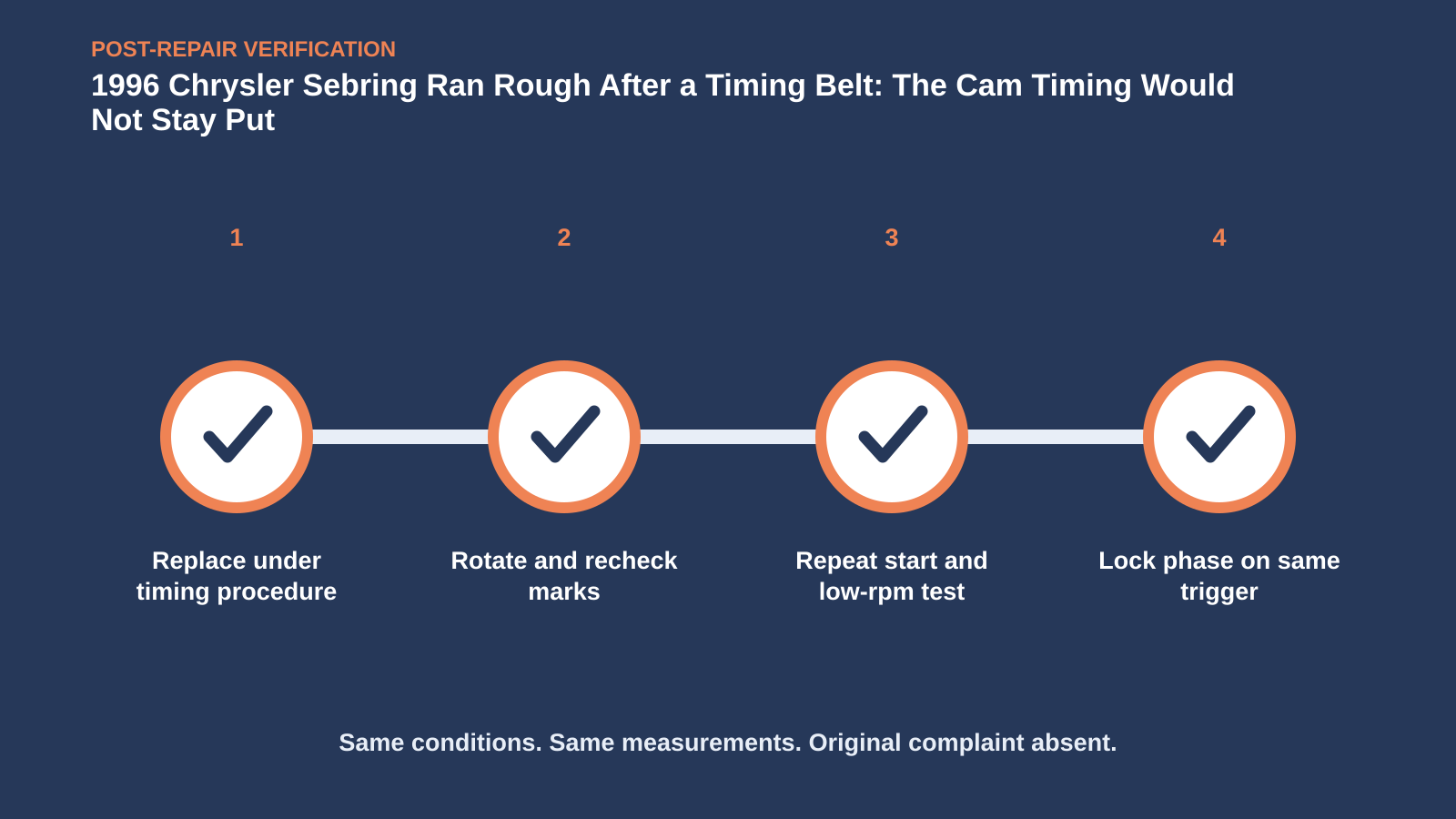
Follow the service manual for access, timing marks, tensioner preparation and engine rotation. Support the engine where required and protect hands from spring-loaded components. Replace the confirmed faulty tensioner and any timing components that fail inspection or belong in the specified service kit. Rotate the crank by hand through the required cycles and recheck marks and tension before starting. A belt drive assembled one tooth out can produce a different but equally serious problem.
Reassemble and establish a clean start
The repaired Sebring started easily and ran well through the low-rpm range. Check for abnormal belt noise, covers rubbing and oil or coolant contamination. Allow the engine to reach operating temperature, restart it and repeat the previously unreliable condition. The source recorded good operation at 128,000 miles; the customer-facing result is useful, but it should be paired with the measurement that made the repair credible.
Lock the post-repair phase on the same trigger
Trigger the post-repair capture from the same crank feature and overlay several cycles. The crank trace should remain locked while the cam edge holds its expected position instead of drifting. Save timebase, channel scaling, rpm and temperature so the before/after comparison is fair. Rescan and road-test below the former 2,500-rpm problem band. A stable phase plus restored starting closes both the electrical-looking symptom and the mechanical cause.
The timing belt had been changed, but the system that controlled it had not proved it could hold time. Watching crank and cam together converted a temporary post-service improvement into a testable tensioner diagnosis.








Comments 0
Questions, fixes, and real-world diagnostic notes from readers.
Be the first to share a diagnostic result or ask a follow-up question.