
2009 Chevy Aveo A/C Stayed Warm After Charging: The Compressor Control Valve Was Stuck

Charged But Still Warm? Read The Pressure Pattern
The Aveo arrived with warm vents and low refrigerant. Charging it was necessary, but it did not make cold air—and the nearly flat relationship between the high and low sides said the job was no longer just about quantity. The case became a sequence of permissions, pressure behavior and one moving valve inside the V5 compressor.
One useful machine class at this stage is a bounded measurement tool, chosen only after the circuit or system question is defined. The AUTOOL LM708 is one route for that supporting task. LM708 can recover, evacuate, leak-check and recharge compatible R134a or HFO-1234yf systems by the applicable procedure. It cannot prove the valve is stuck, command the fan or replace pressure and temperature diagnosis.
This article follows one documented vehicle. Its cause is a useful diagnostic pattern, not a failure-rate claim and not permission to replace the same part on a similar symptom. The goal is to show which evidence changed the decision and how the repair was verified.
Quick answer: Adding refrigerant corrected the low-charge state only. Plausible sensors plus weak pressure separation led to the stuck V5 control valve; replacement restored cold air.
In this guide
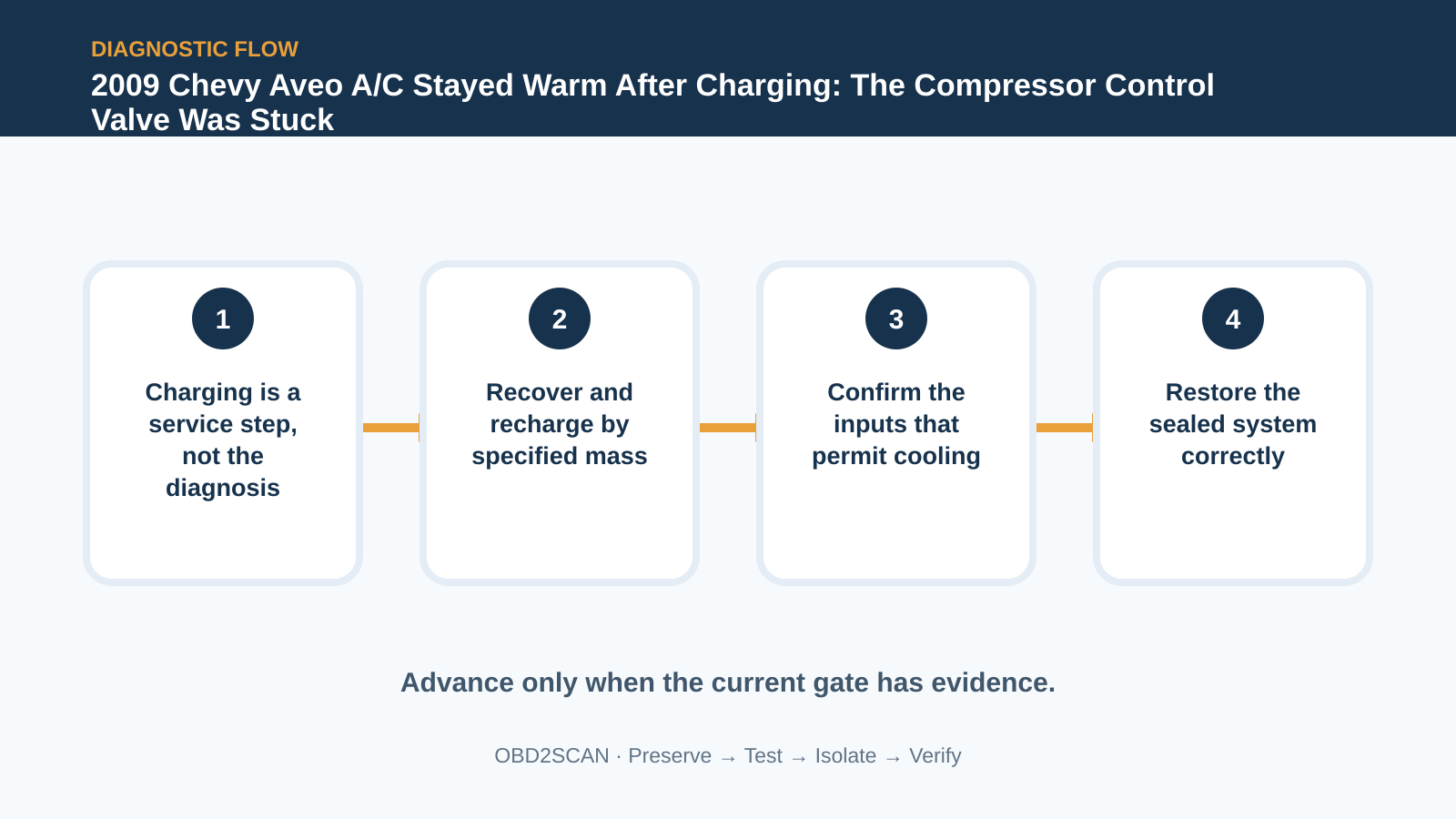
- Charging is a service step, not the diagnosis
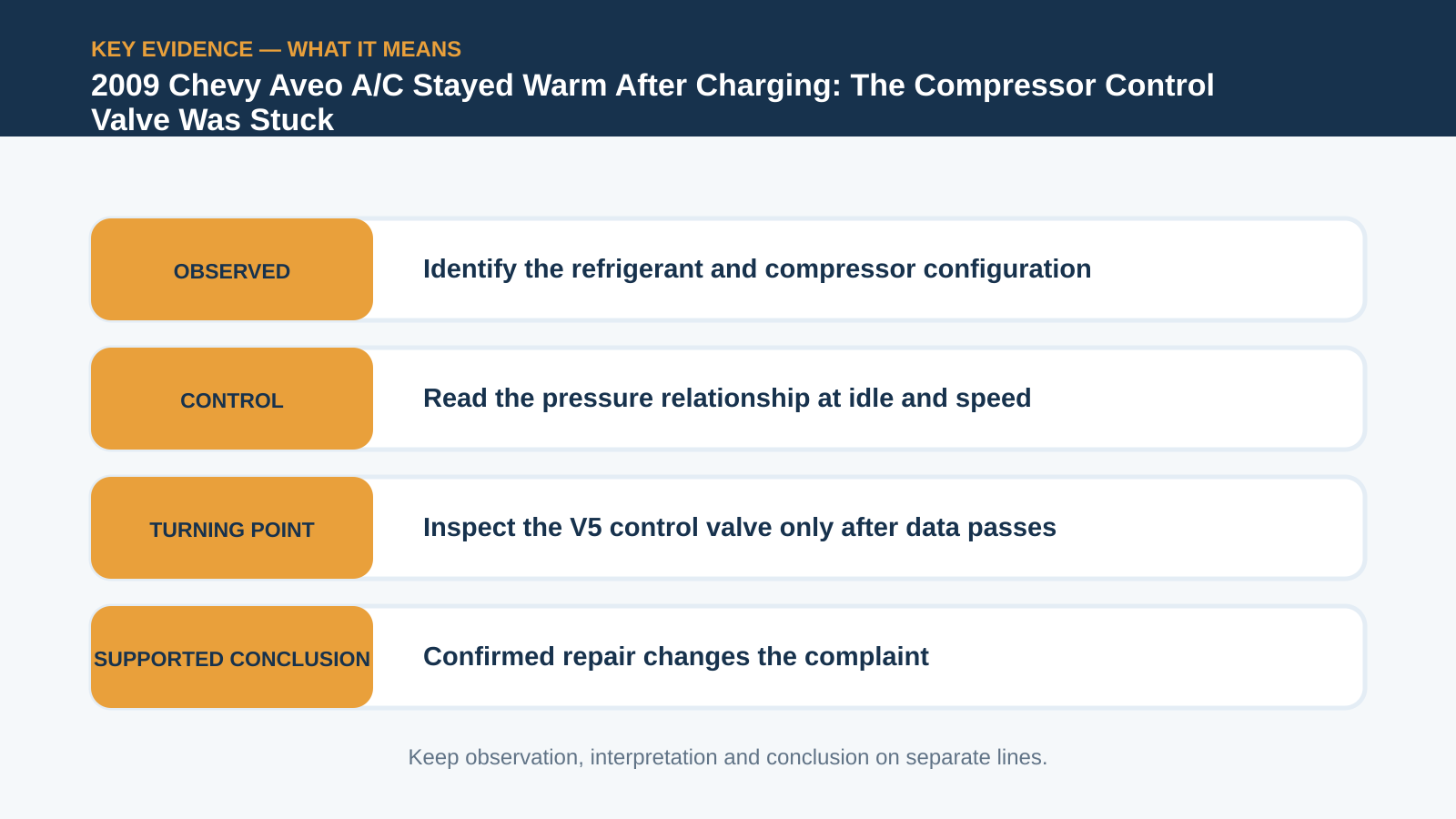
- Identify the refrigerant and compressor configuration
- Recover and recharge by specified mass
- Read the pressure relationship at idle and speed
- Confirm the inputs that permit cooling
- Inspect the V5 control valve only after data passes
- Restore the sealed system correctly
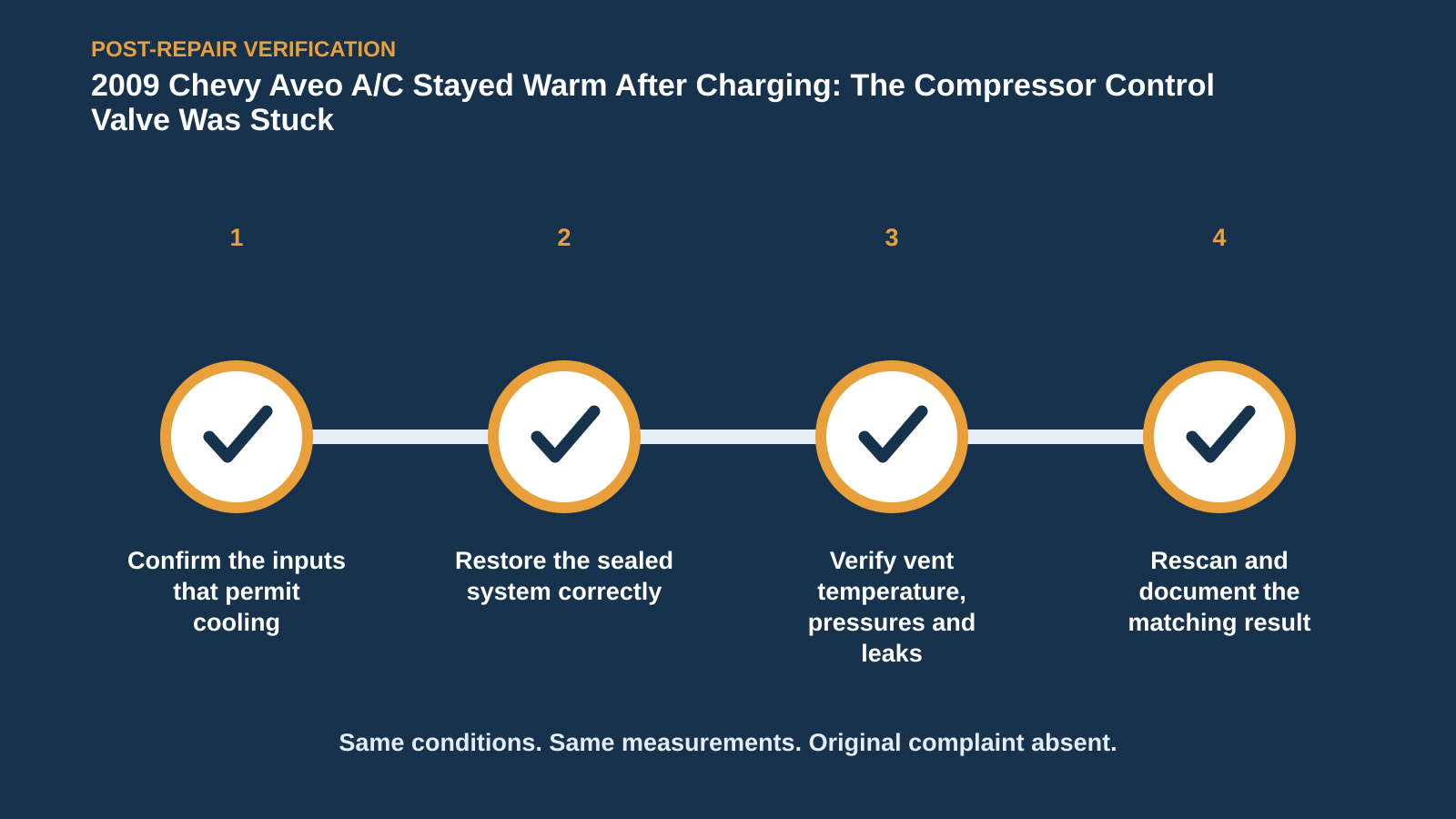
- Verify vent temperature, pressures and leaks
Charging is a service step, not the diagnosis
Warm air first requires a safe refrigerant assessment. Identify the label, use trained personnel and approved recovery equipment, and separate blower or blend-door complaints from compressor and sealed-system faults. Keep the vehicle in the failed state long enough to capture evidence, but never extend a test beyond the point where a stall, brake event, refrigerant release or moving component creates risk.
Identify the refrigerant and compressor configuration
The Aveo used a manual HVAC system with a V5 compressor. Confirm that configuration before applying a test path; compressor control and expected behavior can differ across engines, options and replacement assemblies. Write down the conditions before disconnecting anything. That record is what lets a later change mean something instead of becoming another uncontrolled attempt.
Recover and recharge by specified mass
The source found a low charge and added the specified 1.1 pounds. A responsible workflow recovers, evacuates, leak-checks and charges by specified mass; pressure alone is not an accurate charging method. Use service information for the exact engine, build and option set. A correct test on the wrong pin or configuration can produce a precise but useless answer.
Read the pressure relationship at idle and speed
After charging, low and high sides stayed unusually close—reported around 75/140 psi at idle and 80/140 at 2,500 rpm—and the lines remained warm. Use vehicle and ambient specifications, not those numbers as a universal chart. This is the turning point in the documented case. It gains weight because earlier branches were tested and because the symptom changed with one controlled condition.
| Observation | What it supports | What it does not prove |
|---|---|---|
| Charge was low | Refrigerant service is required | Leak cause is known |
| Sides barely separate | Compressor pumping/control is weak | Universal pressure diagnosis |
| Three inputs plausible | Those inhibit paths move down list | Every electrical circuit is good |
| Valve stuck and cooling returns | Valve was causal in this car | Every warm Aveo needs a valve |
Confirm the inputs that permit cooling
Check evaporator temperature, coolant temperature and high-pressure input for plausibility, plus fan and compressor requests. All three sensor values in this case passed, giving the internal control branch more weight. Separate observation from inference: record what moved, opened, failed or remained stable, then state only the component or path that result actually narrows.
Inspect the V5 control valve only after data passes
With the system recovered and depressurized by procedure, inspect the compressor control valve for debris and free movement. The documented valve was stuck; that observation, not the earlier pressure-sensor replacement, supported the repair. The repair must remove the demonstrated mechanism and restore mechanical support, sealing, torque or terminal fit—not merely make the symptom disappear once.
Restore the sealed system correctly
Replace the confirmed valve with compatible seals and oil handling, then evacuate and recharge again by mass. Do not open a charged system, vent refrigerant or reuse contaminated sealing parts. Reassemble to the original protection standard. Clear codes only after preserving the pre-repair record and confirming the relevant controller is online.
Verify vent temperature, pressures and leaks
Stabilize engine speed and cabin settings, then record vent temperature, both pressure sides, fan function and leak status. Cooling returned in the mature case; the final check should also ensure the low-charge reason is not still open. Use the customer’s original complaint as the final test specification. Matching conditions and a post-repair scan are stronger closure than a quiet bay or a cleared warning lamp.
For the owner or service adviser, the useful explanation has three parts: what was observed, why the decisive test narrowed the fault, and which original condition was repeated after repair. It should not promise that every similar vehicle needs the same component. This was one evidence chain on one vehicle, and the appropriate next step on another car may change with build data, prior work, safety condition and test results. That honest boundary makes the case easier to trust and more useful at the next diagnostic visit.
Adding refrigerant corrected the low-charge state only. Plausible sensors plus weak pressure separation led to the stuck V5 control valve; replacement restored cold air. The reusable lesson is narrower and more valuable: Use the pressure relationship and sequential permission checks, not a single gauge value or an automatic recharge conclusion.








Comments 0
Questions, fixes, and real-world diagnostic notes from readers.
Be the first to share a diagnostic result or ask a follow-up question.