
Honda CR-V Surged Only at Full Throttle: The Fuel-Rail Tuning Box Was Lying to the ECU

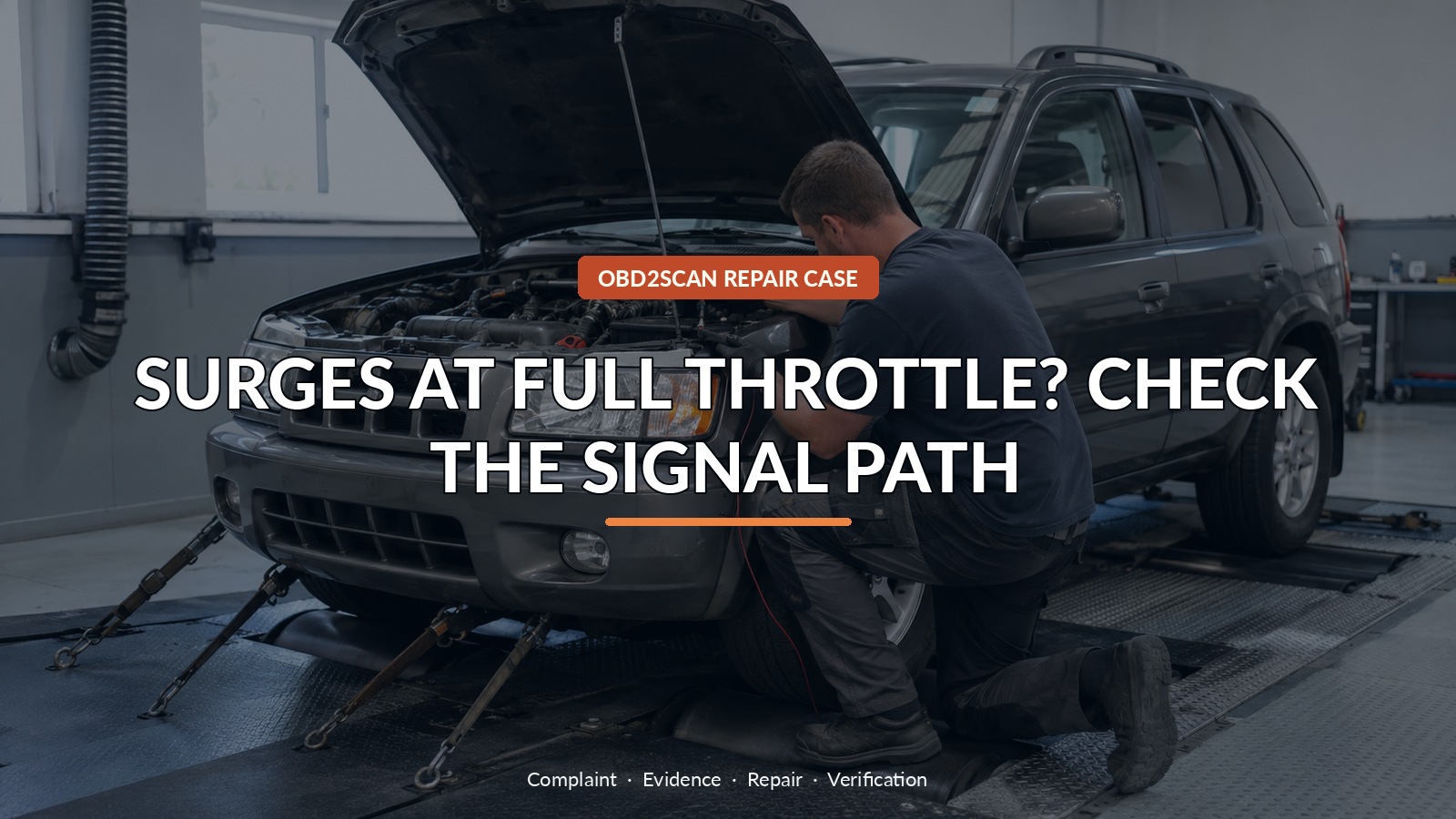
Surges At Full Throttle? Check The Signal Path
A 2007 Honda CR-V 2.2 CDTi arrived with a wonderfully specific complaint: it drove normally until the driver asked for hard acceleration, then surged violently back and forth. Lifting the accelerator made it civil again. There was no warning lamp, no useful DTC, no unusual smoke, and nothing alarming at idle or during a 3,000-rpm free-rev. That last detail matters. An engine can look healthy in a bay while fuel demand on a hill exposes a problem that simply does not exist unloaded.
The first useful tool category here is an automotive meter or scope that can watch an identified sensor circuit over time, not a fuel-pressure gauge connected by guesswork. A handheld option such as the AUTOOL DM303 can support accessible power, ground and signal checks once the wiring diagram defines the pins. DM303 can support accessible power, ground, voltage and slow automotive waveform checks once Honda wiring information identifies the circuit; it cannot measure common-rail fuel pressure directly, reproduce a safe loaded road test alone, or replace simultaneous multi-channel capture.
This is one documented CR-V repair, not proof that every diesel hesitation comes from a tuning box. Its value is the method: preserve the exact failure, compare what the driver requests with what the ECU is told, and verify the same road condition after the signal path is restored.
Quick answer: A no-code CR-V surge under hard load came from an inline tuning box corrupting the fuel-rail-pressure signal. Stable supplies and a stock-path retest proved the repair.
In this guide
- The road-test condition mattered more than the empty code list
- An auction purchase changes the first inspection
- Do not remove the tuning box before preserving the fault
- Compare driver demand with both pressure signals
- Separate a bad message from a lost power supply
- Return the rail sensor to the factory signal path
- Repeat the hill and full-load test without improvising
- What this case can—and cannot—tell another CR-V owner
The road-test condition mattered more than the empty code list
The absence of a code was not permission to start replacing parts. The symptom had three boundaries: wide-open throttle, substantial road load, and immediate recovery when demand was removed. Boost control, fuel delivery, accelerator input and EGR behavior could all sit on the list, but none had earned a part yet. The safest way to reproduce a violent surge is on suitable workshop equipment or a controlled test route with one person driving and another system recording. Do not watch test leads or a screen while driving. A repeatable condition is diagnostic leverage only when the test itself is controlled.
An auction purchase changes the first inspection
The CR-V had recently come from an auction, so its service and modification history was thin. A careful visual inspection found an unknown accessory wired in series with the fuel-rail-pressure sensor. That immediately raised suspicion, but suspicion is not the same as proof. The accessory might have been innocent while a genuine rail-pressure, boost or accelerator fault caused the surge. Photographing its connections, checking for damaged terminals and identifying the original sensor wires preserved both the evidence and a route back to stock.
Do not remove the tuning box before preserving the fault
It would have taken minutes to remove the box and see whether the CR-V felt better. That shortcut might have fixed the symptom, but it would not show whether the accessory was corrupting the signal, losing power, or merely disturbing a weak connector. The better test recorded accelerator position, the pressure-sensor signal before the accessory, and the accessory’s output to the ECU during the failure. This approach also checked whether the underlying fuel system still behaved normally once the extra device was out of the picture.
Compare driver demand with both pressure signals
At the start of acceleration, both pressure-related signals rose in a believable relationship. Near maximum demand, the accessory output and the actual sensor path dropped and recovered in rapid cycles. The scan data had hinted that rail pressure fell toward zero even though the accelerator remained high, but its update rate blurred the event. The faster electrical capture showed the altered output moving between roughly idle and maximum signal levels in about 200 milliseconds. That timing matched the lurch the driver felt.
| Observation | What it changed |
|---|---|
| Normal idle and free-rev | Kept the investigation focused on loaded operation |
| No DTCs | Prevented the code list from becoming the diagnostic plan |
| Added device in the FRP signal path | Created a testable comparison, not an automatic conviction |
| Stable supply/ground but unstable altered signal | Pointed to the accessory rather than a shared electrical feed |
Separate a bad message from a lost power supply
Power and ground at the rail-pressure sensor remained stable through the event. That was the separating test. If supply voltage or ground had collapsed, the investigation would move upstream toward shared power, wiring or the ECU. Here, the stable foundation and unstable modified signal kept the added device in focus. The distinction is important because a low scan-tool pressure value does not automatically mean the high-pressure pump physically lost pressure. The ECU can react badly when the voltage representing pressure becomes implausible, even while the hydraulic hardware is still capable.
Return the rail sensor to the factory signal path
The accessory was removed and the factory sensor circuit was restored without leaving stretched terminals or improvised splices. On an unknown-history vehicle, that means inspecting the connector pin fit, protecting any repaired insulation and securing the harness away from vibration and heat. The goal was not to tune the box differently. It was to return the ECU to the signal relationship Honda intended and give the next test a clean baseline.
Repeat the hill and full-load test without improvising
Verification repeated the condition that had always caused the complaint: full demand under load, including the hill-like portion of the test. Rail-pressure behavior remained stable and the violent surge did not return. Normal idle alone would have been a weak sign-off because the car had always idled normally. A credible close-out therefore paired the driver’s outcome with the electrical evidence—same demand, stock signal path, no collapse and no consequential symptom.
What this case can—and cannot—tell another CR-V owner
Another CR-V with hesitation could have a restricted fuel supply, boost leak, sticking EGR system, accelerator-input problem or a genuine pressure-control fault. This case does not rank those causes. What transfers is the order of work: define the load window, inspect for non-factory devices, preserve before-data, prove supplies, remove only the verified disturbance and repeat the same load. If high-pressure diesel work or a road test cannot be controlled safely, give a specialist the symptom timeline and photographs rather than experimenting.
The repair was the removal of one untrustworthy messenger, not the replacement of an expensive fuel system. That is the useful lesson for an owner facing a no-code surge: tell the shop exactly when the car fails, disclose or photograph every added device, and ask for before-and-after evidence from the same condition. Stop the loaded test immediately if the vehicle cannot be controlled safely. A short, well-aimed test can answer more than an afternoon of free-revving in the bay.






Comments 0
Questions, fixes, and real-world diagnostic notes from readers.
Be the first to share a diagnostic result or ask a follow-up question.