
2014 Dodge Ram P0456 Survived a Smoke Test: The ESIM Signal Wire Was Crushed

P0456 But No Smoke Leak? Test The Signal
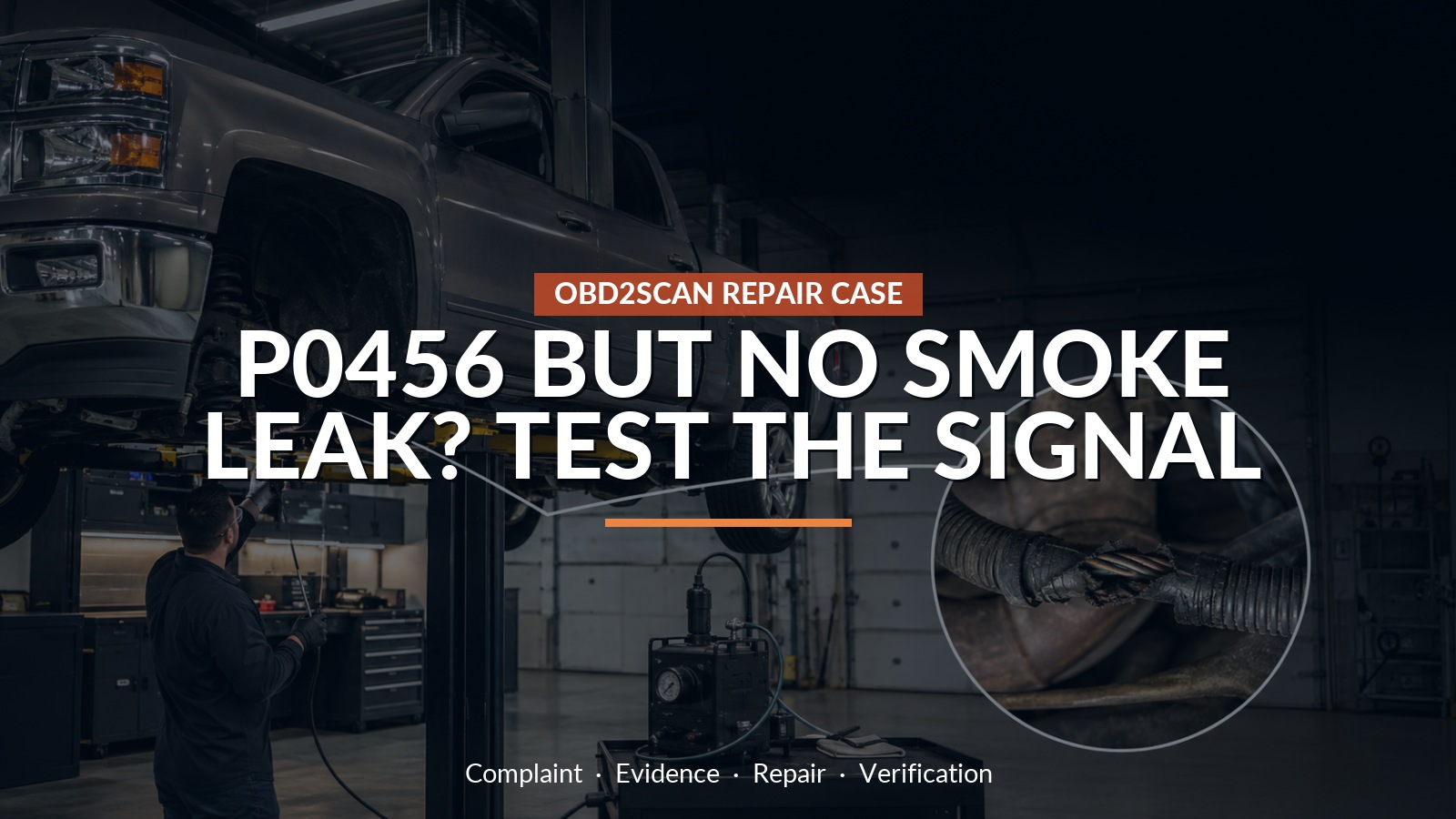
The Ram displayed a loose-fuel-cap message and stored P0456. An OEM cap did not clear it, and extensive smoke testing revealed no leak. The absence of escaping smoke was not a failed diagnosis—it was the result that finally allowed the case to move from sealing to sensing.
A self-contained low-pressure machine such as the AUTOOL SDT106 can help answer whether a correctly isolated EVAP path leaks visibly. SDT106 can support a correctly isolated low-pressure EVAP leak check within its instructions. It cannot test ESIM logic, locate an open wire or establish the vehicle’s monitor conditions.
The fuel-tank pressure sensor showed strong vacuum, but the evaporative system integrity monitor never changed to closed. Even a controlled connector test still read open. Infinite resistance at PCM connector C1 pin 70 led to a crushed and broken signal wire near the driver-side exhaust manifold. Wire repair restored ESIM state and the readiness monitor completed.
Quick answer: The EVAP system held vacuum and showed no smoke leak, but a crushed ESIM signal wire could never report the closed state.
In this guide
- P0456 does not guarantee a hole
- Confirm cap fit, then stop replacing caps
- Use low-pressure smoke to answer one question
- Compare tank vacuum with ESIM state
- Jumping the connector did not change the data
- Trace the open from the PCM boundary
- Protect the repaired wire from heat and crush
- Complete the EVAP readiness monitor
P0456 does not guarantee a hole
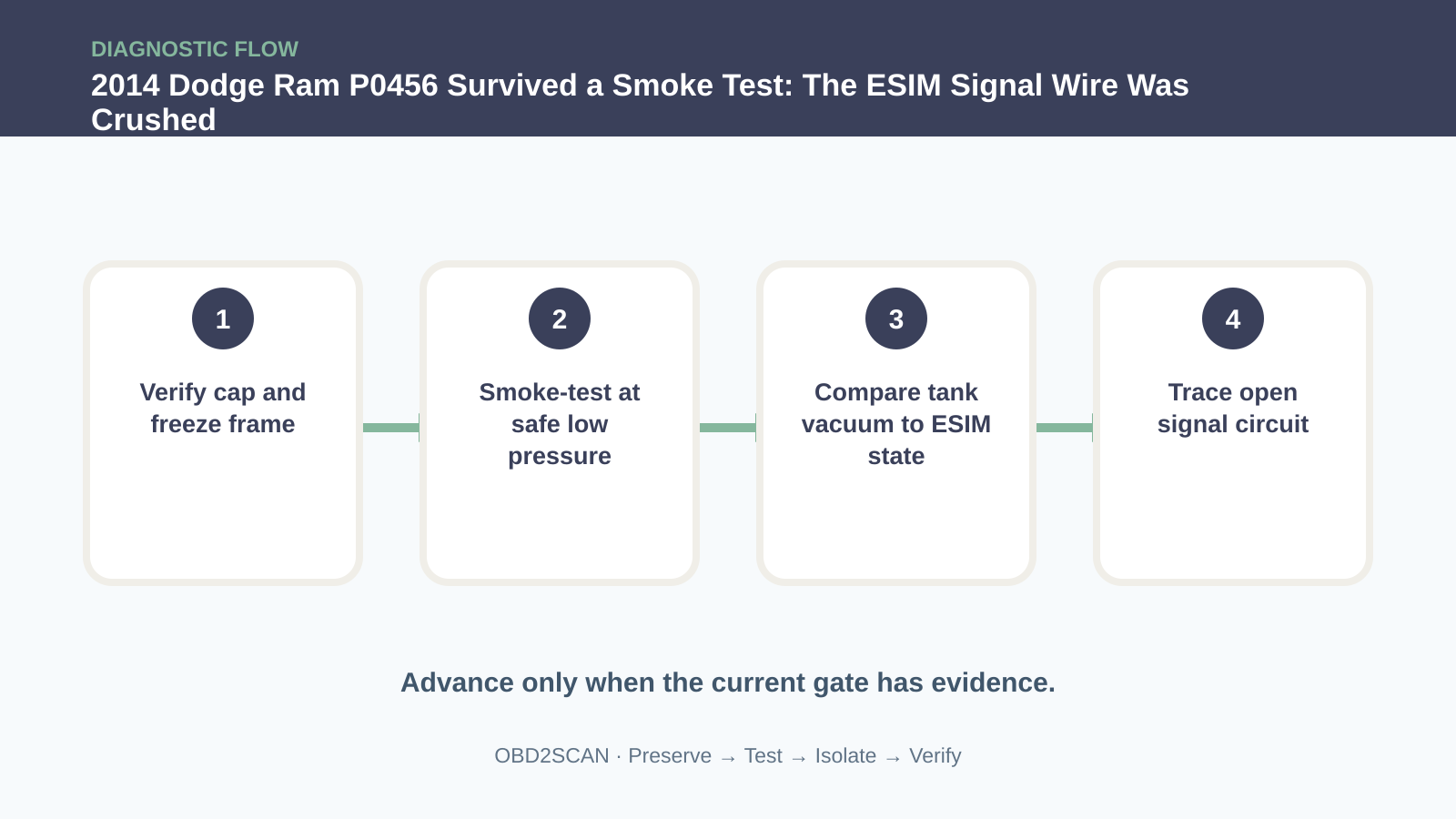
Start by recording P0456 status, freeze-frame, fuel level and the customer’s refueling history. Inspect cap seal, filler neck and obvious hose damage, and confirm the replacement cap is correct. A small-leak code indicates the monitor did not see its expected pressure or switch response; it is not a parts label for the cap. Work in a ventilated area away from ignition sources, follow EVAP service precautions and never pressurize a tank beyond the tool and vehicle limits.
Confirm cap fit, then stop replacing caps
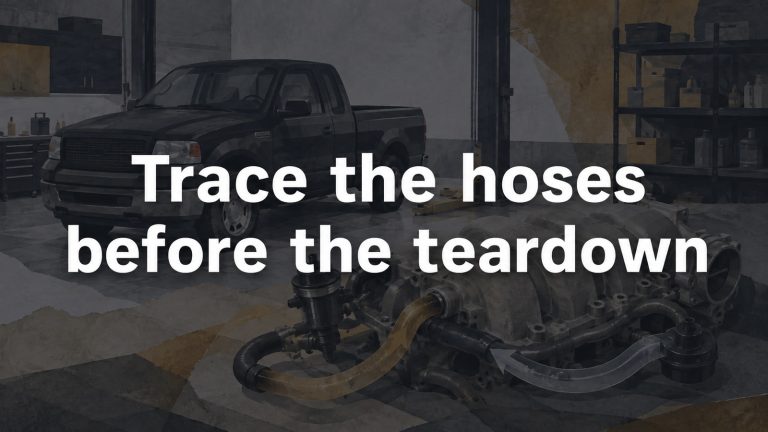
The new OEM cap made no difference, so the next question was whether vapor actually escaped. Isolate the system as the manufacturer procedure requires and apply regulated, low-pressure smoke. Watch the flow indication before chasing a wisp; a small system can fill slowly, while fuel vapor and temperature can alter pressure. Inspect purge, vent, canister, filler and line joints. The technician smoked this system extensively without finding a leak. That result moved a physical opening down the list, though it could not prove every leak was impossible under all temperatures.
Use low-pressure smoke to answer one question
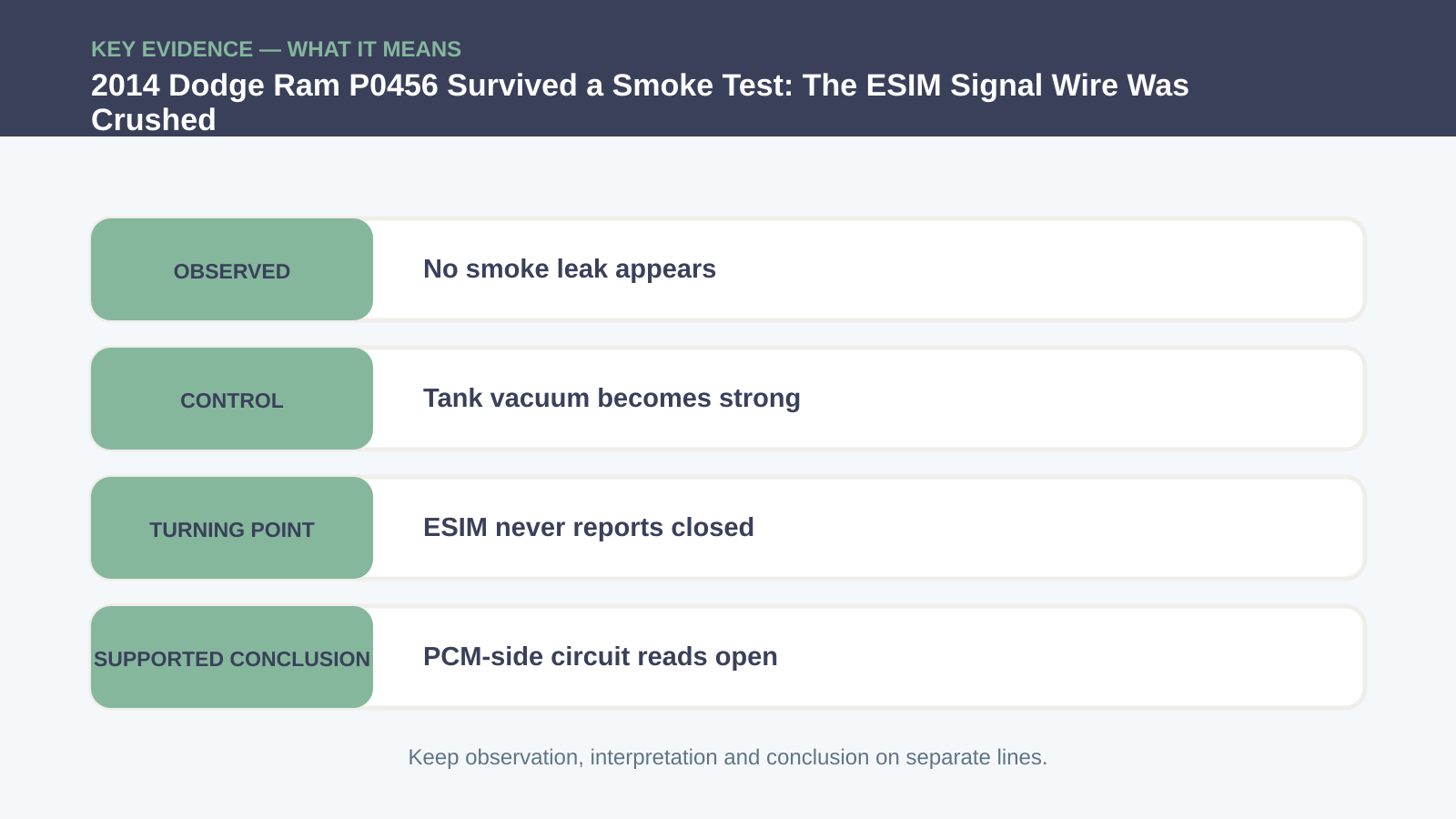
Scan data then supplied an important disagreement. The fuel-tank pressure sensor reported a strong vacuum, showing that the system could change pressure. The ESIM status never reported closed. Two observations that should occur together had separated: physical vacuum existed, but the monitor input did not acknowledge the state. Before replacing the ESIM, verify the scan parameter definition and command conditions. A switch can fail, but an open signal circuit produces the same unmoving data.
Compare tank vacuum with ESIM state
A controlled check at the ESIM connector was intended to create the expected closed input, yet scan data still showed open. That moved the boundary away from the vapor system and into the wire, terminals or PCM input. Use the factory diagram and specified method; do not jumper arbitrary connector pins because some monitors share bias voltage or module protection. Record which pin was connected to what and whether the state changed. A no-change result is powerful only when the simulated condition itself is valid.
| Test result | Question answered | Next direction |
|---|---|---|
| No visible smoke and low flow | No accessible leak found under test | Check monitor logic and electrical state |
| Tank vacuum becomes strong | System can create pressure differential | Compare with ESIM switch response |
| ESIM remains open | Feedback disagrees with physical state | Test switch and signal circuit |
| Connector simulation still reads open | Fault is upstream of the connector | Trace wire to PCM and inspect terminals |
Jumping the connector did not change the data
Resistance measured from PCM connector C1 pin 70 was infinite. With modules isolated and power removed exactly as service information requires, divide the circuit at accessible connectors and test each section. Continuity alone is not enough if a conductor makes contact unloaded, so use an approved load or voltage-drop method where applicable. Keep probes from spreading terminals. The open finally led to a harness area mounted to the frame near the driver-side exhaust manifold, where heat, movement and clamping deserve special attention.
Trace the open from the PCM boundary
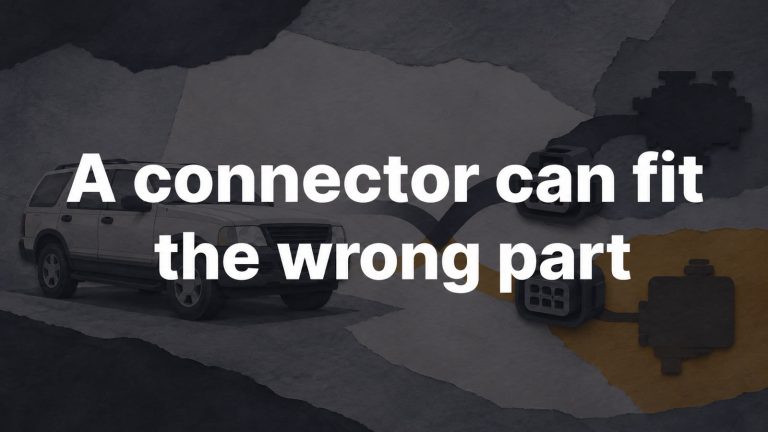
The signal wire was crushed and broken. Repair it with conductor size, insulation, sealing and support appropriate to the environment. Route it away from exhaust heat and sharp mounting pressure, restore loom protection, and confirm the harness cannot be pinched as fasteners are tightened. Do not simply twist the ends together or leave a test jumper exposed. Inspect adjacent wires because the same physical event can damage more than the single circuit that happened to set a code.
Protect the repaired wire from heat and crush
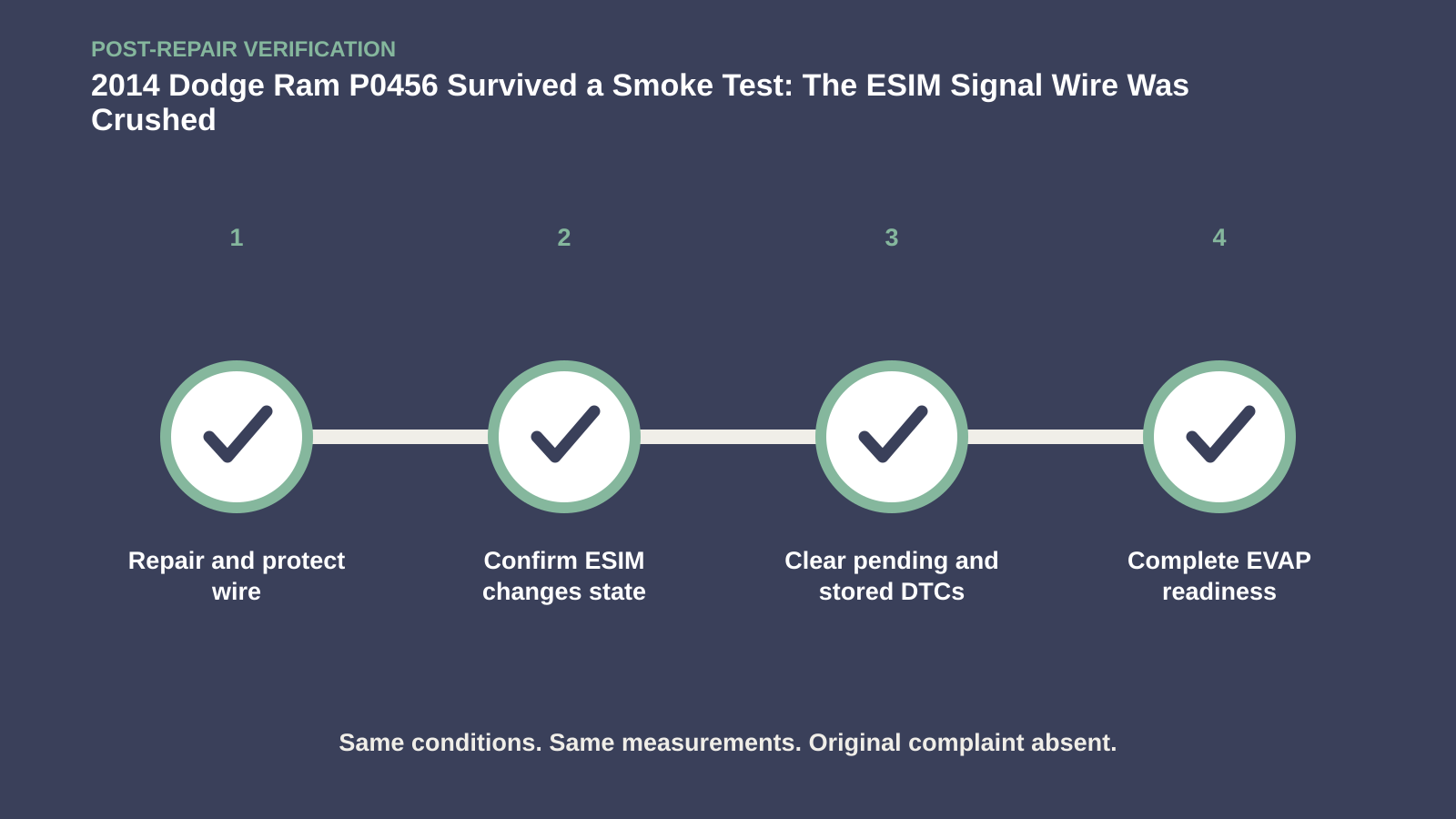
After repair, the ESIM parameter changed to closed when the monitor conditions required it. That is closer to proof than a cleared light because it confirms the previously missing information now reaches the PCM. Repeat the smoke/flow check if the system was opened, confirm purge and vent commands, and clear codes only after preserving the initial record. A repaired wire can restore state reporting while a separate tiny leak remains, so both electrical logic and sealing deserve their own final answers.
Complete the EVAP readiness monitor
The drive cycle ran the EVAP readiness monitor to completion without P0456 returning. Verify pending and permanent code status, not just the dashboard lamp. EVAP monitors often require a particular fuel level, soak temperature and drive pattern, so follow current service information instead of promising completion in a fixed number of miles. This case closes with a monitor result: the system created the expected condition, reported it correctly and passed its own enabling test after the wire repair.
The smoke machine did its job by finding no leak under the test. The repair emerged when that negative result was allowed to change the question—from “where is vapor escaping?” to “why can’t the PCM see closed?”







Comments 0
Questions, fixes, and real-world diagnostic notes from readers.
Be the first to share a diagnostic result or ask a follow-up question.