
2002 Ford Explorer Stayed Hard to Start After an Intake Leak Repair: The EGR Valve Had Rusted Through

One Real Leak Fixed—Why Still P1131?
Quick answer: This Explorer had more than one real problem. Correcting the leaking replacement intake seal removed the vacuum leak, but the hard start and lean indication remained until inspection found a rust hole bypassing the closed EGR valve; replacement restored easy starting. This article follows one documented vehicle. It explains the evidence chain, not a universal failure rate or a direction to replace the same part on every similar car. Stop whenever the test would involve overheated brakes, high current, moving parts, refrigerant handling or an uncontrolled road condition.
After repair work opens the intake, regulated low-pressure smoke can answer whether the new sealing surfaces are actually tight; AUTOOL SDT205S Smoke Leak Tester adds pressure and flow feedback for that limited question. It cannot reveal every internal EGR passage failure, prove oxygen-sensor operation, or replace fuel-pressure, vacuum and commanded-EGR tests.
The Explorer’s first intake leak was real and worth repairing, but the hard start and P1131 survived it. That comeback only made sense after the technician allowed two genuine faults to exist in the same story.
Quick answer: This Explorer had more than one real problem. Correcting the leaking replacement intake seal removed the vacuum leak, but the hard start and lean indication remained until inspection found a rust hole bypassing the closed EGR valve; replacement restored easy starting.
In this guide
Split the original repair from the comeback
Separate the original complaint from the post-repair complaint. The Explorer first arrived with P0202 and a cylinder-two misfire, and the injector test supported replacement. Hard starting and P1131 appeared after intake work, so the new sealing surfaces deserved inspection before the original diagnosis was reopened. Preserve the original condition before changing it. The first observation is the control sample against which every later test must be compared.
Prove the replaced injector branch
A smoke test found one replacement intake O-ring leaking. Replacing that seal was necessary, but it was not a complete repair because the hard start and lean indication remained. Always repeat the symptom after correcting a discovered fault; a real leak can coexist with a second fault. Use service information for the exact engine, build date and options. A correct method on the wrong terminal can create a precise but useless result.
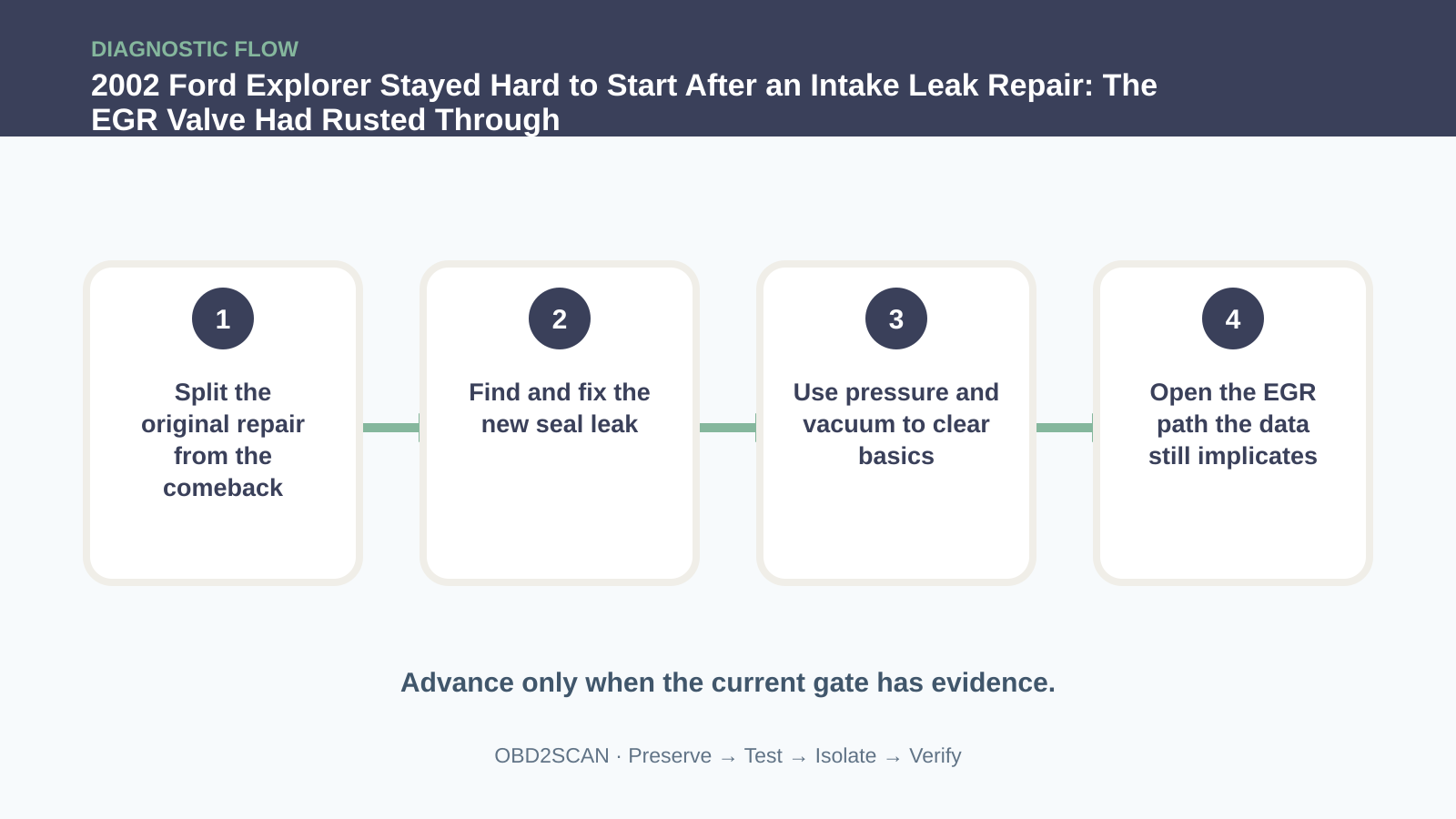
Find and fix the new seal leak
Fuel pressure measured 65 psi while running and remained above 60 psi after an hour in the documented case. Those numbers belong only to that test and configuration, but the stable result lowered the priority of a weak pump or rapid pressure bleed-down. It did not evaluate injector pattern or EGR flow. Treat prior work as evidence, not blame. A repair that made no change can narrow the case when its installation and test conditions are verified.
Retest instead of declaring victory
Manifold vacuum held near 22 inHg with a steady needle after the intake seal repair. Again, a stable gauge is a branch result, not a universal engine-health certificate. Combine it with the fact that the engine ran well off idle and had good power to focus on a condition that mattered most during starting and idle. At this stage, separate what was observed from what is inferred. The observation should remain true even if the current theory is later rejected.
| Observation | What it supports | What it does not prove |
|---|---|---|
| New intake O-ring leaks | A post-repair vacuum fault is real | It explains every remaining symptom |
| Leak repaired; P1131 remains | A second branch is still open | The original injector diagnosis was wrong |
| Fuel pressure and vacuum hold | Two basic branches lose priority | EGR flow is proved normal |
| Rusted EGR wall is visible | Closed-valve bypass is physically supported | Every P1131 is an EGR valve |
Use pressure and vacuum to clear basics
Replacing the oxygen sensor did not change the symptom. Count that failed substitution as evidence: the sensor was unlikely to be the cause of the reported lean state. A controller can report lean because exhaust oxygen is genuinely high; it is not obligated to be the failed part named by the data. This is the decision point in the documented case. Its value comes from changing one bounded condition while leaving the rest of the system intact.
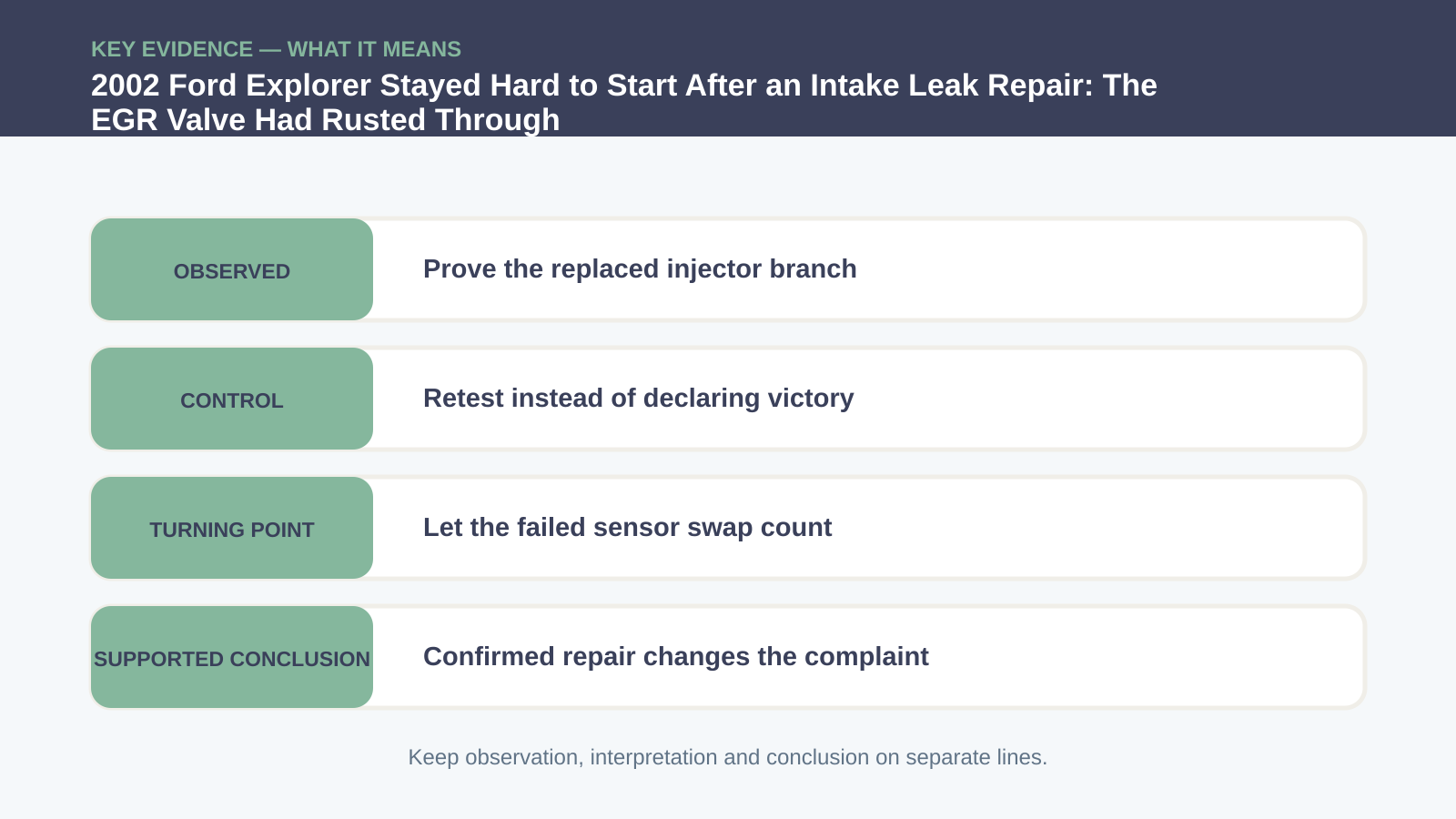
Let the failed sensor swap count
The EGR path was the next controlled branch. Removing the valve showed a rust hole in the chamber wall, allowing exhaust gas to bypass even when the valve was closed. That physical defect connected the idle/hard-start complaint to a flow path that ordinary intake smoke had not necessarily exposed. A confirmed component still needs a repair that restores sealing, support, torque, routing or terminal fit—the physical conditions that keep the fault from returning.
Open the EGR path the data still implicates
Replace the EGR valve by the vehicle procedure and inspect mating surfaces, vacuum or electrical control and passages before reassembly. Do not use sealant where it can enter the gas path. Clear codes only after the new valve is seated and all disturbed intake connections are checked again. Reassemble protective covers and retainers before declaring success. A diagnostic shortcut must not become the next failure mechanism.
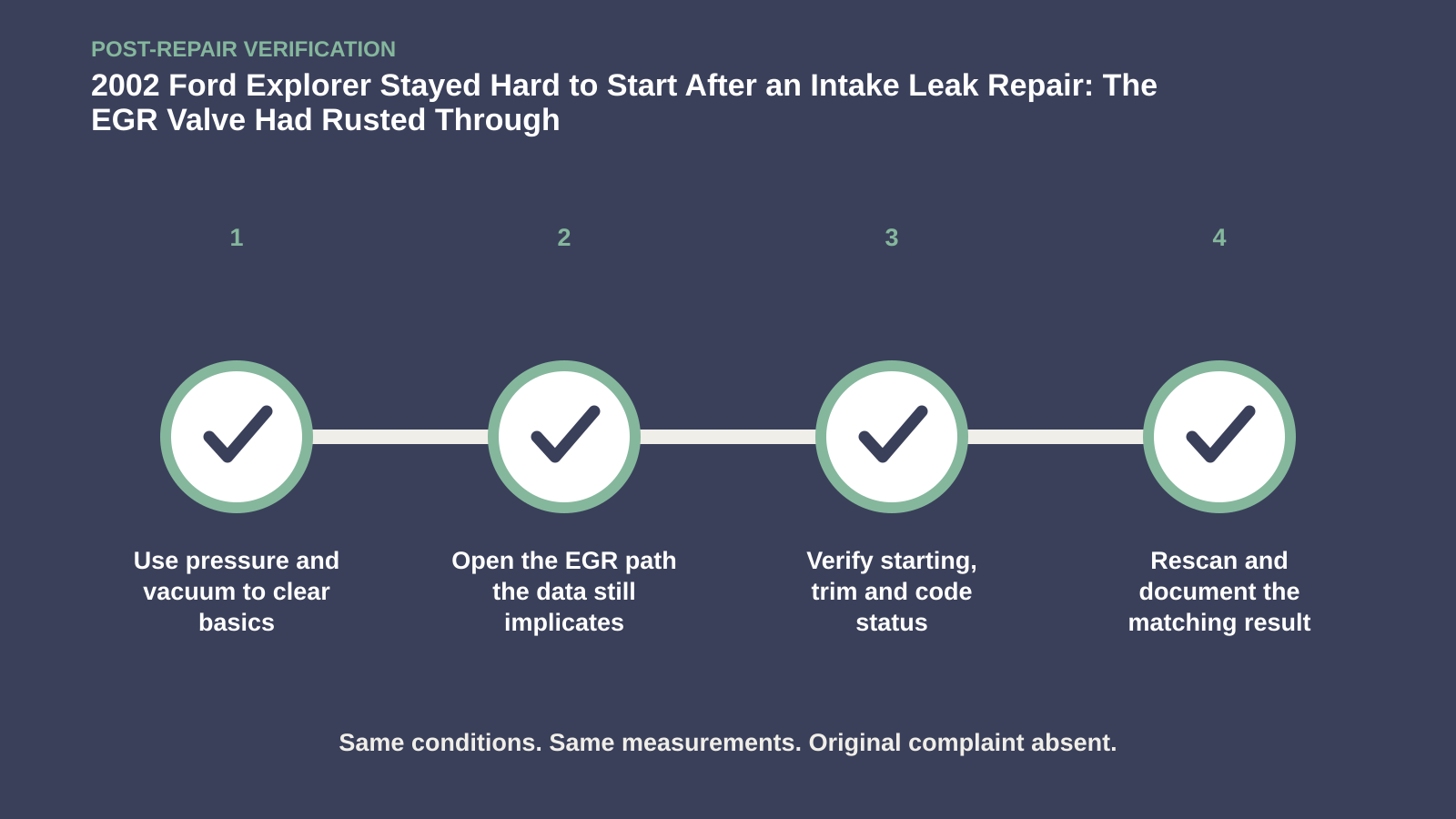
Verify starting, trim and code status
Verification needs an easy cold and warm start, stable idle, a rescan for P1131 and a check that commanded EGR behavior is plausible under the proper condition. The lesson is not that every P1131 needs an EGR valve; it is that each repair must be retested before the case is allowed to end. Use the customer’s original complaint as the final specification. A cleared code, quiet bay or one good key cycle is not equivalent to reproducing and passing that condition.
If you are bringing a similar symptom to a shop, arrive with the useful conditions rather than a requested part: whether the vehicle was cold or hot, the exact speed or switch position, which warning lamps appeared, what changed after a restart, and a chronological list of earlier repairs. A short video can preserve an intermittent sound or lamp pattern, but record it only while parked or with a passenger handling the camera. Ask the technician to retain the pre-repair scan and measurements, explain the test that separated the failed path from the alternatives, and show how the original complaint was repeated afterward.
For the owner or service adviser, a useful repair explanation has three parts: what was observed, why the decisive test narrowed the fault, and which original condition passed after the repair. It should also say what the test did not prove. That boundary prevents a memorable case from becoming an automatic parts recommendation.
This Explorer had more than one real problem. Correcting the leaking replacement intake seal removed the vacuum leak, but the hard start and lean indication remained until inspection found a rust hole bypassing the closed EGR valve; replacement restored easy starting. The reusable lesson is narrower and more valuable: Let each negative test shrink the comeback rather than using a fixed checklist; the first found leak is a repair, not automatic closure.






Comments 0
Questions, fixes, and real-world diagnostic notes from readers.
Be the first to share a diagnostic result or ask a follow-up question.