
2022 RAV4 Will Not Accelerate After Collision Repair: Is Straight Ahead Reported as a Turn?

Quick answer: Steering geometry, sensor position and stability intervention must agree. A mechanically straight-looking wheel is not enough after steering-system repairs.
After collision repair, a car that looks straight but binds in a turn is not ready for a proving drive. Stop and return the problem to the repairer. This case is useful because it separates three things that are easy to collapse into one phrase: where the wheels point, how the steering mechanism is positioned and what the electronics report.
In this guide
Resolve the steering problem before the road test
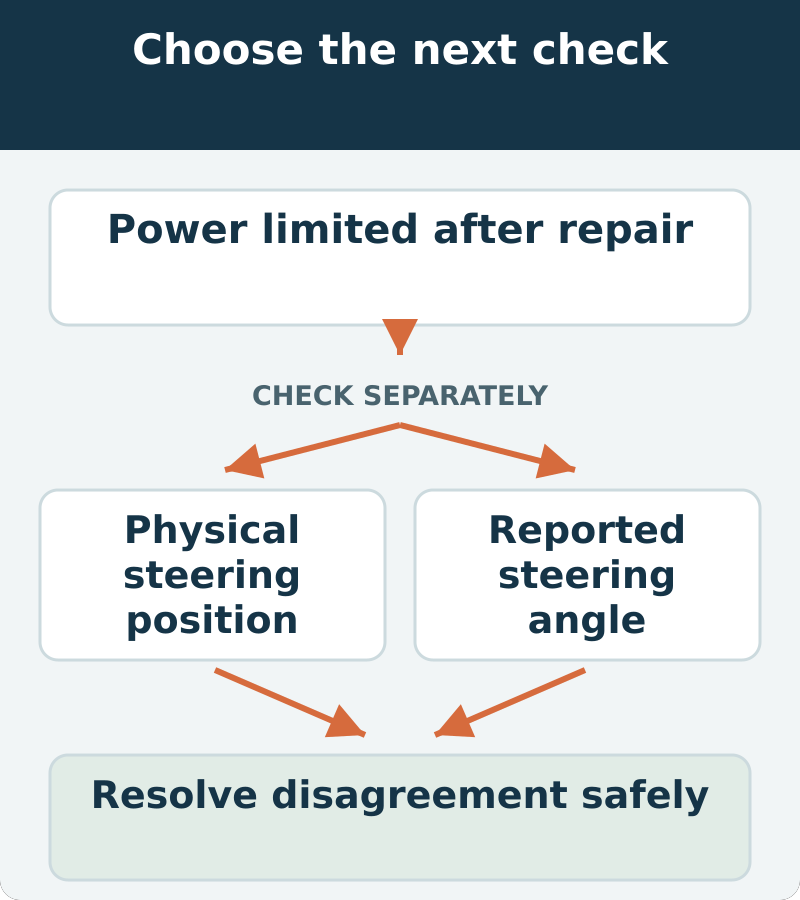
Binding steering and unexpected power limitation belong at the front of the handover conversation. Describe when they were noticed, but do not attempt to reproduce them in traffic. Ask the shop how the vehicle should be recovered and controlled safely.
A warning-free display would not override a physical steering concern. Conversely, a wheel that looks centered while parked does not establish that the whole system has been assembled or calibrated correctly. Collision work can involve interacting mechanical and electronic tasks. The appropriate response is to check those tasks together, with the vehicle’s exact repair requirements, before treating the complaint as an ordinary engine-power issue.
Three versions of straight ahead must agree
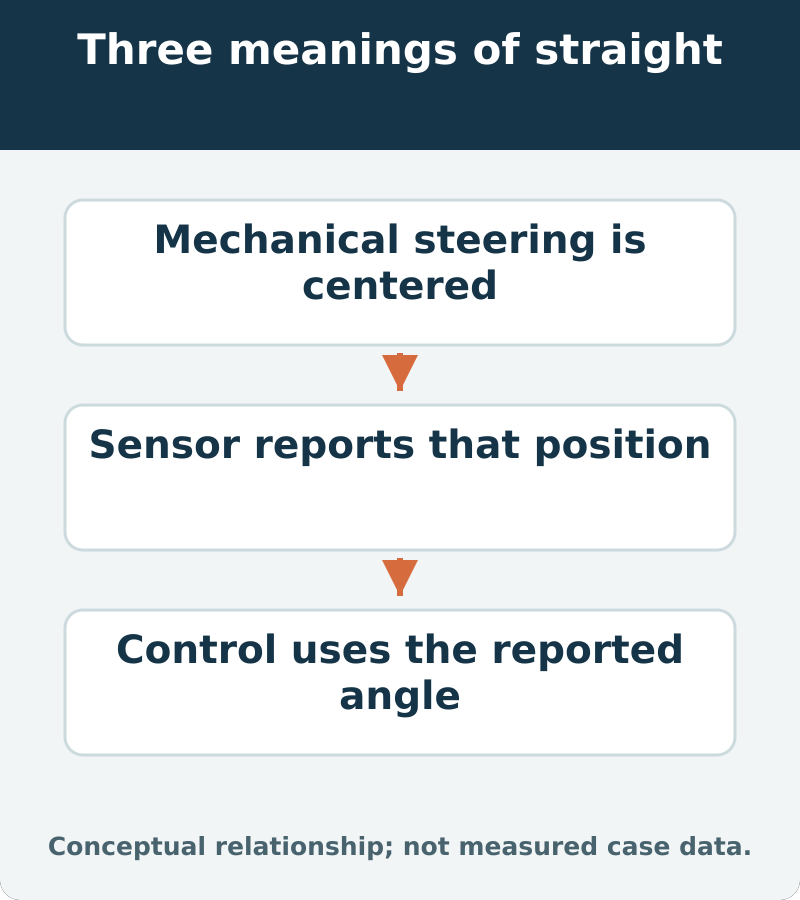
There is the road-wheel direction, the steering system’s physical position and the angle represented in control-system data. In a completed repair, these must agree in the way the manufacturer specifies. A mismatch can be informative even when individual wheel-speed readings appear plausible.
Use the illustration as a consistency check, not an alignment chart. It deliberately contains no numerical target or installation instructions. Owners can ask what was compared without moving a rack or clockspring themselves. Centering components incorrectly can create further steering or restraint problems, so a simple-looking angle discrepancy still needs qualified handling.
In the published ALLDATA case, after collision and steering repairs, this RAV4 bound while steering and restricted acceleration. Wheel speeds were similar, but straight-ahead steering data showed a full-turn offset. Correcting steering position restored the centered reading and normal operation. The source does not publish the complete collision, restraint or alignment sign-off.
Why similar wheel speeds were not the final answer
Similar wheel-speed values answer a limited question about those observations under those conditions. They do not certify steering geometry, the installation of every component or the meaning of a different sensor input. This is a useful example of why several apparently reasonable numbers can coexist with a serious overall inconsistency.
When discussing the diagnosis, ask which comparison actually contradicted the vehicle’s physical state. That question is more productive than asking whether the scan was “good.” The technician should be able to distinguish a normal observation from the observation that changed the next step. It is the relationship between them that matters.
Coding cannot correct every installation error
Coding configures electronics; mechanical indexing concerns how parts are physically positioned. Calibration establishes a required reference under specified conditions. These are related jobs, but none is a universal replacement for the others.
If something is physically installed incorrectly, repeatedly running a learning routine may not correct it. Equally, a correctly assembled mechanism can still need prescribed electronic setup. Ask the repairer to name the job being completed rather than using “reset” for every operation. Do not request disabled stability functions or altered software as a way to make the vehicle accelerate despite a remaining steering discrepancy.
What belongs on a collision handover
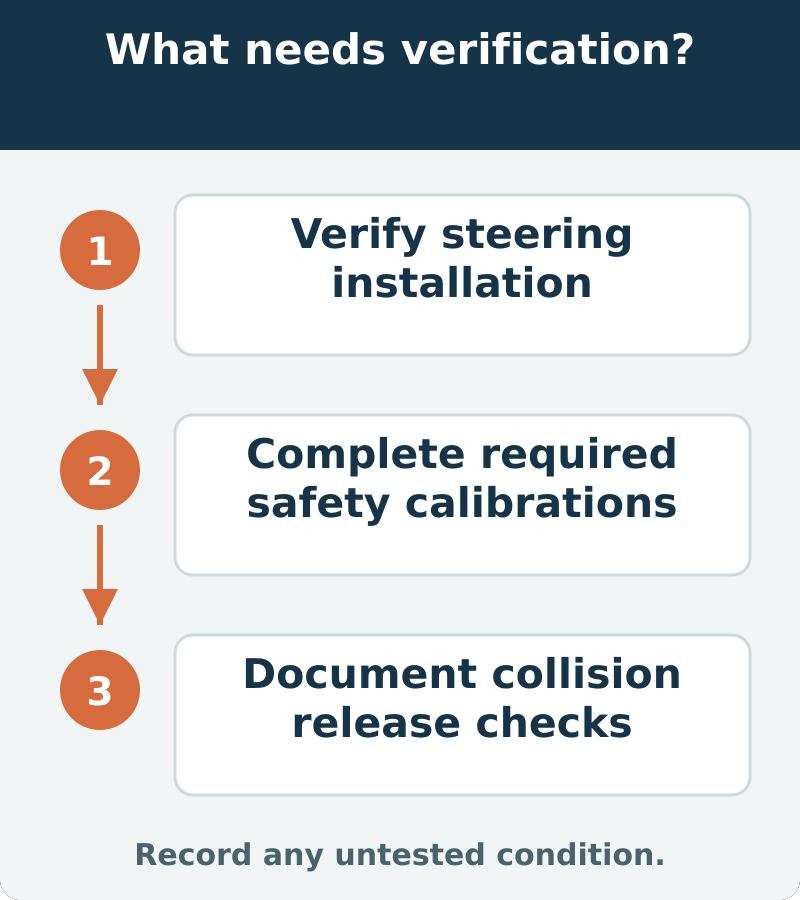
A collision handover needs more than a successful start and a short drive. Ask which steering, alignment, restraint and driver-assistance checks apply to the exact damage and work performed. Not every vehicle has the same equipment, and not every collision requires the same procedures.
The repair account’s successful symptom correction is not proof that all those separate jobs were documented. For your vehicle, obtain the relevant completion records from the people doing the work. If a task was subcontracted, ask who completed it and where its result is recorded. This keeps responsibility clear without assuming that an unmentioned task was necessarily omitted.
Ask for the completed safety checks, not just a centered display
At collection, ask for confirmation of free, correct steering operation, the required physical and electronic agreement, and the applicable safety-system completion checks. Any remaining warning or abnormal effort deserves an explanation before release, not a suggestion that it will probably learn itself away.
Keep the final alignment and setup documents with the collision invoice. If another shop later sees the vehicle, those records explain what was repaired and what was verified. The lesson is not that every power-limited RAV4 needs its steering repositioned. It is that a post-repair mismatch should be resolved at its source before the car is judged ready for normal use.






Comments 0
Questions, fixes, and real-world diagnostic notes from readers.
Be the first to share a diagnostic result or ask a follow-up question.