
2021 Ram 1500 P000C and Rough Running: Watch the Camshaft Return, Not Just Move

Quick answer: An intermittent camshaft-response fault needs a comparison across the full movement and return. A normal oil level or one successful response does not close the investigation.
“It moved when we checked it” sounds reassuring, but it answers only half the question. If your truck runs roughly on some journeys and behaves normally at the workshop, the useful next step is a record that includes what happens after the requested movement ends. Bring the warning history and the conditions you remember, not a demand for a particular solenoid.

In this guide
What does slow response mean here?
Slow response describes a relationship: the controller asks for a change, and the observed position does not follow as expected. It is not a parts-shopping instruction. Before discussing replacement, ask which camshaft, which direction of movement and which portion of the event looked wrong.
That wording matters with an intermittent complaint. A technician may see a normal response while the truck happens to be behaving. Equally, a single unfamiliar number without its operating conditions may be misleading. The goal is to identify the disagreement that accompanies the complaint, using vehicle-specific scan information and the correct test procedure.
A movement has a beginning and an end
Picture a door that opens correctly but sometimes fails to close. Watching it open once would not demonstrate that the whole mechanism works. A camshaft-position investigation has a similar observation problem, although the actual mechanism and control strategy are much more complex.
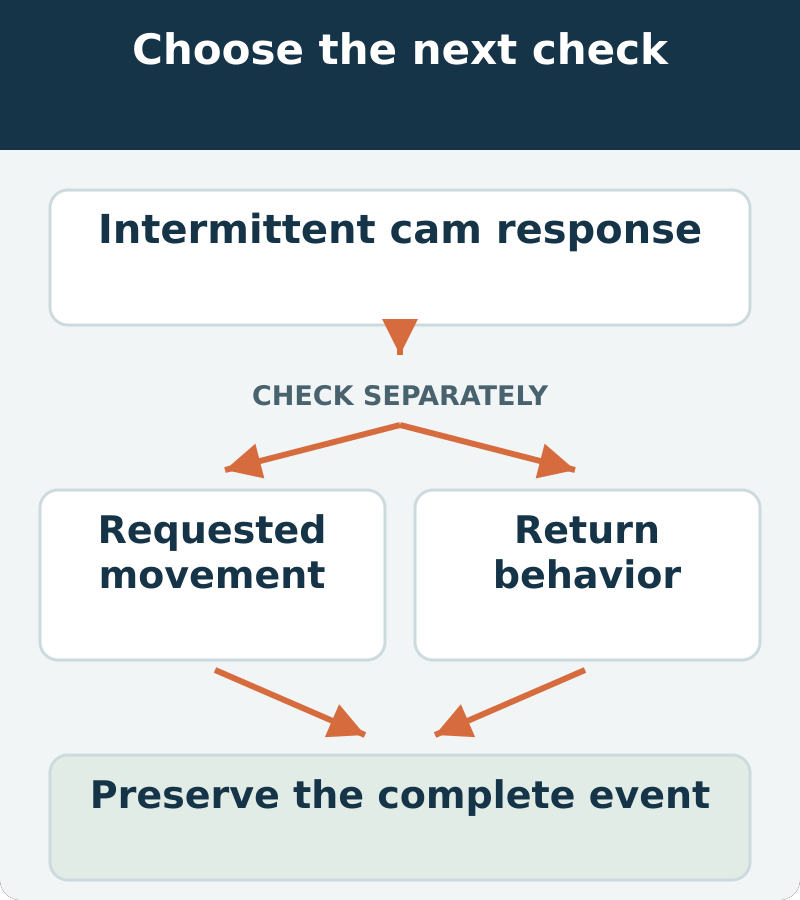
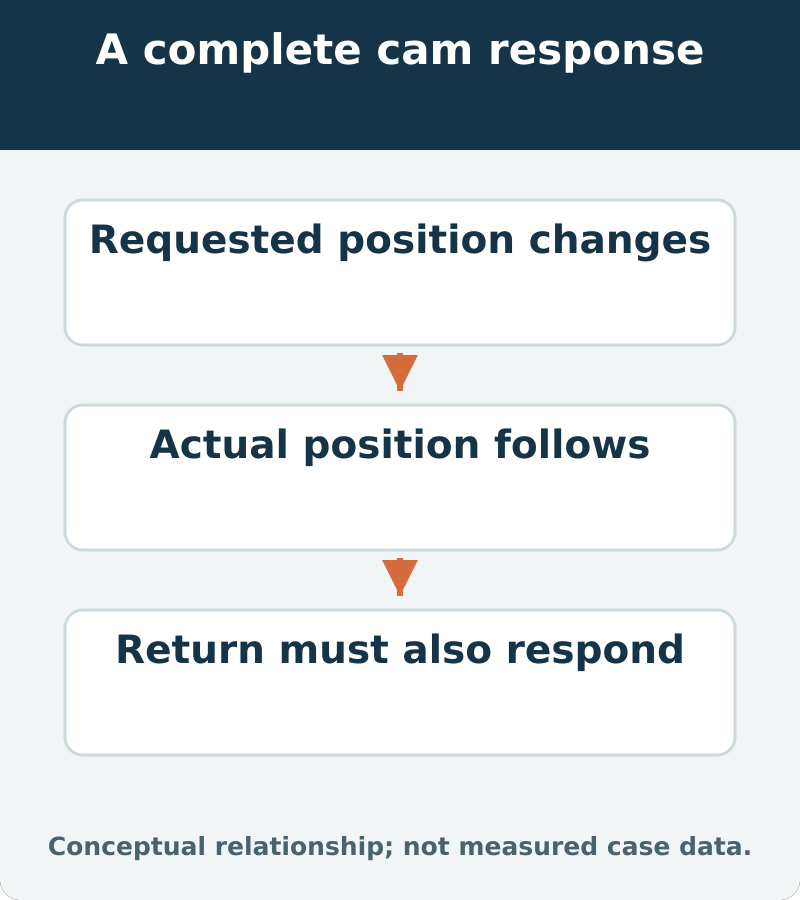
A useful capture should preserve the request and the measured response together. The return phase needs attention, not just the maximum movement. This is why a screenshot of one position is less informative than a properly obtained sequence. The workshop decides which controlled operating conditions are safe; owners should not try repeated high-rpm experiments to make the warning reappear.
In the published ALLDATA case, the reported Ram had P0300 and P000C with intermittent rough running. Oil level and appearance were normal. Comparing requested and actual intake-cam positions exposed intermittent failure to return as expected. Replacing the bank-two intake oil-control valve and VVT solenoid was reported successful; the account does not isolate which replacement was decisive.
Why the oil check still matters
Checking oil is not an embarrassing preliminary step before “real” diagnostics. It establishes whether a basic operating requirement needs correction before interpreting more complicated behavior. However, an acceptable level and ordinary appearance cannot certify every oil passage or control mechanism.
Tell the shop about the last service, the oil specification recorded on the invoice and any warning about pressure. Do not assume that adding an additive will free a suspected sticking component. If pressure warnings, knocking or severe misfire occur, stop using the truck and obtain professional advice. The appropriate decision may be recovery, not another drive to collect information.
Two replacements do not identify one failed part
When an invoice lists two related replacements, ask what justified the scope. Sometimes access, component design or the available evidence supports replacing an assembly or associated parts together. That is different from having separately demonstrated that each part failed.
For this case, the defensible lesson is about the response pattern and the successful reported intervention. It is not proof that every similar truck needs both items, or that one of them is always the culprit. A fair estimate should separate the observed fault, the recommended work and any remaining uncertainty. That makes a second opinion more useful than comparing parts totals alone.
What to ask for before authorizing VVT work
Three questions can keep the conversation focused. Was the requested-versus-actual disagreement recorded? Were the relevant operating prerequisites checked? What result will count as a successful repair?
Ask for an explanation in ordinary language if the graph labels are unfamiliar. You do not need to interpret a timing trace yourself to understand whether the return was delayed, incomplete or normal during the test. Also identify the exact engine configuration on the work order. This is not a guide to probing eTorque components or accessing hybrid electrical hardware; those systems require the appropriate training and isolation procedures.
The next useful record is a complete response
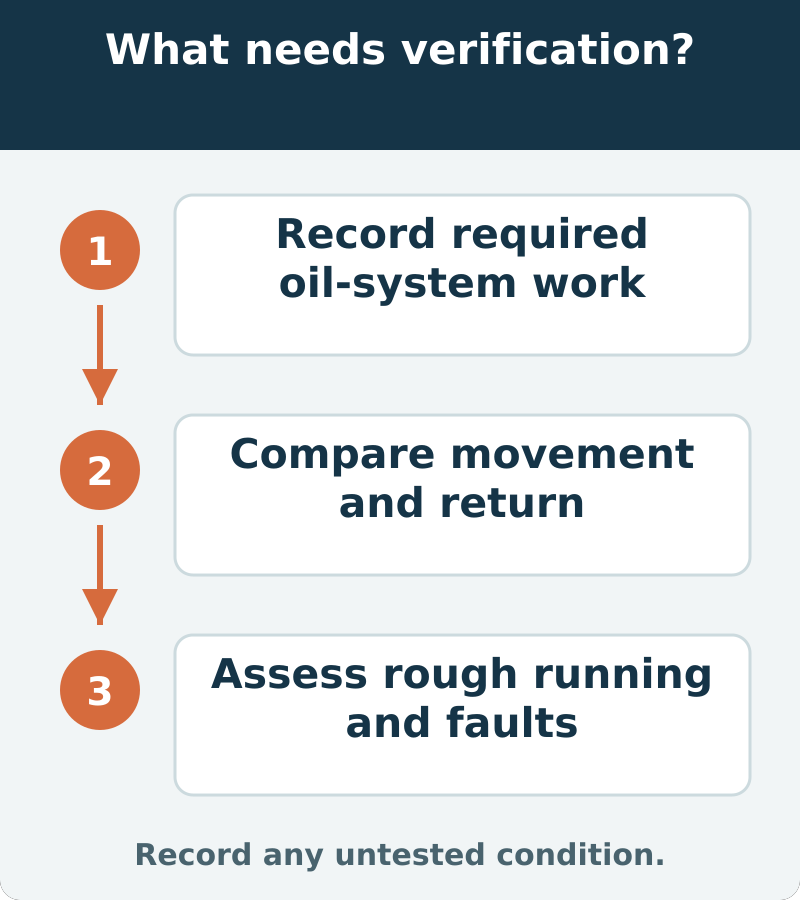
The collection conversation should return to the original complaint: intermittent rough running and the response fault, not merely a cleared warning lamp. Ask whether the technician repeated the relevant approved check and compared the request with the return after the work.
If the complaint later recurs, retain the new warning information and describe whether the operating conditions resemble the earlier event. Avoid erasing the record before arranging service. A complete sequence gives the next diagnosis somewhere concrete to begin. The most valuable item you take away may be a clear account of the movement that failed and the movement that was verified afterward.








Comments 0
Questions, fixes, and real-world diagnostic notes from readers.
Be the first to share a diagnostic result or ask a follow-up question.