
2013 Volvo XC70 Would Idle but Not Accelerate: The Differential Module Silenced High-Speed CAN

No Throttle? A Rear Module Can Silence Can
The XC70 started and idled, but the accelerator seemed disconnected. The failed part sat nowhere near the pedal or throttle body: a rear differential electronic module was silencing high-speed CAN. Distance inside a vehicle is not diagnostic distance when controllers share the same bus.
The opening need in a network-wide failure is clean access to the specified DLC bus lines, power and grounds. A basic breakout device such as the AUTOOL OBD2 Breakout Box Basic can support that first observation with a compatible meter or scope. The basic OBD2 breakout box can support access to specified DLC network lines, power and grounds for initial measurement. It cannot identify Volvo branch locations, determine which module to unplug first, load-test a remote module or configure a replacement DEM.
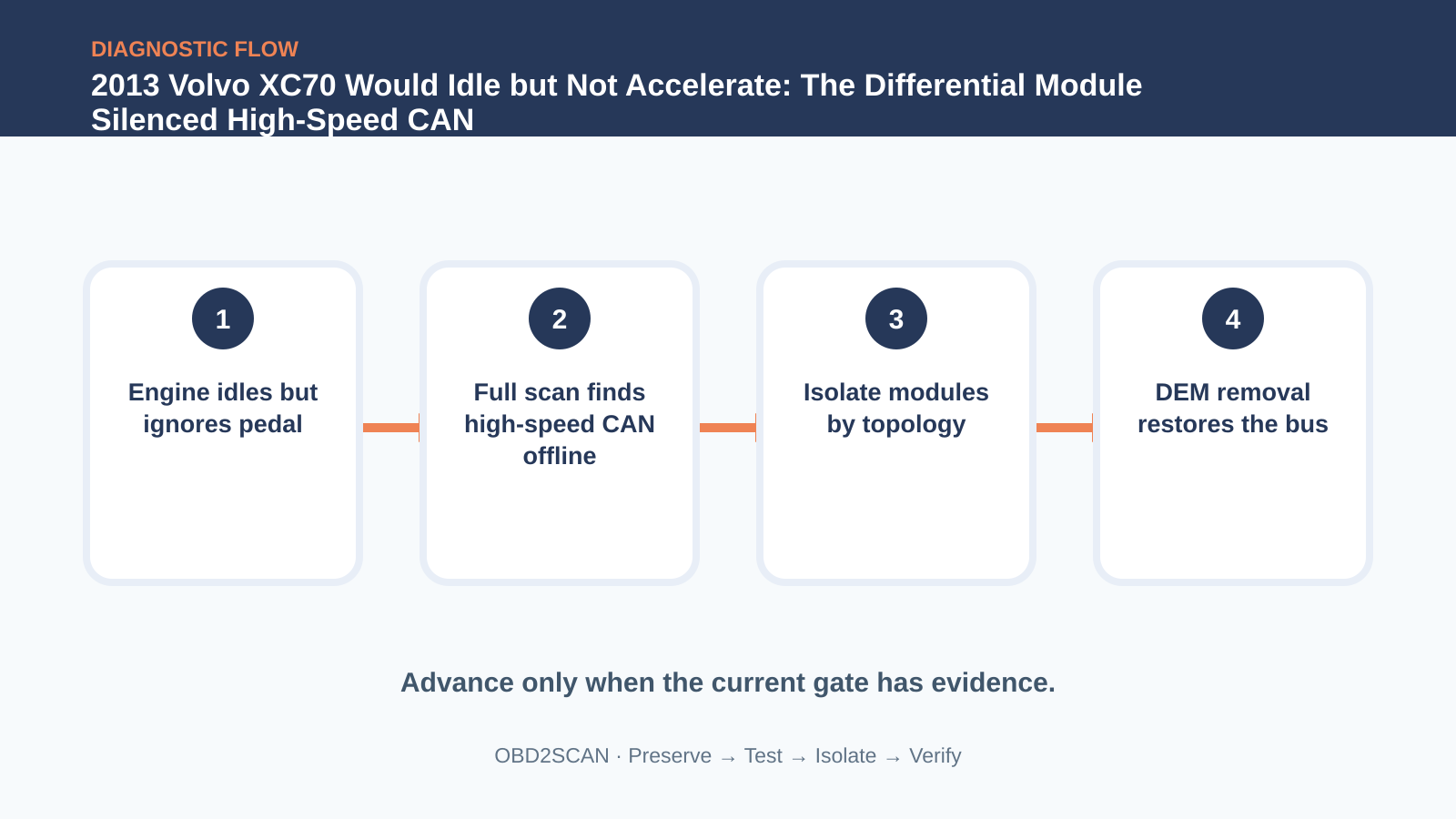
The complete scan found no communication on high-speed CAN. Disconnecting modules one at a time restored the bus when the differential electronic module was removed. Its power and ground were then checked, replacement restored communication, and a road test confirmed normal throttle response.
Quick answer: The high-speed bus returned when the rear differential module was disconnected; with its supports intact, replacement restored throttle response.

In this guide
- Idle without throttle response is not automatically a pedal fault
- A full-scan silence changes the problem
- Check the high-speed bus at the DLC
- Use Volvo topology to isolate modules
- Disconnecting the DEM restored communication
- Prove its power and ground before replacement
- Configure the replacement where required
- Road-test throttle, AWD and the complete network
Idle without throttle response is not automatically a pedal fault
An engine that idles but will not respond to the accelerator can result from pedal sensors, throttle control, limp strategy or missing network information. Record warning messages and verify whether rpm is truly fixed, but do not repeatedly floor the pedal in the bay. Chock the vehicle and keep the area ventilated. Start with a complete scan rather than one engine code reader. If the pedal PID is available, save it, yet remember that a controller may intentionally ignore a plausible pedal when it no longer trusts messages from the rest of the vehicle.
A full-scan silence changes the problem
The striking result was not a DTC; it was the absence of high-speed CAN communication. A network that cannot carry messages may prevent controllers from storing or reporting helpful codes. List which modules are silent and which slower networks remain reachable. Check battery and charging voltage because undervoltage can remove several controllers at once. When the entire high-speed group disappears, replacing an accelerator pedal from the driver’s symptom would skip the shared failure. Topology becomes the primary service information.
Check the high-speed bus at the DLC
At the DLC, identify the correct high-speed pins and observe voltage or waveform with approved equipment. Verify connector power and grounds separately. Do not use an ohmmeter on an active bus and do not force voltage onto CAN High or CAN Low. A distorted or fixed signal confirms a physical-layer problem but cannot identify the offending module. Likewise, a nominal resistance reading with the vehicle asleep does not guarantee clean communication when a controller wakes. Use the measurement to confirm state, then move to isolation.
Use Volvo topology to isolate modules
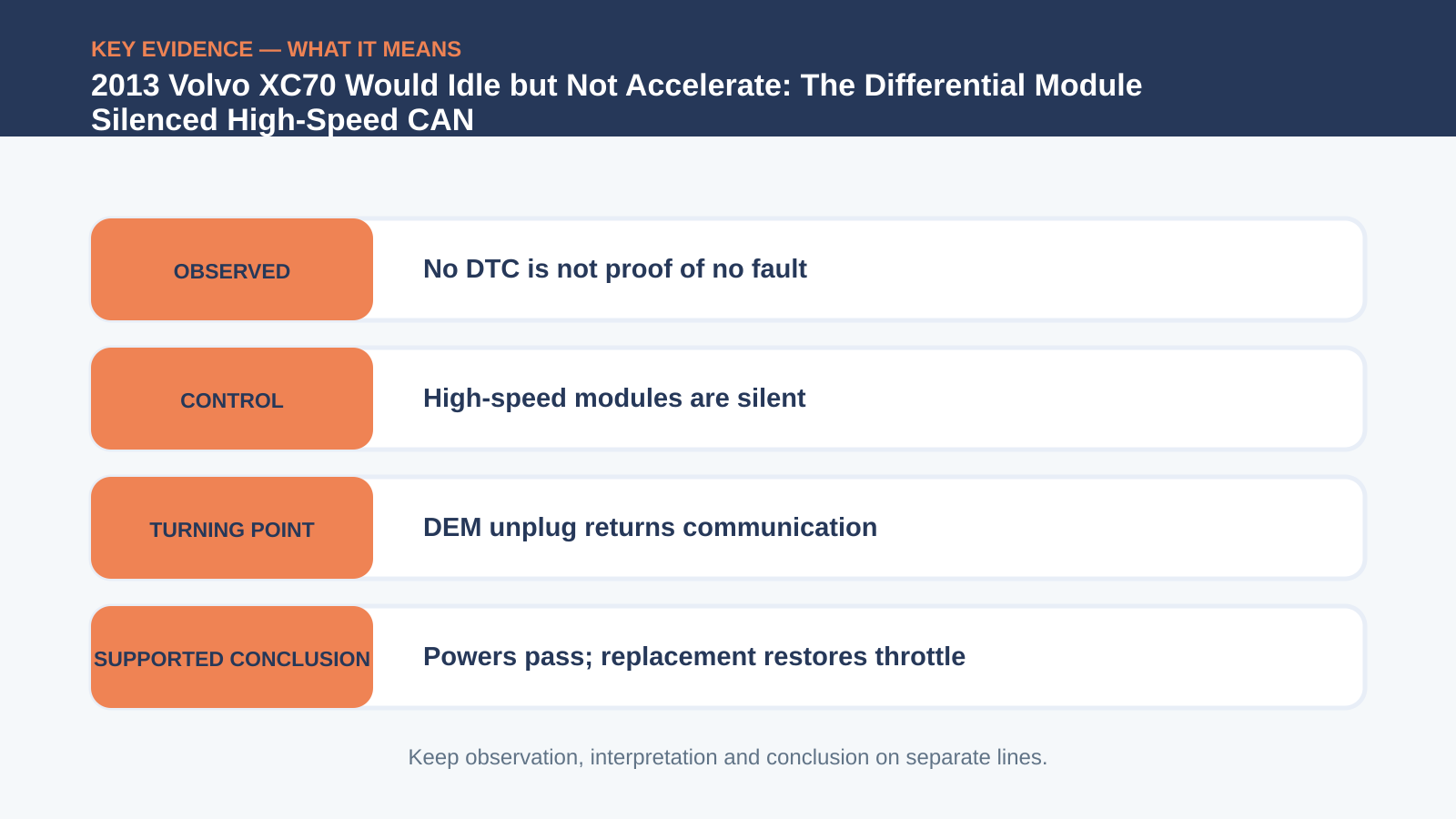
Volvo wiring information shows which modules share the high-speed network and where they can be disconnected. Power the vehicle down as specified, then isolate one candidate at a time. The case prioritized the power-steering module and differential electronic module based on experience and access. Communication returned when the DEM was unplugged. That is a decisive branch result: the bus functions without that node. It still leaves the DEM connector, its power/ground and the local wiring as possible causes.
| State | Network behavior | Supported conclusion |
|---|---|---|
| DEM connected | High-speed CAN is unavailable | A node or wiring on the bus is disrupting it |
| Other initial branch isolated | Communication does not return | That branch is less likely |
| DEM disconnected | High-speed communication returns | Fault is localized to DEM branch |
| DEM supports pass and replacement works | Bus and throttle remain normal | Internal DEM failure is supported |
Disconnecting the DEM restored communication
Inspect the rear module and connector for water, corrosion, impact damage and wiring contact before ordering it. Load-test specified powers and grounds rather than relying on static voltage, and check the network pair between the module and junction. Water near a rear differential controller can damage both terminals and the module; replacing only the electronics without fixing ingress invites recurrence. In the documented XC70, the supports remained credible, so the bus recovery with DEM removed carried the diagnosis toward an internal module failure.
Prove its power and ground before replacement
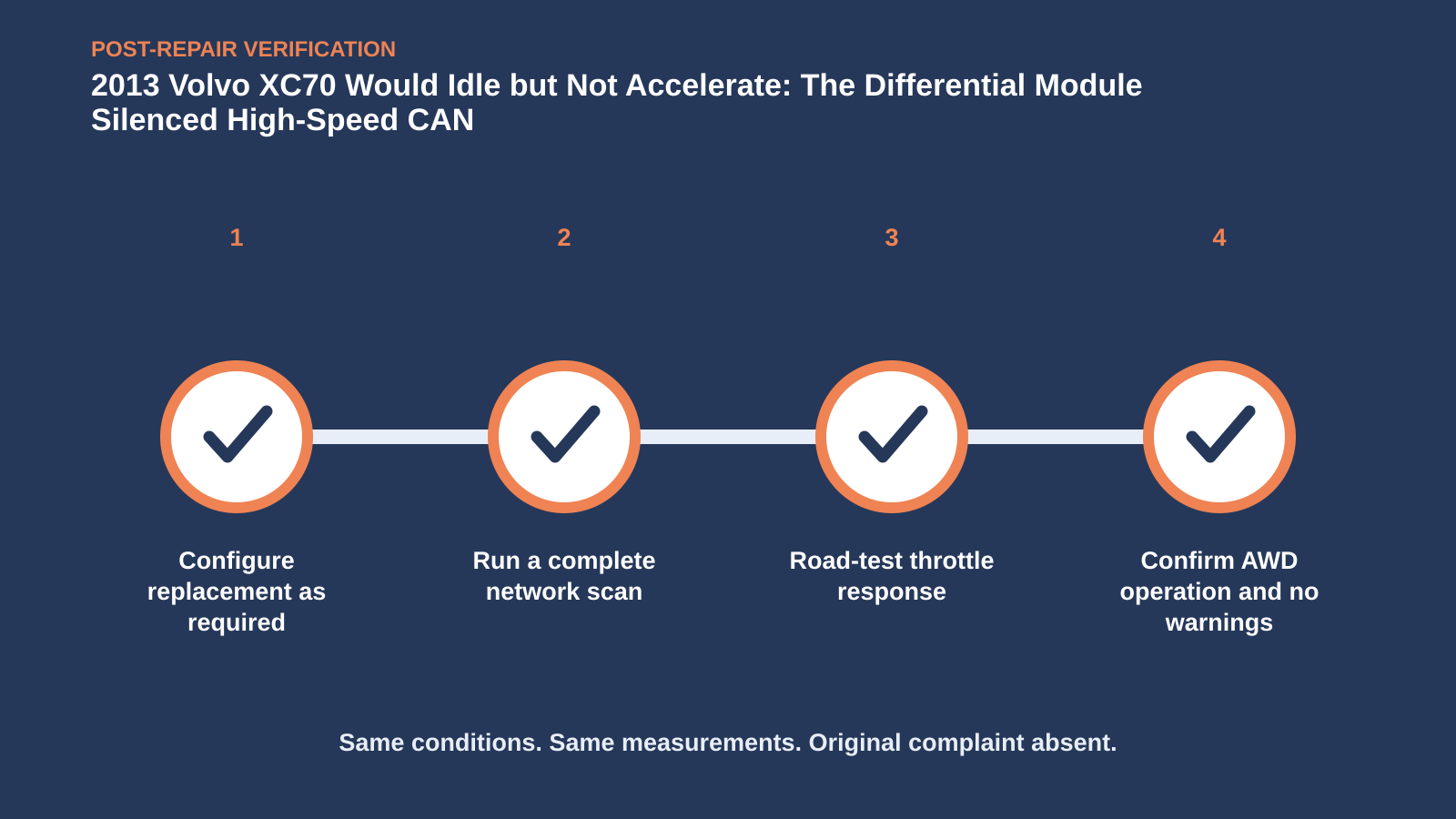
Fit the correct replacement and follow Volvo procedures for software, configuration and AWD initialization. Stable support voltage is essential during programming. Do not road-test permanently with the DEM disconnected: the isolation condition may restore engine communication while disabling all-wheel-drive functions and other safety strategies. Clear codes only after saving the pre-repair record, then run a complete scan. The replacement must appear with the correct identity and no configuration conflict before the car leaves the bay.
Configure the replacement where required
Test accelerator response in Park only as the procedure allows, then use a controlled road route. Confirm smooth response from idle, predictable shifting and no AWD, stability or drivetrain messages. Monitor communication throughout and rescan after the drive. The mature case reported that DEM replacement restored the high-speed bus and a good road test confirmed the complaint was gone. That functional link matters: network recovery alone could still leave an unrelated pedal fault, while acceleration proves the driver’s problem was resolved too.
Road-test throttle, AWD and the complete network
Reinspect the rear connector and water protection after the test, especially on a high-mileage AWD vehicle. Record the modules that returned and the bus state before and after replacement. Explain to the owner why the failed unit was remote from the symptom: the engine controller needs trustworthy network participation to permit normal torque. This makes the result understandable without suggesting that every XC70 no-throttle event is a differential module. Other cars must earn the same topology and isolation evidence.
The pedal was where the driver felt the fault; the network was where the vehicle made the decision. Isolating the DEM connected those two distant points with evidence.










Comments 0
Questions, fixes, and real-world diagnostic notes from readers.
Be the first to share a diagnostic result or ask a follow-up question.