
2000 Jeep Grand Cherokee Battery Drain: Why Finding the Fuse Was Only Half the Repair

Quick answer: An overnight battery drain needs a stable sleep-state measurement and a traced circuit. This Jeep also had damaged aftermarket wiring and a separate running-state communication problem.
A current reading without a vehicle state is an incomplete observation. Was the Jeep asleep, waking up, or running? Pulling a fuse can help locate a branch while also changing the condition you are trying to measure.
A low-current DC clamp allows spot checks without opening the battery circuit. The AUTOOL BT270 is one example, but its automatic shutdown makes it unsuitable as an unattended overnight logger. A delayed or intermittent draw needs equipment that can actually capture the relevant period.
Burned wiring changes the priority: stop using the vehicle until the damage and fire risk are assessed. Do not keep installing fuses or disconnect charging-system wiring with the engine running to reproduce someone else’s case.
In this guide
Write the vehicle state next to the number
In Gary Goms’s Jeep investigation, a 2000 Grand Cherokee retained a 240–250 mA overnight draw after stereo removal. Pulling underhood fuse 7 reduced it almost to zero; reinsertion produced a 350 mA wake-up reading. Interior fuse 23 led to damaged aftermarket wiring on the brake-switch supply. A separate running cluster fault and P1687 changed with the alternator-field connection. PCM replacement resolved that communication symptom. The account gives no final overnight current measurement.
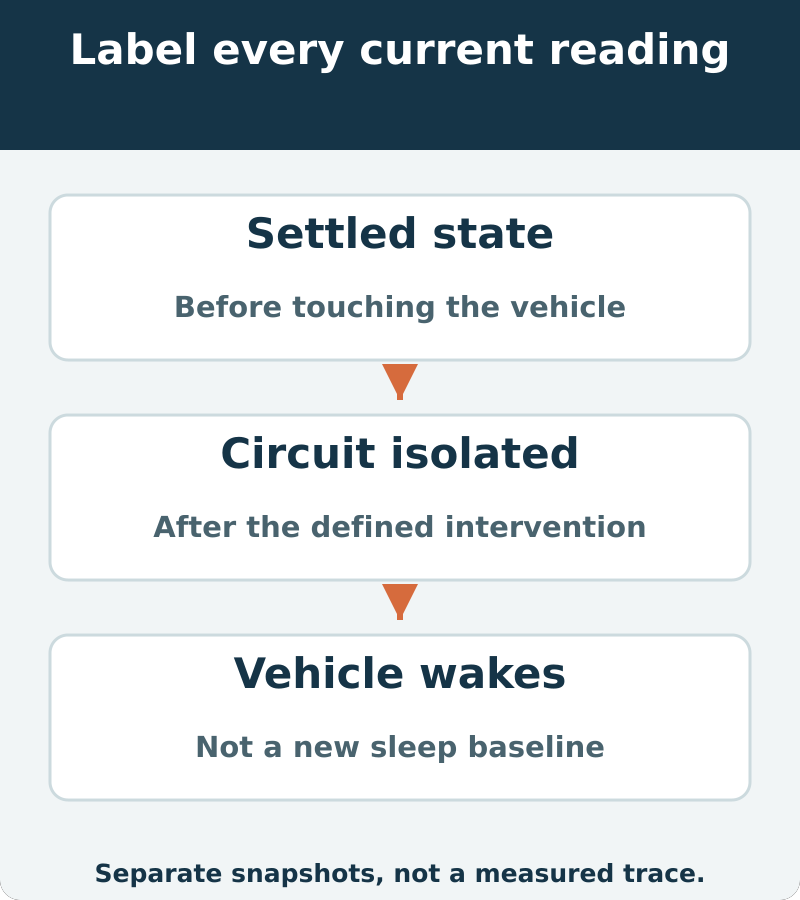
The numbers belong to that investigation, not to a universal Jeep pass/fail chart. Most importantly, the higher reading followed an intervention. Comparing it directly with the settled reading would ignore what the technician had just changed.
For your own test record, use three columns: action, elapsed time and current. “Door opened, immediately afterward” and “untouched since the required sleep period” describe different conditions even when the meter is connected in the same place.
A fuse narrows the search; it does not finish it
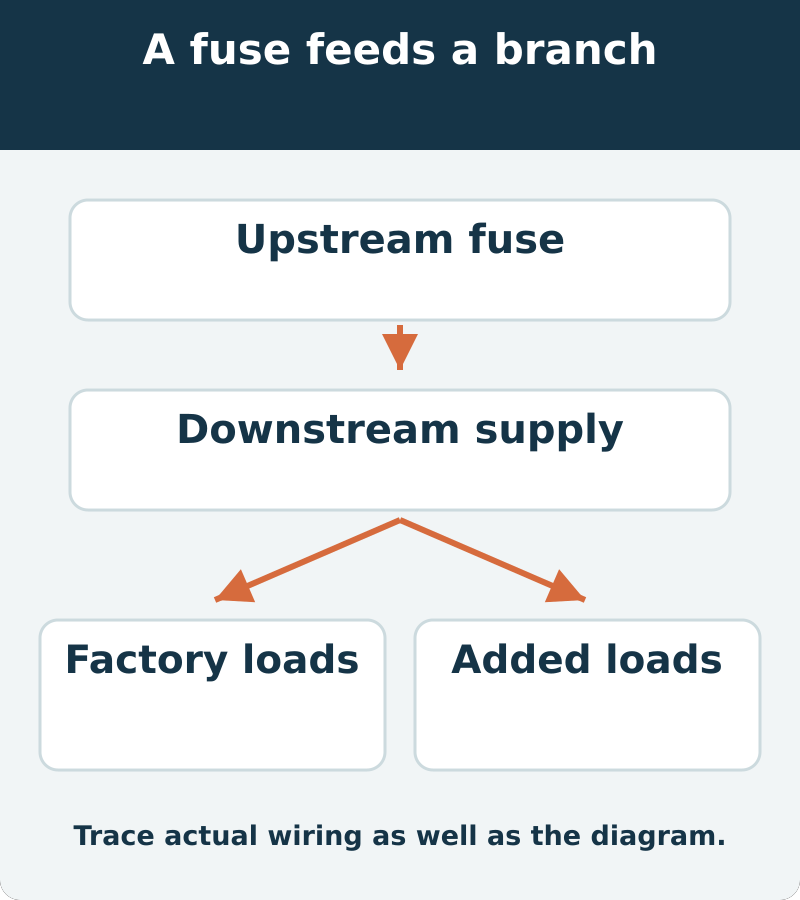
When current falls after a fuse is removed, something supplied through that path deserves investigation. The fuse can feed multiple devices or another distribution point. It does not name the failed part, and the label on the lid may not describe every attached load.
Where appropriate, measuring voltage drop across an installed fuse can help localize a draw without repeatedly waking the vehicle through fuse removal. Fluke’s parasitic-drain method explains that approach. Interpretation still needs the correct fuse information, a sufficiently sensitive instrument and a stable vehicle state.
Ask for the actual measurement and method, not just “fuse tested.” Do not adopt one generic normal-current threshold or a fixed sleep time for every vehicle. Equipment settings, clamp zero and the conductor being measured also belong in the record. A clamp around opposing current paths can hide the quantity you wanted to observe.
An aftermarket branch can be missing from the diagram
A factory diagram describes the intended vehicle. It cannot document an accessory somebody added later. Removed equipment can also leave a live supply wire, splice, relay or damaged insulation behind.
That is why accessory history matters even when the obvious device is gone. Tell the shop about previous stereos, alarms, tracking equipment, remote starters and lighting. An old invoice or installation photo may identify a branch that is difficult to recognize after the interior has been reassembled.
The repair should address the damaged circuit and its protection, not merely make the current reading fall. Ask whether the remaining wiring has been properly terminated, insulated, routed and secured. Do not cut an unidentified wire based on its color or the fact that it runs toward the dashboard.
Do not merge a running fault with a parked fault
A battery complaint can lead the technician to discover another problem. That does not make the second problem a complete explanation for the first.
| Complaint | Evidence needed to close it |
|---|---|
| Battery loses usable charge while parked | A repeatable parked-state current record, with battery condition accounted for |
| Gauges or communication fail while running | Normal operation under the relevant running conditions and appropriate fault checks |
| Wiring is visibly burned | A documented repair of the damage, protection and contributing cause |
Keeping these entries separate prevents an impressive running repair from becoming an unsupported claim that the overnight drain is gone. Likewise, a low parked reading does not establish that the charging system behaves correctly under load.
What a useful overnight test report contains
Start with the battery’s tested condition and state of charge. A weak or insufficiently charged battery can confuse the owner’s description of how quickly the problem returns. Then record how the vehicle was prepared, which accessories remained connected and what triggered any wake-up events.
Choose the capture duration from the complaint. If the battery goes flat after several days, a brief stable reading may miss the event. If access to the vehicle wakes it, plan the setup before waiting for sleep rather than repeatedly restarting the test.
Use a suitable fused measurement method. Never crank the engine or operate a large load through a meter’s low-current series connection. Owners who lack the equipment or safe procedure should request this report from a qualified shop instead of improvising one.
Close the battery complaint on its own evidence
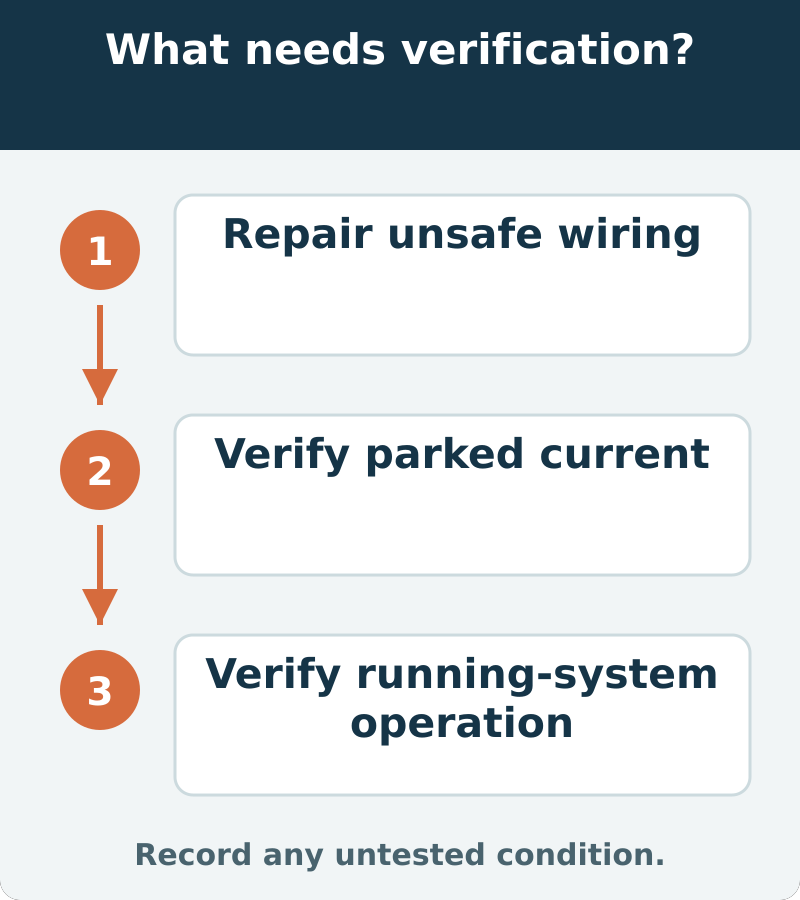
The final record should distinguish “circuit repaired,” “running fault resolved” and “parked draw verified.” Mark anything not yet tested as open, with the next observation needed to close it.
If the battery fails again, bring the elapsed parked time and any unusual wake-up activity. A useful return visit starts with the new event and the previous baseline—not another round of pulling the same fuse and assuming the answer has already been found.







Comments 0
Questions, fixes, and real-world diagnostic notes from readers.
Be the first to share a diagnostic result or ask a follow-up question.