
2017 Dodge Ram Lost Throttle Intermittently: A 12-Volt Valve Disturbed the 5-Volt Sensors

Normal 5 Volts—Until The Valve Switches
The Ram’s idle wandered and the accelerator sometimes seemed to disappear. Four codes named the five-volt reference, pedal position and cooling system, yet the technician measured a healthy-looking 5.02 volts at both accelerator circuits. That reading was true at the instant it was taken—and still insufficient for an intermittent fault.
A graphing meter can watch an identified reference circuit through the fault window instead of reducing it to one number. The AUTOOL DM303 is one supporting option. DM303 can record an identified five-volt rail and support resistance, voltage and basic waveform checks. It cannot infer shared circuits without correct wiring data or make power injection safe on sensor and controller lines.
Wiring information linked the affected five-volt reference to several sensors and to a coolant bypass valve that also received 12-volt power. Unplugging the valve removed the symptoms. Replacement, code clearing and a road test completed without recurrence, supporting the valve as the source of the transient reference disturbance.
Quick answer: A 12-volt coolant bypass valve intermittently disturbed a shared five-volt sensor reference and removed throttle response.

In this guide
- Four codes can describe one electrical event
- A normal 5.02 volts is only a snapshot
- Draw every load on reference circuit two
- Notice the component that also receives 12 volts
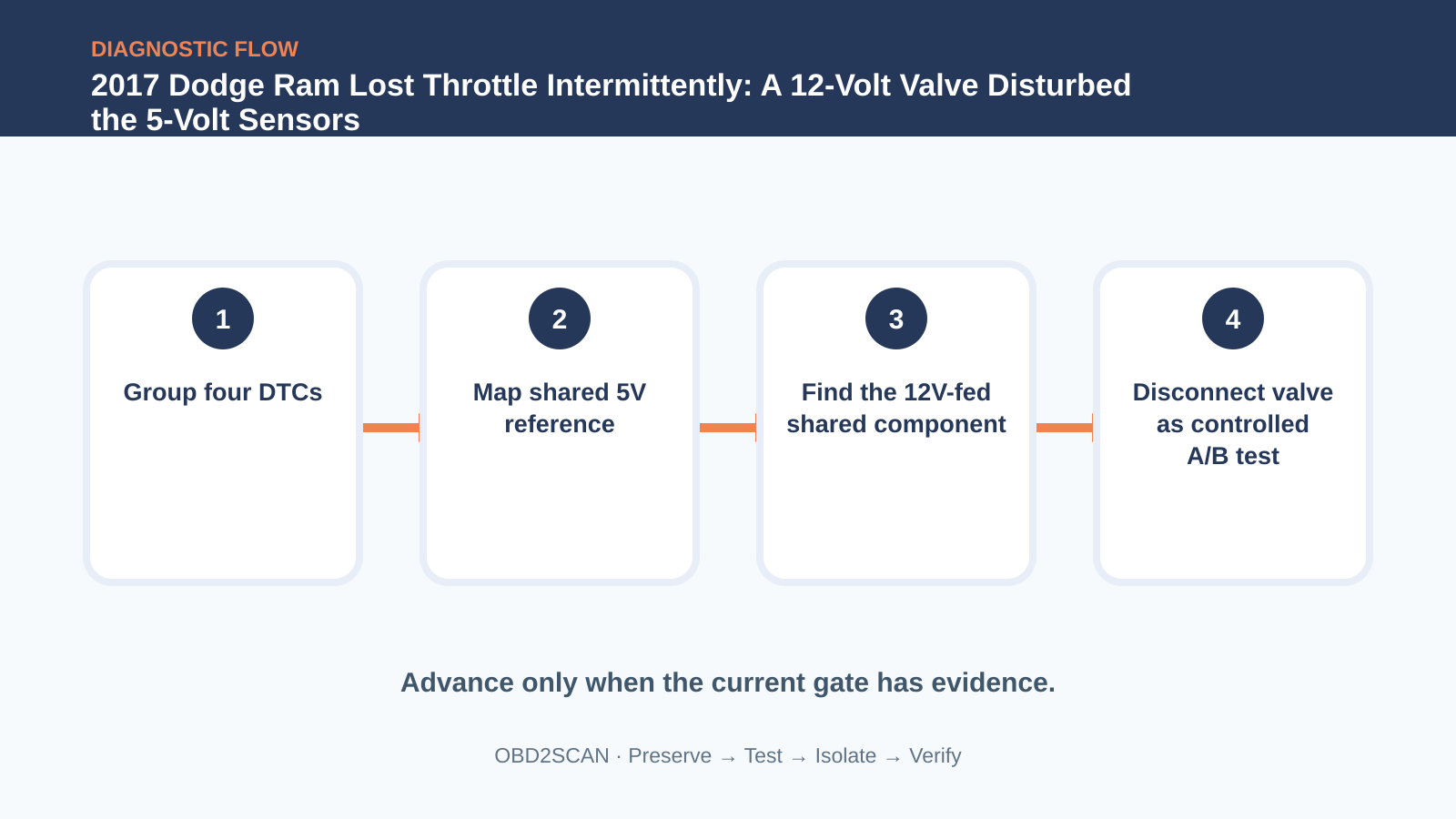
- Disconnect one suspect as a controlled test
- Why the throttle returned immediately
- Replace the valve and inspect its circuit
- Road-test the original intermittent condition
Four codes can describe one electrical event
Save all four codes with status and freeze-frame before clearing anything: P0653 for reference circuit high, P2127 for accelerator-pedal sensor low, P2181 for cooling performance and P2681 for an open coolant-bypass-valve control circuit. Read together, they describe electrical disagreement across systems, not four simultaneous parts requests. Note temperature, vibration and duty cycle when throttle response disappears. If the vehicle cannot respond predictably to the accelerator, stop road use and reproduce the event in a controlled area.
A normal 5.02 volts is only a snapshot
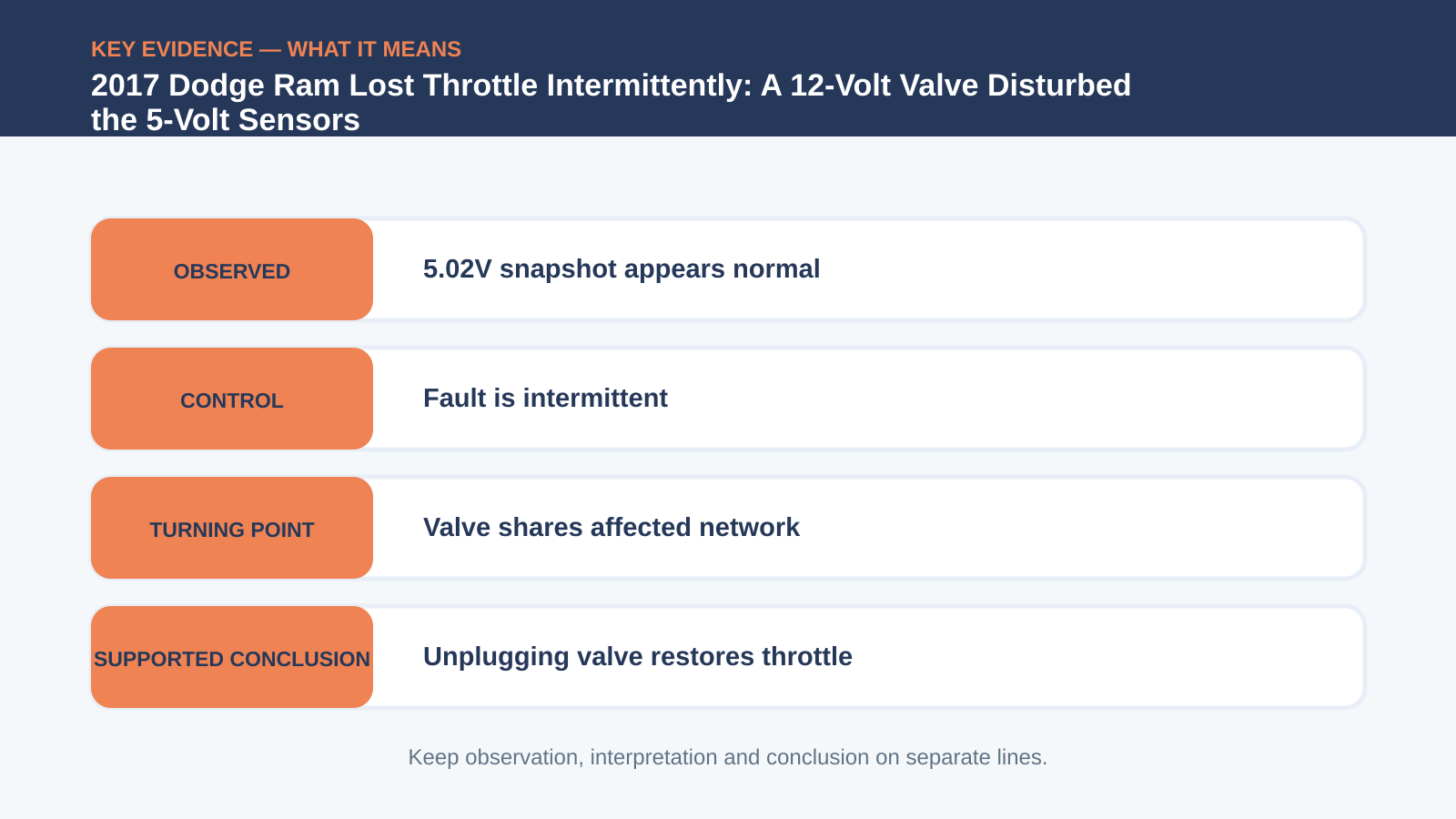
A digital meter displaying 5.02 volts answers only what existed during that sample and at that test point. A short spike, shared-rail pull-up or brief open can set a code and vanish before the hood opens. Verify meter ground, test at the receiving sensor as well as the source, and use recording or min/max capture when permitted. Do not conclude that a reference is perfect because its average is close to five volts. The fault description, chronology and shared loads must agree with the electrical trace.
Draw every load on reference circuit two
Use the correct wiring diagram to list every component supplied by reference circuit two: MAP, cam sensors, accelerator-pedal position, fuel-rail pressure and coolant-related inputs in this application. Then mark power sources that are not five volts. A component sitting only on a shared sensor rail might pull it low; a component with both 12-volt power and a relationship to that rail can, if it fails internally, push the rail high. That cross-voltage possibility makes the coolant bypass valve more interesting than its name initially suggests.
Notice the component that also receives 12 volts
The bypass valve’s own P2681 offered a direct clue, but a code for an open circuit does not automatically prove the valve. Inspect its connector, supply, control wire and shared grounds. If service information allows, unplug it with the fault active and observe reference voltage, pedal data, idle and throttle response. Do not inject battery voltage into a five-volt rail or controller output. The purpose is to remove one suspected load safely and see whether the wider symptom changes, not to force the component to operate through unknown electronics.
| Evidence | Supports | Does not prove by itself |
|---|---|---|
| P0653 and P2127 occur together | Shared reference disturbance | Failed accelerator pedal |
| 5.02 V during static check | Rail is normal at that moment | Rail stayed normal during the event |
| Valve also has a 12 V feed | Internal cross-feed is possible | Valve is definitely shorted |
| Symptoms stop when valve is unplugged | Valve/branch participates | Harness and connector need no inspection |
Disconnect one suspect as a controlled test
With the coolant bypass valve disconnected, the idle and throttle complaints disappeared. That is a useful A/B test because it changes one branch and observes several symptoms. Repeat it enough to cover the intermittent window, and wiggle the connector and nearby loom without stressing terminals. If the fault persists disconnected, return to other shared loads and the reference source. If it stops consistently, inspect for coolant intrusion, pin spread, rub-through or an internal valve fault before ordering the assembly.
Why the throttle returned immediately
The immediate return of pedal response makes sense when the reference rail stabilizes. The PCM can again trust accelerator, manifold and other sensor inputs rather than entering a protective strategy. This does not mean a failed cooling valve physically blocked the throttle. It corrupted the information infrastructure used to calculate safe torque. Explaining that distinction helps the owner understand why an apparently unrelated coolant component caused a drivability complaint and why replacing the accelerator pedal would not have addressed the root event.
Replace the valve and inspect its circuit
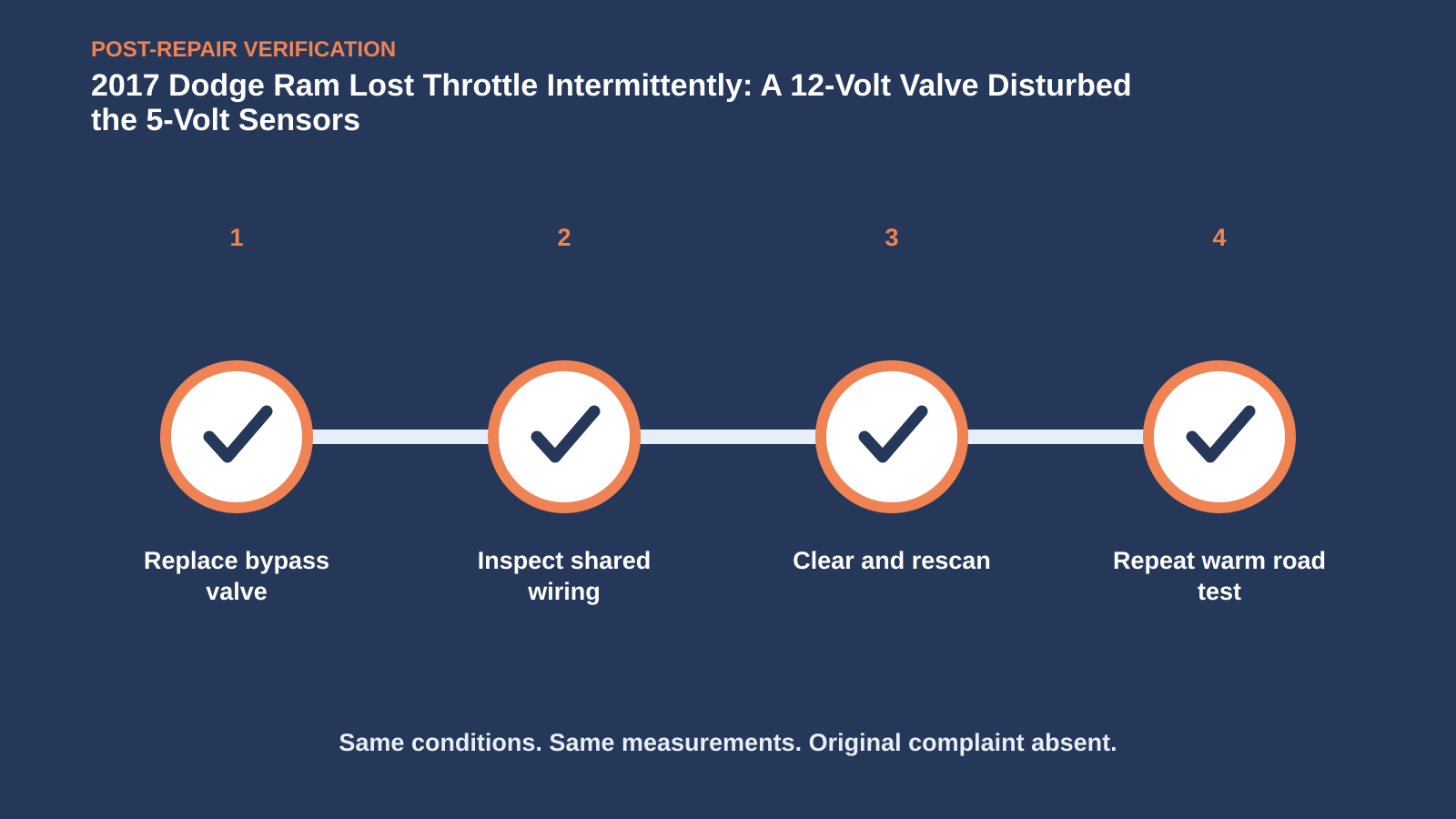
The documented repair was replacement of the coolant temperature bypass valve. Inspect and clean the connector only with approved methods, repair any damaged wiring, refill or bleed coolant if the service procedure requires opening the circuit, and confirm valve command. Avoid describing disconnection as a repair; cooling strategy and emissions performance depend on the component. Clear codes only after saving evidence, then compare reference behavior during commanded valve changes so the new part does not merely pass a quiet idle check.
Road-test the original intermittent condition
Road-test through the original warm-up and load conditions while recording accelerator position sensors, five-volt reference-related data and valve command. Confirm the two pedal tracks agree, idle remains stable and full throttle response returns without P0653, P2127, P2181 or P2681 pending. Recheck cooling-system temperature behavior after the drive. The mature case reported no further issue after replacement and road testing, which closes this vehicle without turning the bypass valve into a universal answer for every Ram reference fault.
The normal 5.02-volt reading was not wrong; it was incomplete. A wiring map and one controlled disconnect captured the missing relationship between a 12-volt valve and a five-volt sensor network.










Comments 0
Questions, fixes, and real-world diagnostic notes from readers.
Be the first to share a diagnostic result or ask a follow-up question.