
2016 Chrysler 200 P0101 Under Acceleration: Follow the Wiring Beyond the MAF Plug

Quick answer: A clean MAF and an intact-looking plug do not clear the rest of its circuit. A fault under acceleration needs attention to connections beyond the visible sensor.
Do not recreate hard acceleration on public roads or reach into a running engine bay to disturb wiring. Give the workshop the conditions you already noticed and let it choose a controlled assessment.
Following an electrical route requires suitable measurements as well as a diagram. The MRCARTOOL B550 can support passive voltage checks at approved test points; unknown sensor or controller wires must not be powered as a shortcut.

In this guide
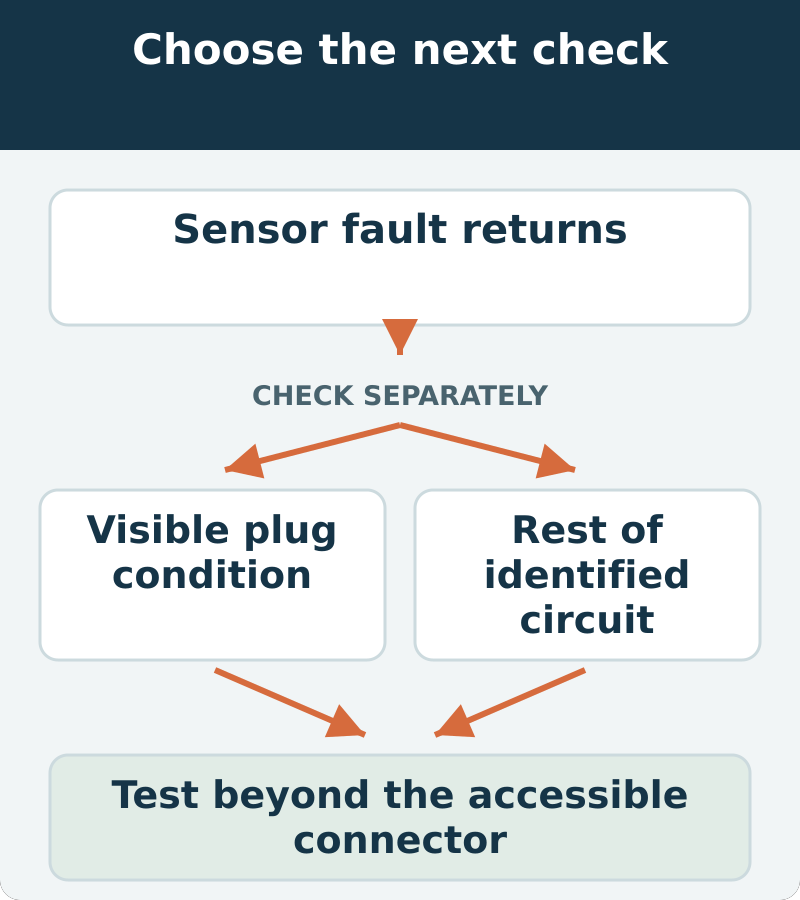
The visible plug is only one connection
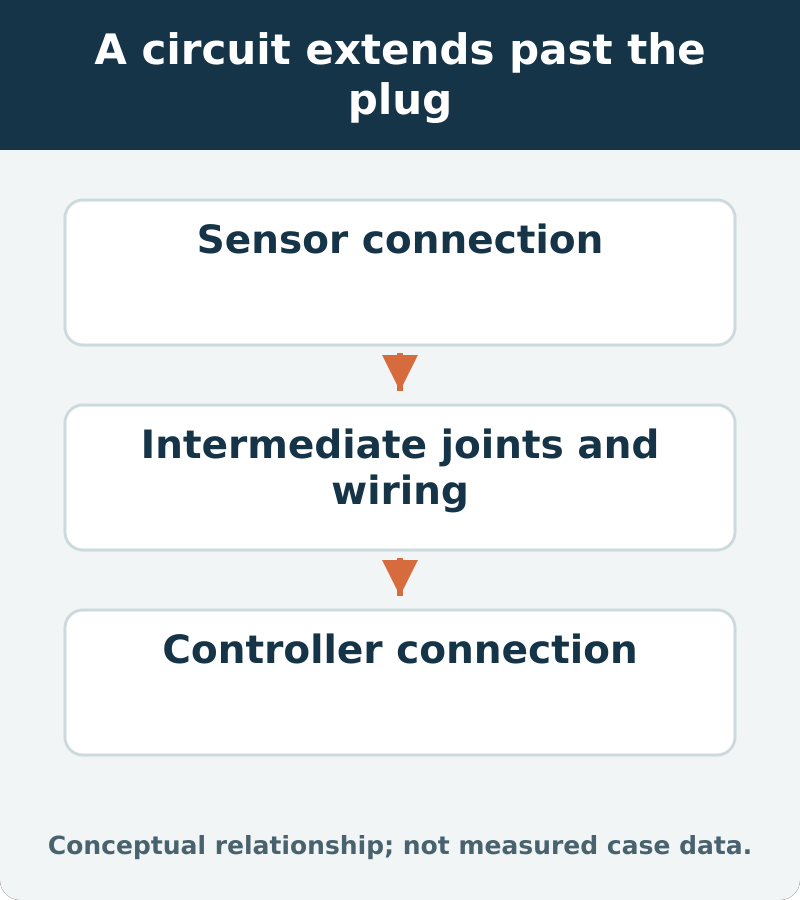
The connector beside a sensor is easy to recognize, so it naturally receives attention first. But the electrical route can continue through protected junctions and other connections before reaching its destination. A good-looking plug is one observation about that route, not an inspection of its entire length.
That distinction becomes especially useful after cleaning or replacing a sensor has not changed the complaint. Instead of asking which version of the same part to buy next, ask what remains untested between the component and the controller. The correct wiring information turns that broad question into a finite route that a technician can identify and evaluate.
What the known-good sensor changed
In ALLDATA’s Chrysler 200 case, P0101 appeared under hard acceleration on a 2016 2.4L car. A known-good MAF did not resolve it and the plug looked normal. A loose engine-area splice was repaired, after which the warning did not return during the road test. No event signal capture was published.
A properly matched substitution can reduce suspicion of the exchanged component. It does not certify every part surrounding it. Ask whether the comparison actually held the relevant conditions constant, and whether the substitute was appropriate for the application. If those points are sound, the unchanged symptom is a reason to widen the investigation rather than repeat the purchase.
Read the route between sensor and controller
Think of the wiring diagram as a route map, not just a source of wire colors. It tells the technician which connections belong to the circuit and which shared paths may affect more than one function. The physical location information then helps relate that map to the car actually in the bay.
Vehicle identification matters here. An online location from another engine or build should not be treated as an instruction to unwrap a particular harness. Ask the workshop to identify the relevant route for your vehicle, then explain where its findings narrowed the fault. There is no benefit in exposing unrelated wiring simply because a photograph looks familiar.
Choose a test that matches the complaint
The phrase “under acceleration” describes when the driver noticed the warning. It does not prove that engine movement pulled a wire, or that airflow demand was the sole trigger. Those remain hypotheses until evidence distinguishes them. An attractive physical explanation should not become a reported measurement by repetition.
Useful testing asks what each hypothesis predicts and whether that prediction can be checked safely. A normal stationary reading may leave an intermittent condition unresolved, but that is not permission to shake live wiring near belts or exhaust components. The workshop should choose the relevant recording or circuit method and keep the connection procedure within the vehicle’s service requirements.
A durable splice repair needs more than continuity
An electrical repair has both a connection job and a protection job. Restoring the intended path is essential, but the repaired area must also retain the insulation, environmental protection and mechanical support required by the specified method. A wire that works during a brief check should not be left vulnerable to the conditions it normally encounters.
You do not need a generic soldering recipe to discuss that quality standard. Ask which approved repair method applies, whether surrounding damage was checked and how the harness was secured afterward. The answer should concern the actual location and materials, not a claim that one splice technique is universally best for every automotive circuit.
Recheck the conditions recorded before repair
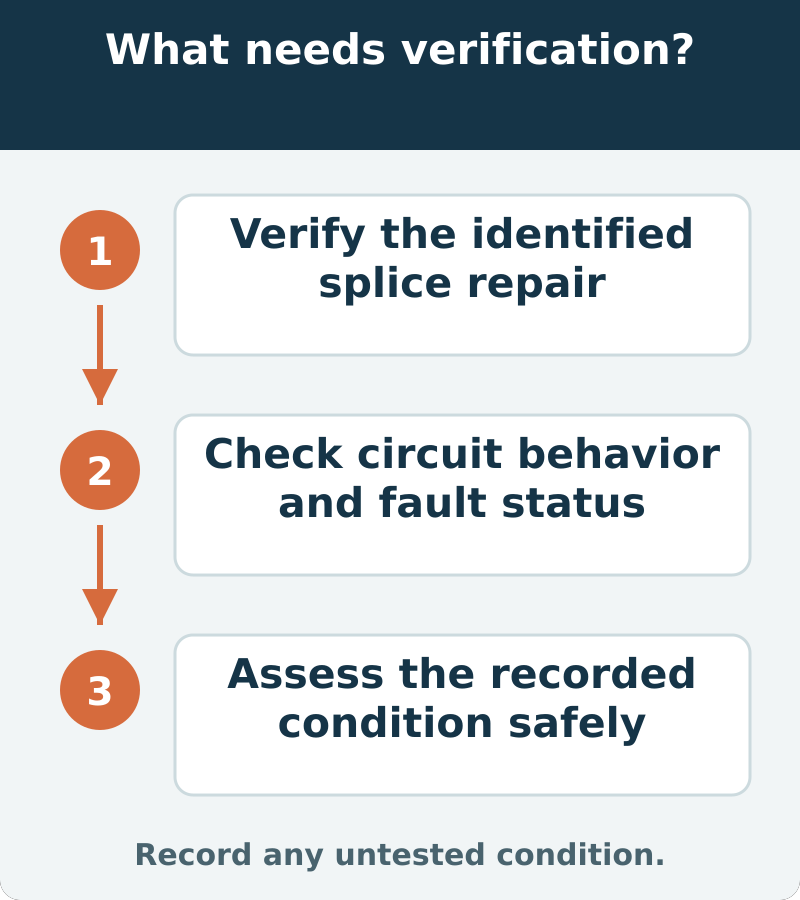
The final comparison should return to the original complaint: the relevant fault status and a safe evaluation of the conditions under which it appeared. A clean idle alone may not address a warning first noticed elsewhere in operation. Nor does cleared memory establish that the monitoring system has had an opportunity to reassess the fault.
Keep the record of the localized repair and the post-repair observations. If the warning returns, provide that record and let the next diagnosis determine whether it is the same event. The central lesson is simple: inspect the route the information must travel, and let the evidence decide where along that route the repair belongs.










Comments 0
Questions, fixes, and real-world diagnostic notes from readers.
Be the first to share a diagnostic result or ask a follow-up question.