
2014 Chevy Captiva ABS Activated on Slow Right Turns: Calibration Exposed the Steering Sensor

Abs Pulses On Right Turns? Check Steering Angle
The Captiva pulsed the brakes during slow right turns even when the driver’s foot was off the pedal. No ABS code appeared and a substituted EBCM changed nothing. The repeatable maneuver mattered more: direction, speed, steering angle and an eventual calibration refusal turned an unnerving symptom into a bounded sensor case.
One useful machine class at this stage is a bounded measurement tool, chosen only after the circuit or system question is defined. The AUTOOL DM303 is one route for that supporting task. DM303 can support bounded low-voltage sensor-circuit checks and one signal. It cannot graph yaw plus four wheel speeds, perform GM calibration or make a public-road brake reproduction safe.
This article follows one documented vehicle. Its cause is a useful diagnostic pattern, not a failure-rate claim and not permission to replace the same part on a similar symptom. The goal is to show which evidence changed the decision and how the repair was verified.
Quick answer: The swapped controller and tires were not the cause. The steering-angle sensor failed its required calibration; replacement and successful calibration stopped the false intervention.
In this guide
- False brake intervention is a safety complaint
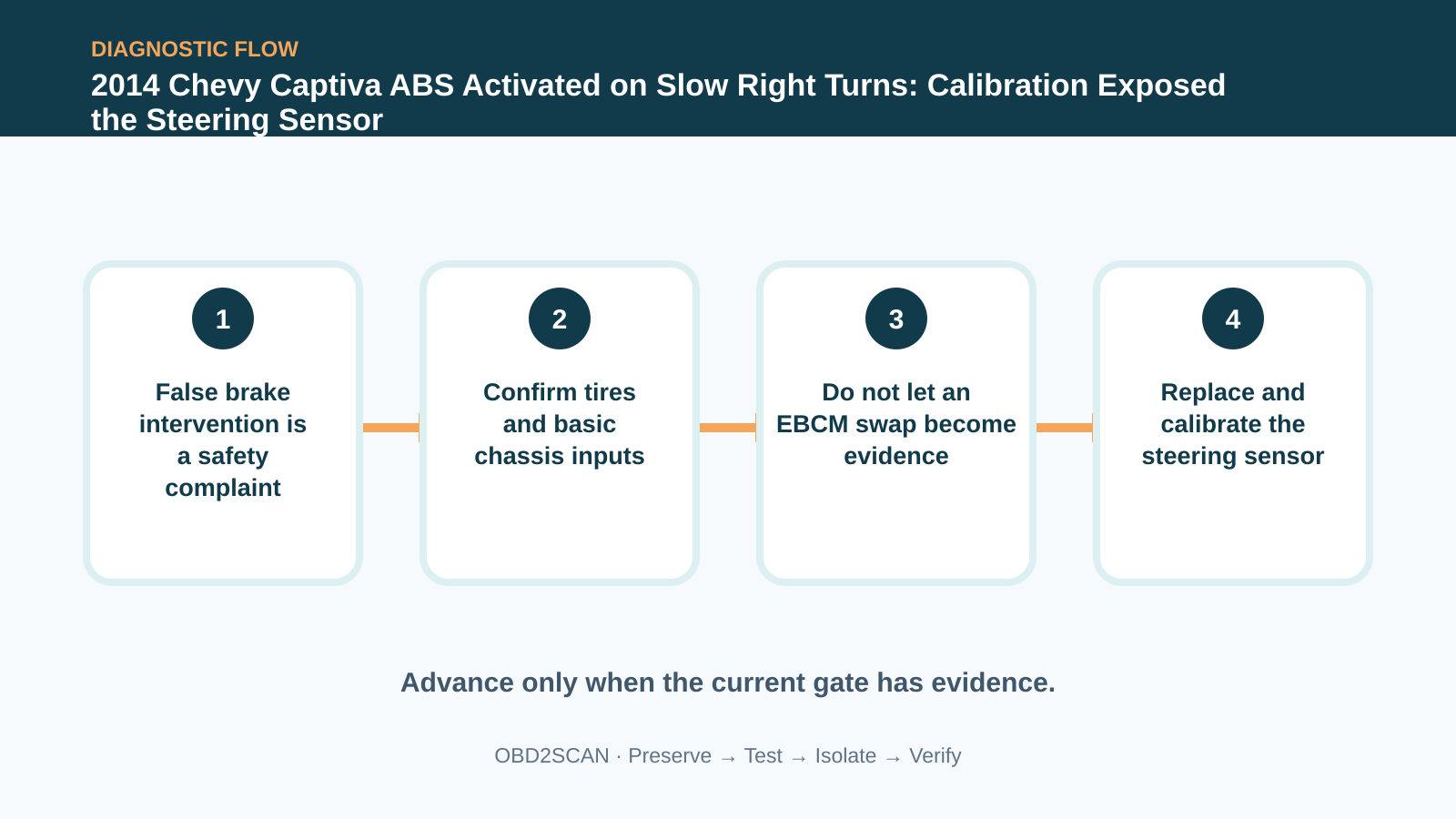
- Define the exact right-turn condition
- Confirm tires and basic chassis inputs
- Graph yaw, wheel speed and steering angle together
- Do not let an EBCM swap become evidence
- A failed calibration is a decisive clue
- Replace and calibrate the steering sensor
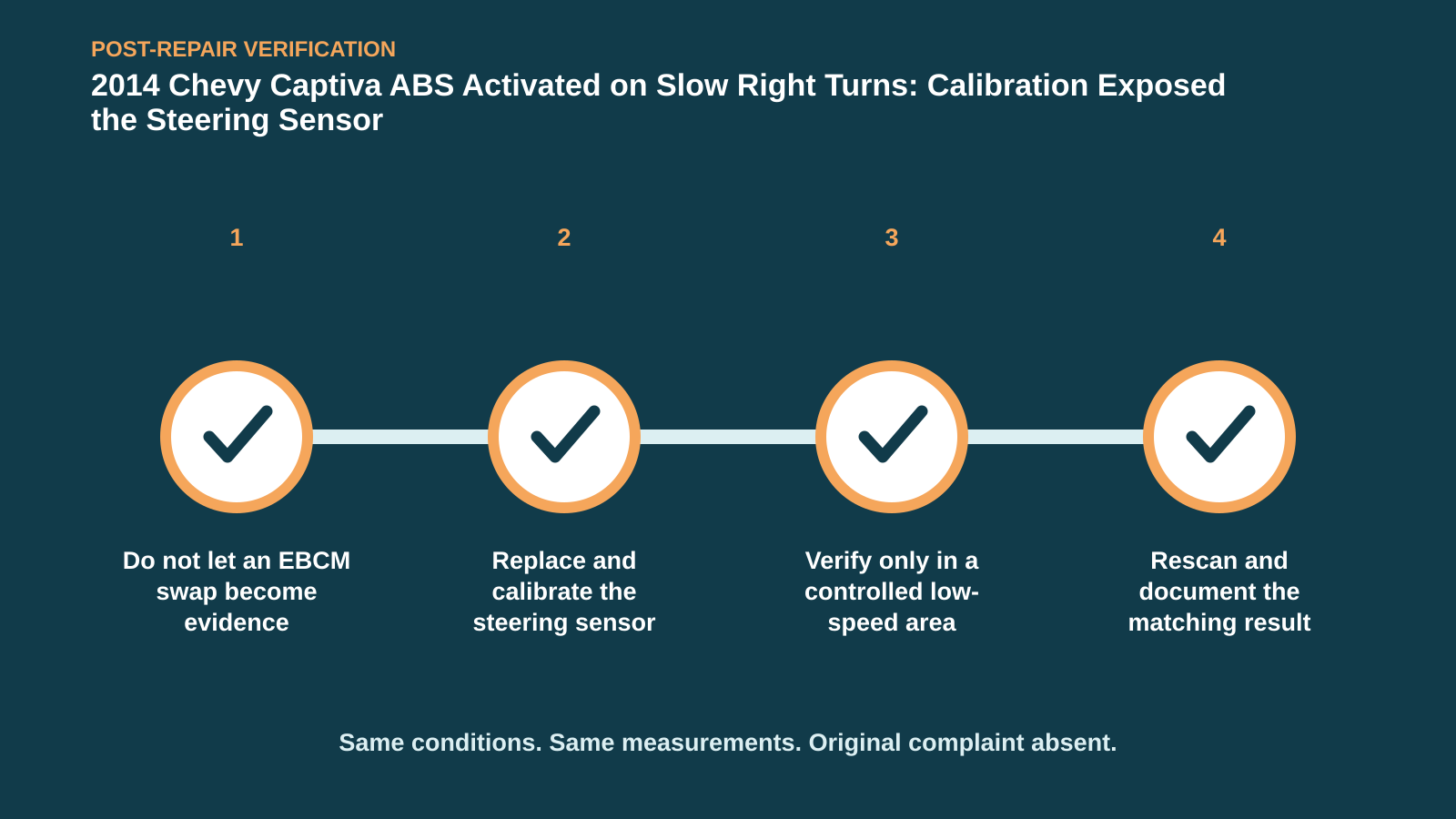
- Verify only in a controlled low-speed area
False brake intervention is a safety complaint
Uncommanded brake intervention can change the vehicle’s path. Reproduce only in a closed, low-speed area with a qualified driver, an observer and a clear stop condition—never in ordinary traffic. Keep the vehicle in the failed state long enough to capture evidence, but never extend a test beyond the point where a stall, brake event, refrigerant release or moving component creates risk.
Define the exact right-turn condition
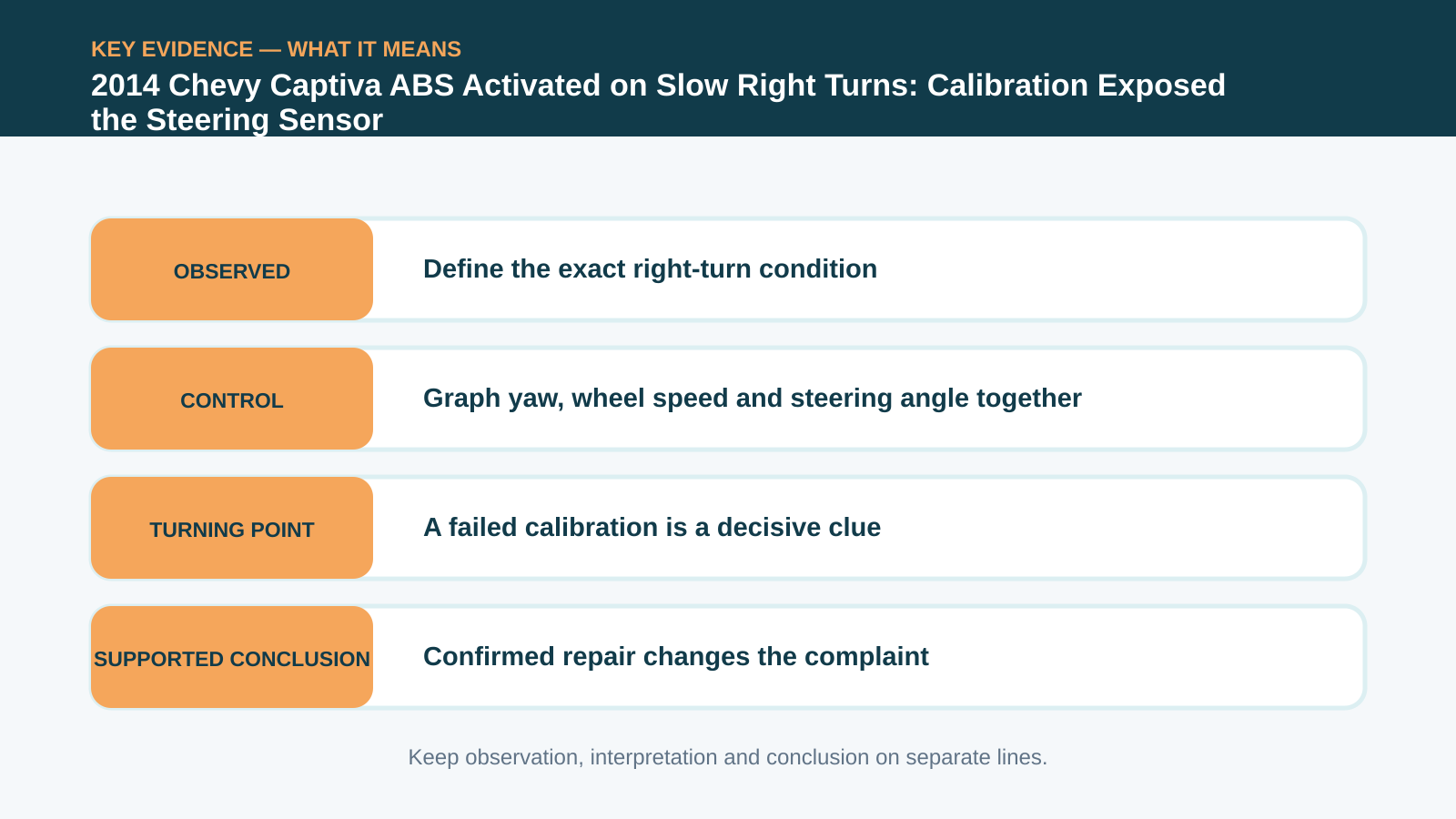
Write the maneuver precisely: slow right turn, foot off the brake, stability lamp flash and pedal/ABS pulsation. Direction-specific detail is diagnostic evidence, not storytelling decoration. Write down the conditions before disconnecting anything. That record is what lets a later change mean something instead of becoming another uncontrolled attempt.
Confirm tires and basic chassis inputs
Confirm tire size, brand, wear and pressure, then inspect bearings and suspension. Matching tires in the case removed a common input mismatch but did not prove each wheel-speed signal was clean. Use service information for the exact engine, build and option set. A correct test on the wrong pin or configuration can produce a precise but useless answer.
Graph yaw, wheel speed and steering angle together
Record steering angle, yaw/accelerometer data and all wheel speeds through the same turn. Look for sign errors, implausible zero, momentary dropout or disagreement rather than judging each PID alone. This is the turning point in the documented case. It gains weight because earlier branches were tested and because the symptom changed with one controlled condition.
| Observation | What it supports | What it does not prove |
|---|---|---|
| Only right turn triggers | Direction and geometry matter | Right wheel sensor failed |
| Tires match | Size mismatch is less likely | Signals are all clean |
| EBCM swap no change | Controller theory loses weight | Original EBCM is certified |
| SAS cannot calibrate | Sensor/setup branch is strong | Prerequisites can be ignored |
Do not let an EBCM swap become evidence
A substituted EBCM produced no change, so it did not support the controller theory. Restore the original known configuration and avoid building later conclusions on an unprogrammed swap. Separate observation from inference: record what moved, opened, failed or remained stable, then state only the component or path that result actually narrows.
A failed calibration is a decisive clue
The steering-angle sensor would not complete calibration. Verify steering center, alignment, battery voltage and prerequisites; when those are correct, a repeatable calibration refusal is stronger evidence than the absent DTC. The repair must remove the demonstrated mechanism and restore mechanical support, sealing, torque or terminal fit—not merely make the symptom disappear once.
Replace and calibrate the steering sensor
Replace the correct sensor at the steering column and perform the GM calibration routine. Keep the wheel and clockspring centered and complete any required setup before moving the vehicle. Reassemble to the original protection standard. Clear codes only after preserving the pre-repair record and confirming the relevant controller is online.
Verify only in a controlled low-speed area
Return to the same closed course and right-turn condition, then compare live data. The documented intervention stopped after successful calibration; also test left turns, straight braking and a final ABS scan. Use the customer’s original complaint as the final test specification. Matching conditions and a post-repair scan are stronger closure than a quiet bay or a cleared warning lamp.
For the owner or service adviser, the useful explanation has three parts: what was observed, why the decisive test narrowed the fault, and which original condition was repeated after repair. It should not promise that every similar vehicle needs the same component. This was one evidence chain on one vehicle, and the appropriate next step on another car may change with build data, prior work, safety condition and test results. That honest boundary makes the case easier to trust and more useful at the next diagnostic visit.
The swapped controller and tires were not the cause. The steering-angle sensor failed its required calibration; replacement and successful calibration stopped the false intervention. The reusable lesson is narrower and more valuable: Build around a precise maneuver and distinguish a calibration that cannot complete from a code that never appeared.






Comments 0
Questions, fixes, and real-world diagnostic notes from readers.
Be the first to share a diagnostic result or ask a follow-up question.