
2001 Nissan Frontier Brake and ABS Warnings: No Communication Was Only Half the Job

Abs Offline? Do Not Ignore The Base Brakes
The Frontier turned on both the brake and ABS warnings after the pedal was applied, and the ABS controller would not communicate. That was serious, but it was not the whole job. Electronic braking had failed while the master cylinder, booster and fluid condition still had to be judged as an independent base-brake system.
Before a silent ABS assembly is condemned, its identified low-voltage feeds and grounds must carry a meaningful load. On documented 9–30-volt test points, the MRCARTOOL B550 can support that circuit work. B550 can support loaded checks of identified 9–30-volt ABS feeds and grounds after Nissan wiring information identifies safe points. Never inject power into an ABS module output or data line; it cannot pressure-test hydraulics, bleed the system or judge stopping safety.
The mature case resolved two layers: a failed ABS motor/actuator-control assembly and hydraulic concerns involving the master cylinder, booster and old fluid. The components were repaired, the system was flushed and bled, communication returned, and controlled braking verification completed the safety chain.
Quick answer: The Frontier needed both an ABS actuator/control repair and base-brake hydraulic work; no communication was only one layer of the fault.
In this guide
- Brake and ABS lamps require a safety stop
- Separate base-brake feel from ABS communication
- Check the silent module’s loaded supports
- Confirm the actuator failure without bypass tricks
- Inspect the master cylinder, booster and fluid independently
- Repair both layers of the braking system
- Flush and bleed to the specified sequence
- Verify pedal, warnings, scan access and controlled stops
Brake and ABS lamps require a safety stop
Any red brake warning or abnormal pedal should stop normal driving until the cause is understood. Park on level ground, chock the wheels and check fluid level without assuming that topping up is a repair. Record whether the pedal sinks, feels hard, pulses or changes with engine vacuum. Also note exactly when each lamp appears. ABS loss may leave conventional braking available, but base braking can be compromised at the same time. This article explains the evidence; brake diagnosis and road testing belong with qualified personnel and a controlled test area.
Separate base-brake feel from ABS communication
Separate the system into two questions. First, can the truck build and hold hydraulic pressure with predictable booster assistance? Second, can the ABS controller communicate, monitor wheel speeds and operate its hydraulic unit when commanded? A no-communication scan result does not prove the master cylinder is good, and a firm pedal does not prove the ABS module is alive. Save all module codes and attempt communication with stable battery voltage. If only the ABS unit is silent, follow its electrical branch while the hydraulic inspection continues on its own sheet.
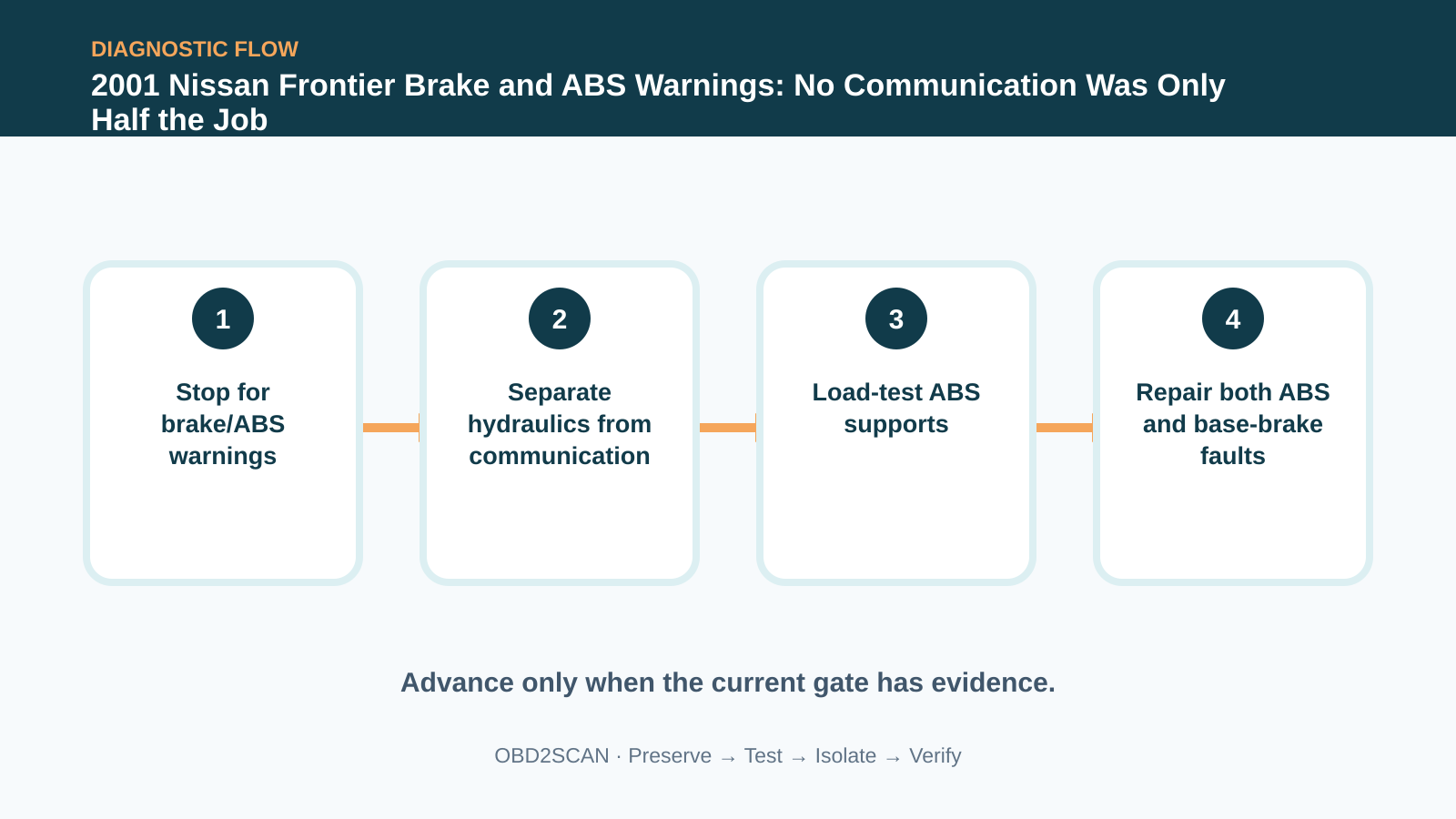
Check the silent module’s loaded supports
Use Nissan wiring information to identify every fuse, ignition feed, constant feed and ground for the ABS assembly. Check connectors for corrosion and fluid intrusion, then load-test the power and return paths with an appropriate device. An open circuit is easy; excessive resistance is the trap. A ground that reads near zero ohms without load may rise enough to reset a motor controller when current is demanded. Never energize an unknown ABS pin. Pump and valve circuits may be module-controlled and can be damaged by unauthorized power injection.
Confirm the actuator failure without bypass tricks
Once supports and communication paths pass, the silent actuator/control assembly becomes a defensible suspect. Confirm the part includes the motor and electronics specified for this truck and note whether coding, initialization or special bleeding is required. Do not use a disconnected ABS unit as a permanent way to extinguish a symptom. The mature case identified a failed ABS motor and replaced the actuator/control assembly. That repaired the electronic layer, but the brake warning and pedal evidence still required the base system to be made safe.
| Evidence branch | Question answered | Remaining boundary |
|---|---|---|
| ABS will not communicate | Controller is not participating | Power, ground, bus or module may be responsible |
| Loaded feeds and grounds pass | Supports can carry current | Internal ABS failure still needs confirmation |
| Pedal/master/booster checks are abnormal | Base braking has a separate problem | ABS replacement will not correct it |
| Repair, flush and bleed normalize all checks | Both layers operate together | Controlled stop test is still required |
Inspect the master cylinder, booster and fluid independently
Inspect the master cylinder for internal bypass, external leakage and reservoir contamination. Evaluate booster assistance and vacuum supply according to the engine and brake procedure. Dark or degraded fluid is maintenance evidence, not a universal percentage rule, and it cannot identify the failed hydraulic component by color alone. In the documented repair, the master cylinder and booster were also addressed. That matters because replacing only the ABS unit could restore communication while leaving the driver’s pedal complaint and stopping performance unresolved.
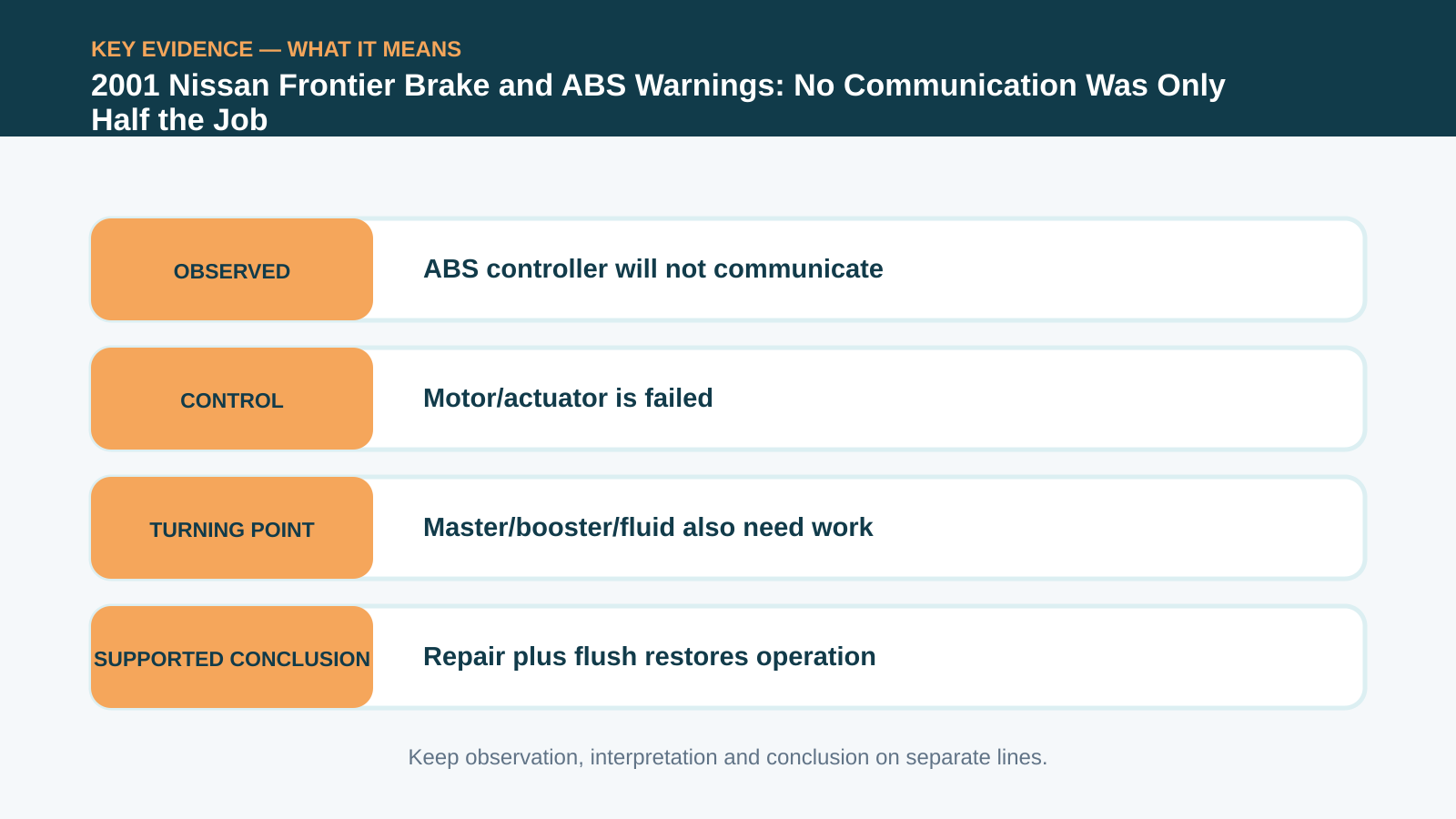
Repair both layers of the braking system
After component replacement, use only the specified fluid and keep the system clean. Bench preparation, line connection torque and bleeding order vary by vehicle. Some ABS hydraulic units require scan-tool valve cycling to remove trapped air. Do not improvise that step with direct electrical power. Flush until the procedure’s condition is met, maintain reservoir level and contain waste fluid. A pedal that feels acceptable in the bay can still contain compressible air, so pressure and leak checks precede any moving test.
Flush and bleed to the specified sequence
Verify the stationary brake first: firm pedal at constant force, no sinking, correct booster transition and no external leaks. Restore scan communication and confirm wheel-speed data remains sensible with the truck safely lifted or moving only as the procedure allows. Check that both warning lamps complete their bulb check and turn off. Clear codes after recording them, cycle the ignition and rescan. If the ABS unit requires initialization, complete it before interpreting a remaining lamp as a new failure.
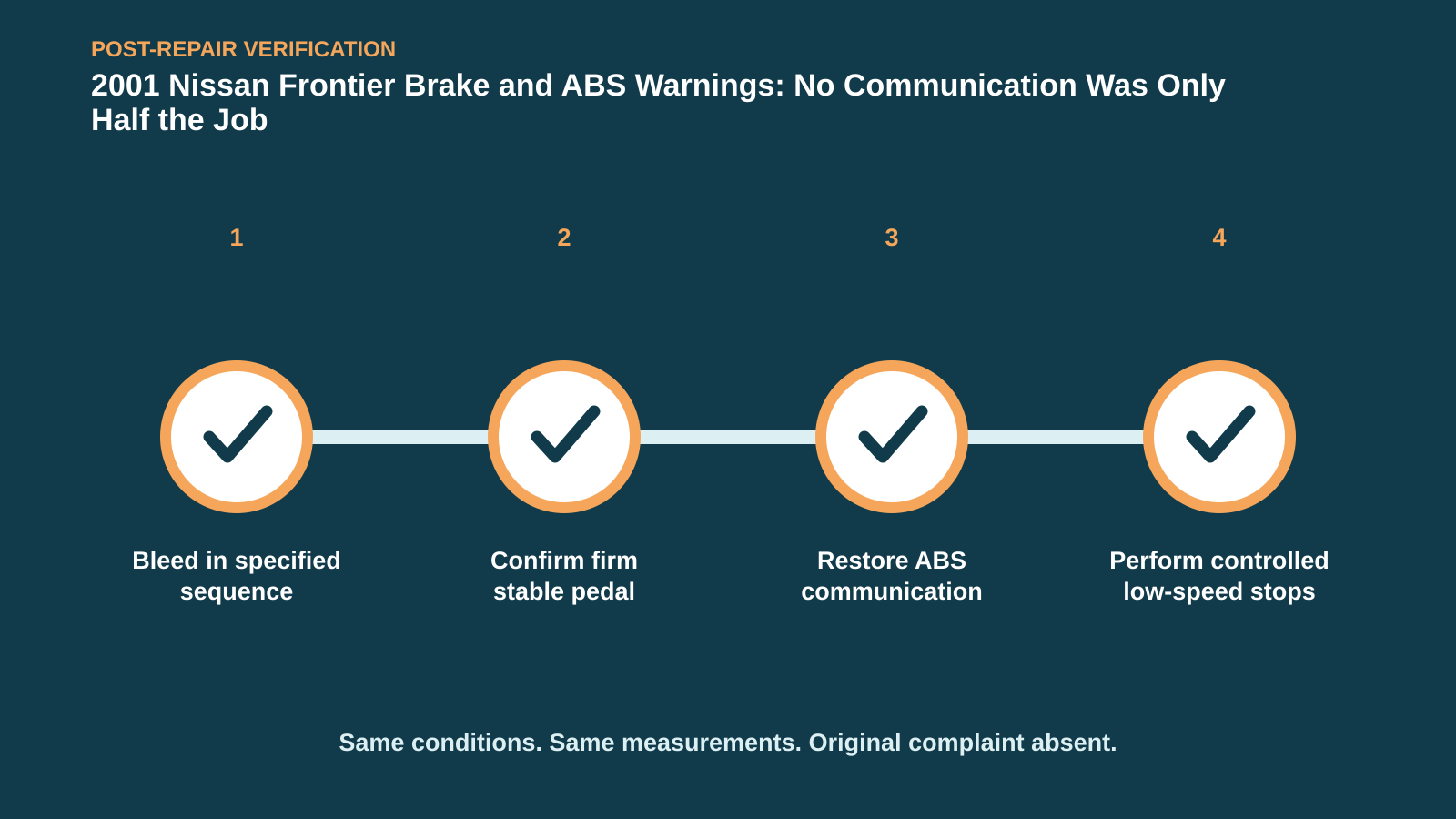
Verify pedal, warnings, scan access and controlled stops
Use a closed, low-speed area for initial stops. Confirm straight braking, predictable pedal travel and no pull, noise or premature ABS action. Increase speed only after repeated safe results. Then rescan and reinspect every opened connection. The final answer for this Frontier is not merely “replace the ABS module.” It is a restored electronic controller sitting on top of a verified hydraulic foundation. Both are required before the truck is returned to ordinary traffic.
No communication identified one broken layer. A safe repair required the other layer—fluid pressure, booster assistance and pedal behavior—to earn the same level of proof.










Comments 0
Questions, fixes, and real-world diagnostic notes from readers.
Be the first to share a diagnostic result or ask a follow-up question.