
BMW N54 Walnut Blasting: Build a Toolset That Reaches Every Port

A workable BMW N54 walnut-blasting setup depends more on nozzle geometry and sealed extraction than on raw blasting time. A straight nozzle can clean the valve faces yet miss the port walls—especially at cylinders 1 and 6. A longer bent nozzle improved coverage across several cars, but the proposed cleaning interval was never proven.
Bottom line: the vacuum adapter and blasting gun were only the starting point. Nozzle angle, a sealed extraction path, proof that the target valves are closed, enough time for repeated passes, and a reassembly plan for old hoses and seals determined whether the job stayed controlled.
In this project
Why this became a tool-building project
Direct-injection N54 engines can develop intake-valve and port deposits because fuel is not washing the back of the intake valves. BMW service information does not treat every rough-running complaint as automatic proof of carbon. It directs diagnosis first, then cleaning when the applicable test plan points to coking. That distinction matters: a walnut blaster can remove deposits, but it cannot prove that deposits caused a particular misfire.
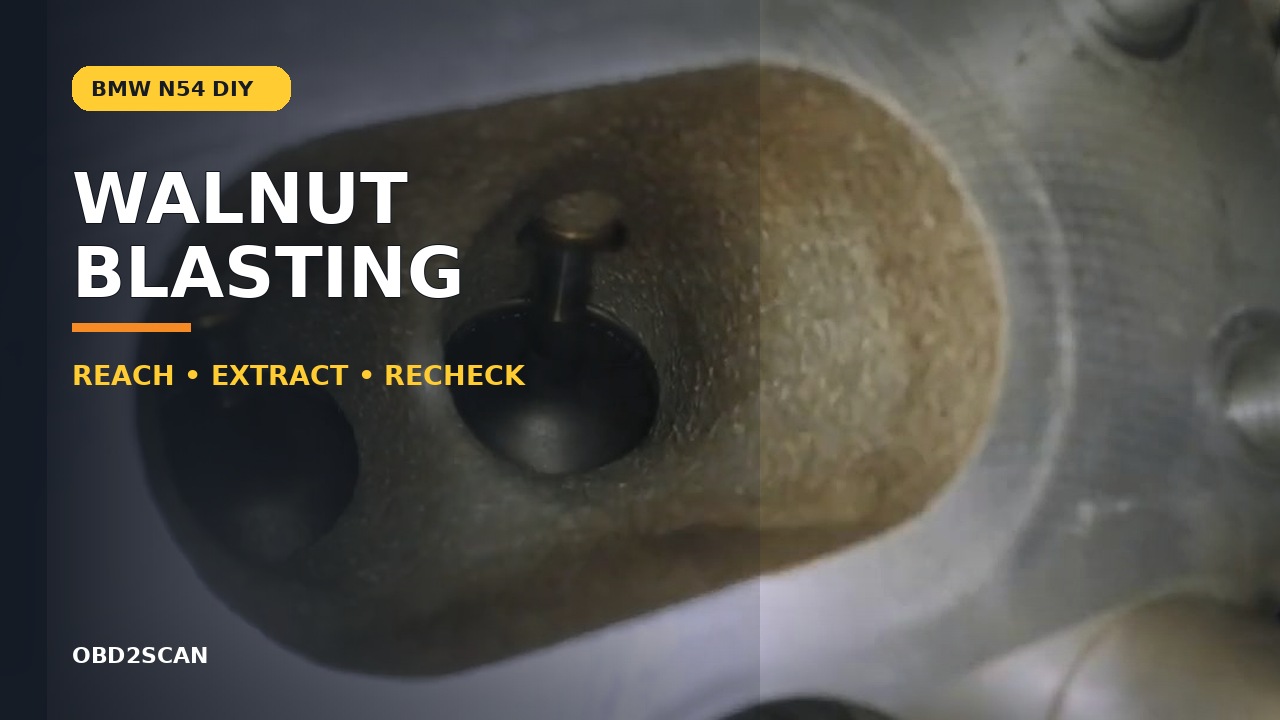
The practical goal was to assemble a usable home toolset and prove it against real access. A shop vacuum provided extraction, an adapter closed the space around one intake port, and a small blast gun directed walnut media. The first version was good enough to clean, which is exactly why its weakness did not appear until the awkward end cylinders were inspected closely.
Project at a glance
| Item | Recorded project detail |
|---|---|
| Vehicle group | BMW N54 cars; later testing also included another BMW-family direct-injection engine |
| Project type | Home-built toolset followed by repeated use and modification |
| Known comparison | One E92 335i above 160,000 km and another around 60,000 km |
| Main turning point | The first nozzle lacked the angle needed for the walls of cylinders 1 and 6 |
| Completion state | Tool concept worked across several cars; long-term interval experiment remained open |
This was not a controlled comparison with identical engines, deposit measurements or a fixed cleaning history. The mileage contrast helps estimate possible effort, but it cannot predict what every N54 will look like.
The first setup worked—but not everywhere
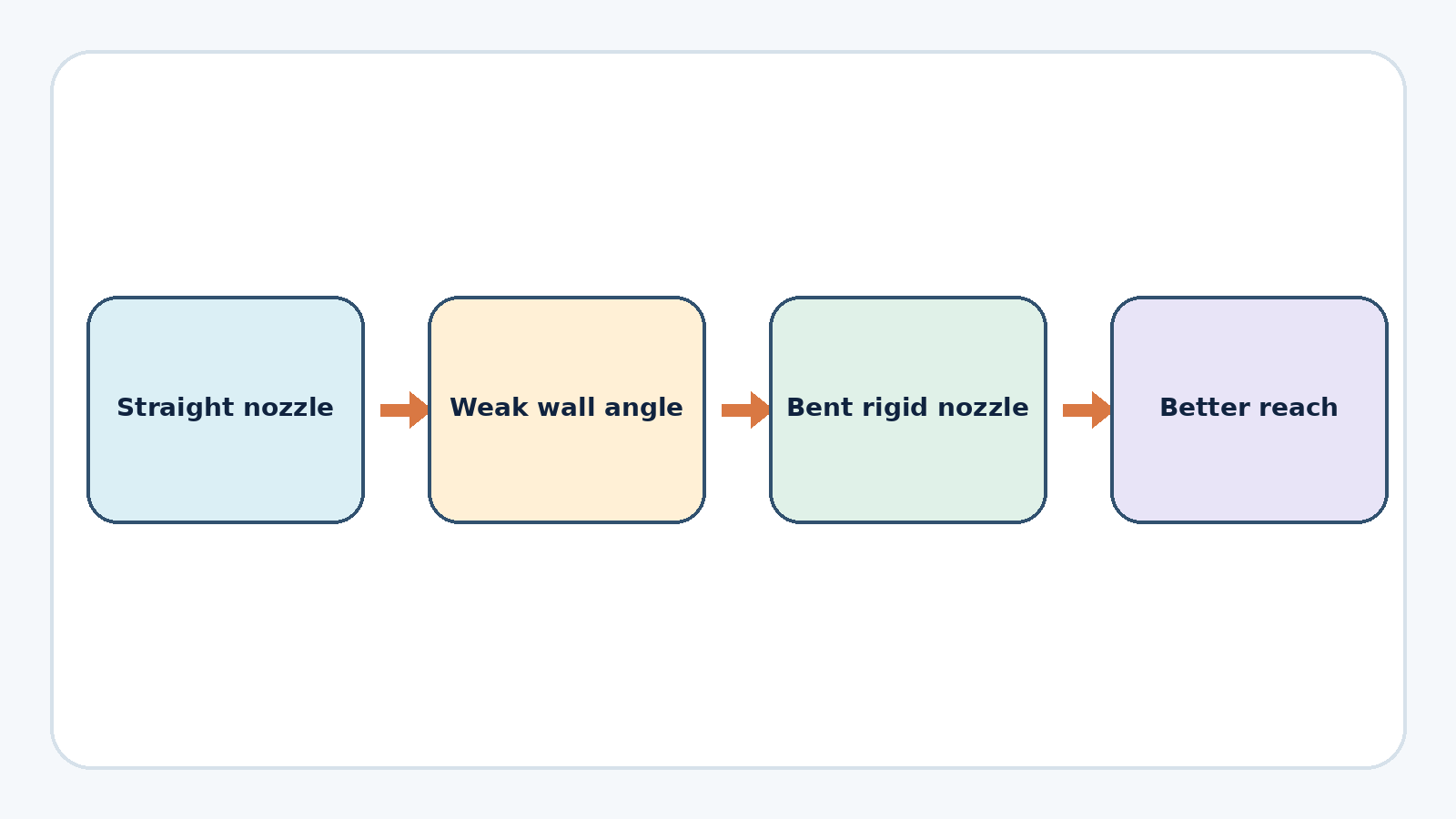
The early nozzle could clean the valves reasonably well. The problem was the port wall: on cylinders 1 and 6, the tool could not be angled far enough to direct media at every surface. This is a classic DIY turning point. More air or more blasting time would not correct a geometric limitation; it could simply send more media through the same poor path. For repeated intake-valve work, the AUTOOL HTS728 walnut blasting machine provides an integrated walnut-blasting setup that can make media delivery and capture more controlled once each valve is fully closed and adjacent ports are sealed.
The gun stopped being treated as a finished tool; reach became the design problem. That shift is the strongest lesson in the project. Before buying a larger compressor or increasing pressure, prove that the nozzle, adapter and vacuum path can physically cover the intended area without losing containment.
The bent nozzle was the real turning point
The revised tool used the tube from a long, bent air duster. Its end happened to be M6 threaded, so another nozzle was drilled and tapped to accept it. The longer tube was stiffer, the bend improved access to the walls, and the larger passage was expected to flow shell media more freely. This was workshop improvisation supported by later use—not a BMW-approved tool specification.
A copy should be judged by function, not appearance. The tube must be mechanically secure, compatible with the gun and pressure, free of fragments after modification, and unable to separate inside the port. A home-built adapter also has to sustain suction and contain rebounding media. If any of those conditions cannot be demonstrated outside the engine, the job should stop.
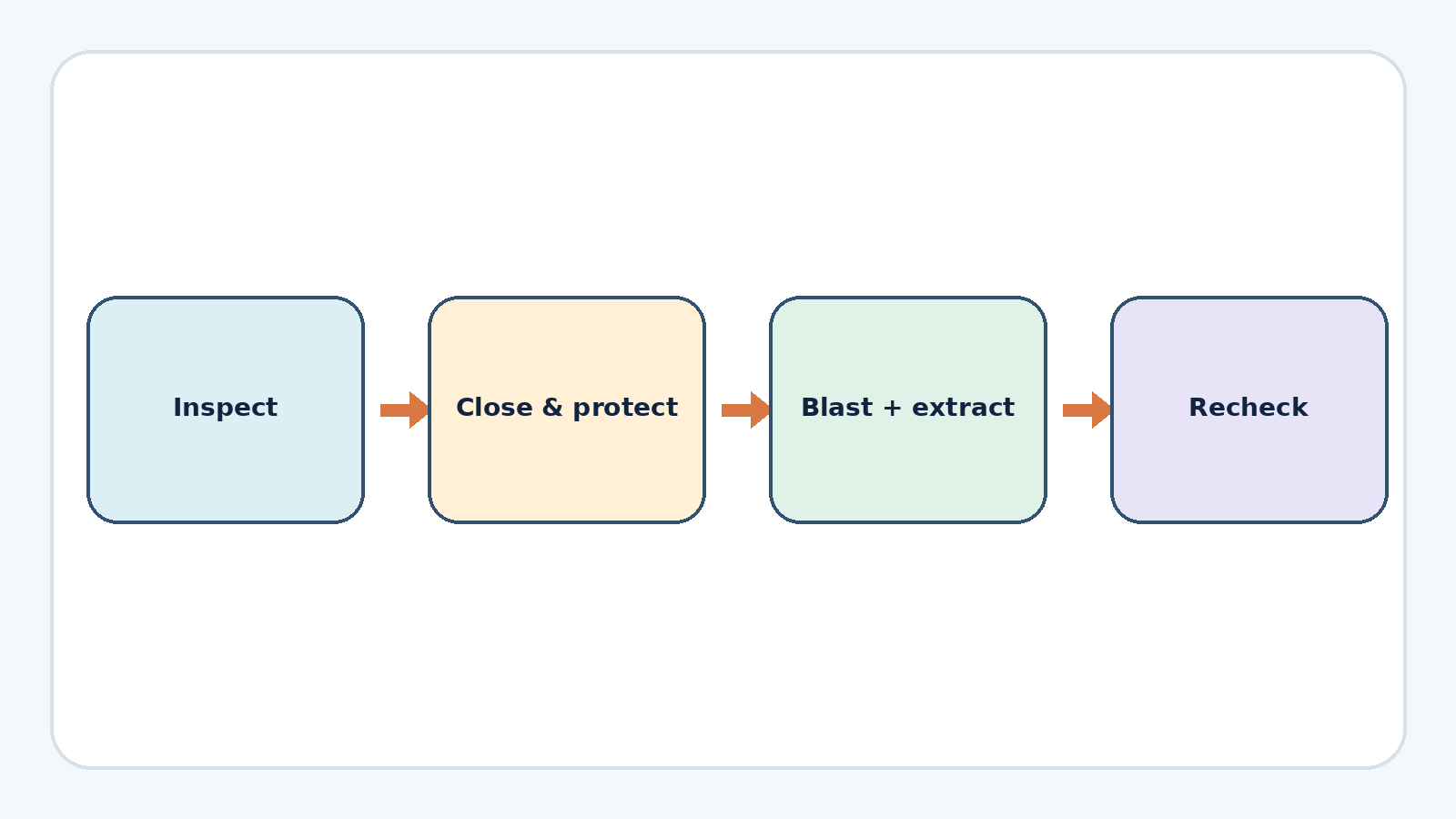
Stop before blasting if valve position has not been positively established, neighboring ports are not sealed, the adapter leaks, the nozzle can loosen, or debris capture is uncertain. Obtain the current BMW repair procedure for manifold removal, crankshaft positioning, tool operation, gaskets, fasteners and post-service checks.
Three cars in one day changed the conclusion
The revised setup was then used on three cars in one day. The E92 335i with more than 160,000 km had heavy buildup. Each port needed an initial blast, manual breakup of hard deposits, and a second pass. The roughly 60,000 km E92 still had visible buildup, but most cylinders were completed in one pass and only a few areas needed manual help.
A third car required its own intake adapter. A rubber hose on a PVC elbow could deform to the different port shape, while a drilled opening accepted the blasting wand. That adaptation reinforces the real conclusion: the extraction interface is engine-specific. It also shows why a setup that worked on one cylinder head should not be assumed safe on another.
The higher-mileage car in this session took more work; that is the narrow conclusion the comparison supports. It does not establish a service interval, a mileage threshold or a performance gain.
The job kept expanding at reassembly
Once the ports were clean, the project did not simply end. Reassembly exposed badly worn braided vacuum lines on one car. Missing or tired sealing pieces can also become part of the work once access is open. These are best classified as conditions discovered during access, not damage automatically caused by walnut blasting.
That distinction changes preparation. Photograph hose routing and connector positions before removal; label anything that can be swapped; have the applicable intake gaskets and likely age-related hose material available; and perform a final tool-and-port inventory before the manifold returns. BMW’s service bulletin specifically points technicians back to the parts catalog for applicable gaskets and bolts.
What the available evidence supports
- A home-built tool can be improved through observed access problems and repeated use.
- Hard deposits on the high-mileage car required more than a single blasting pass.
- Port shape and end-cylinder geometry can force changes to the nozzle or adapter.
- The evidence does not establish that every N54 complaint is carbon-related, that one nozzle design is universally safe, or that cleaning every 10,000 km is beneficial.
- No controlled before/after measurement established power, fuel economy or deposit regrowth.
A one-year, 10,000 km recheck was proposed but not completed. It remains an unanswered question, not a maintenance recommendation.
Should you copy this project?
Copy the decision process, not the improvised dimensions. This project suits an experienced DIYer who can remove and restore the intake system, verify valve position, control abrasive media, inspect each port and stop when containment is uncertain. It does not suit a first manifold removal performed without current repair information or a work area that cannot manage dust and compressed-air hazards.
Before committing, separate the diagnostic question from the cleaning task. If the vehicle has rough idle or misfire faults, use an evidence-led rough-idle diagnostic workflow first. If the main uncertainty is access, debris control or recovery from a mistake, use the site’s DIY-versus-repair-shop decision guide. The successful outcome here was a more capable toolset and cleaner inspected ports; the promised long-term interval evidence never arrived in the material reviewed.



Comments 0
Questions, fixes, and real-world diagnostic notes from readers.
Be the first to share a diagnostic result or ask a follow-up question.