
DAF CF75 Rear Steering Centered Itself and Shut Down: The Accumulator Could Not Hold Pressure

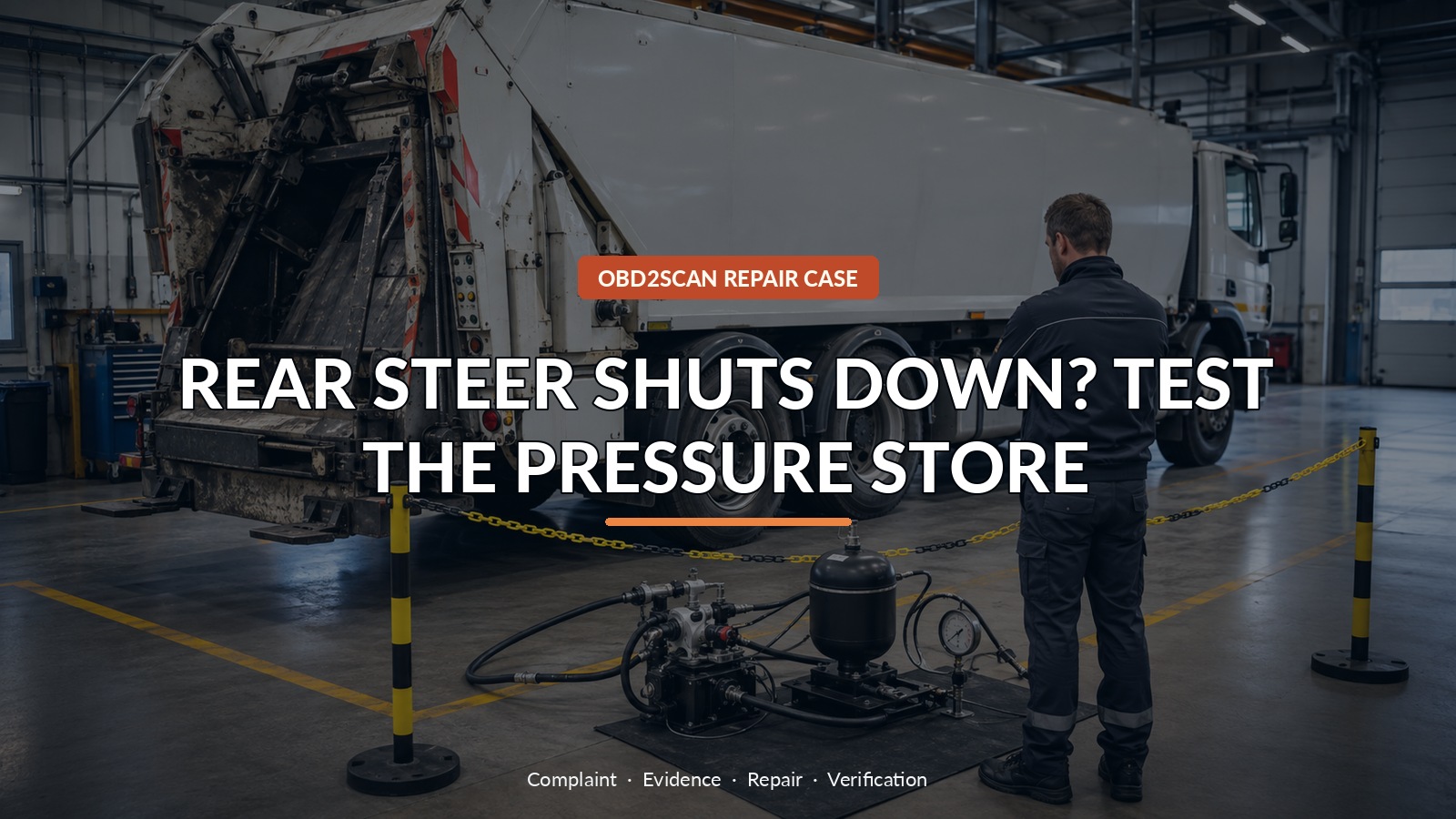
Rear Steer Shuts Down? Test The Pressure Store
A DAF CF75’s rear-steering system repeatedly centered the axle and shut itself down. That behavior felt like a steering failure, but centering was the fail-safe doing its job after stored hydraulic pressure became unreliable. The cylinder could hold pressure. The spherical accumulator could not store it.
Once a qualified technician has proved the accumulator fully discharged and removed it, an articulating inspection camera can document the visible bladder position. The AUTOOL SVB308 is one example for that bounded post-isolation view. SVB308 can document the visible bladder or valve position only after a qualified technician has proved the accumulator is fully discharged and removed it. It cannot measure nitrogen precharge, hydraulic pressure or make a charged accumulator safe.
Synchronized pressure, command and angle evidence eliminated the main supply and isolated cylinder. After safe discharge and removal, a borescope showed the accumulator bladder fully deflated. Replacement and bleeding made centering pressure hold smoothly at roughly 40 bar after a maneuver, and the road test completed without another fault. Stored energy—not steering geometry—was the missing function.
Quick answer: The steering cylinder held pressure, but the accumulator could not store centering pressure. A deflated bladder was confirmed; replacement stabilized the system.
In this guide
- A self-centering rear axle is the fail-safe working
- Map the pressure store before touching hardware
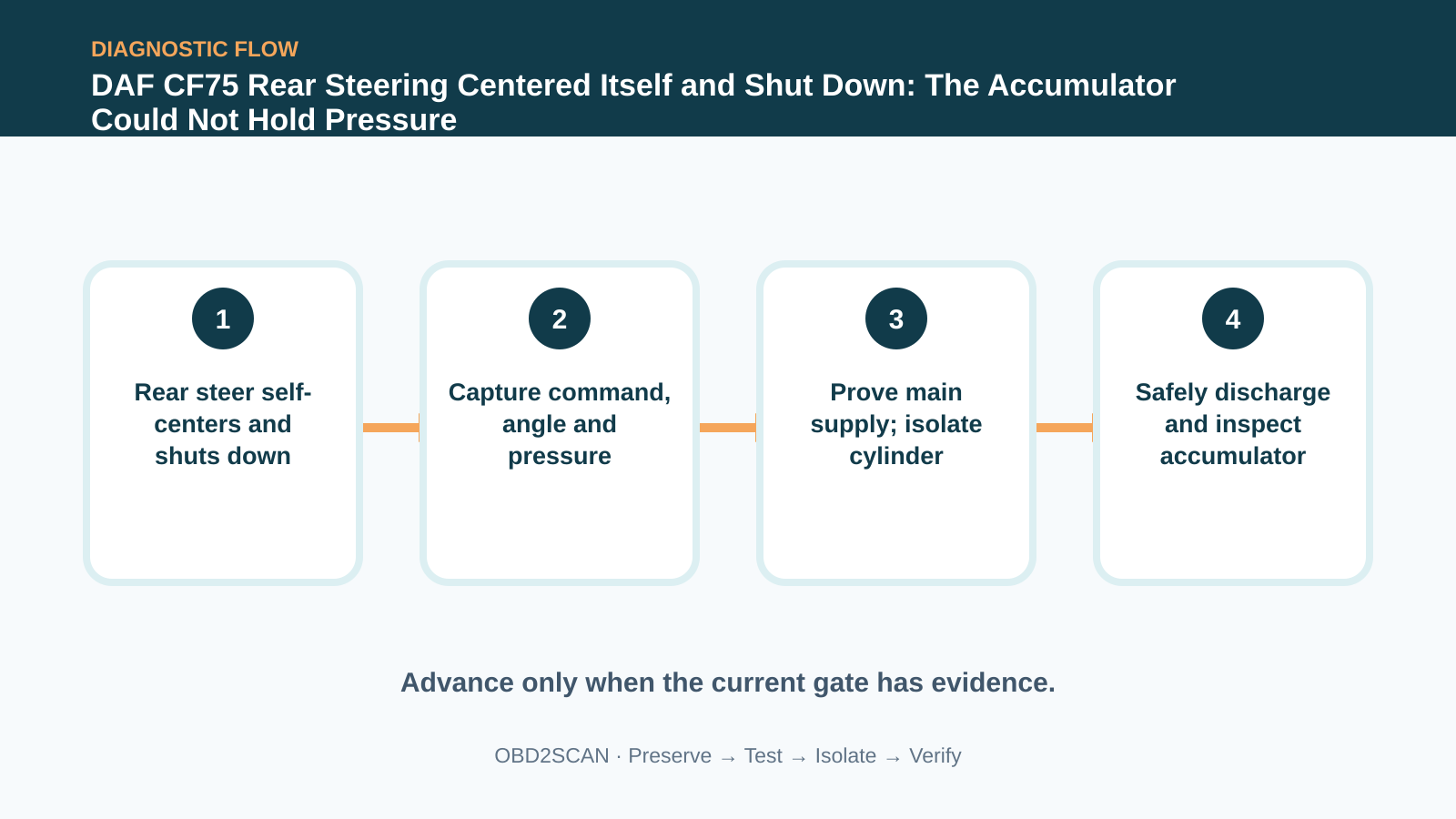
- Capture command, angle and pressure in one event
- Prove the main hydraulic supply is available
- Isolate the cylinder and see whether pressure holds
- Treat accumulator removal as high-risk work
- Confirm the collapsed bladder after discharge
- Bleed, road-test and watch centering pressure stay stable
A self-centering rear axle is the fail-safe working
Treat unexpected rear-steer shutdown as a commercial-vehicle safety fault. Remove the truck from road service, secure it on level ground and follow DAF and system-supplier procedures for centering, lifting and hydraulic isolation. Record whether the axle self-centers while driving, during stationary commands or after a time delay. Save all pressure, angle, communication and supply faults before clearing. Never stand in the axle’s movement zone or crack a hydraulic connection to “see if pressure is there.”
Map the pressure store before touching hardware
Map the circuit before measuring it: pump supply, control valves, steering cylinder, pressure sensor and gas-charged accumulator. The accumulator acts like an electrical capacitor only as an analogy—it stores hydraulic energy by compressing gas behind a bladder, then releases that energy as demand changes. The analogy helps explain smoothing and reserve pressure, but it does not describe service technique. Nitrogen precharge and hydraulic oil are stored-energy hazards that require specified tools and training.
Capture command, angle and pressure in one event
Capture steering command, axle angle, main pressure and centering pressure through one maneuver and the shutdown. Note whether the commanded direction and measured angle agree before fail-safe centering begins. If electrical command vanishes first, investigate control and interlocks. If pump supply collapses, stay upstream. In this case the shape of centering pressure—rather than lack of steering command—suggested that energy was not being stored and released smoothly.
Prove the main hydraulic supply is available
Confirm the main hydraulic source can build the required pressure and that valves receive their electrical command. Use rated transducers at approved test points and keep the cab operator in communication with the test lead. A healthy supply during the event moves the problem toward the storage, isolation and actuator branches. Do not interpret one static peak as proof; the rate of rise, decay and behavior after a maneuver show whether pressure is being maintained.
Isolate the cylinder and see whether pressure holds
Isolate the steering cylinder only with manufacturer-approved valves or test fittings. If pressure holds across the isolated cylinder, internal bypass there becomes less likely. That negative result protects the owner from replacing an expensive actuator because it is physically central to the symptom. Restore the system carefully after the test and check for trapped pressure. Any unexpected movement or inability to maintain a safe centered state ends testing until the truck is secured again.
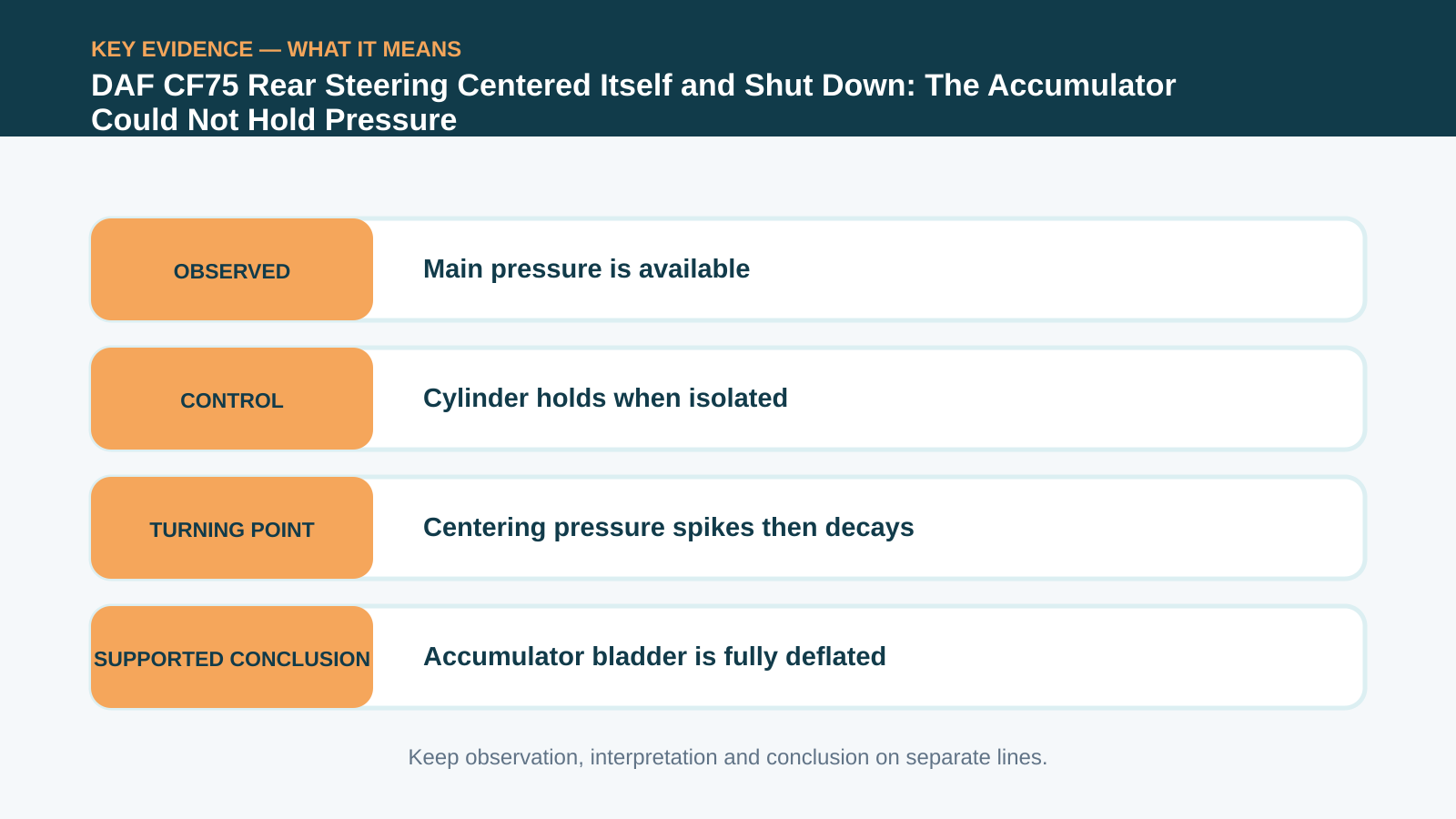
| Test | Result | Diagnostic value |
|---|---|---|
| Main hydraulic supply | Available | Pump/source less likely |
| Cylinder isolated | Pressure holds | Cylinder leakage not primary |
| Centering circuit after maneuver | Pressure spikes then decays | Storage/smoothing is lost |
| Accumulator inspected after discharge | Bladder fully deflated | Accumulator failure confirmed |
Treat accumulator removal as high-risk work
Accumulator removal requires proof of zero hydraulic pressure and safe handling of the gas side. Follow the specified discharge and precharge procedure; do not puncture, heat or casually depress a vessel. In the documented case, internal viewing after safe removal showed the bladder completely deflated. An inspection camera can record that visible condition, but it cannot measure nitrogen charge or declare an installed vessel safe. Replace the accumulator with the correct pressure, volume and connection specification.
Confirm the collapsed bladder after discharge
Bleed the circuit, inspect every disturbed connection and perform the prescribed stationary steering checks. Centering pressure after repair held more smoothly at around 40 bar following a maneuver, rather than collapsing as before. Then complete a controlled road test with steering angle, pressure and fault status monitored. Verify normal rear-axle response, fail-safe behavior and absence of leaks. The documented truck completed the test without the fault returning.
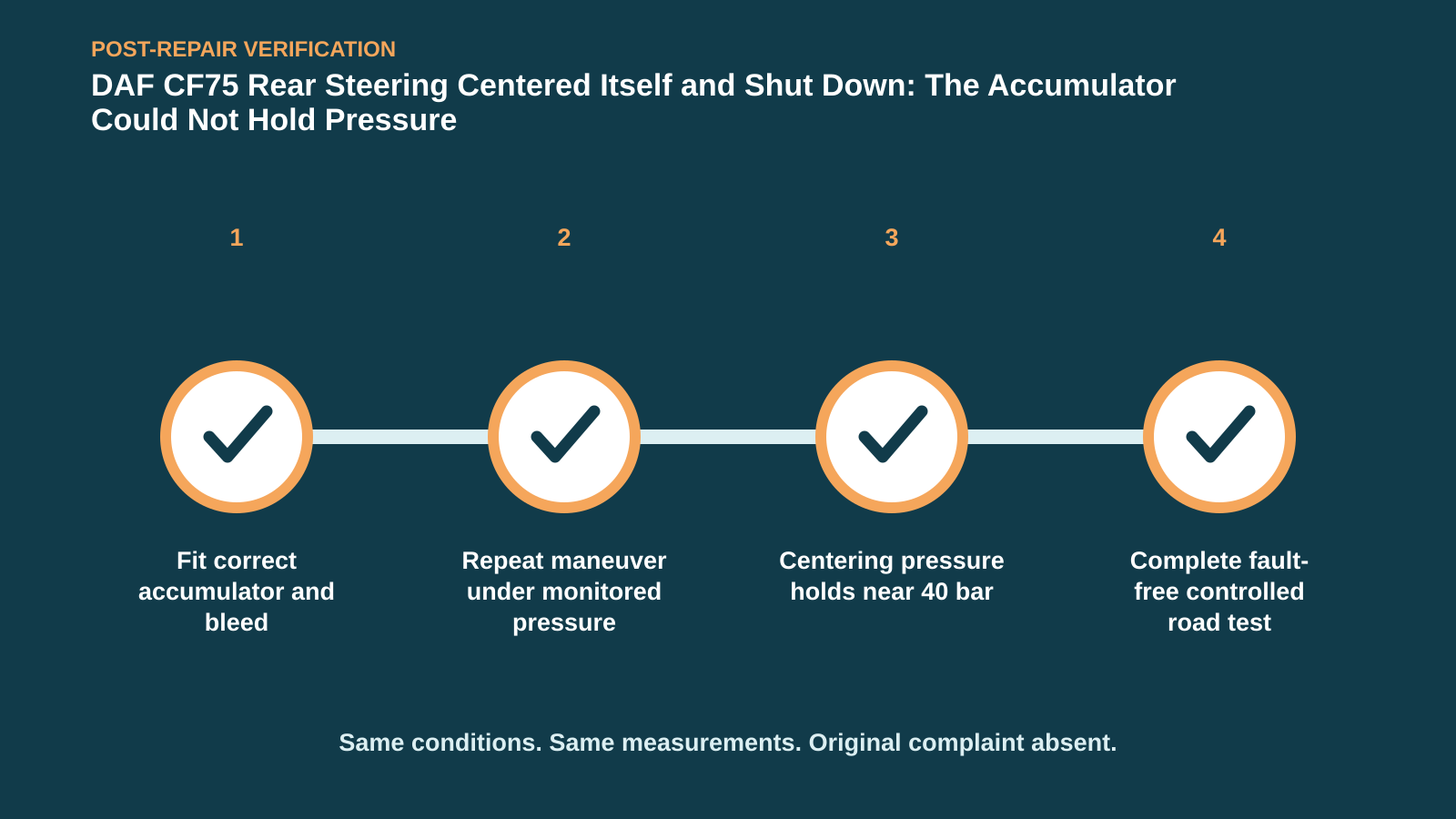
Bleed, road-test and watch centering pressure stay stable
Attach the before/after pressure traces and accumulator details to the fleet record. Establish any specified precharge or replacement inspection interval and ask drivers to report self-centering immediately. This single failure does not make every CF75 steering fault an accumulator problem; electrical commands, sensors, valves and cylinders remain possible. The reusable lesson is to test where hydraulic energy is supplied, stored and held before the most visible steering component receives blame.
The axle centered because the system no longer trusted its pressure reserve. Proving the cylinder could hold and the accumulator could not made the repair both safer and less expensive than guessing at the steering actuator.






Comments 0
Questions, fixes, and real-world diagnostic notes from readers.
Be the first to share a diagnostic result or ask a follow-up question.