
MK7 GTI Water Pump Leak: Plan the Intake-Off Repair and Cooling-System Refill

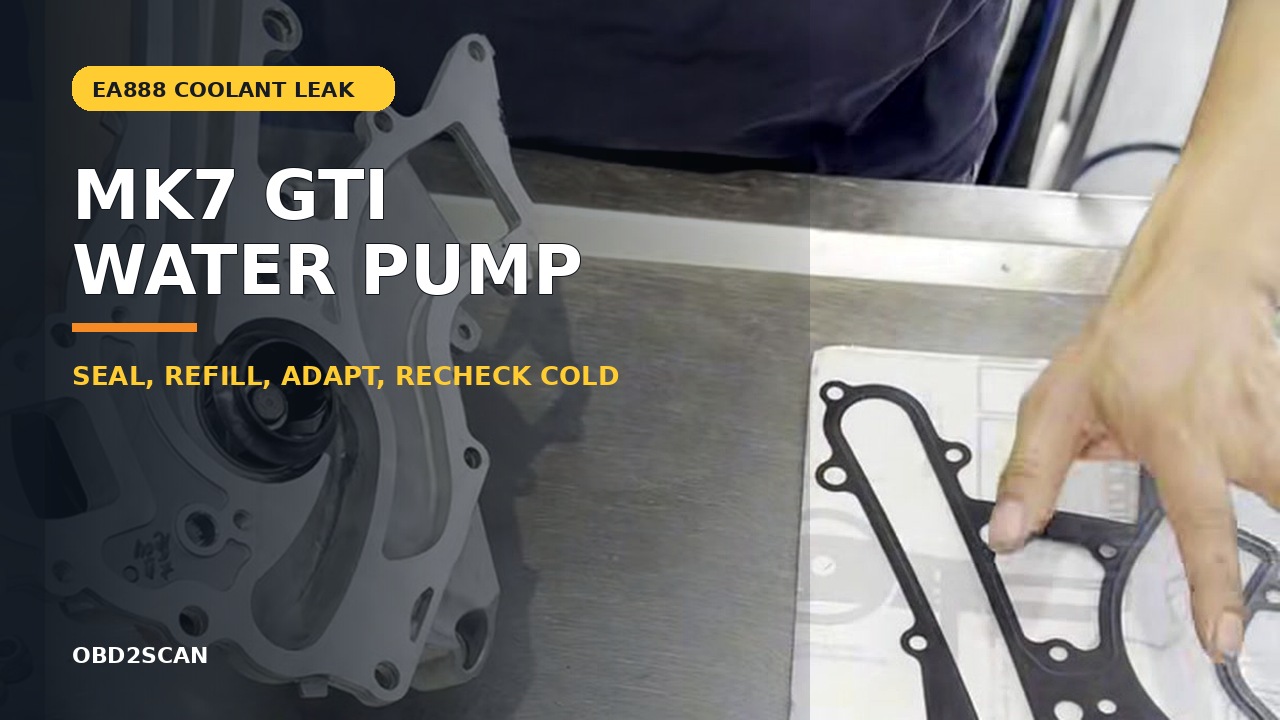
Bottom line: A 2015 GTI water-pump and thermostat-housing workflow covering access, the reverse-thread drive bolt, low-torque assembly and actuator adaptation.
In this case
- Case at a glance
- The answer: access and final setup decide whether the repair stays dry
- Confirm the leak and warranty status before buying parts
- Choose the intake-manifold route deliberately
- Remove coolant connections and the pump drive without creating a second repair
- Bench-assemble the housing and respect the low torque
- Seal the cooling system early, then finish the wiring map
- Verify hot, then recheck cold
- Minimum record to retain
Case at a glance
| Field | Case detail |
|---|---|
| Vehicle | 2015 Volkswagen GTI, about 100,000 miles |
| Complaint | Visible coolant leakage at the pump/thermostat area |
| Access choice | Intake manifold removed; fuel rail remained in place on this build |
| Parts | Pump, thermostat housing, union seals, drive belt and specified fastener |
| Verification | Leak inspection, hot heater output, thermostat actuator basic setting, road test and next-morning level check |
The answer: access and final setup decide whether the repair stays dry
The pump and thermostat housing were visibly leaking on this 2015 GTI. Removing the intake manifold created controlled access, left the fuel rail and injector seals undisturbed on this configuration, and made the sealing surfaces and hose connections visible. The pump, housing, union seals, drive belt and specified drive fastener were renewed.
The repair was not finished at the last bolt. The cooling system was filled and bled, fuel and coolant connections were checked under operation, the engine-temperature-control actuator basic setting was run, and the cold level was checked again the next morning.
Evidence boundary: The numeric values in this article belong to the documented vehicle unless an official applicability statement says otherwise.
Confirm the leak and warranty status before buying parts
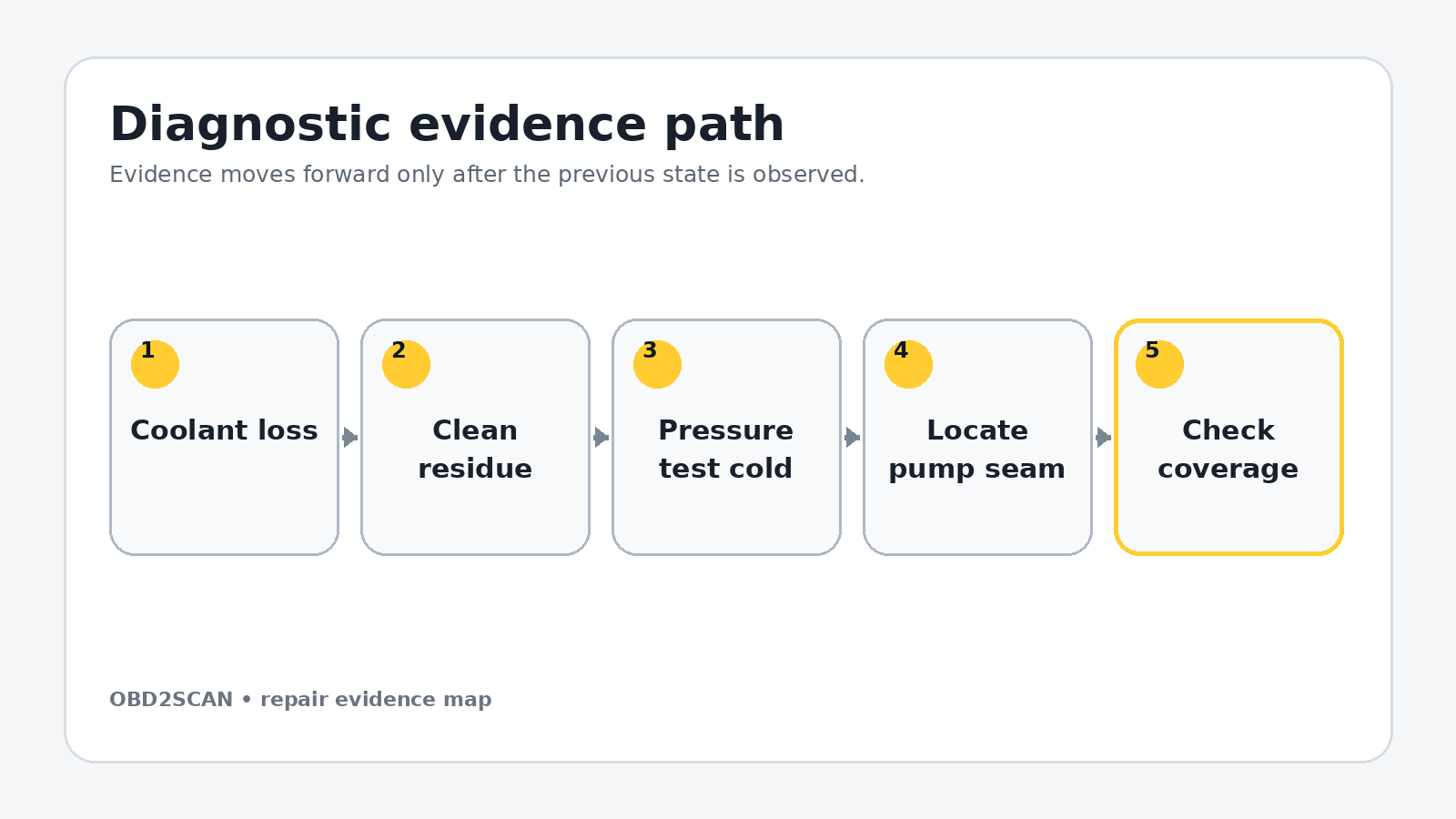
Old pink or white residue can point toward the pump area, but clean it and use the safe pressure-test guide on a cold system. Trace wetness from the highest fresh point. Oil-cooler, hose and flange leakage can travel across the same area.
Volkswagen extended pump, thermostat and thermostat-housing coverage to 8 years or 80,000 miles for certain 2014–2021 settlement vehicles. Eligibility depends on VIN, original in-service date, mileage, exclusions and market. Check with an authorized dealer before dismantling; coverage is not universal and many cars are now outside the time limit.
Choose the intake-manifold route deliberately
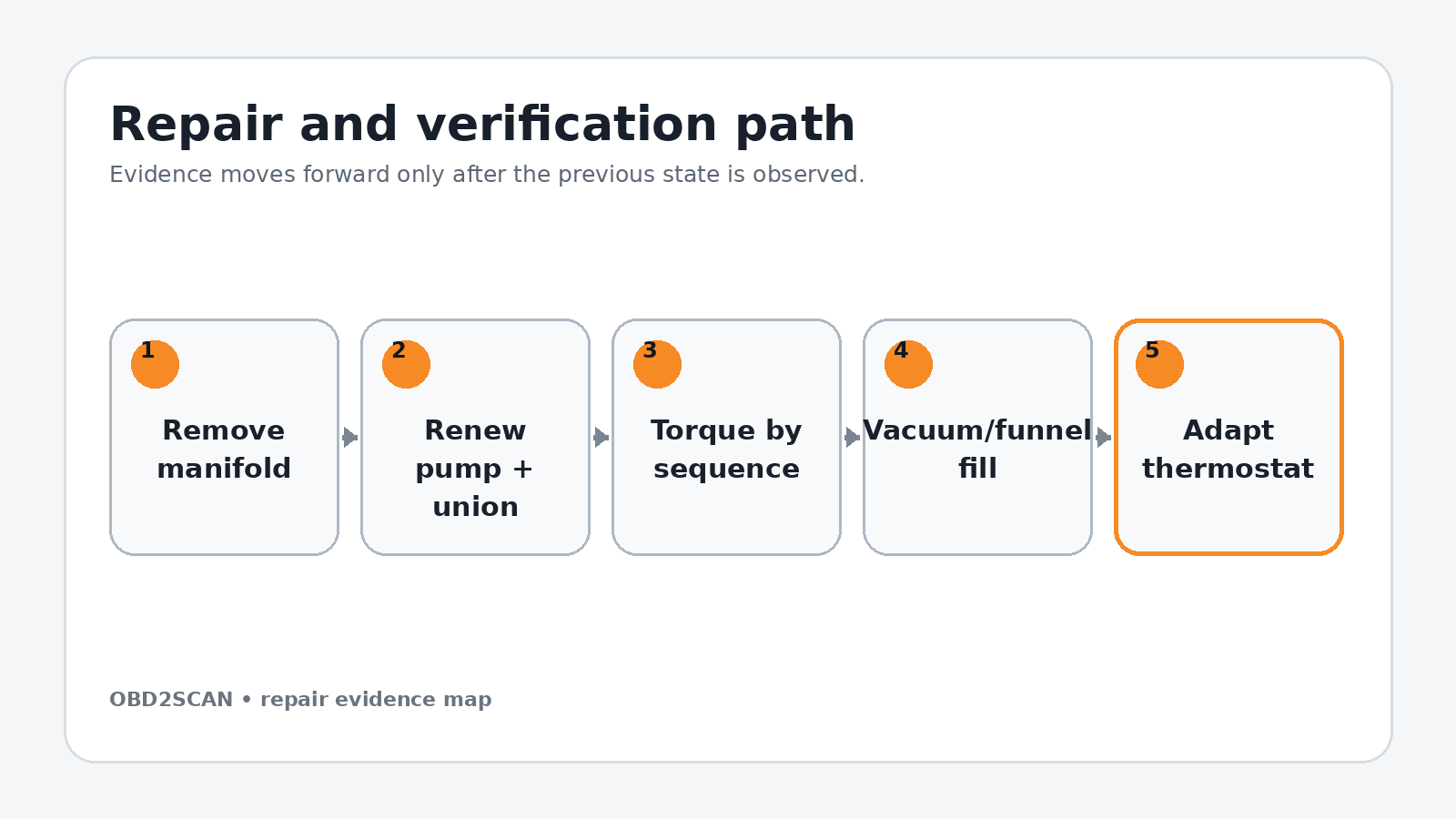
The housing sits below the intake manifold. Some technicians work through throttle-body clearance, but removing the manifold on this early MK7 exposed the pump and kept the rail in place. Depressurize and contain residual fuel, disconnect every hidden vacuum line and sensor, and protect open intake ports immediately.
Use the water-pump-area leak workflow to document the wet path before cleaning. Take connection photographs; the lower intake-flap connector and rear vacuum routing are easy to miss during reassembly.
Safety boundary: Use current vehicle-specific service information, approved support and the correct test load before opening a circuit or assembly.
Remove coolant connections and the pump drive without creating a second repair
Release coolant-hose clips without losing them, remove the small belt cover and note the belt’s no-kink warning. The water-pump drive gear uses a reverse-thread fastener on this engine. Counter-hold with the specified crankshaft tool and confirm the loosening direction before applying force; the head can round easily.
Keep coolant away from open ports and electrical terminals. Clean the pump opening only after the ports are protected. Remove the plastic union and both seals rather than leaving an aged sealing interface behind.
Bench-assemble the housing and respect the low torque
Clean alignment dowels and the block face without removing base material. Lubricate new seals only with a compatible product specified for the application. Seat the union and pump fully before tightening.
On this 2015 example, the pump-to-housing and pump-to-block fasteners were tightened to 9 N·m in a specified sequence, and the renewed drive fastener used 10 N·m plus 90 degrees. These values are recorded case facts, not substitutes for current repair information for another EA888 revision. An inch-pound-range torque wrench is essential because “snug” can distort plastic.
Seal the cooling system early, then finish the wiring map
Reconnect all coolant hoses and the thermostat electrical connector, inspect the circuit, and fill with the correct coolant mixture using an approved vacuum fill or controlled funnel method. Sealing and filling before the last trim pieces go on creates time to catch a leak while access remains. After the pump housing is sealed, the MRCARTOOL cooling-system vacuum refill kit can vacuum-fill the cold cooling system and reduce trapped air before the hot run and next-cold recheck.
Route the fuel lines before the manifold is fully tightened, reconnect the hidden intake-flap and boost-pressure sensors, and pull-test every quick connection. Run the engine-temperature-control-actuator basic setting with a compatible scan tool when specified for the exact vehicle.
Verify hot, then recheck cold
Start the engine and check immediately for fuel, coolant, oil and intake-air leaks. Command full cabin heat and verify stable hot output while monitoring temperature. Road test with live temperature data and inspect the dry pump area again.
Allow the engine to cool completely and recheck the expansion-tank level the next morning. Air released after the first heat cycle can lower the level even when the repair is dry. The repair closes only after a stable cold level, no fresh residue, correct actuator operation and no new faults.
Verification boundary: A cleared code is not a result by itself. Repeat the original operating condition and retain the measured before-and-after evidence.
Minimum record to retain
Keep the initial scan before clearing anything, the exact ambient and operating condition that reproduces the complaint, and one labeled result for every branch tested. Save photographs or waveforms at their original resolution and identify the measurement point, scale, engine state and tool setup. A future technician should be able to distinguish a direct observation from an inference without reconstructing the whole visit from invoices. Retain exact vehicle identification with every saved measurement.
- Coolant residue localized the leak at the pump/thermostat area.
- The drive-gear bolt is reverse threaded and was replaced after removal.
- Pump/housing fasteners on this example were tightened to 9 N·m in specified order.
- Cooling system was filled, leaks checked, actuator adapted and level rechecked cold.
This case includes a repair result, but the same-condition retest is still the reason the result is credible. Record what changed, what did not change, and which test was repeated after the work. Also retain any programming, adaptation or calibration report and a final whole-vehicle scan. If the symptom is intermittent, define a monitoring window instead of treating one successful start or one short drive as permanent proof.




Comments 0
Questions, fixes, and real-world diagnostic notes from readers.
Be the first to share a diagnostic result or ask a follow-up question.