
2014 Renault Kangoo Z.E. Would Not Charge: The Hardware Was Waiting for Permission

Plugged In, Not Charging? Check Permission
The Kangoo accepted the plug. The latch engaged, the charge lead was detected, and the pilot signal began—yet the traction battery stayed at 3 percent. That combination matters because it separates “the cable is invisible” from “the vehicle sees the request but will not grant charging.” The most expensive hardware in the path was not the missing condition.
On the identified low-voltage side, a graphing automotive meter can help observe a bounded signal after the circuit and category rating are known. The AUTOOL DM303 is one such option. DM303 can support identified low-voltage checks only within its ratings and the vehicle procedure. It is not CAT-rated EVSE equipment, is not an insulation tester and must not be used on energized mains or high-voltage traction circuits.
The control-pilot sequence reached connection but normal key-off charging did not start. Turning the ignition on changed contactor state and allowed some energy to flow, proving more of the hardware path than a static code scan did. Another shop replaced the on-board charger without effect. The real block was an unpaid battery lease that had allowed Renault to disable charging remotely.
Quick answer: The Kangoo recognized and latched its charge cable, but an unpaid traction-battery lease had remotely disabled normal charging.
In this guide
- Treat a three-percent traction battery as urgent
- Start with ownership history and charging rights
- Confirm what the cable handshake completes
- Do not mistake contactor silence for a failed charger
- The ignition-on clue changed the system state
- Why a new on-board charger changed nothing
- Resolve the authorization path
- Define the safe final charge test
Treat a three-percent traction battery as urgent
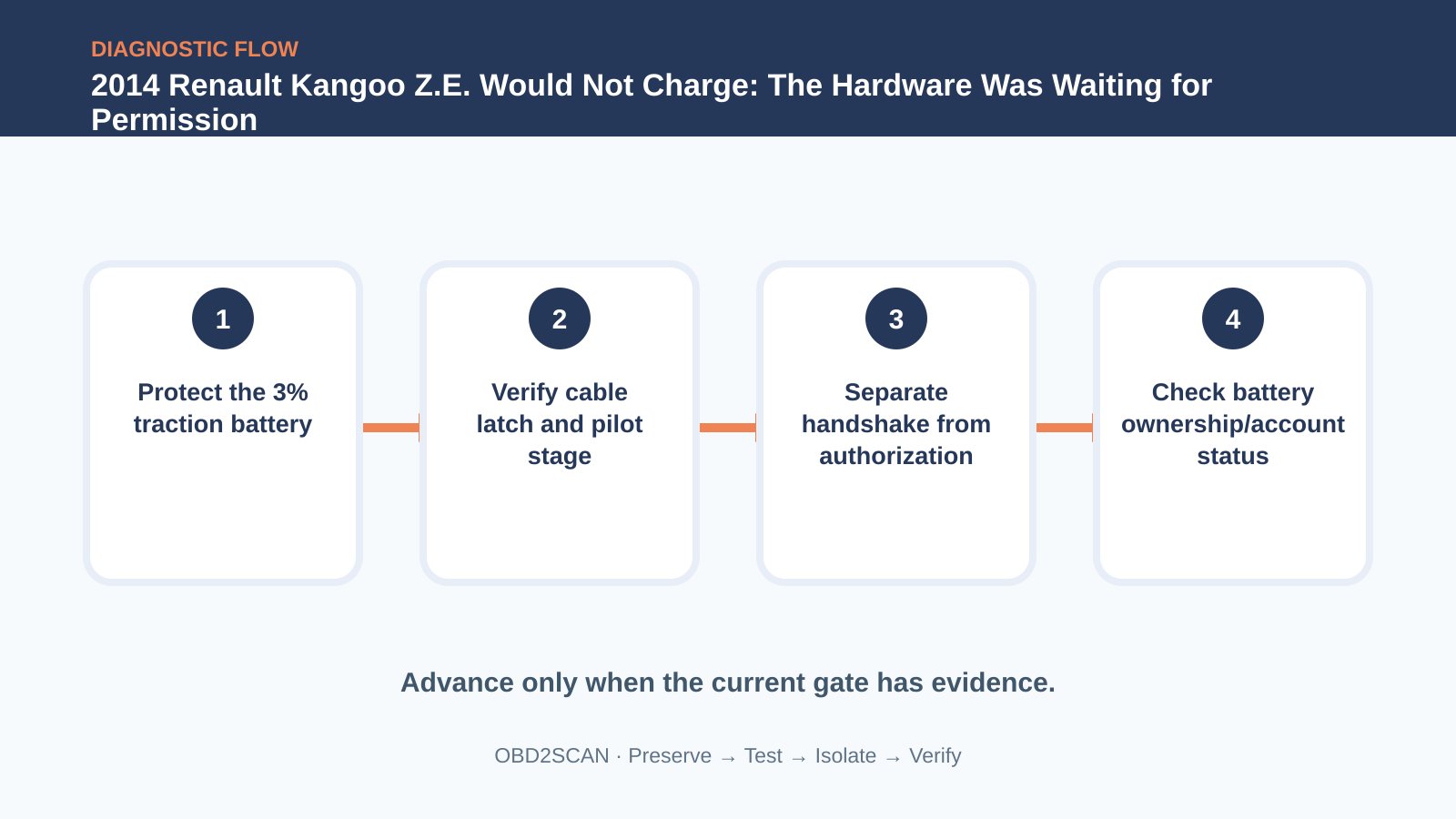
At 3 percent state of charge, this was no longer a vehicle that could tolerate leisurely experimentation. Deep discharge can move a traction battery below the threshold where ordinary charging is possible. Stop unnecessary key-on sessions, do not road-test for curiosity, and involve an EV-qualified workshop. Before touching a charger-connected vehicle, establish the EVSE installation category and use equipment, PPE and procedures rated for the exact mains and high-voltage environment. This article explains the reasoning; it is not an instruction to probe a live charge connector.
Start with ownership history and charging rights
The vehicle had changed owners and arrived with a story about rodent damage plus a recommendation for an inverter and on-board charger. The visual inspection found neither an animal hazard nor exposed high-voltage cable. The missing interview question was contractual: was the traction battery owned, leased, paid up and transferable? Older EV programs sometimes separate vehicle ownership from battery rights. Record VIN, account documents, prior dealer messages and auction paperwork early. Administrative status can be an enable condition just as real as temperature, insulation resistance or a closed latch.
Confirm what the cable handshake completes
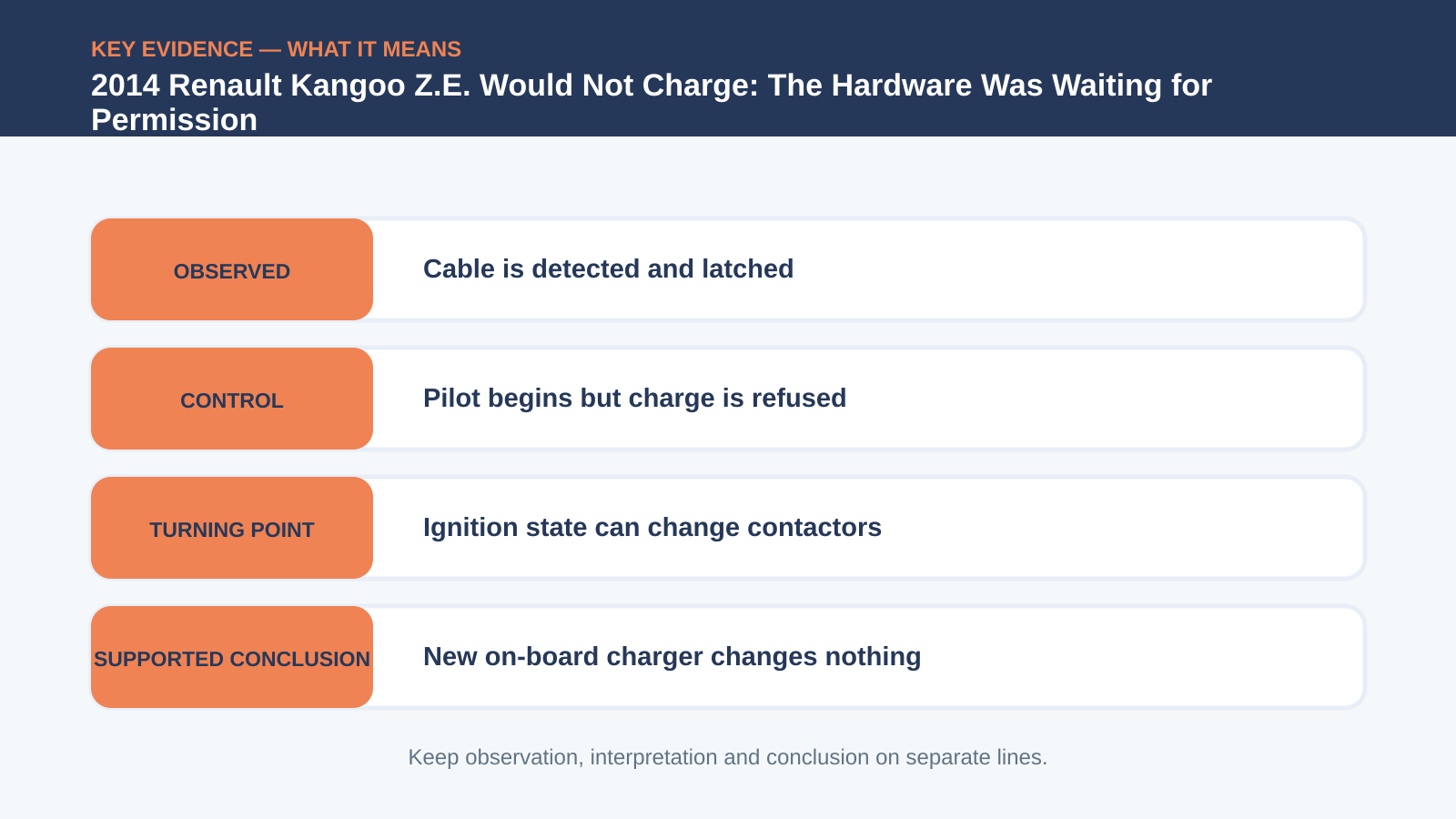
With the portable EVSE connected, its indicators appeared normal and the inlet latch engaged. The dash also recognized the connection. On a Type 2 path, proximity recognition precedes the control-pilot stages that advertise connection and current availability. The measured pilot began at about 1 kHz and moved from the disconnected level toward the connected state, so the cable was not simply absent. It did not progress to the stage that commands ordinary charging. That narrows the question to why the vehicle withheld permission; it does not by itself condemn the on-board charger or battery controller.
Do not mistake contactor silence for a failed charger
No contactor click, fan activity or current flow was heard during a normal key-off attempt. A silent contactor can result from low state of charge, interlock state, isolation concern, temperature, controller communication, authorization or failed hardware. Scan results mainly reflected the very low battery. Resist jumping from “contactor open” to “charger failed.” The contactors are safety devices obeying upstream logic. The useful diagnostic task is to identify which prerequisite has not been satisfied, using factory information and qualified measurements rather than bypassing the safety chain.
| Evidence | Supported conclusion | Boundary |
|---|---|---|
| Cable latches and pilot begins | Vehicle and EVSE recognize connection | Full charge authorization is not complete |
| Ignition-on state closes contactors | Major hardware path can transfer energy | This is not a normal charging workaround |
| SOC rises from 3% to 12% | Energy can reach the battery in that state | Battery health is not fully proven |
| New OBC changes nothing | Original OBC was not the missing condition | Every OBC fault is excluded |
The ignition-on clue changed the system state
A chance ignition-on observation changed the case. With the EVSE still connected, the contactors closed, the pilot moved to the next state and input current became visible. State of charge rose from about 3 to 12 percent. That temporary result protected the battery and proved that the inlet, portions of the pilot path, contactors, charger and pack could participate under a different state. It was diagnostic evidence, not a customer operating method. Leaving ignition on while charging is not the documented normal process and may introduce additional loads or hazards.
Why a new on-board charger changed nothing
The vehicle then went elsewhere and received an on-board charger. Nothing changed. The overlooked fact was Renault’s battery lease program: the lease had not been paid, and charging had been remotely disabled. That explains why apparently healthy hardware waited for permission and why ordinary DTCs offered little direction. It is a single documented case, not a claim that every Kangoo no-charge is account related. Isolation faults, pilot faults, 12-volt weakness, OBC failures and battery faults remain possible on other vehicles.
Resolve the authorization path
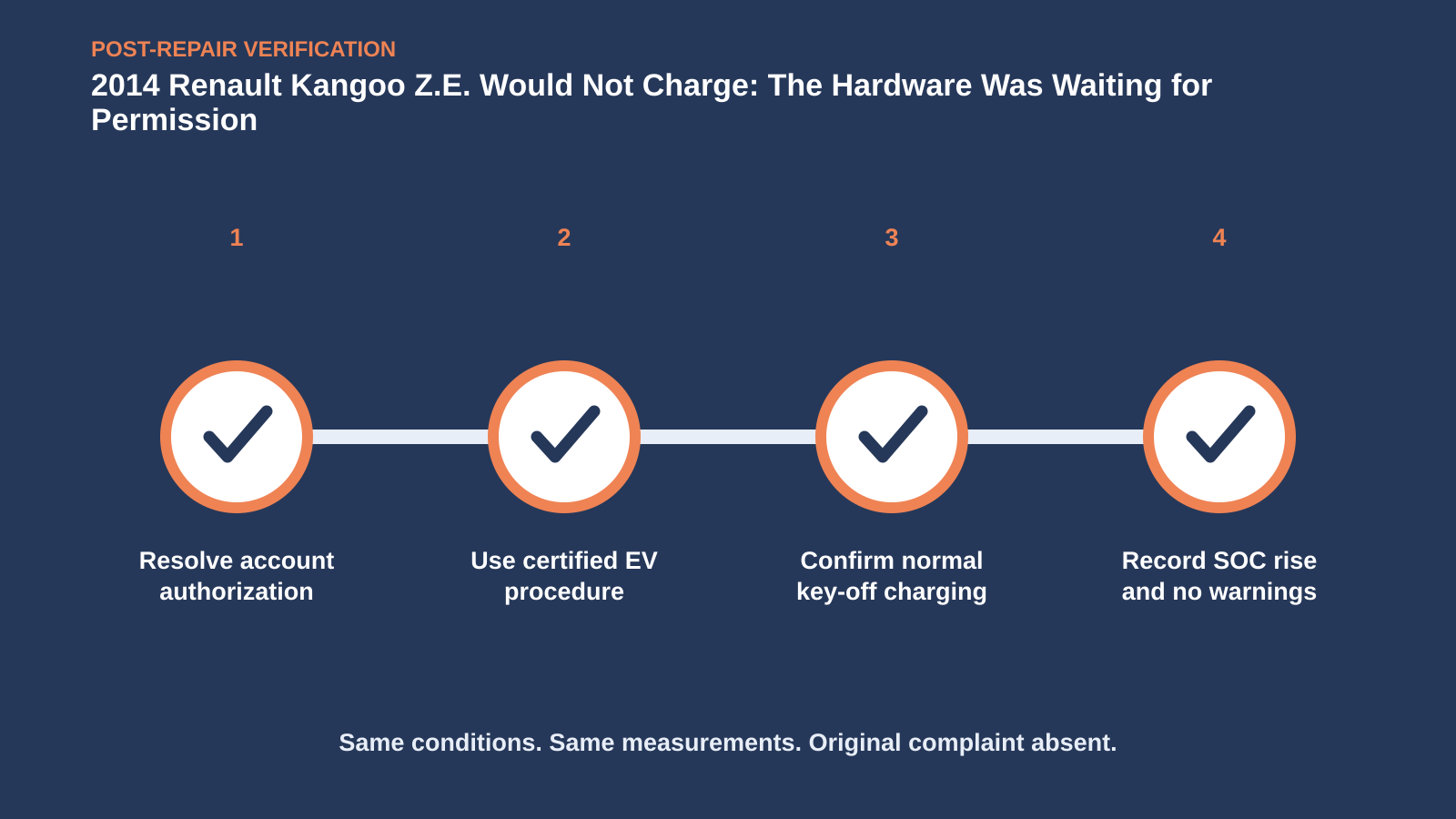
Resolution belongs through the authorized account and manufacturer channel, with ownership and payment status corrected rather than electronics defeated. Do not attempt to emulate, code around or bypass a remote charging lock. Once access is restored, use the approved EV procedure to confirm a normal key-off connection advances through the correct pilot stages, the contactors close, charge current remains stable and state of charge rises. The source identified the remote disable precisely but did not publish that final administrative reactivation and complete normal-charge record.
Define the safe final charge test
A proper close would include a full scan before and after authorization, 12-volt system condition, successful charging from the customer’s usual EVSE and a second known-good supply if needed, plus temperature and state-of-charge progression. The vehicle should enter Ready and charging modes only when commanded, with no isolation or thermal warnings. Because the public case stops before that result, the honest endpoint is a proven permission problem and a defined confirmation plan—not a fictional claim that a dealer click instantly restored everything.
This no-charge diagnosis crossed a boundary workshops increasingly face: software permission and ownership status can sit in the same causal chain as contactors and cables. Asking who is allowed to charge the battery would have saved the most expensive guess.




Comments 0
Questions, fixes, and real-world diagnostic notes from readers.
Be the first to share a diagnostic result or ask a follow-up question.