
Mercedes GL500 Battery Drain: Find the 0.8-A Load Without Pulling Fuses


Bottom line: A sleep-current diagnosis that uses fuse voltage drop and thermal confirmation to locate a rear blower controller draining the battery overnight.
In this case
- Case at a glance
- The answer: a hidden rear blower stayed awake
- Prove the battery and charging baseline first
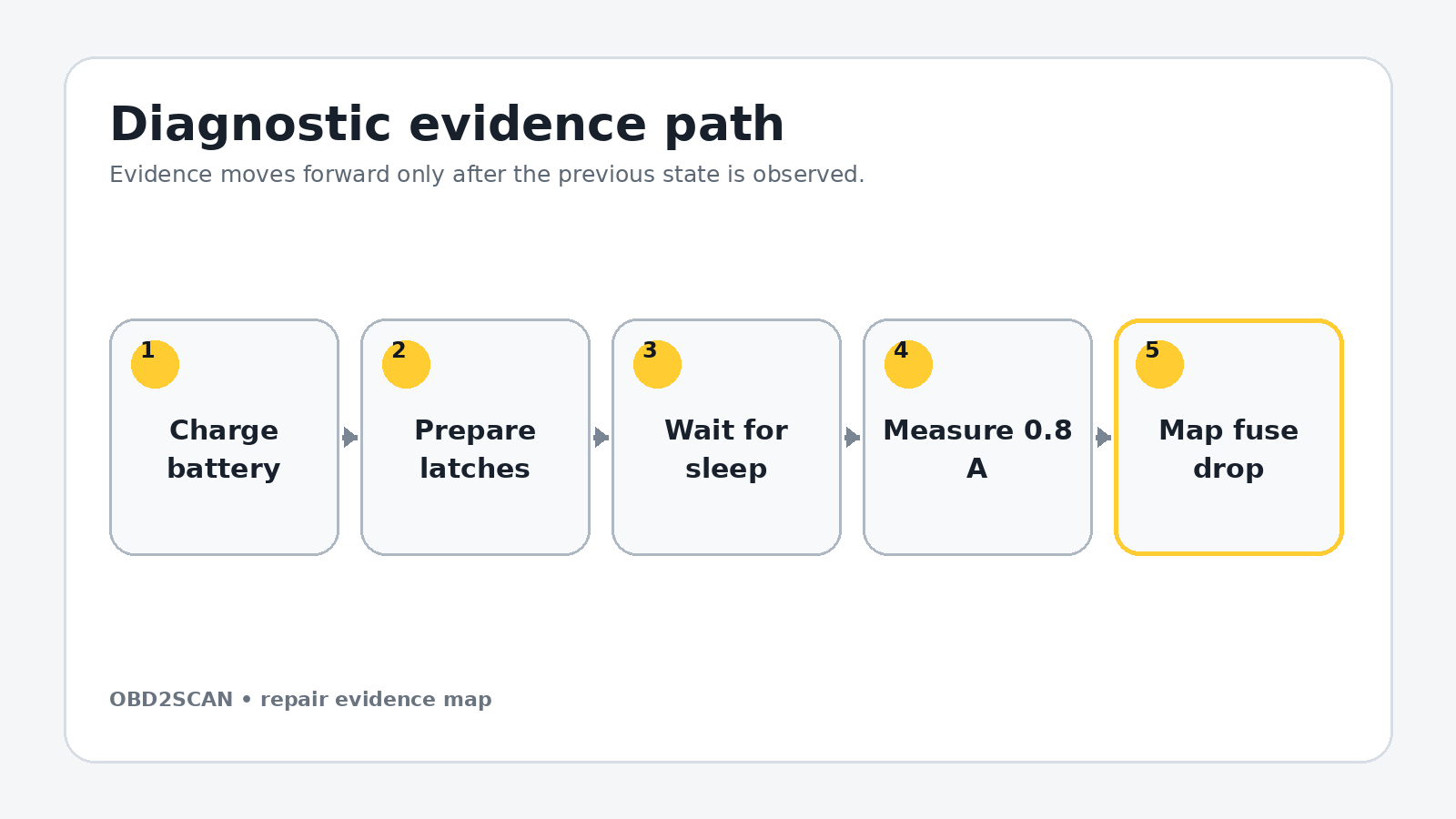
- Prepare every latch before the meter starts
- Use fuse voltage drop to avoid waking the network
- Confirm the component, not just the fuse
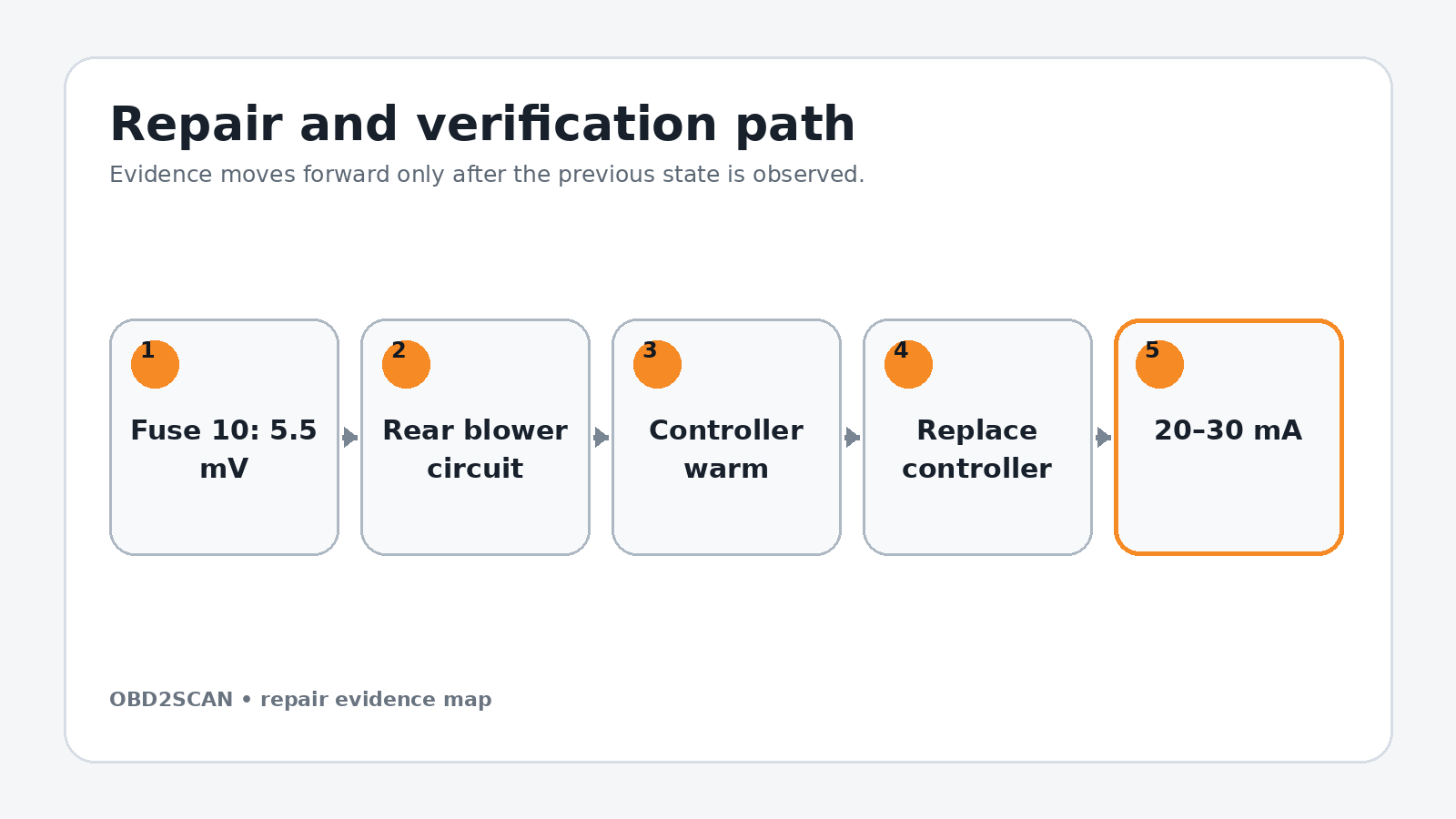
- Replace, restore, and repeat the full sleep test
- The reusable diagnostic order
- Minimum record to retain
Case at a glance
| Field | Case detail |
|---|---|
| Vehicle | 2007 Mercedes-Benz GL500 |
| Complaint | Battery discharged by the next morning despite daily driving |
| Sleep current | About 0.8 A on this vehicle |
| Decisive test | Approximately 5.5 mV across fuse 10 after sleep |
| Repair | Rear booster-blower controller replaced |
| Verification | Sleep current fell to roughly 20–30 mA and blower operation returned |
The answer: a hidden rear blower stayed awake
The battery and alternator were serviceable. The overnight discharge came from the rear booster-blower controller, which kept the rear fan running after the vehicle should have gone to sleep. The current draw was about 0.8 amp on this GL500. After the controller was replaced, settled current dropped to roughly 20–30 milliamps and the blower still worked normally.
The fastest part of the diagnosis was not a fuse-pulling marathon. It was keeping the vehicle asleep, measuring the tiny voltage drop across each installed fuse, and using the one active branch to locate a warm component hidden below the rear cupholder area.
Evidence boundary: The numeric values in this article belong to the documented vehicle unless an official applicability statement says otherwise.
Prove the battery and charging baseline first
An overnight no-start can begin with a depleted battery, a charging problem, excessive key-off current or more than one of those faults. Charge and test the battery before draw testing; otherwise a damaged battery can distort the result or fail again after the drain is repaired. Confirm charging voltage and cable voltage drop under load. Before opening the circuit, the AUTOOL BT270 clamp-on ammeter can provide a quick non-invasive current baseline if its DC range and resolution cover the expected sleep draw; the final diagnosis should still use the article’s network-safe fuse-drop method.
Use the battery baseline guide to separate state of charge from capacity. A normal open-circuit number cannot erase a repeated overnight discharge, and a freshly replaced battery cannot cure a module that never sleeps.
Prepare every latch before the meter starts
Open the access points you need, mechanically latch doors or tailgate where appropriate, keep keys away, disable lamps without defeating the monitored latch state, and route the meter so nothing must be reopened later. Then wait for the exact vehicle’s shutdown sequence to finish.
The 0.8 A and 20–30 mA figures belong to this case. They are not universal Mercedes specifications. Network architecture, alarm state, telematics, ambient conditions and elapsed time all affect normal sleep behavior. Use current service data and compare a stable plateau, not a number captured while modules are still shutting down.
Safety boundary: Use current vehicle-specific service information, approved support and the correct test load before opening a circuit or assembly.
Use fuse voltage drop to avoid waking the network
Pulling a fuse can interrupt power, wake modules and erase the very state being tested. Measuring millivolts across the two exposed test points leaves the fuse installed. Current flowing through the fuse element produces a small, repeatable voltage drop; an inactive circuit approaches zero.
Fuse 10 showed about 5.5 mV after other branches had gone quiet. Fuse type and rating are needed to estimate current from a conversion chart, but exact conversion was not necessary here. The nonzero drop identified the branch worth tracing.
Confirm the component, not just the fuse
The circuit description led to the rear booster blower. Thermal scanning from the visible trim did not initially reveal what was hot because the controller was buried. Removing the appropriate access trim exposed a warm controller and a fan that was physically running with the vehicle off.
That direct observation converted a branch-level clue into a component-level diagnosis. A whole-vehicle scan workflow is still useful before unplugging modules, but absence of a DTC does not make an unwanted mechanical output disappear.
Replace, restore, and repeat the full sleep test
The controller was replaced, the blower was checked for commanded operation, and the vehicle was allowed to complete another sleep cycle. Only then did the current settle near 20–30 mA. That is stronger verification than “it started tomorrow,” because it proves the abnormal load is gone before another night passes.
Recheck the battery after it has been fully charged and allowed to rest. If the draw returns, repeat the branch test rather than assuming the new part failed; an intermittent wake request, chafed wiring or a second consumer can coexist.
Verification boundary: A cleared code is not a result by itself. Repeat the original operating condition and retain the measured before-and-after evidence.
The reusable diagnostic order
Start with battery health and charging. Prepare the vehicle so the network can sleep. Measure the stable key-off current. Leave fuses installed and compare their millivolt drops. Trace only the active branch, confirm the actual consumer, repair it, and repeat the same sleep test.
That order preserves vehicle state and creates a before-and-after measurement. It also turns a symptom that occurs eight hours later into a fault you can see on the meter now.
Minimum record to retain
Keep the initial scan before clearing anything, the exact ambient and operating condition that reproduces the complaint, and one labeled result for every branch tested. Save photographs or waveforms at their original resolution and identify the measurement point, scale, engine state and tool setup. A future technician should be able to distinguish a direct observation from an inference without reconstructing the whole visit from invoices. Retain exact vehicle identification with every saved measurement.
- The vehicle settled at about 0.8 A after sleep.
- Fuse 10 showed about 5.5 mV and fed the rear booster blower circuit.
- The hidden controller was warm and the rear fan was running with the vehicle off.
- Replacement reduced sleep current to about 20–30 mA.
This case includes a repair result, but the same-condition retest is still the reason the result is credible. Record what changed, what did not change, and which test was repeated after the work. Also retain any programming, adaptation or calibration report and a final whole-vehicle scan. If the symptom is intermittent, define a monitoring window instead of treating one successful start or one short drive as permanent proof.








Comments 0
Questions, fixes, and real-world diagnostic notes from readers.
Be the first to share a diagnostic result or ask a follow-up question.