
DAF CF DEF Warnings Did Not Need a New Pump: The Filter Was Restricting Flow

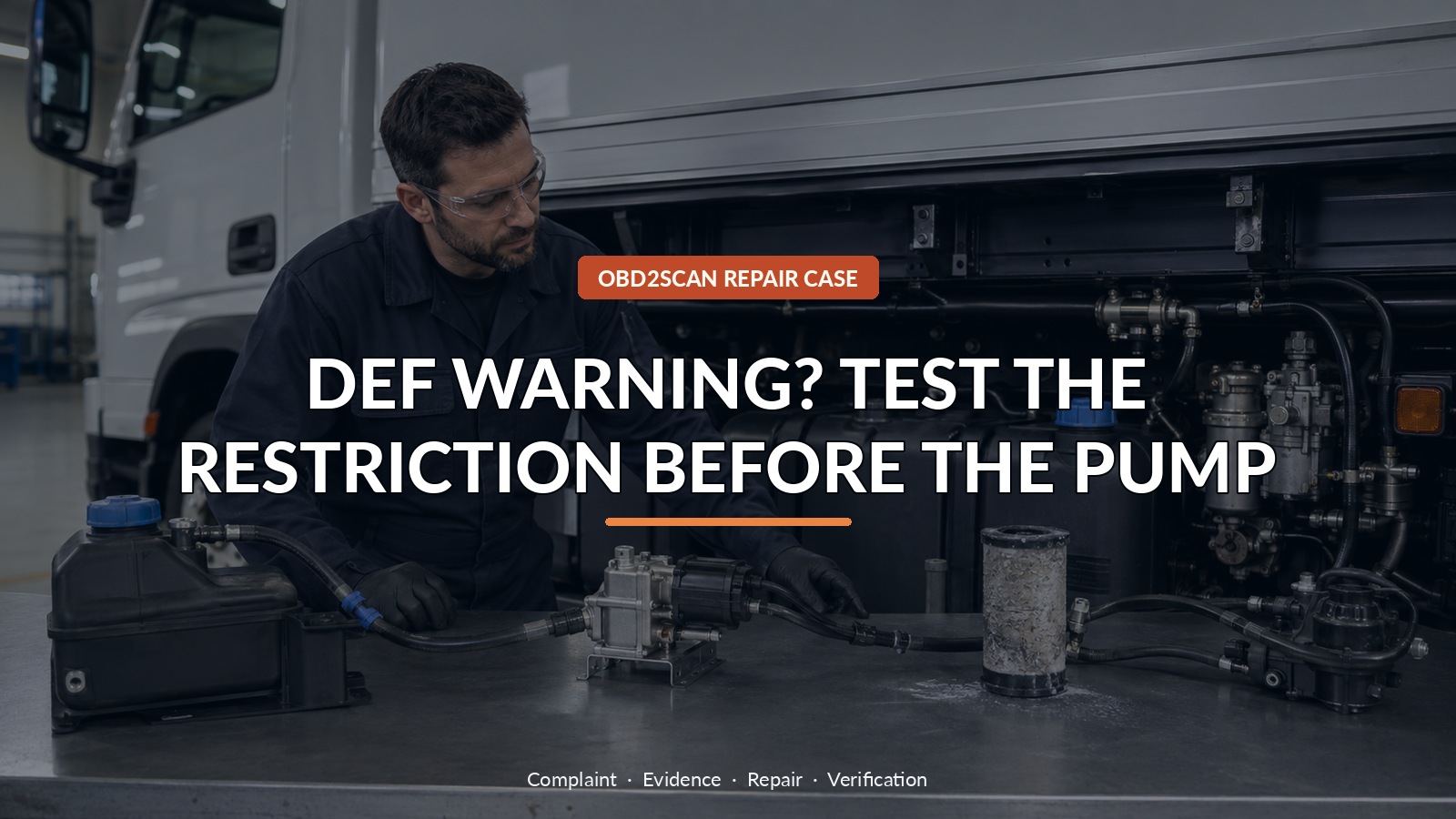
Def Warning? Test The Restriction Before The Pump
A DAF CF displayed DEF warnings and stored dosing-system faults. On an emissions system, a pump or module can become the expensive default suspect. This case was solved by following the fluid path in order. The system could create activity, but a serviceable filter was restricting delivery.
Visual inspection helps only after functional testing and safe system access. An articulating camera such as the AUTOOL SVB308 can document accessible crystallization, opened housings and sealing areas without pretending to see through a filter. SVB308 can support visual documentation of accessible crystallization, connector condition, opened housings and cleaned sealing areas after the DEF system is made safe; it cannot measure dosing pressure or quality, see through a filter or prove a pump healthy.
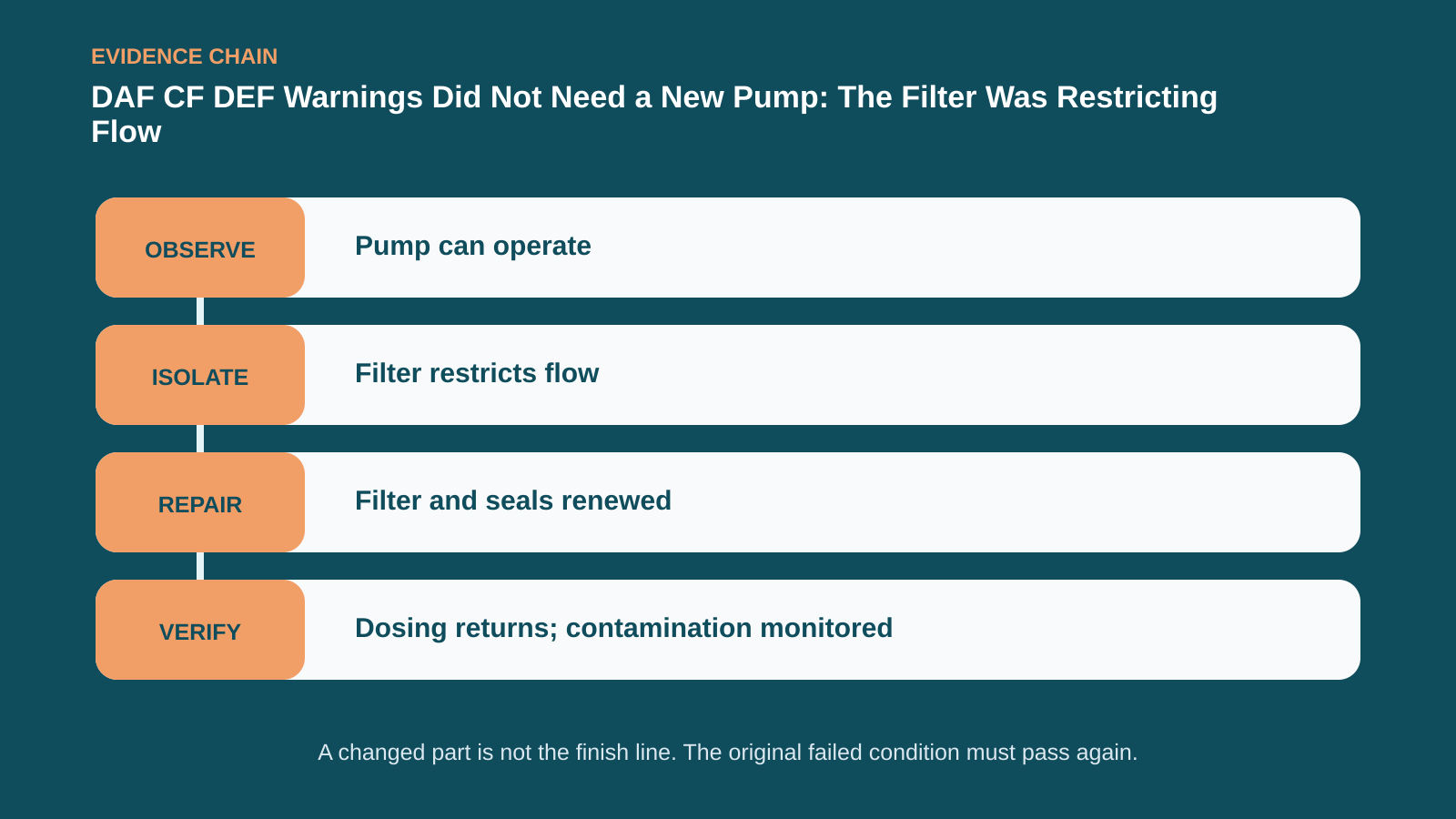
Replacing the restricted filter, gaskets and specified fasteners restored DEF injection. Possible contamination from fittings remained a recurrence risk, so the repair did not end with a new consumable. This is a flow-path case: prove pressure creation, restriction and delivery separately before authorizing the costly assembly.
Quick answer: The DEF pump could operate, but a restricted service filter limited delivery. Replacing the filter and seals restored dosing while contamination stayed on watch.
In this guide
- Save warning state and dosing codes before clearing
- Check DEF quality and visible contamination
- Command the system under approved conditions
- Separate pressure creation from flow delivery
- Prove the filter is the restriction
- Renew filter, seals and specified fasteners
- Address the contamination source as a recurrence risk
- Verify dosing and warning status
Save warning state and dosing codes before clearing
Save the dashboard countdown or warning stage and scan every relevant aftertreatment module before clearing anything. Record code status, DEF level and temperature, ambient temperature, engine hours and recent refill or repair history. Check whether the truck is already derated and follow legal operating requirements; defeating emissions controls is not a diagnostic option. DEF can irritate skin and crystallize on components, while hot exhaust parts can burn. Let the system cool, wear suitable protection and stop testing if a line or housing is pressurized unexpectedly.
Check DEF quality and visible contamination
Inspect fluid condition and the path from tank to doser. Wrong fluid, dirt, crystallization or repeated topping from an unclean container can create a new filter restriction. Use the approved quality method rather than judging color alone. Look at caps, breathers, pickup areas, connectors and external leaks. Preserve a sample if contamination is suspected. A warning after a refill does not prove the new fluid caused the fault, but the refill method belongs in the evidence because a clean repair will not last if contamination continues.
Command the system under approved conditions
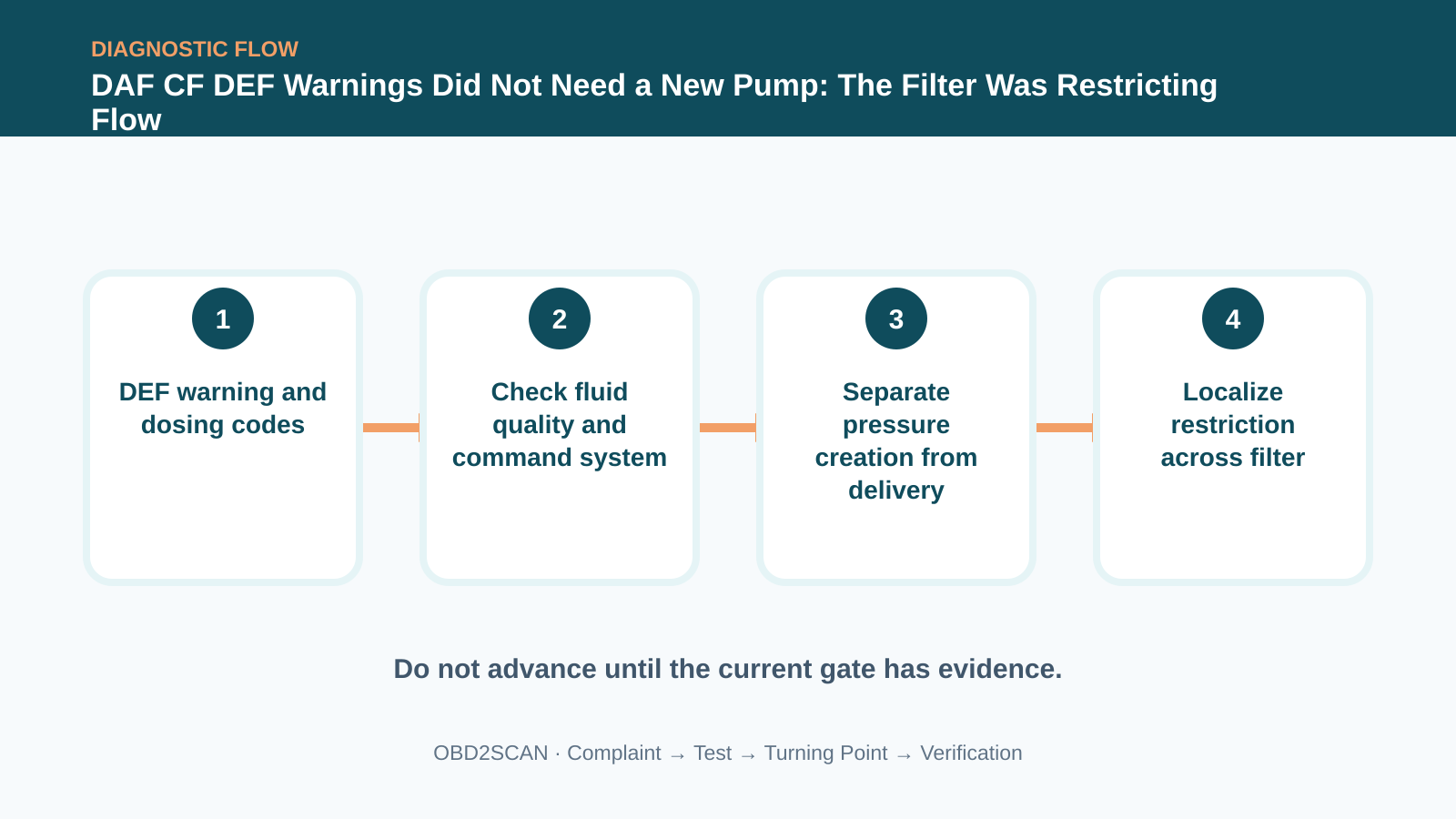
Command the system only under the temperature, pressure and engine-state conditions specified by DAF. Observe pump command, pressure response, dosing request and injector activity with an appropriate scan platform. Some tests will be inhibited when exhaust or fluid conditions are wrong; an inhibited test is not a failed pump. Confirm electrical feed and ground under load if the pump does not run. If it runs, the next question is whether pressure and flow reach the next point in the path.
Separate pressure creation from flow delivery
Pressure creation and flow delivery are related but not identical. A pump may produce pressure against a restriction while little usable fluid reaches the doser. Compare behavior across the service filter using the approved method and consider how quickly the system builds and releases pressure. Do not crack a line to ‘see what comes out.’ Controlled measurement and commanded dosing are safer and more repeatable. In the documented DAF, the evidence isolated the filter as the restriction rather than immediately condemning the pump.
| Finding | Best interpretation | Expensive mistake avoided |
|---|---|---|
| Pump responds to command | Electrical/control path can operate | Replacing a working pump on code wording |
| Pressure/flow changes across filter | Restriction is localized | Replacing the doser first |
| Filter visibly contaminated | Cause or recurrence clue | Treating the new filter as permanent cure |
| Dosing restored after service | Repair changed the failed function | Calling it fixed before warning recheck |
Prove the filter is the restriction
Remove the filter only after depressurizing and cleaning the surrounding area. Cap open ports and prevent crystals or dirt from entering downstream. Inspect the old element and housing for a pattern that supports restriction; a borescope can document hidden corners, but the functional test remains primary. If metallic or unusual debris appears, investigate its source instead of installing a filter and releasing the truck. Note whether damaged fittings or service practices could have introduced contamination.
Renew filter, seals and specified fasteners
Fit the correct filter, gaskets, seals and specified bolts. Lubricate only where the procedure permits, torque the housing evenly and route lines without twist. Clean spilled DEF with the approved method so later white crystals are not mistaken for a fresh leak. If a suspect fitting may shed material, repair or replace it within the agreed scope. The article should not promise that a filter alone prevents recurrence when the source case leaves contamination risk visible.
Address the contamination source as a recurrence risk
Prime and bleed the system as required, then repeat the same commanded test. Confirm stable pressure creation, actual dosing and correct release or purge behavior. Inspect for leaks during and after the cycle. Clear codes only after the first successful functional check, then run the enabling drive or stationary routine and rescan. Verify that the warning stage does not return. If a countdown persists, follow DAF reset and completion criteria rather than erasing history repeatedly.
Verify dosing and warning status
For the driver and fleet, add a practical prevention note: use sealed, correct-spec fluid and clean dispensing equipment, and document filter service intervals and warning chronology. If the warning returns, bring the truck back before derate rather than adding fluid blindly. The repair order should say what was proved—the filter restricted flow and dosing returned—and what remains a monitored risk. That clarity turns a modest service part into a trustworthy diagnosis rather than a lucky swap.
The DAF did not ask for the most expensive part first. It asked for the path to be tested in order. Once the restriction was isolated and serviced, dosing returned—and contamination control became the next human problem worth preventing.







Comments 0
Questions, fixes, and real-world diagnostic notes from readers.
Be the first to share a diagnostic result or ask a follow-up question.