
2012 Hyundai Veloster P0106 and Low Power: The Air Box Was Packed With Snow

P0106 With Low Power? Open The Air Box
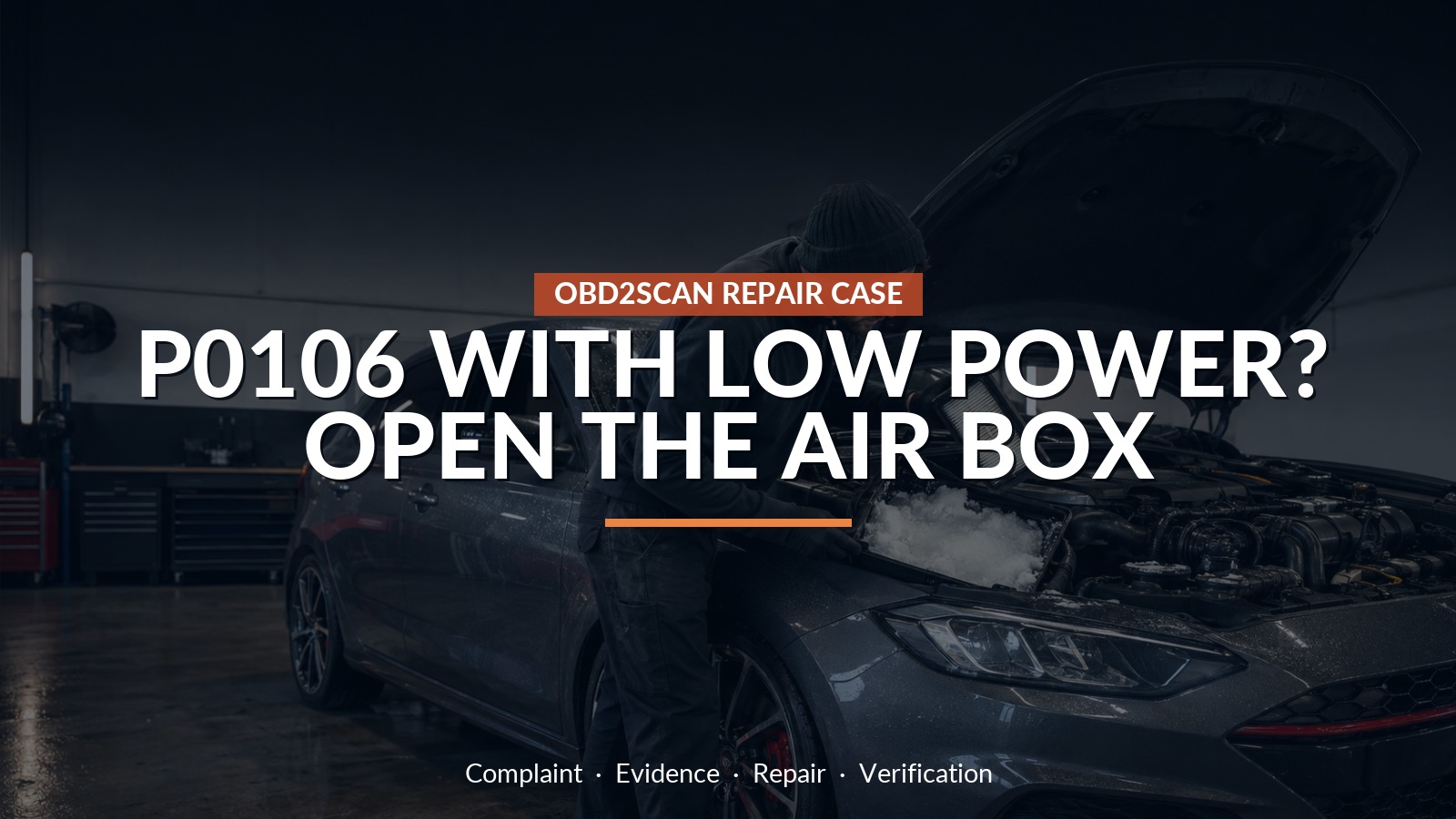
At idle, the Veloster’s MAP and throttle readings did not look alarming. Under acceleration, they stopped telling the same story: the throttle opened but manifold pressure did not respond at the expected rate. That mismatch turned P0106 from a sensor accusation into an airflow question, and a five-minute visual inspection found a very physical answer.
One useful machine class at this stage is a bounded measurement tool, chosen only after the circuit or system question is defined. The AUTOOL SDT208 is one route for that supporting task. SDT208 can help check a sealed compatible intake path for leaks at appropriate pressure after the obstruction is removed. It cannot find packed snow by itself, measure restriction, dry a wet engine or be used with the engine running.
This article follows one documented vehicle. Its cause is a useful diagnostic pattern, not a failure-rate claim and not permission to replace the same part on a similar symptom. The goal is to show which evidence changed the decision and how the repair was verified.
Quick answer: The MAP circuit was not simply open. MAP response lagged throttle because airflow was restricted by snow; clearing and drying the intake restored power.
In this guide
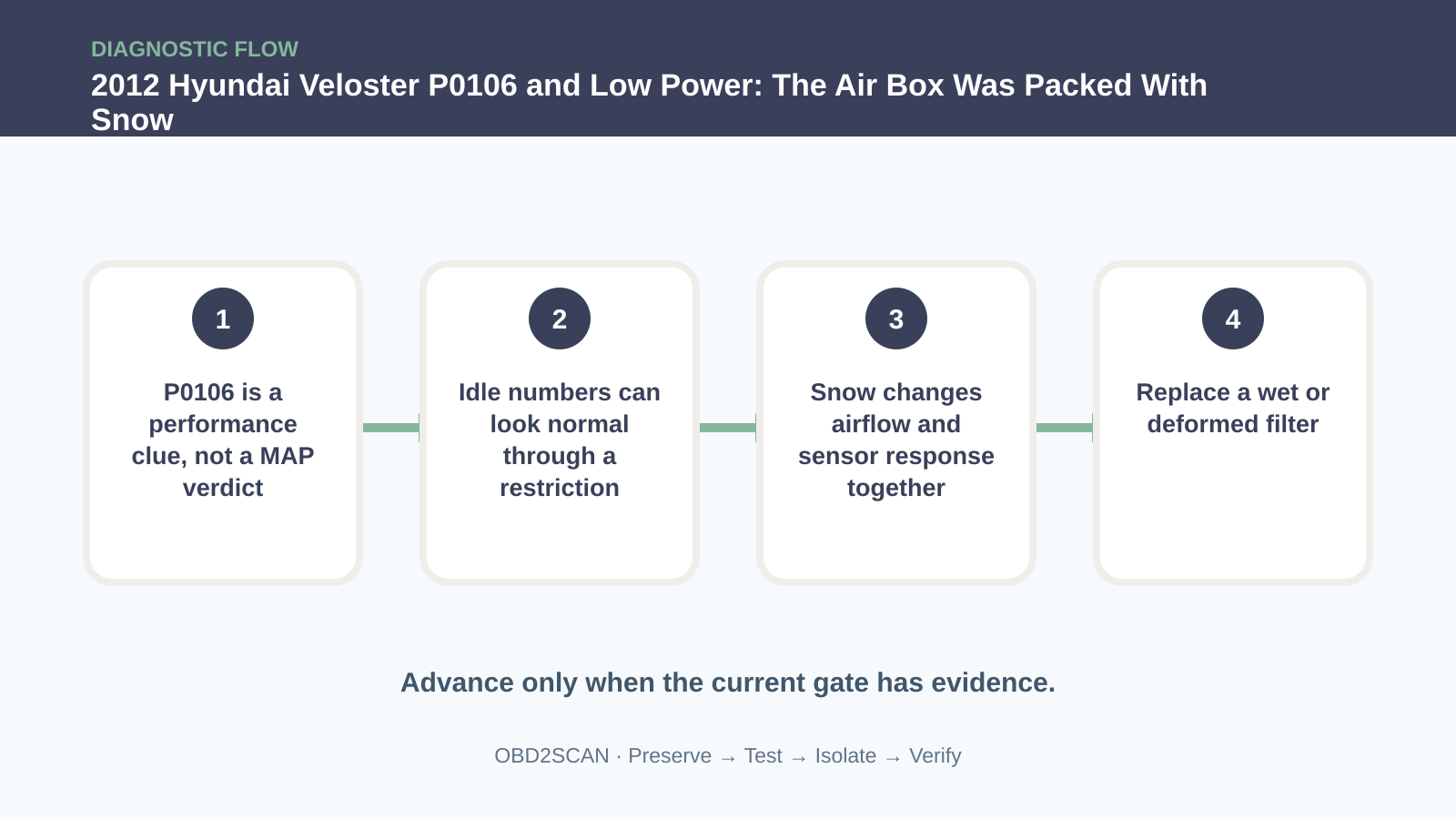
- P0106 is a performance clue, not a MAP verdict
- Compare MAP with throttle under the same event
- Idle numbers can look normal through a restriction
- Inspect the entire intake path
- Snow changes airflow and sensor response together
- Dry the system before restarting
- Replace a wet or deformed filter
- Road-test the same acceleration and rescan
P0106 is a performance clue, not a MAP verdict
P0106 describes MAP performance outside the controller’s expected relationship. Save RPM, load, throttle, MAP and barometric data; do not order a sensor from the code name alone. Keep the vehicle in the failed state long enough to capture evidence, but never extend a test beyond the point where a stall, brake event, refrigerant release or moving component creates risk.
Compare MAP with throttle under the same event
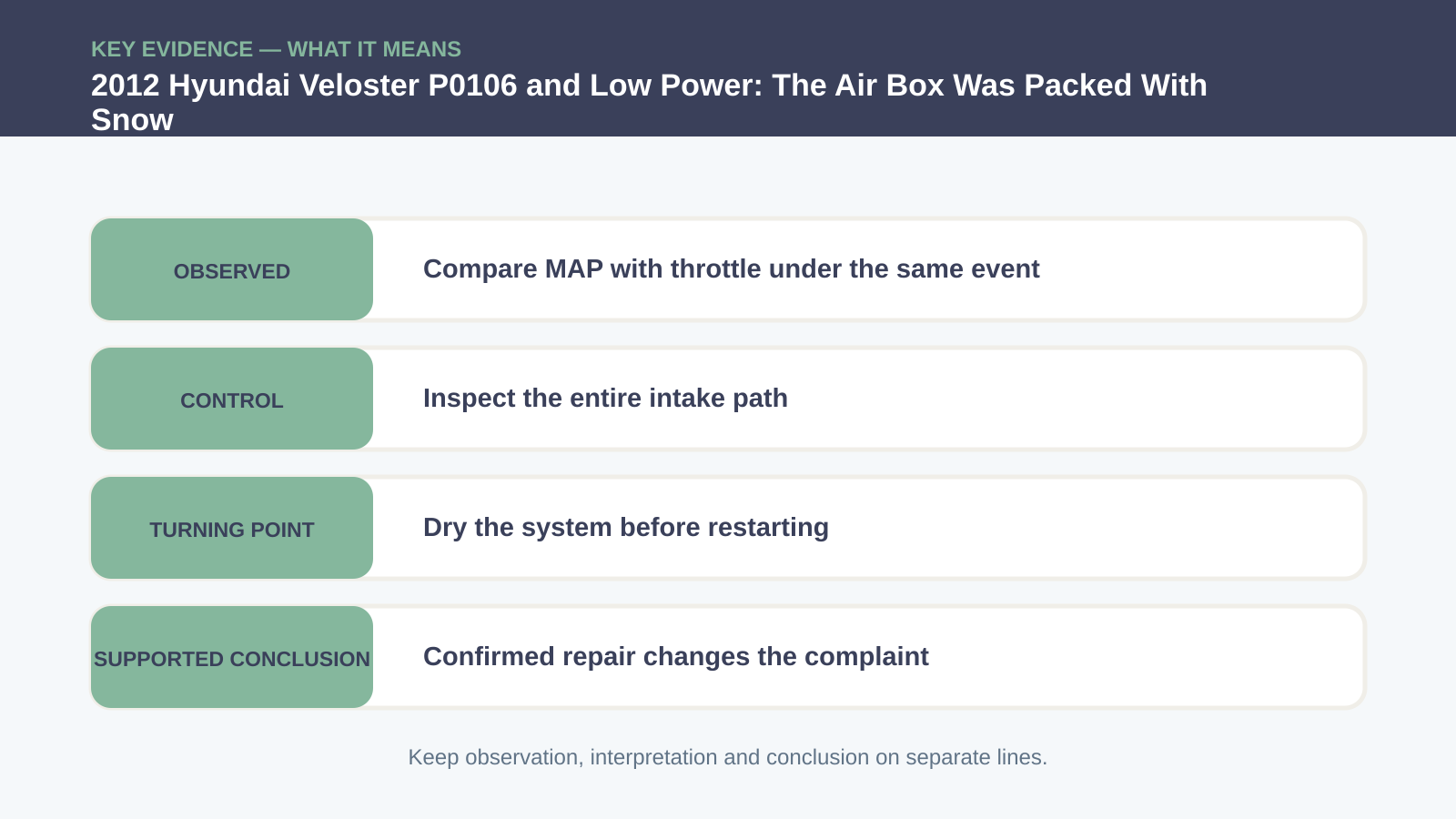
Graph MAP voltage beside throttle position during the same acceleration. The key observation was not either absolute number at idle, but that manifold response lagged while the throttle clearly opened. Write down the conditions before disconnecting anything. That record is what lets a later change mean something instead of becoming another uncontrolled attempt.
Idle numbers can look normal through a restriction
A restriction downstream or upstream can hide during idle because airflow demand is small. Increase load only in a safe, controlled way and stop if the engine cannot breathe or the intake begins ingesting water. Use service information for the exact engine, build and option set. A correct test on the wrong pin or configuration can produce a precise but useless answer.
Inspect the entire intake path
Open the snorkel, resonators, air box, filter and downstream duct. Look for snow, collapsed media, plastic bags, nests and water marks before testing an electrically healthy sensor again. This is the turning point in the documented case. It gains weight because earlier branches were tested and because the symptom changed with one controlled condition.
| Observation | What it supports | What it does not prove |
|---|---|---|
| Idle MAP plausible | Sensor is not obviously dead | Airflow is unrestricted |
| TPS rises, MAP lags | Engine does not receive expected air | MAP sensor alone failed |
| Snow fills air box | Physical restriction is present | No water entered downstream |
| Power returns after drying | Restriction was causal | Ingress path cannot recur |
Snow changes airflow and sensor response together
Packed snow reduced available air and changed manifold response without severing a wire. The code recorded the model’s failed expectation; it did not know whether the reason was ice, a leak or a biased sensor. Separate observation from inference: record what moved, opened, failed or remained stable, then state only the component or path that result actually narrows.
Dry the system before restarting
Remove the obstruction with the engine off. Dry the housing and duct completely, check that no water reached the throttle or cylinders, and never crank an engine that may be hydrolocked. The repair must remove the demonstrated mechanism and restore mechanical support, sealing, torque or terminal fit—not merely make the symptom disappear once.
Replace a wet or deformed filter
Replace filter media that is wet, distorted or contaminated, and inspect how snow entered. Confirm the snorkel, splash shields and housing drains are installed as designed rather than inventing a restrictive fix. Reassemble to the original protection standard. Clear codes only after preserving the pre-repair record and confirming the relevant controller is online.
Road-test the same acceleration and rescan
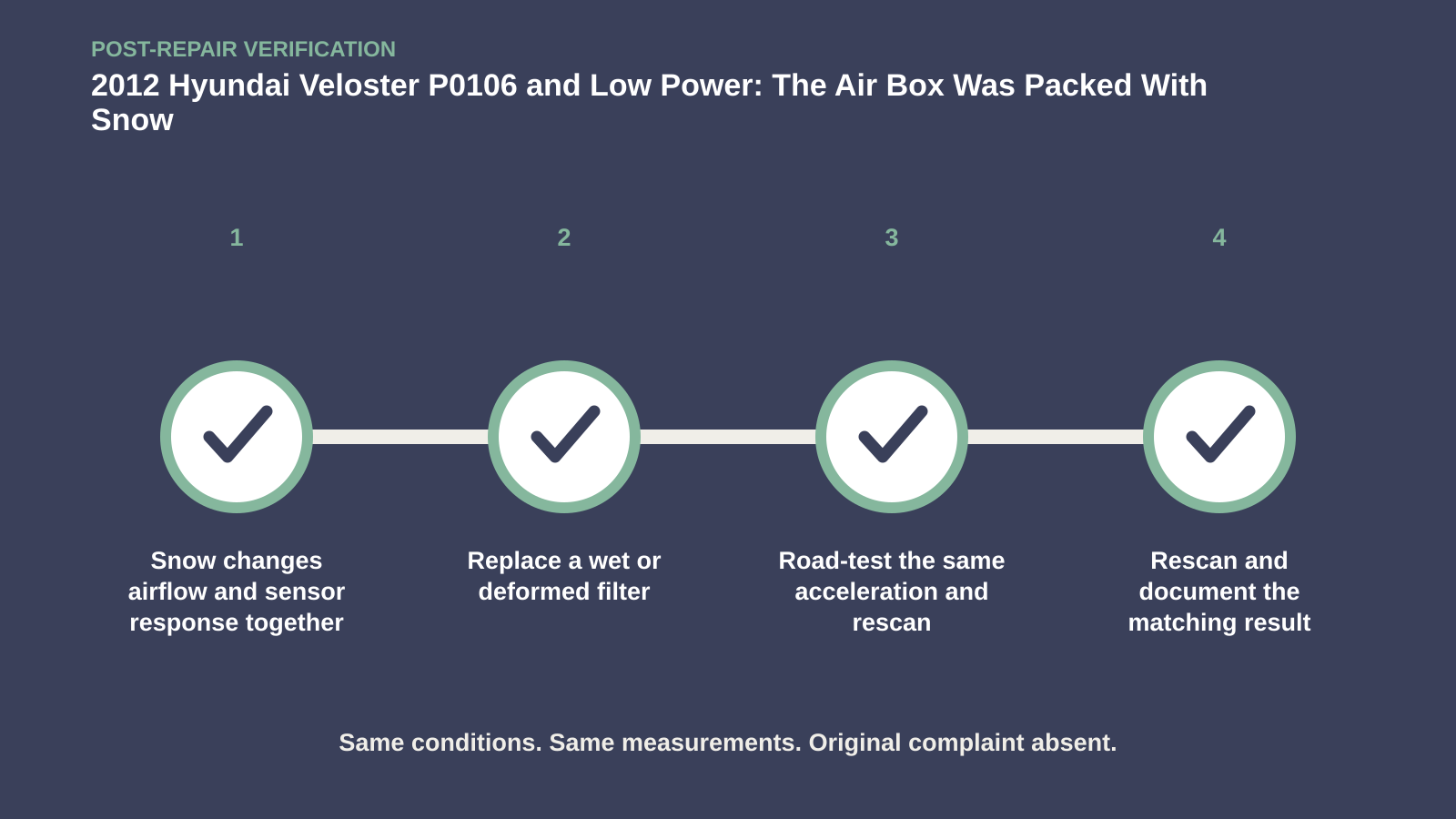
Repeat the same acceleration while graphing MAP and throttle. Restored power, a normal relationship and no returning MIL on the documented test drive collectively close the case better than clearing P0106. Use the customer’s original complaint as the final test specification. Matching conditions and a post-repair scan are stronger closure than a quiet bay or a cleared warning lamp.
For the owner or service adviser, the useful explanation has three parts: what was observed, why the decisive test narrowed the fault, and which original condition was repeated after repair. It should not promise that every similar vehicle needs the same component. This was one evidence chain on one vehicle, and the appropriate next step on another car may change with build data, prior work, safety condition and test results. That honest boundary makes the case easier to trust and more useful at the next diagnostic visit.
The MAP circuit was not simply open. MAP response lagged throttle because airflow was restricted by snow; clearing and drying the intake restored power. The reusable lesson is narrower and more valuable: Let two PIDs disagree under load, then resolve the contradiction with a simple physical inspection.








Comments 0
Questions, fixes, and real-world diagnostic notes from readers.
Be the first to share a diagnostic result or ask a follow-up question.