
2008 Ford F-250 Lost the Dash at Idle: An A/C Diode Was Parked in the Wrong Fuse-Box Slot

Dash Dead At Idle, Normal When Revved?
<strong>Quick answer:</strong> The rpm-dependent cabin failure was not caused by a weak alternator. A suppression diode had been misplaced in the fuse box; returning it to the correct position restored normal operation at idle. This article follows one documented vehicle. It explains the evidence chain, not a universal failure rate or a direction to replace the same part on every similar car. Stop whenever the test would involve overheated brakes, high current, moving parts, refrigerant handling or an uncontrolled road condition.
A multimeter with diode and automotive circuit modes can verify a removed component in the correct polarity after the fuse-box map is known; AUTOOL DM301 Circuit Tester is suitable for that bounded bench and circuit check. It cannot infer the correct slot, validate every diode in-circuit, or make probing a live high-current diesel fuse box safe without Ford procedures.
The F-250’s radio, PRNDL illumination and cluster went dark at idle, then returned near 1,500 rpm. Healthy charging voltage forced the investigation away from the alternator and toward the fuse box’s physical configuration.
Quick answer: The rpm-dependent cabin failure was not caused by a weak alternator. A suppression diode had been misplaced in the fuse box; returning it to the correct position restored normal operation at idle.

In this guide
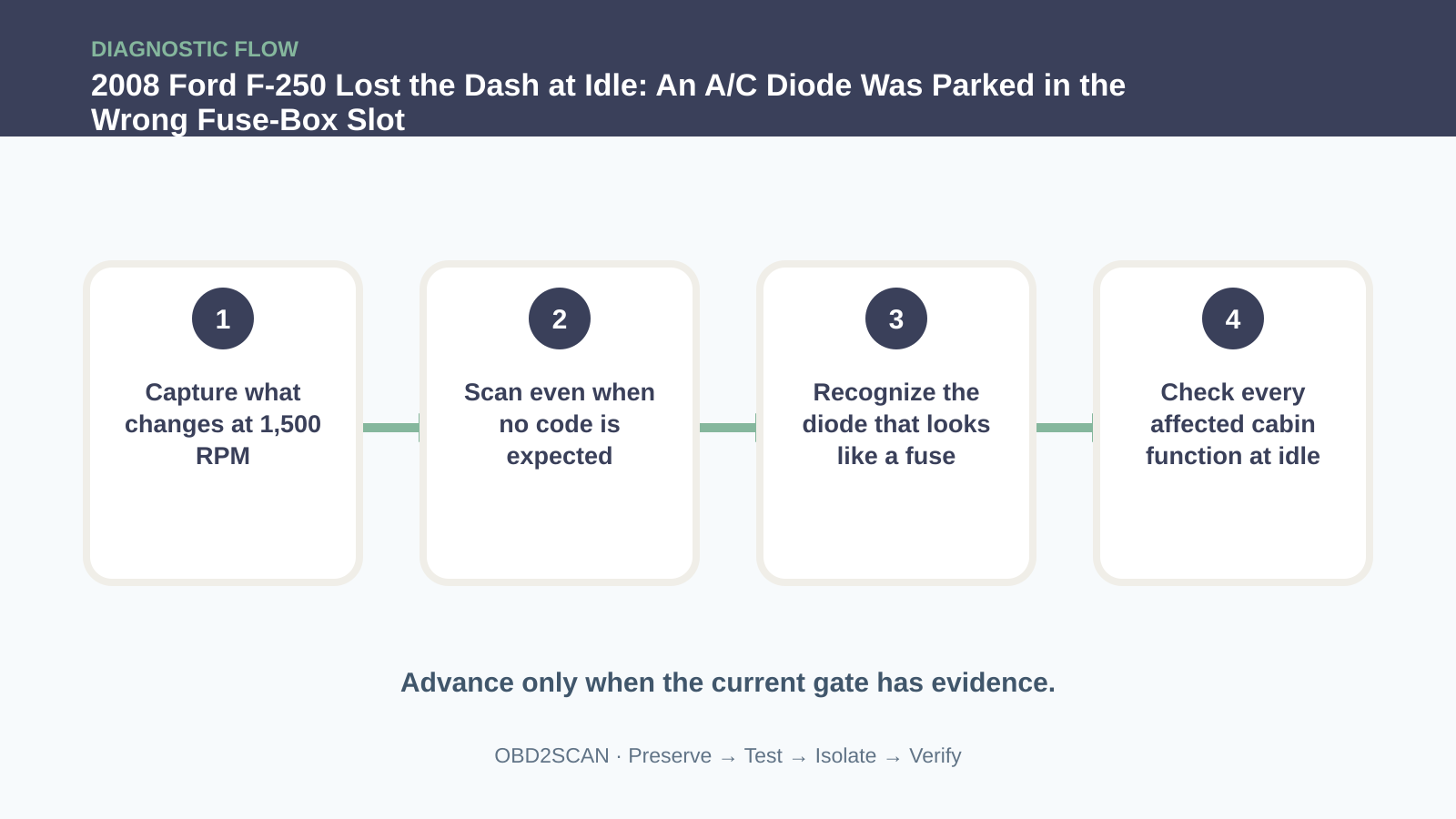
- Capture what changes at 1,500 RPM
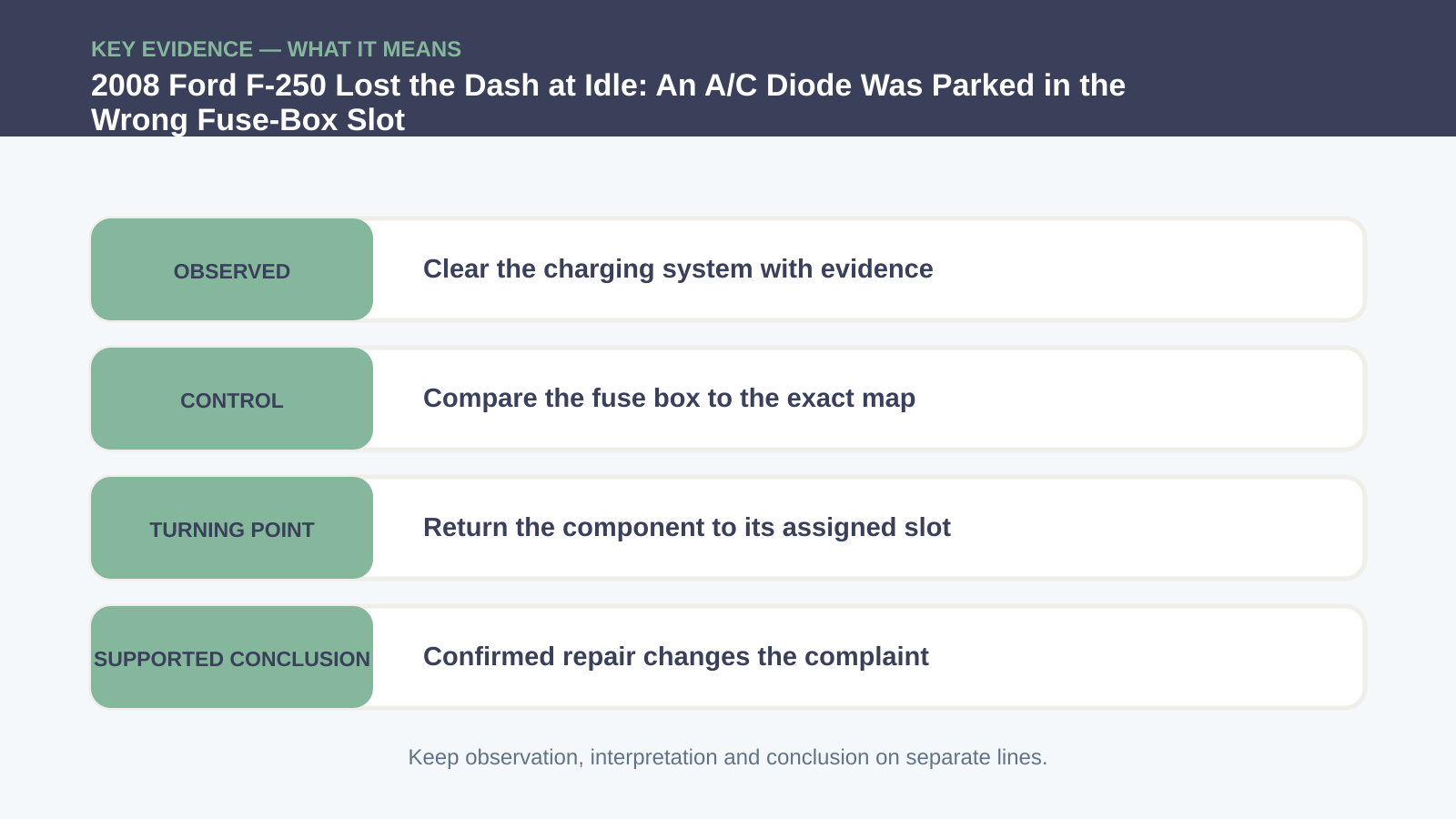
- Clear the charging system with evidence
- Scan even when no code is expected
- Compare the fuse box to the exact map
- Recognize the diode that looks like a fuse
- Return the component to its assigned slot
- Check every affected cabin function at idle
- Configuration comes before component theory
Capture what changes at 1,500 RPM
Record the rpm threshold: radio, PRNDL and instrument-panel operation were absent at idle and returned near 1,500 rpm. Test while stationary and watch system voltage. A repeatable threshold is a clue, but do not sustain unnecessary engine speed on a 6.4L diesel in an enclosed bay. Preserve the original condition before changing it. The first observation is the control sample against which every later test must be compared.
Clear the charging system with evidence
Charging-system output tested correctly. Verify at the battery and relevant distribution points under the affected load, including ripple if indicated. That result lowered the probability of alternator output causing the cabin outage, even though rpm dependence initially made charging look convincing. Use service information for the exact engine, build date and options. A correct method on the wrong terminal can create a precise but useless result.
Scan even when no code is expected
No DTCs were found. Modules that lose a shared supply or suppression path may not store a useful code, especially when the condition changes before interrogation. Preserve which modules communicate at idle versus raised rpm rather than declaring the electrical system clear. Treat prior work as evidence, not blame. A repair that made no change can narrow the case when its installation and test conditions are verified.
Compare the fuse box to the exact map
Compare the underhood fuse box with the exact diesel build diagram, not a gasoline cover or a similar truck. Note empty positions, relay/diode orientation and option-dependent cavities. A component in a populated slot is not necessarily in its assigned slot. At this stage, separate what was observed from what is inferred. The observation should remain true even if the current theory is later rejected.
| Observation | What it supports | What it does not prove |
|---|---|---|
| Cabin functions return near 1,500 rpm | Rpm-dependent supply or configuration clue exists | Alternator is weak |
| Charging system passes | Output branch loses priority | Fuse-box layout is correct |
| A/C diode sits in OTIS slot | Population differs from diagram | Diode itself is bad |
| Correct placement restores idle operation | Configuration was causal here | Every F-250 uses identical population |
Recognize the diode that looks like a fuse
The A/C suppression diode resembled a fuse. Its purpose is to control the voltage spike created when clutch-coil current is interrupted. Diodes are polarity-sensitive; remove and test only by the documented method, and never substitute a fuse or reverse the component casually. This is the decision point in the documented case. Its value comes from changing one bounded condition while leaving the rest of the system intact.
Return the component to its assigned slot
In this truck the diode occupied the OTIS slot, a function the diesel did not use, instead of its correct cavity. Returning it to the specified position restored the intended circuit configuration. Inspect for bent terminals or previous fuse-box service that might explain the move. A confirmed component still needs a repair that restores sealing, support, torque, routing or terminal fit—the physical conditions that keep the fault from returning.
Check every affected cabin function at idle
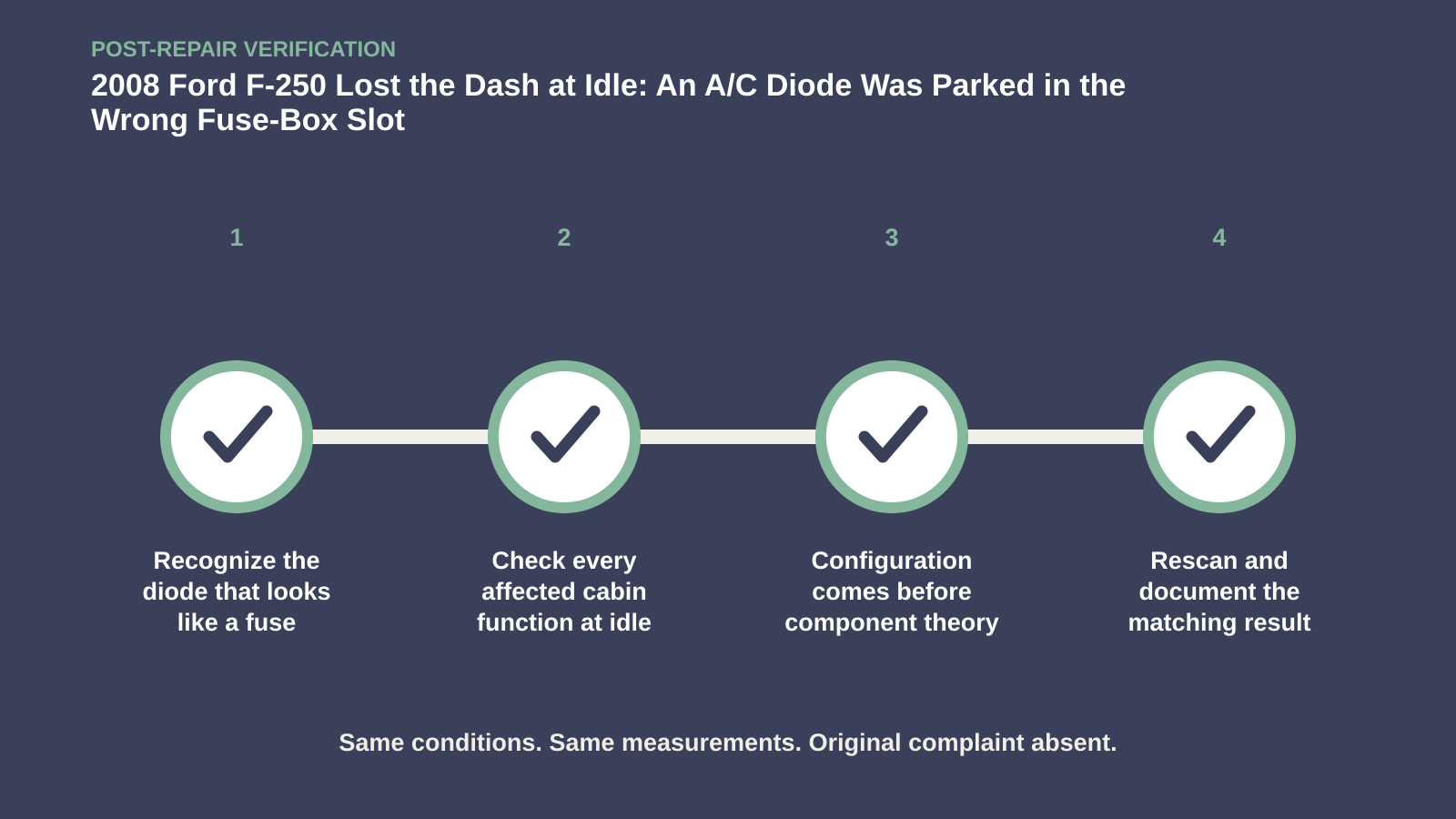
At idle, operate the radio, cluster and gear indicator together, then raise and return rpm while monitoring voltage. Cycle A/C request as appropriate and check for new relay or fuse-box heat. A correct repair removes the rpm dependency instead of merely moving its threshold. Reassemble protective covers and retainers before declaring success. A diagnostic shortcut must not become the next failure mechanism.
Configuration comes before component theory
The reusable lesson is to verify population before component failure. Fuse boxes are configurable assemblies, not trays where same-shaped parts are interchangeable. A diagram, option list and orientation check can resolve a fault that perfect charging numbers and a clean scan cannot. Use the customer’s original complaint as the final specification. A cleared code, quiet bay or one good key cycle is not equivalent to reproducing and passing that condition.
If you are bringing a similar symptom to a shop, arrive with the useful conditions rather than a requested part: whether the vehicle was cold or hot, the exact speed or switch position, which warning lamps appeared, what changed after a restart, and a chronological list of earlier repairs. A short video can preserve an intermittent sound or lamp pattern, but record it only while parked or with a passenger handling the camera. Ask the technician to retain the pre-repair scan and measurements, explain the test that separated the failed path from the alternatives, and show how the original complaint was repeated afterward.
For the owner or service adviser, a useful repair explanation has three parts: what was observed, why the decisive test narrowed the fault, and which original condition passed after the repair. It should also say what the test did not prove. That boundary prevents a memorable case from becoming an automatic parts recommendation.
The rpm-dependent cabin failure was not caused by a weak alternator. A suppression diode had been misplaced in the fuse box; returning it to the correct position restored normal operation at idle. The reusable lesson is narrower and more valuable: Write it as configuration archaeology: empty cavity, wrong population and component orientation become evidence before voltage numbers do.










Comments 0
Questions, fixes, and real-world diagnostic notes from readers.
Be the first to share a diagnostic result or ask a follow-up question.