
Harley Throttle Response Returns After a Key Cycle? Capture the Limp-Mode Event First

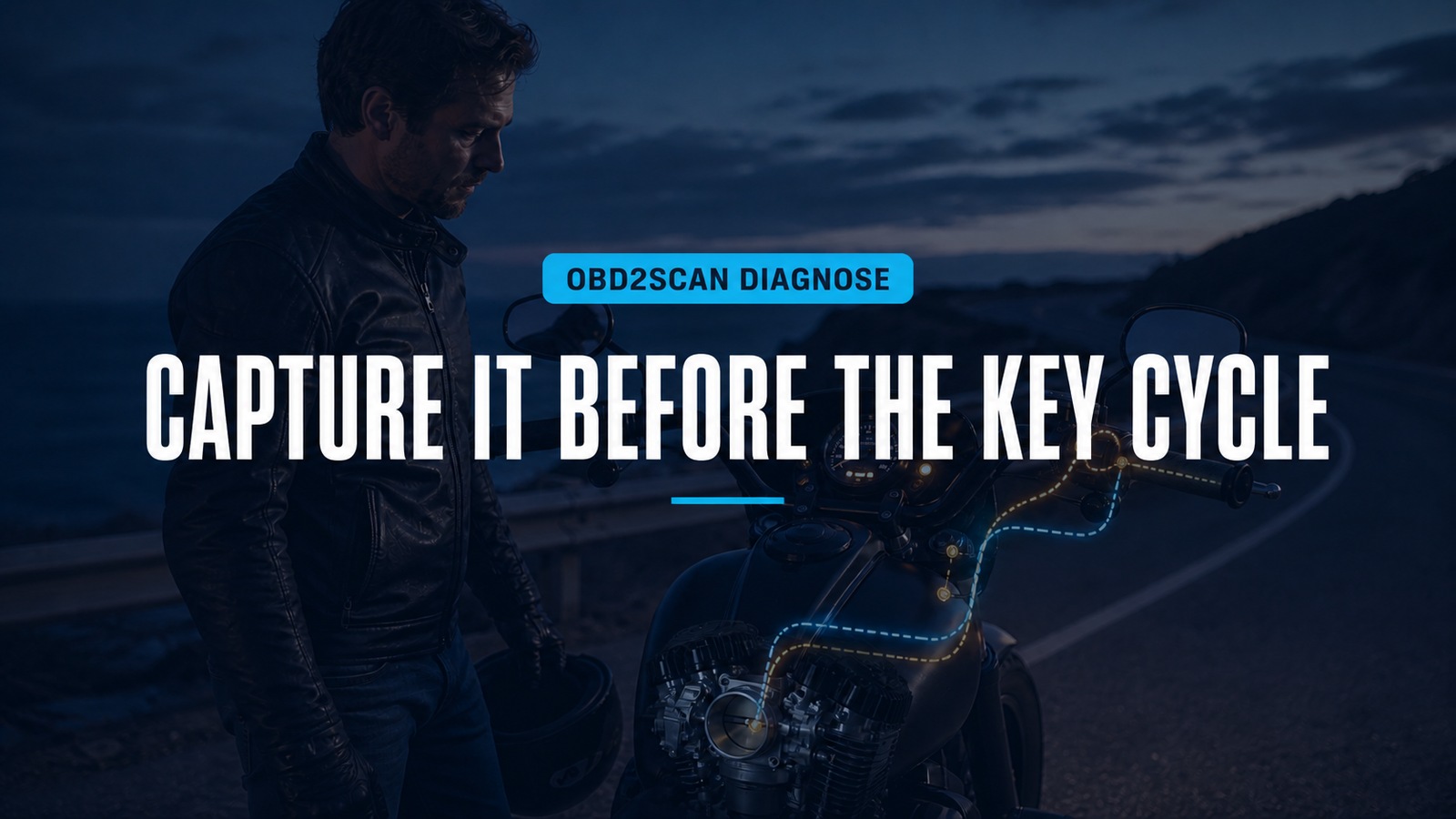
Capture It Before The Key Cycle
If a ride-by-wire Harley loses throttle response, surges, or enters reduced-power mode, make safety the first decision. Move out of traffic without demanding more performance than the motorcycle can deliver. A key cycle may restore response, but it also divides the most useful evidence into “before” and “after.”
When the motorcycle is secure, a compatible diagnostic scanner can preserve supported module data. The FXTUL M4-HD Harley-Davidson diagnostic tool is one route for codes, live data and supported actuator functions on matched models and installed systems. It cannot make the bike safe to ride, repair a harness, or guarantee every function on every year.
Treat the occurrence as an incident to capture, not a reset to celebrate. Electronic throttle control compares redundant grip inputs, commanded throttle and actual plate behavior while monitoring power and plausibility. The protection mode is part of that story.
Quick answer: Get safely off the road, photograph the active warning, and save current/history codes, freeze data, grip channels, throttle command/feedback and voltage before cycling the key. The reset is an event boundary, not a repair.
In this guide
- Make the motorcycle safe before preserving data
- Capture the dashboard before the key cycle
- Save the code and freeze-data state
- Compare grip command with throttle response
- Inspect voltage, connectors and recent work
- Use supported active tests only after the event
- Verify without recreating danger on the road
Make the motorcycle safe before preserving data
If throttle response is unpredictable, reduced, stuck, or accompanied by severe running problems, signal and leave the traffic lane using the safest available path. Do not attempt to reproduce the fault on a public road. If normal control is not assured, transport the motorcycle.
Once stopped, keep clear of moving parts and hot exhaust. Note whether the engine still idles, whether response is limited or absent, and whether the motorcycle can be switched off safely. The rider’s safety overrides the desire to keep the ignition on for data.
Do not twist connectors, strike the throttle body, or move the handlebar harness while balancing beside traffic. Those actions may alter an intermittent fault without preserving its location. Secure the bike first.
Capture the dashboard before the key cycle
Photograph the warning lamps, message area, odometer and tachometer while the event is active, if this can be done safely. Record time, weather, engine temperature, road surface, speed and rpm immediately before the change. Note whether it followed rain, washing, a hot restart, handlebar movement, a bump, sustained cruising or recent handlebar/accessory work.
Describe response precisely. Did grip movement produce no rpm change, a fixed limited rpm, delayed response, surging or an idle-only mode? Did cruise control disengage? Were ABS or other warnings present? A broad statement that the bike “went into limp mode” can hide several protective strategies.
If the ignition must be switched off, write that time down. After restart, note which lamps remain, whether response is fully restored and whether the code status changed. The reset is now an explicit event boundary.
Save the code and freeze-data state
With a compatible tool and adapter, perform an all-supported-module scan before clearing anything. Save current, historic and pending fault status, descriptions, occurrence counts and freeze data. Harley-specific codes related to throttle-grip sensors, throttle actuator control, correlation, return spring, power supply or communication should be interpreted from current service information for the exact model and year.
Do not replace a throttle grip, throttle body or ECM from the code name alone. A plausibility code may be triggered by connector resistance, shared power or ground, a harness open during handlebar movement, battery voltage, contamination, actuator mechanics or a true sensor fault. Multiple codes with one timestamp may share a single interruption.
Separate primary from consequential codes by timestamp and operating state. A throttle fault can cause cruise cancellation, airflow disagreement and reduced-power messages that are responses rather than three independent failed systems. Conversely, a supply-voltage or communication code that predates the throttle codes may be the better opening branch. Preserve the sequence exactly as the tool reports it.
If the key was already cycled, historic codes and freeze data still matter. Record that the active state was lost rather than pretending the post-reset idle reproduces it.
Compare grip command with throttle response
Electronic throttle control typically uses redundant signals so the controller can compare channels. View supported throttle-grip sensor channels, requested throttle, actual throttle position, engine speed and protective-mode state. Move the grip slowly with the engine off or in the exact service condition. Never command an actuator while the motorcycle can move.
Look for agreement and smoothness, not one generic voltage. Both channels may scale differently by design. A dropout at one handlebar position, disagreement during steering movement or an actual plate that fails to follow command sharpens the branch. Save graphs or screenshots rather than relying on “looked okay.”
Separate command from outcome:
| Observation | Next boundary |
|---|---|
| Grip channels disagree or drop | grip sensor, connector, handlebar harness, supply/ground |
| Grip command stable; plate feedback does not follow | throttle body, actuator circuit, mechanics, power |
| Both data paths plausible; engine response poor | fuel, ignition, air, engine or protective strategy |
| Data and communication disappear together | voltage, ground, network or module power |
Inspect voltage, connectors and recent work
Check battery state, cranking behavior and charging voltage by the motorcycle specification. A key cycle temporarily changes electrical load and module state, which can make a marginal connection appear cured. Voltage-drop power and ground paths under load; an open-circuit 12-volt reading is not enough.
Inspect throttle-grip and throttle-body connectors, pin fit, locks, seals, moisture and corrosion. Follow the harness through steering movement, clamps and high-vibration points. Recent handlebars, heated grips, controls, fairings, tank removal or accessory wiring deserve special attention. Look for stretched wires, sharp bends, crushed loom and grounds stacked incorrectly.
Use a wiggle test only in a stationary safe condition while monitoring data. Do not pull on individual wires or pierce sealed insulation without an approved repair method. If the fault is heat-related, compare cold and hot resistance or waveform behavior without exceeding component limits.
Use supported active tests only after the event
An actuator sweep or throttle test can separate whether the controller can command motion in the bay, but first confirm the motorcycle is secured, transmission state and all service preconditions. Keep hands and tools clear. Verify the function is actually supported for the installed system rather than assuming every menu item applies.
A successful active test does not clear an intermittent road fault. It proves only that the command, circuit and mechanism worked during that test. A failed test must be followed through power, ground, wiring, actuator and mechanics before a throttle body is replaced.
Compare cold and fully warmed results if the incident was thermal. Log grip channels and plate feedback continuously while the handlebar moves through its normal range, then repeat with the harness undisturbed. A dropout that appears only when the bars turn is more discriminating than ten stationary key cycles.
Follow the manufacturer’s initialization, adaptation or calibration procedure after component or software work. Do not invent a relearn by repeatedly cycling the key or twisting the grip. Also confirm whether security and module programming make a replacement part non-plug-and-play.
Verify without recreating danger on the road
Close the repair with stationary signal sweeps, harness movement within normal range, cold and hot checks, stable supply voltage, complete module scan and supported actuator tests. Clear codes only after saving the original incident. Confirm that required historic/permanent status changes through the approved process.
If a road check is necessary, use a trained rider, controlled route and escape plan; stop at the first abnormal response. The case passes when grip channels, requested and actual throttle, voltage and communication remain stable through the original temperature or movement condition and no relevant code returns. The key cycle is no longer the “fix”—the captured fault and verified boundary are.







Comments 0
Questions, fixes, and real-world diagnostic notes from readers.
Be the first to share a diagnostic result or ask a follow-up question.