
VW Polo P0106/P0172 Power Loss: The MAP Code Was Timing-Chain Evidence

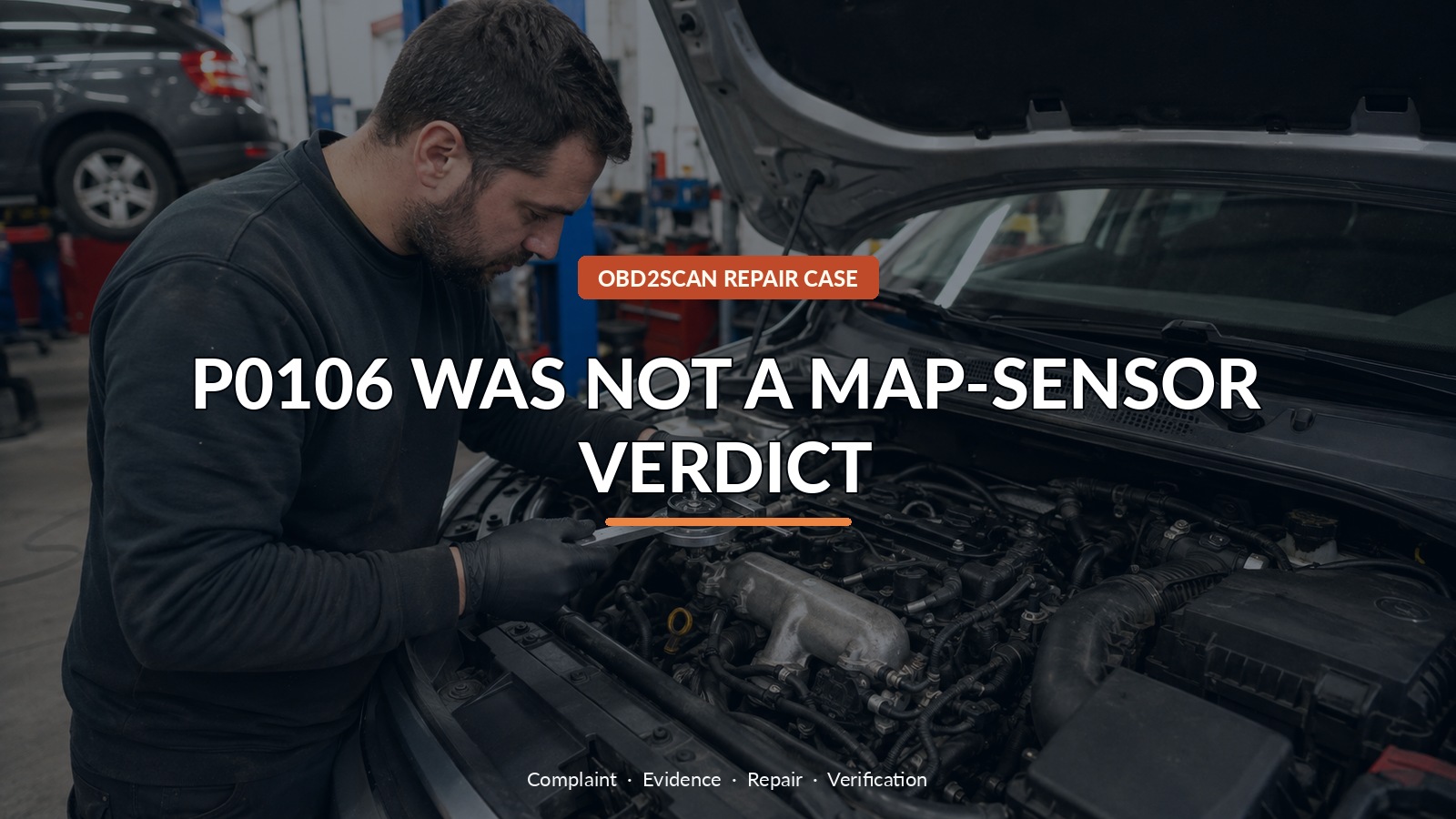
P0106 Was Not A Map-Sensor Verdict
A three-cylinder VW Polo lost power, cut out and stored P0106 and P0172. P0106 placed the MAP sensor in the headline, and the sensor was dirty enough to make cleaning feel productive. The fault remained. What the codes had recorded was an implausible pressure and fueling result created by valve timing that had moved—not a sensor asking to be replaced.
The early electrical tool class is a meter/scope able to compare accessible MAP, cam and crank signals at approved points. The AUTOOL DM303 can support those bounded signal checks when channel count, sample rate and Volkswagen data suit the test. DM303 can support accessible cam, crank and MAP waveform checks if Volkswagen data defines safe connections and its channels suit the comparison; it cannot measure in-cylinder pressure by itself, prove valve sealing, authorize continued running or identify a jumped chain from one static voltage.
Dynamic correlation showed a small, variable phase error. Pressure evidence then helped answer the expensive question: had the jumped chain damaged valves badly enough to require cylinder-head removal? The evidence supported a timing-set repair without unnecessary head work. After the chain was corrected, pressure, power and code state returned to normal.
Quick answer: P0106 and P0172 described pressure and fueling effects, not failed sensors. Dynamic timing and pressure evidence proved the chain had jumped.
In this guide
- Read P0106 and P0172 as allegations
- Do not count the absence of a timing code as proof
- Compare MAP response before replacing it
- Watch cam/crank phase dynamically
- Use pressure to judge whether the head must come off
- Open the timing cover only after the evidence converges
- Replace the jumped chain set
- Verify correlation, pressure, power and stored codes
Read P0106 and P0172 as allegations
Treat each DTC as an allegation. P0106 says manifold pressure behavior fell outside what the controller considered plausible. P0172 says fuel control was driven rich or corrected strongly. Neither identifies a dirty MAP, leaking injector or chain. Save freeze frame and note whether the engine rattles, cranks unevenly or cuts out under load. If timing noise is severe, oil pressure is low or the engine stops abruptly, avoid repeated running. A slipped chain can progress from poor performance to internal contact.
Do not count the absence of a timing code as proof
A controller may detect timing correlation only when phase error, speed and enabling conditions cross a threshold. The absence of a cam/crank DTC therefore cannot certify mechanical time. Three-cylinder intake pressure is especially sensitive to valve events, so a MAP plausibility code can be downstream evidence. Review service history, oil level and any previous chain noise. Static marks may appear close while tension, wear or intermittent movement shifts timing dynamically. Use the no-code state as context, never as clearance.
Compare MAP response before replacing it
Check the MAP sensor’s reference, ground and signal, then compare key-on engine-off pressure with ambient/barometric expectation. Observe idle, snap-throttle and deceleration response. Cleaning should be performed only with an approved method and should be judged by changed data, not by appearance. In this case cleaning did not cure the symptom. A signal can be electrically valid while reporting real but unexpected manifold pressure created by late or early valve events. The sensor may be the messenger that exposes a mechanical problem.
Watch cam/crank phase dynamically
Compare crank and cam signals across several revolutions and operating states. Use a known-good reference for the exact engine and be meticulous about time base and channel alignment. A small phase shift that changes is more informative than two disconnected screenshots. One or two channels may support an initial check, but specialist multi-channel capture and in-cylinder pressure can be required to understand all events. Never put hands near a moving chain or belt while chasing a waveform.
| Allegation or evidence | Proper weight | Wrong verdict |
|---|---|---|
| P0106 | Pressure behavior is implausible | MAP sensor has failed |
| P0172 | Fuel correction/rich behavior exists | Injectors must be leaking |
| No timing DTC | Threshold may not have been met | Mechanical timing is correct |
| Variable cam/crank shift | Mechanical phase deserves inspection | Head is certainly damaged |
| Pressure after correction | Helps assess valve sealing | One peak proves every cylinder perfect |
Use pressure to judge whether the head must come off
Before removing the cylinder head, determine what pressure and leakage say about valve sealing. Relative compression can rank cylinders; in-cylinder pressure or leak-down can show whether an intake or exhaust valve is sealing and when events occur. The mature case used pressure to avoid unnecessary head removal. That is not a promise that every jumped chain escapes damage. If compression is low, leakage is heard through a valve or the engine binds, stop and inspect further. The test decides repair scope, not merely fault category.
Open the timing cover only after the evidence converges
Once dynamic timing and pressure evidence converged, opening the timing area was justified. Inspect chain length/wear, guides, tensioner, sprockets, oil feed and any debris. Confirm crank and cam positions mechanically according to Volkswagen procedure; do not rotate an interference engine carelessly with timing released. A shifted chain is a system failure, so replacing only the easiest guide may leave the cause. Preserve photos of alignment and damaged parts to connect the measurement with what was physically found.
Replace the jumped chain set
Fit the complete confirmed timing set and one-time-use fasteners specified for the engine. Establish base positions with the correct fixtures, tension the chain in the prescribed sequence and rotate the engine by hand through complete cycles before cranking. Check oil level and prime where required. The repair in this documented Polo did not need a cylinder head because pressure evidence had supported intact sealing. That boundary belonged to this engine; another vehicle with the same codes may require very different work.
Verify correlation, pressure, power and stored codes
Repeat the original cam/crank and pressure captures with identical settings. Start and listen before raising rpm, then monitor MAP response and fuel trim. Road-test the prior power-loss/cutout condition only after the mechanical and oil-pressure checks pass. Confirm P0106 and P0172 remain absent after their monitors run. The strongest ending joins four facts: correlation is restored, pressure is plausible, power has returned and codes do not reset. Any one by itself would leave part of the case open.
The MAP sensor did not lie; the diagnosis asked the wrong question of it. Once manifold pressure was treated as the consequence of valve events, dynamic timing and pressure evidence led to the jumped chain without an unnecessary sensor or cylinder head.







Comments 0
Questions, fixes, and real-world diagnostic notes from readers.
Be the first to share a diagnostic result or ask a follow-up question.