
Vauxhall Vectra Intermittent No-Crank: One Bad ECU, One Bad Replacement, Then a Starter-Created No-Start

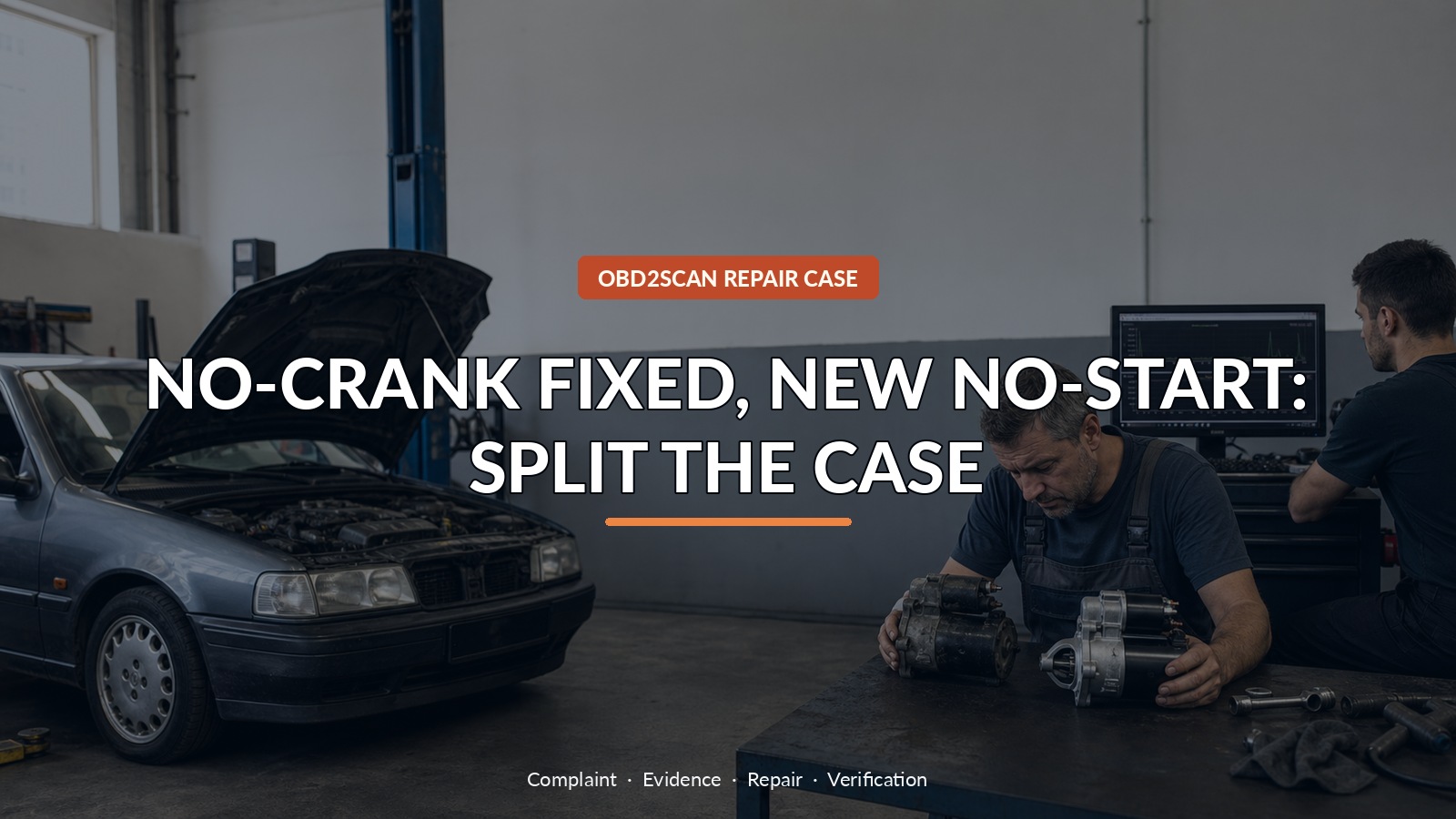
No-Crank Fixed, New No-Start: Split The Case
This Vauxhall Vectra entered the workshop with an intermittent no-crank and starter-relay chatter. Months later, it had taught three separate lessons: the original ECU really did drop offline, the first used replacement really was bad too, and a reconditioned starter introduced a completely new long-crank no-start by corrupting the crank signal. The case only makes sense when those chapters are kept apart.
For the accessible first-line circuit checks, a meter/scope such as the AUTOOL DM303 can support battery, supply, ground, relay, cranking-voltage and basic K/CAN observations when the Vauxhall diagram defines safe points. DM303 can support accessible battery, supply, ground, relay, cranking-voltage and K/CAN checks with Vauxhall wiring data; its single handheld view cannot reproduce the source case’s simultaneous eight-channel evidence, identify missing CAN IDs, or prove a used ECU or starter reliable.
Long repairs are vulnerable to narrative drift. This account uses a hard boundary between the customer’s original complaint and the new symptom that appeared after parts were fitted, so later evidence cannot quietly rewrite the earlier diagnosis.
Quick answer: The original ECU caused relay chatter and went offline. A bad used ECU repeated it; then a noisy replacement starter created a separate crank-signal no-start.
In this guide
- Name the original complaint before the case grows
- Prove the battery and starter request first
- Watch the ECU release the starter relay
- Confirm the module goes offline rather than blaming CAN wiring
- A used replacement is not a controlled known-good part
- Separate the new prolonged crank from the old no-crank
- Let starter current explain crank-signal interference
- Verify both faults with repeated cranking and a clean start
Name the original complaint before the case grows
The original job card needed exact words: sometimes the key was turned, the starter relay chattered and the engine did not crank. That differs from a starter that cranks normally without firing. Video, temperature, key position, security-lamp behavior and whether a second attempt worked were recorded. Without that definition, a later prolonged-crank event could be mistaken for recurrence even though the starter motor was now operating—a small language error capable of derailing weeks of diagnosis.
Prove the battery and starter request first
Battery condition and voltage drop under an actual crank request came first, followed by ignition-switch, selector/park authorization and starter-relay inputs. An automatic transmission adds an inhibit path that must be proven rather than bypassed. The battery remained capable and the external request reached the control strategy. Swapping or jumping a relay without identifying its power and control terminals could damage a module, so the chatter was observed electrically instead of treated as a bad relay by sound alone.
Watch the ECU release the starter relay
The engine ECU repeatedly supplied and then withdrew the relay’s ground command. At the same moments, communication behavior changed. Inputs requesting a crank remained, which made an upstream key or selector dropout less persuasive. The ECU appeared to reset or abandon the sequence after beginning it. This was not yet proof that the module’s internal hardware was defective; its feeds, grounds and network environment still had to be watched through the same event.
Confirm the module goes offline rather than blaming CAN wiring
External ECU power and ground did not show the collapse needed to explain the reset, while expected CAN identifiers disappeared as the module went offline. Other network traffic continued. That combination distinguished a module leaving the conversation from a complete bus outage. It required simultaneous evidence; checking power five minutes later, when the engine happened to crank, would have found a healthy car and preserved the mystery.
A used replacement is not a controlled known-good part
A used ECU with the required matching/programming work was installed, and it reproduced the original fault. That did not automatically exonerate the diagnosis. Used electronics arrive with unknown thermal and service history and are not laboratory-known-good parts. A second replacement then survived repeated attempts and several weeks without the relay-ground dropout. The result supported the original ECU conclusion while also documenting that the first replacement had carried a similar defect.
Separate the new prolonged crank from the old no-crank
A reconditioned starter had been fitted during the long investigation. Now the engine cranked for an extended period without starting—a new symptom, because the original failure did not crank at all. The ECU remained online and the relay no longer chattered. Rather than dragging the first diagnosis back into doubt, the case opened a second worksheet with new before-data: cranking speed, starter current, crankshaft-sensor signal and injection synchronization.
| Chapter | Symptom | Decisive evidence | Outcome |
|---|---|---|---|
| Original | Relay chatter, no crank | ECU ground command pulsed; module IDs vanished while feeds remained | Second functioning ECU cured no-crank |
| Replacement-part complication | First used ECU did the same | Used part repeated original internal behavior | Did not invalidate earlier circuit evidence |
| New fault | Starter cranked, engine did not fire | Segmented starter current coincided with crank-signal interference | Original starter restored clean start |
Let starter current explain crank-signal interference
The replacement starter drew current in discontinuous segments and generated electrical interference that appeared in the inductive crankshaft-sensor signal. A controller can remain powered yet fail to recognize a corrupted position pattern well enough to schedule injection. The original starter was refitted for comparison; its current was smoother and the crank signal clean. This was not a generic claim that all reconditioned starters create noise—only that this unit changed the electrical environment and recreated the new no-start.
Verify both faults with repeated cranking and a clean start
With the original starter and the second functioning ECU, the Vectra started in approximately 785 ms and repeated the result. Verification therefore covered both chapters: no relay chatter or ECU disappearance across many start requests, and no prolonged crank or corrupted position signal. Parts provenance and dates were retained in the repair record so a future technician would not see two ECUs and two starters on an invoice and assume they represented one unresolved fault.
The most human lesson is to protect the customer’s original complaint from a growing repair story. Stop repeated attempts if the starter, cables or battery begin to overheat. Write down what changed after every intervention and require a same-condition retest. A bad replacement part can resemble a bad diagnosis; a new symptom can also be genuinely new. This Vectra was solved when the evidence was allowed to support two faults instead of being forced into one elegant explanation.







Comments 0
Questions, fixes, and real-world diagnostic notes from readers.
Be the first to share a diagnostic result or ask a follow-up question.