
Opel Kadett Screeched Near 1,000 RPM: The Transmission Was Loud, but the Mounts Were the Fix

Transmission Screech? Test The Mounts First
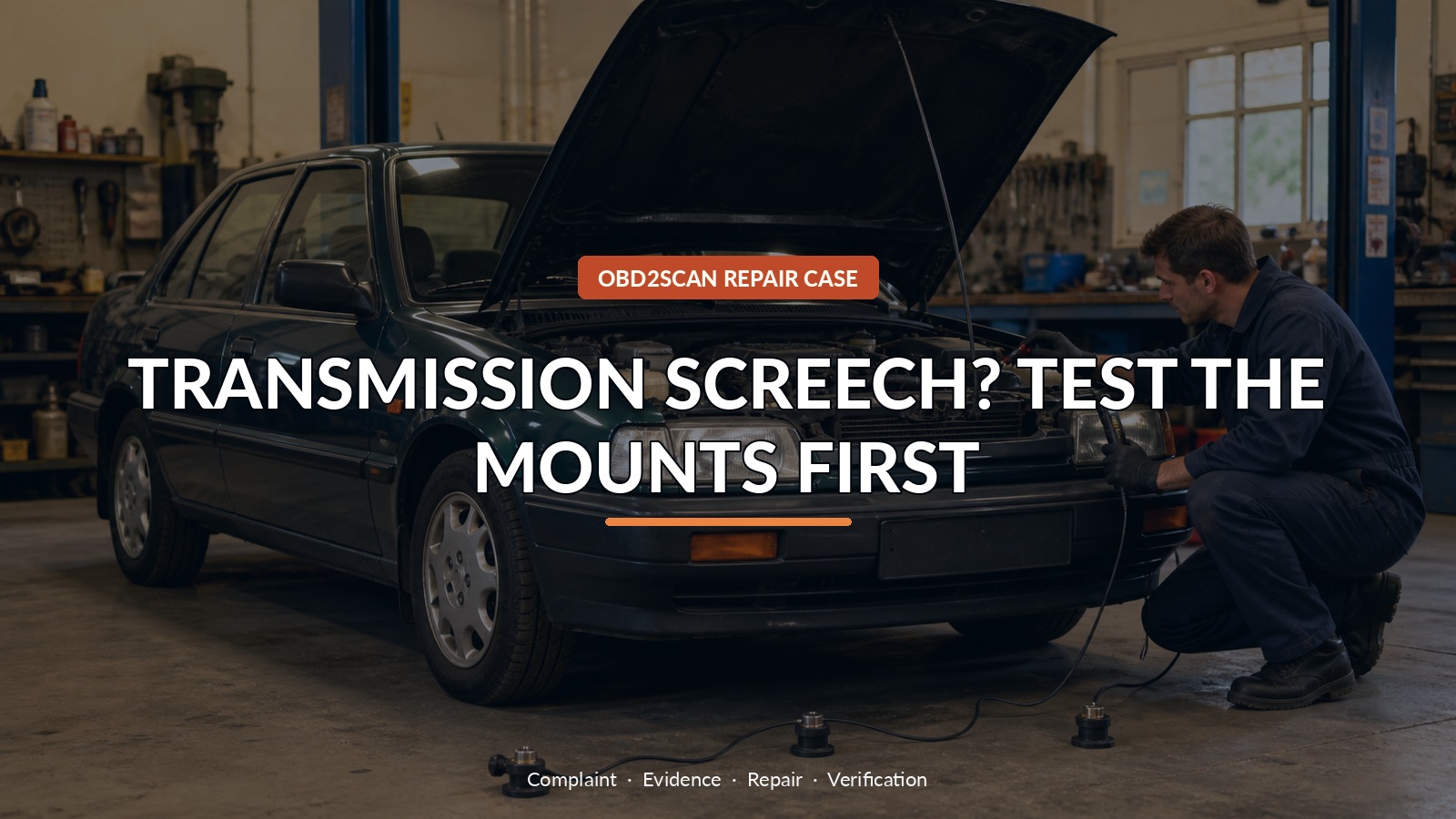
A 1991 Opel Kadett 1.6S made a harsh screech close to the transmission at roughly 1,000 rpm. Fluid service and additives changed nothing, and the sound location kept inviting transmission work. The better clue was the narrow engine-speed band: the car did not need to move or carry driveline load to create the noise.
After the vibration path has been localized, a flexible inspection camera can help document accessible rubber separation, collapse or contact around a mount. The MRCARTOOL N130 is one example for that limited visual task. N130 can document accessible rubber separation, collapse or interference after the vibration path has been localized. It cannot measure frequency or acceleration, inspect every loaded face of a mount or prove a transmission is healthy from appearance alone.
Vibration measurements showed excessive engine-order energy crossing aged supports into the body and transmission. Replacing the right-side mount alone did not cure the screech; replacing all three load-sharing mounts produced a large NVH reduction, and subsequent weeks of driving eliminated the sound. The transmission was the loudspeaker, not the proven source.
Quick answer: The transmission amplified a 1,000-rpm screech, but aged mounts transferred the vibration. Replacing all three supports reduced NVH and eliminated the noise.
In this guide
- Describe the exact rpm band before naming a part
- Prove the screech follows engine speed, not road speed
- Do not confuse the loudest casing with the source
- Record vibration on both sides of each mount
- Let the unsuccessful fluid service close that branch
- Explain why one new mount was not enough
- Replace the full load-sharing mount set
- Repeat the same rpm sweep and keep driving
Describe the exact rpm band before naming a part
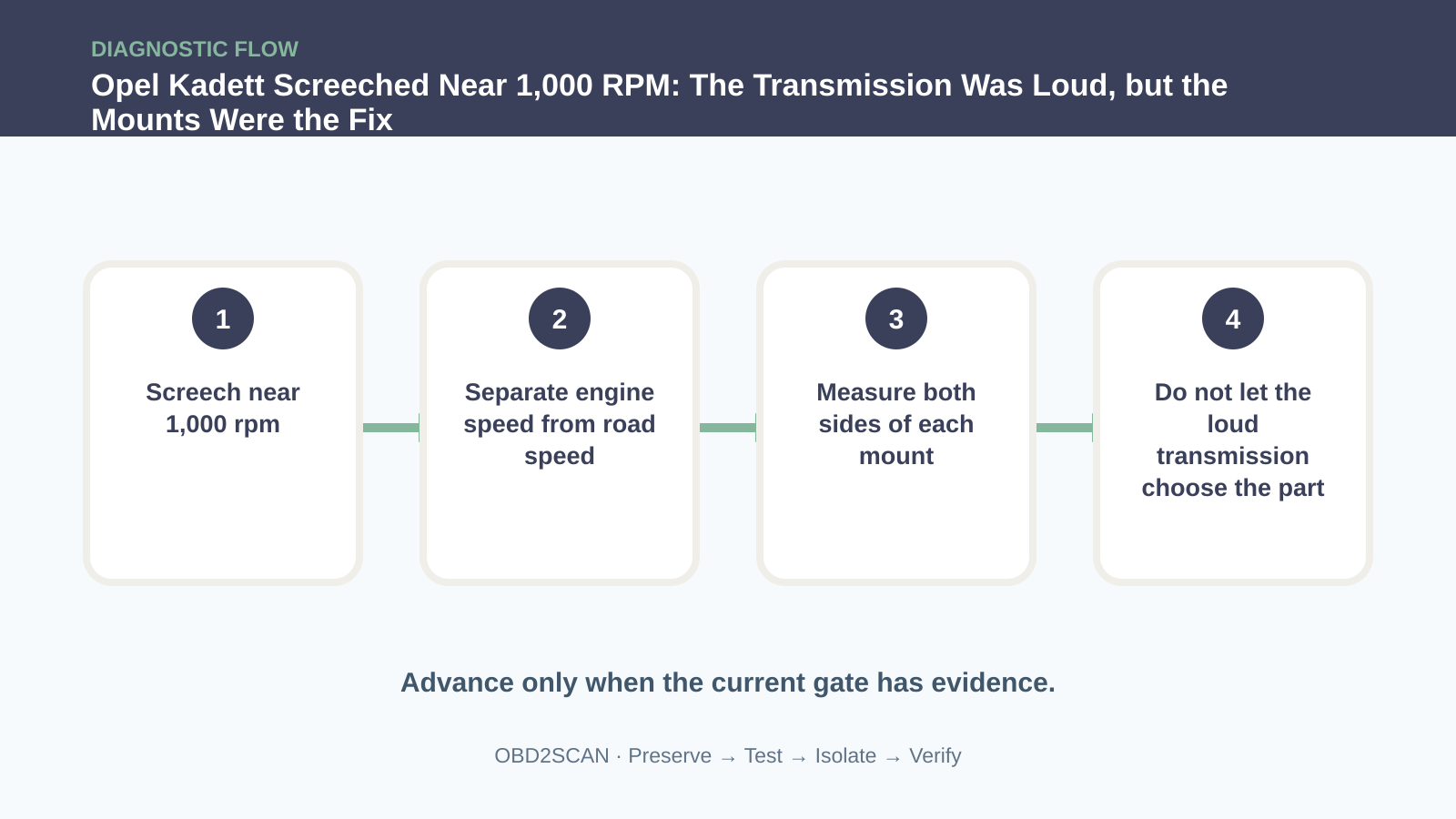
Describe the event in variables a second technician can reproduce: onset and exit rpm, cold or hot, gear selected, clutch or converter state, steering load, electrical load and whether the vehicle must move. Use a stationary rpm sweep only in a ventilated, secured area with a driver at the controls. Stop for belt, pulley or lubrication warnings. A recording from the cabin helps preserve character, but do not place a phone or person near moving engine parts to chase a sound.
Prove the screech follows engine speed, not road speed
Hold engine speed through and around the roughly 1,000-rpm band while vehicle speed remains zero. Then vary gear or driveline load if the procedure is safe. A frequency that follows engine rpm but not road speed moves tires, wheel bearings and final drive down the list. If the sound occurs at one narrow order, resonance becomes plausible: a modest source can become loud when the powertrain, mounts and body respond together at that speed.
Do not confuse the loudest casing with the source
Sound travels through shafts, casings and body panels. The place that sounds loudest to a mechanic’s ear may be the best radiator, not the origin. Compare vibration at the engine, both sides of each mount, transmission casing, subframe and cabin. Use consistent sensor orientation and the same rpm sweep. Tapping parts or loading a mount can support localization only when done safely. Avoid condemning an internal gearbox simply because the bellhousing makes the screech easy to hear.
Record vibration on both sides of each mount
Think of each mount as an isolator between a vibrating source and a responding body. Measure engine-side and body-side acceleration to see how much energy crosses it. On an old vehicle, all supports share powertrain weight and reaction torque; one collapsed mount changes the preload carried by the others. Visual cracks help, but rubber can harden or compress without dramatic separation. The strength of the case came from transfer behavior plus the repair response.
Let the unsuccessful fluid service close that branch
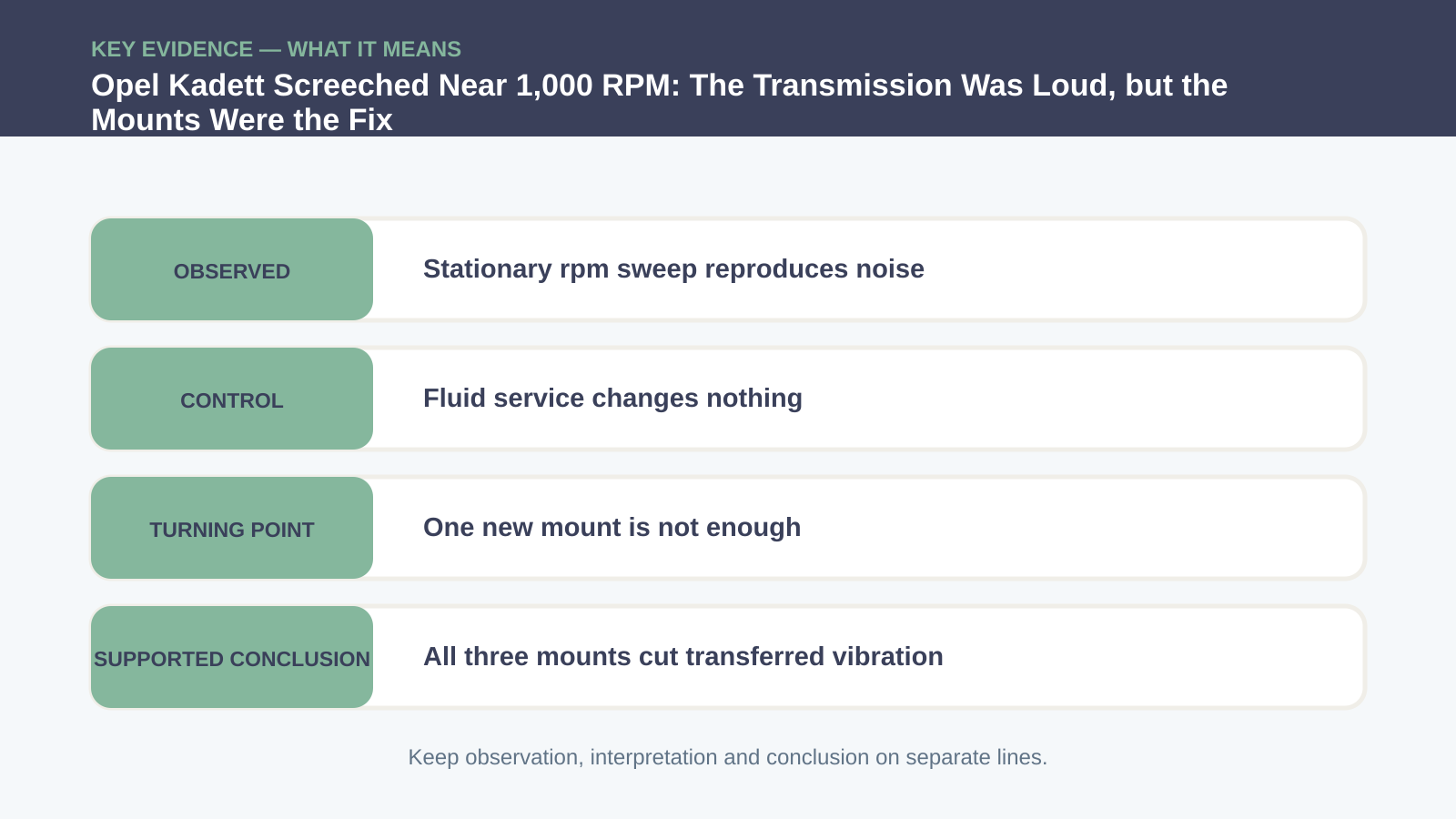
The prior fluid flush and additives did not change the symptom. That result should close a branch, not encourage stronger chemicals. Verify level, specification and evidence of internal transmission trouble, but do not keep changing fluid to treat a repeatable mount resonance. Service history can mislead if an earlier action is treated as proof that the serviced component was faulty. Here, the unchanged noise made the gearbox-fluid theory weaker.
| Condition | Result | Meaning |
|---|---|---|
| Near 1,000 rpm, stationary | Screech present | Engine-speed resonance |
| Road speed/gear changed | Not the controlling variable | Wheel-speed causes less likely |
| Transmission-fluid service | No change | Fluid was not the remedy |
| All three mounts replaced | NVH falls; screech disappears | Support system carried the fault |
Explain why one new mount was not enough
Replacing the right-hand mount alone did not end the screech. That does not mean the mount diagnosis was wrong. A three-point support system redistributes load, and new stiffness at one corner can reveal weakness at the others. Inspect all mounts, brackets and fasteners under controlled engine torque. If the supports are similarly aged or measured isolation remains poor, a complete matched set may be justified. Follow support and alignment procedures so the powertrain settles without preload.
Replace the full load-sharing mount set
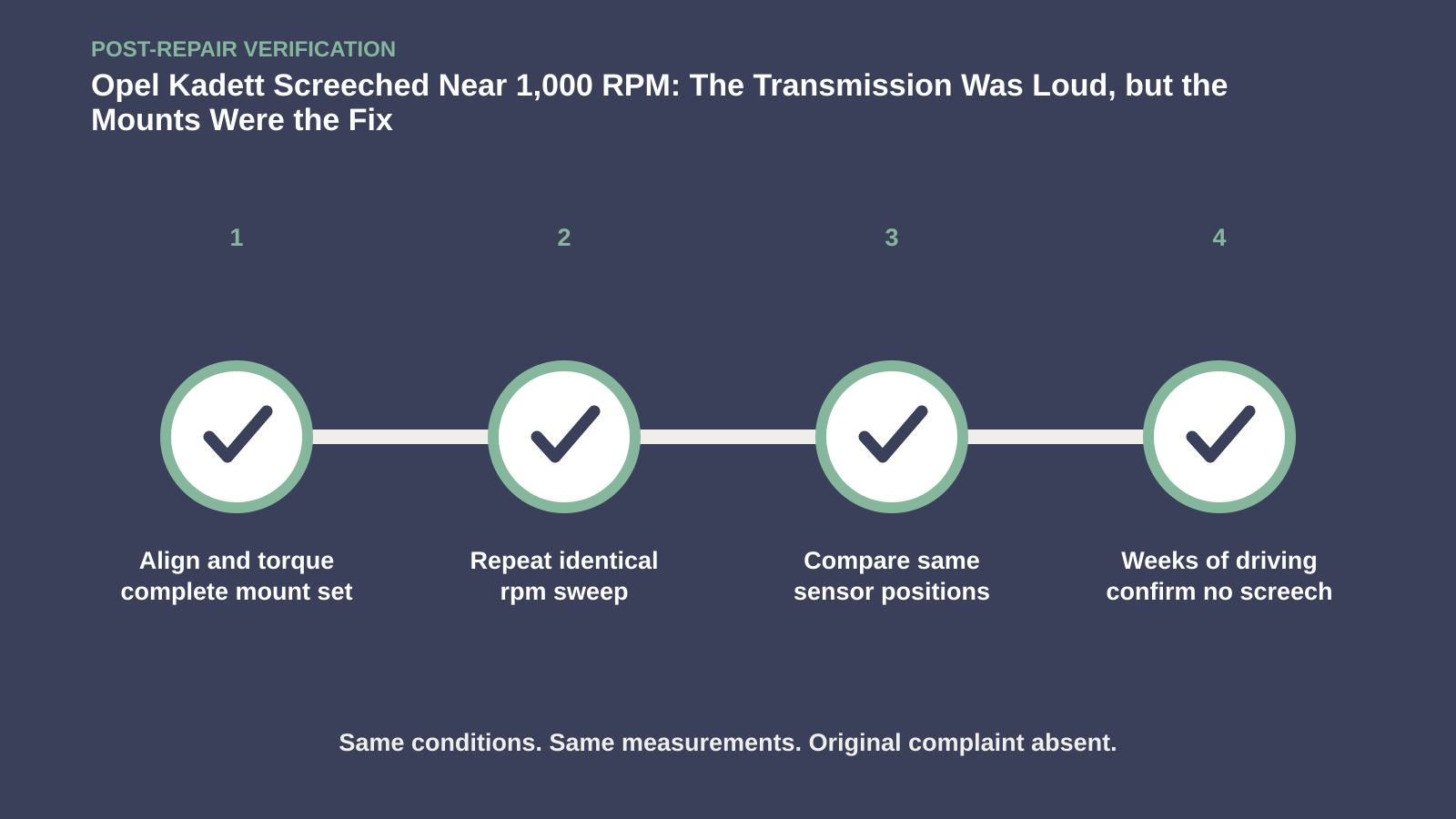
Repeat the identical rpm sweep immediately after repair and compare vibration amplitudes using the same sensor positions and scaling. Check idle, reverse/drive selection where applicable, acceleration and deceleration for contact or harshness. In this case measured vibration fell markedly, while subsequent weeks of driving removed the screech completely. That longer observation matters because rubber settles and an intermittent resonance may not appear in one short bay test.
Repeat the same rpm sweep and keep driving
Keep the result precise. The mount set resolved this Kadett’s narrow-band screech; it does not prove the transmission had no unrelated wear, nor that every similar sound is a mount. Inspect exhaust contact, shields, pulleys and accessories as conditions require. The transferable insight is to separate source, transfer path and radiating surface. When those roles are confused, the loudest housing can receive the most expensive unnecessary repair.
The transmission told everyone where the sound was loud, not where it began. Measuring what crossed the mounts—and accepting that one new mount was not the whole system—turned an old-car screech into a verified isolation repair.









Comments 0
Questions, fixes, and real-world diagnostic notes from readers.
Be the first to share a diagnostic result or ask a follow-up question.