
Gleaner Combine Showed an Unknown DTC During Harvest: Isolate the CAN Branch Before Buying Modules

Unknown Dtc At Harvest? Isolate The Can Branch
A Gleaner combine stopped harvest with an unknown active fault while several expensive suspects—the engine ECU, engine harness and EGR controller—were already being discussed. Decoding the reported SPN did not produce a tidy component name. The way forward was more basic: find which network branch was pulling both CAN wires down and restore the bus before buying modules.
A meter/scope can support an identified CAN physical-layer check and verify that module supplies remain present. The AUTOOL DM303 is one accessible example for this bounded screening work once the combine topology is known. DM303 can screen identified CAN voltage, resistance, power and ground conditions. It cannot decode the full J1939 fault history like a dedicated logger, certify a modified machine harness or decide whether emissions hardware may legally be bypassed in a given jurisdiction.
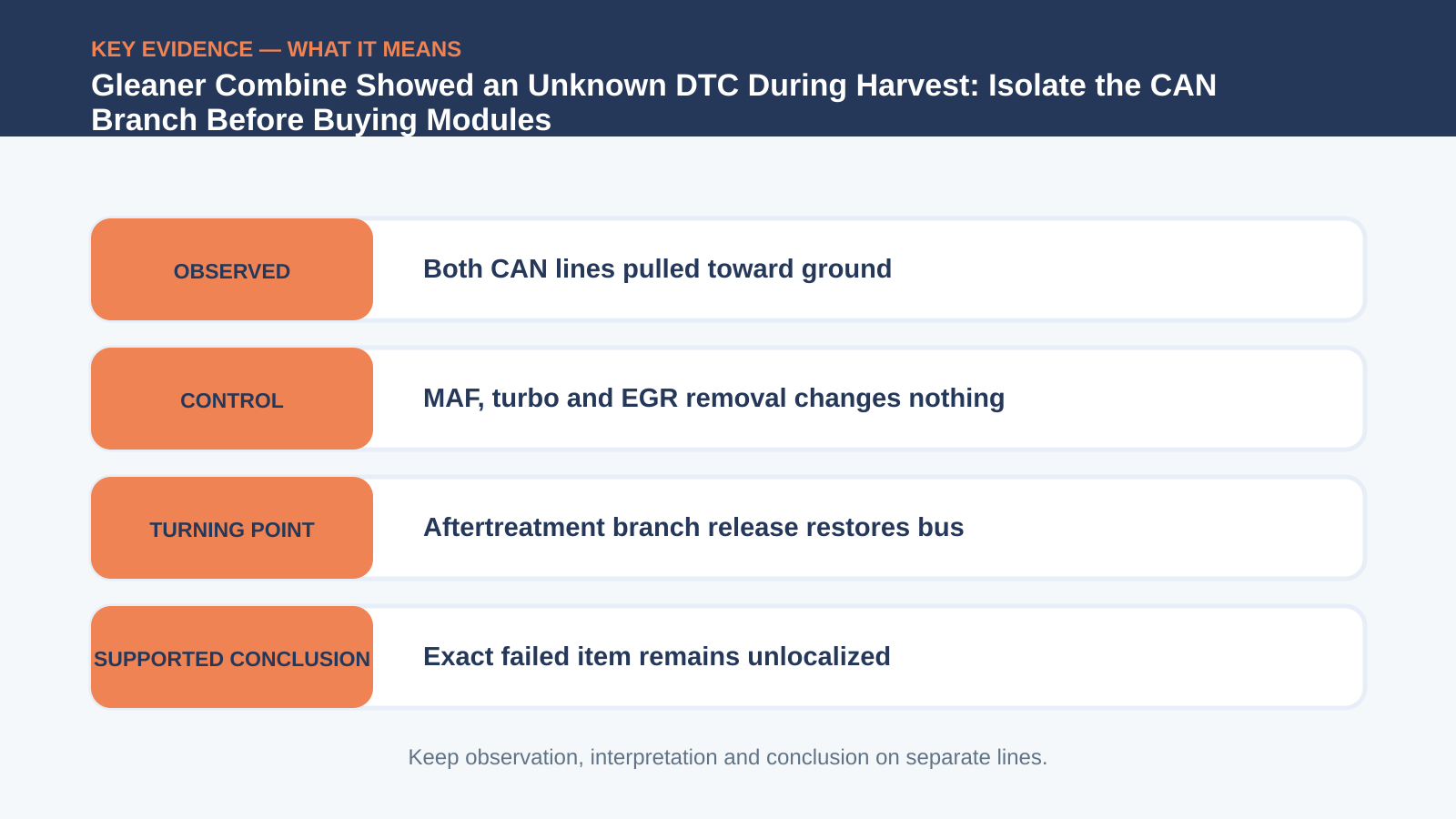
Removing the airflow meter, turbo actuator and EGR controller did not release the fault. Disconnecting the aftertreatment harness did. Its unused branch was isolated, de-pinned and correctly terminated through an engineered bypass, returning the combine to work with no new part. The exact failed item inside that branch was never localized, so the honest conclusion is a proven branch fault—not a named component.
Quick answer: Both CAN lines were pulled down by the aftertreatment branch. Isolating and correctly terminating an unused branch restored the combine without replacing proposed modules.
In this guide
- Do not let ‘Unknown DTC’ authorize three modules
- Decode enough J1939 to choose the network
- Confirm both CAN lines are being pulled down
- Disconnect branches from easiest to hardest
- Prove the fault lives beyond the harness connector
- Choose downtime depth with the owner
- Restore topology and termination deliberately
- Record the unresolved component-level boundary
Do not let ‘Unknown DTC’ authorize three modules
Preserve the harvest context: crop, ambient heat, dust, engine load, hours into the shift and whether a key cycle changes the symptom. Save the complete scan or display report, including the unknown code and all modules that complain about missing data. Do not replace the engine ECU because several other controllers mention it; one network disruption can make healthy modules accuse each other. Park safely, lower attachments and control fire risk around dry crop material before opening looms or making electrical tests.
Decode enough J1939 to choose the network
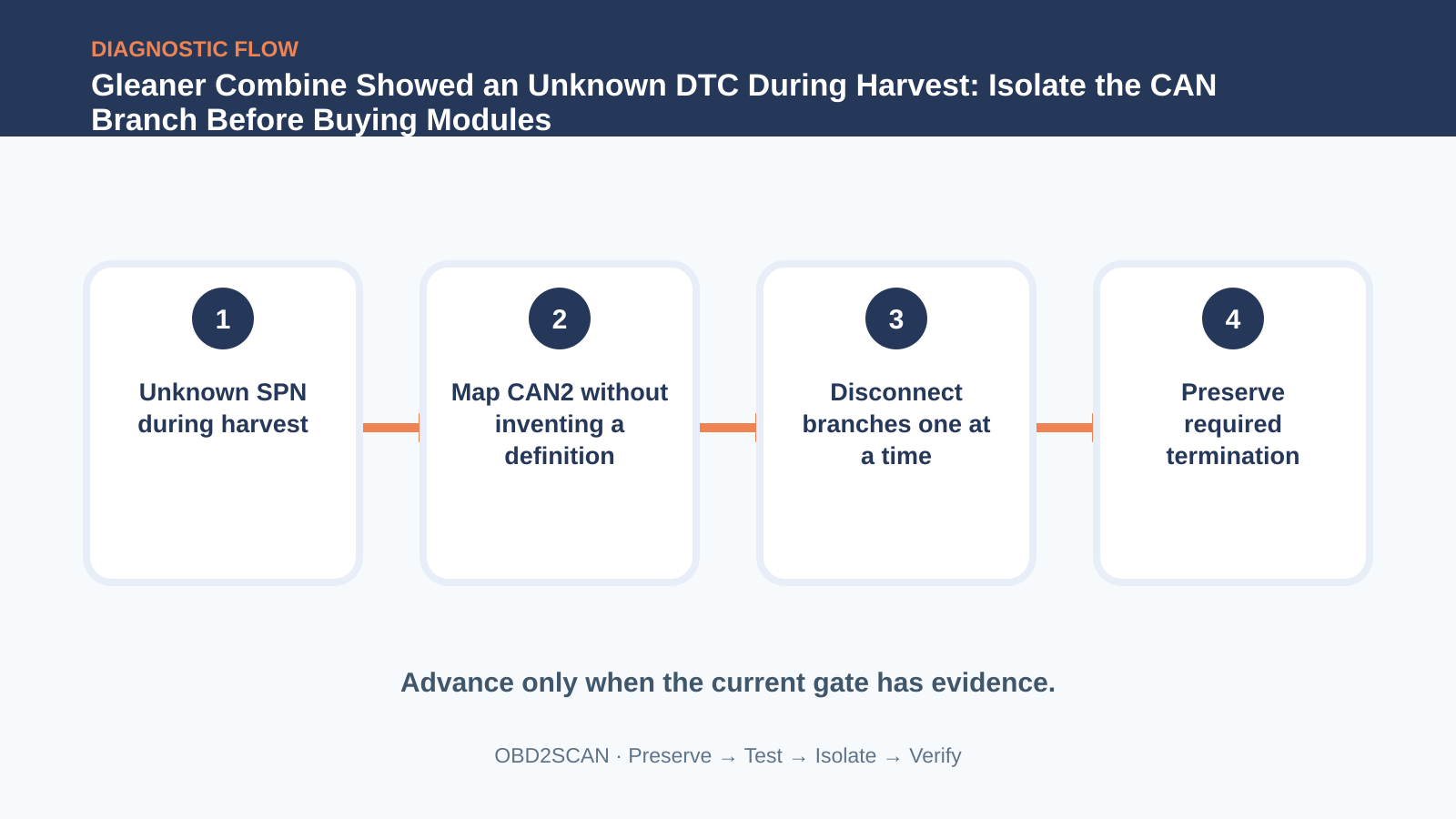
The reported value was decoded as SPN 520393, but a number without an authoritative definition is still an unknown. Record the raw identifier, FMI or status and source address rather than inventing a label. Ask whether it is active because a controller has failed, because required data is missing or because the physical bus is distorted. The code guides attention to a network, but line voltage and branch isolation must show where communication is being damaged.
Confirm both CAN lines are being pulled down
Map CAN2 from the topology and identify each branch connector. With the network active under an approved condition, view CAN high and CAN low together using correct differential probing. Both lines were being pulled toward ground, which is different from one controller merely falling silent. Check termination only after the network is powered down and discharged according to service information. Also verify key supplies and grounds so a shorted power circuit is not mistaken for a data-line defect.
Disconnect branches from easiest to hardest
Disconnect branches methodically, key off where required, and record each result. The MAF, turbo and EGR controller were removed from the network without restoring it. Those negative tests matter: they prevent the story from quietly returning to a favored component. When the aftertreatment harness was disconnected, the bus recovered. Reconnect once to confirm the change if safe. A repeatable release at one connector localizes the electrical problem downstream of that point.
Prove the fault lives beyond the harness connector
Inspect the isolated harness for crushed sections, water, rubbed insulation, corroded splices and modules sharing the branch. In this case the exact failure within the aftertreatment leg was not identified. Say so. A recovered bus does not reveal whether the cause was a sensor, connector or conductor unless it is narrowed further. Time pressure during harvest can justify a stopping point, but it should not turn a branch-level diagnosis into a false component-level claim.
| Isolation step | Bus result | Decision |
|---|---|---|
| Disconnect MAF branch | Fault remains | MAF branch not the release point |
| Disconnect turbo/EGR controllers | Fault remains | Continue branch isolation |
| Disconnect aftertreatment harness | CAN waveform recovers | Fault lies in that branch |
| Reconnect suspect branch | Distortion returns | Branch association is repeatable |
Choose downtime depth with the owner
The unused aftertreatment branch was de-pinned and bypassed with correct network termination, restoring operation without parts. That is an engineered modification, not a universal field trick. It must preserve the required network impedance, environmental sealing and every legally required emissions and safety function. Equipment configuration and jurisdiction determine whether removing a branch is permitted. If that branch controls required aftertreatment, the appropriate repair is to locate and correct the fault, not disable the system.
Restore topology and termination deliberately
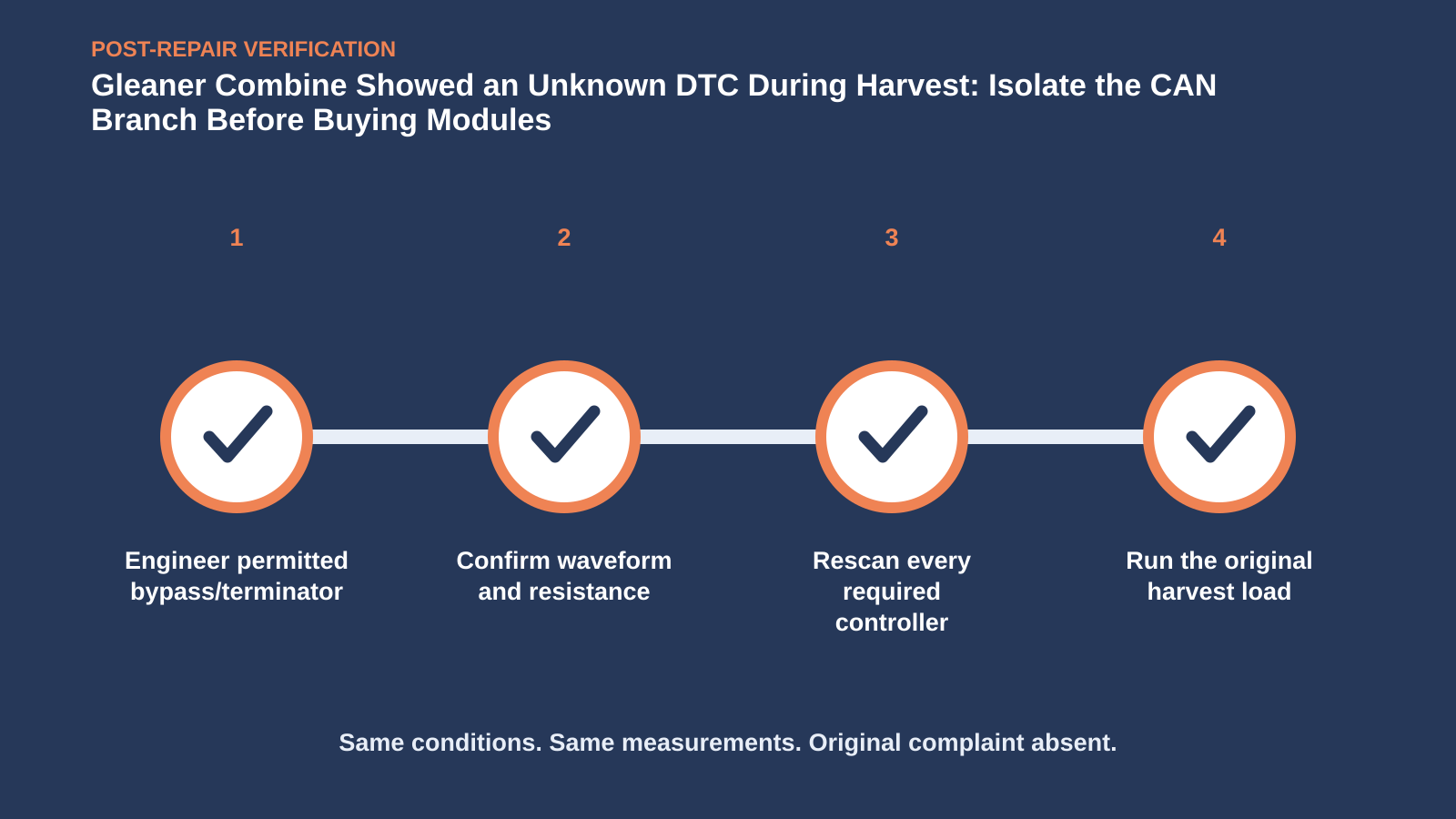
Verify the waveform, dominant/recessive levels and expected termination after the modification, then confirm all required controllers communicate. Run the combine through the load and heat window that triggered the shutdown, rescan and inspect the modified harness after vibration. Watch for new missing-message faults that a simple engine restart might not reveal. The documented machine returned to harvest and the repair required no purchased component; the successful result still belongs to that particular configuration.
Record the unresolved component-level boundary
Leave a wiring record with pin positions, termination method, measured resistance and the original branch status. Label the bypass so the next technician does not interpret it as undocumented damage. If the machine’s configuration changes or regulations require the branch, restore the OEM architecture and diagnose it fully. This case is valuable precisely because it protects the owner from three unproven modules while retaining an honest boundary around the unresolved exact failure.
The combine did not need a confidently named mystery part. It needed the failed network branch isolated, the required bus preserved and the limits of that conclusion written down as carefully as the repair.






Comments 0
Questions, fixes, and real-world diagnostic notes from readers.
Be the first to share a diagnostic result or ask a follow-up question.