
BMW 320d Vibrated at Motorway Speed: Four Balanced Wheels Were Still Out of Round

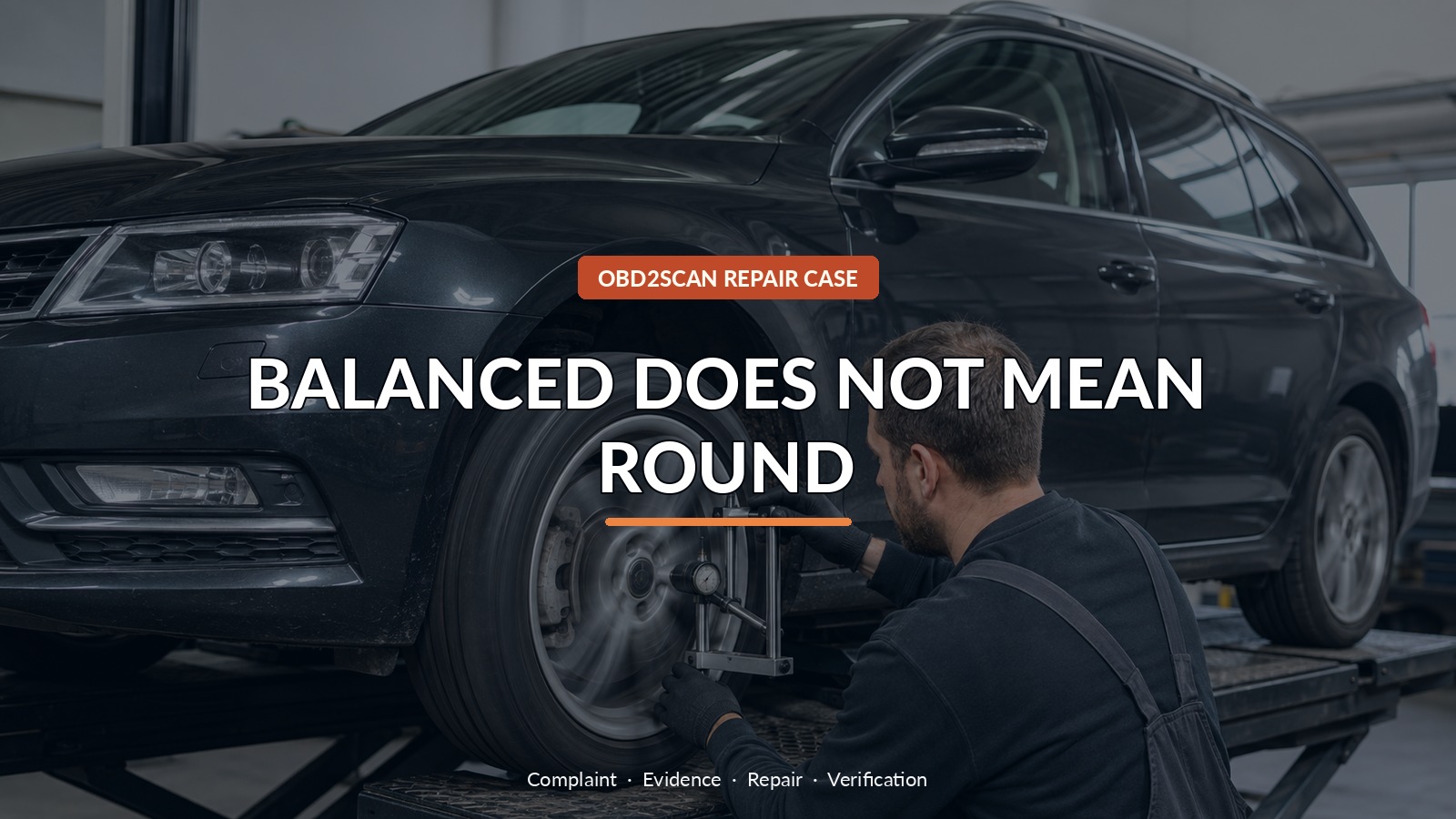
Balanced Does Not Mean Round
For two and a half years, a BMW 320d M Sport xDrive Touring carried a motorway vibration that balancing, replacement tires and wheel straightening had not settled. The owner described a cabin shake around 75–83 mph. The breakthrough was not a new balance setting. It was an agreement to reproduce one exact condition and measure whether the wheel-and-tire assemblies were round.
Once proper NVH and runout testing localizes the area, a compact articulating inspection camera can help document inner-rim repair marks, tire seating or damage that is hard to see on the car. The AUTOOL SVB308 is one such visual aid in that supporting role. SVB308 can help document accessible inner-rim damage, repair marks, tire seating and confined wheel-well condition after the car is safely supported; it cannot measure radial runout, road force, vibration order or certify a wheel as straight.
All four rims showed deformation, with radial runout reaching about 1.45 mm. A known original, unrefurbished wheel set with approved tires became an A/B control. On the same road and speed, measured vertical vibration fell from roughly 18.3 mg to 3.99 mg—more than a 75 percent reduction.
Quick answer: Repeated balancing could not correct radial wheel deformation. A known straight wheel set reduced measured vertical vibration by more than 75 percent.
In this guide
- Agree on speed, road and seat before testing
- Respect the work already tried
- Separate wheel speed from engine speed
- Measure radial geometry instead of adding weights
- Use a known straight wheel set as an A/B test
- Inspect the inner rim and tire as a pair
- Replace rather than repeatedly straighten uncertain wheels
- Repeat the route and publish the before/after result
Agree on speed, road and seat before testing
Before tools, define the complaint in the owner’s language and the technician’s variables. Which seat feels it? Is the steering wheel moving? What road surface, speed band, gear, load and tire temperature reproduce it? Does braking, acceleration or coast change it? Choose a legal, controlled route and use a passenger to record data. Stop the test if the vibration becomes severe or the vehicle becomes difficult to control, and do not chase 80 mph on public roads while watching equipment. A chassis dynamometer or professional test route may be the safe option. The signed condition becomes the contract for both diagnosis and verification.
Respect the work already tried
Repeated balancing and tire replacement are not proof that the rotating assemblies are good, but they are useful history. Record who performed the work, whether wheels were straightened or refurbished, tire make and specification, inflation, mounting position and road-force results if available. Inspect for bent flanges, welds, missing weights, tire runout, separated belts and debris between wheel and hub. Verify wheel-bolt torque and hub cleanliness. Do not spin a damaged tire or unsupported vehicle merely to make the symptom easier to see.
Separate wheel speed from engine speed
Frequency prevents the nearest part from winning. Compare the dominant vibration with wheel rotational frequency, propshaft order and engine order at the complaint speed. If the frequency follows road speed through a gear change, engine accessories move down the list. Direction also helps: vertical seat vibration suggests a different response path than steering-wheel shimmy. These are localization clues, not component verdicts. A sensor mounted where motion is strongest may be measuring the response of the body, not the point where the force originates.
Measure radial geometry instead of adding weights
A balancing machine corrects mass distribution around an axis. It cannot make an oval rim round. Measure radial and lateral runout at defined surfaces with a dial indicator and compare all four corners. Check both rim and tire so their peaks are not confused. In this documented case every wheel was deformed, and the worst radial reading was about 1.45 mm. Whether any number is acceptable depends on current BMW, wheel and tire information; the case value is evidence, not a universal discard specification.
| Test | Question answered | Question still open |
|---|---|---|
| Dynamic balance | Is mass distributed around the assembly? | Is the rim or tire round under load? |
| Dial-indicator runout | How far geometry varies per turn | How the assembly behaves against the road |
| Road-force measurement | Does loaded tire/wheel variation exist? | Which internal feature causes it |
| Known-good wheel set | Does changing the complete assembly change the car? | Long-term suitability until specification is checked |
Use a known straight wheel set as an A/B test
An A/B test is strongest when only one system changes. Fit a verified straight set of OEM wheels and approved tires, use correct pressure and torque, and repeat the same route with the same occupants and measurement position. The alternative set should itself have documented condition; borrowing another unknown set just trades one uncertainty for four more. Here the original unrefurbished set made the decisive change. That did not mean ‘OEM always fixes vibration.’ It meant this known control behaved much better than the four suspect assemblies.
Inspect the inner rim and tire as a pair
With the wheel off and the car correctly supported, inspect inner barrels, bead seats, previous straightening areas and evidence of welding or impact. An inspection camera can make confined surfaces easier to document, but a photograph is not runout data. Inspect hub faces and mounting surfaces because corrosion or debris can introduce eccentricity even with a straight wheel. Keep cosmetic observations separate from structural decisions. A qualified wheel specialist must decide whether any wheel is safely repairable; repeated straightening can leave condition and geometry uncertain.
Replace rather than repeatedly straighten uncertain wheels
The durable correction was a straight, appropriate wheel-and-tire set rather than another balance cycle on deformed rims. Match size, offset, load rating, tire specification and rolling circumference across the xDrive system. Replace damaged hardware and clean mounting faces. After torqueing correctly, remeasure rather than assuming new parts are perfect. If a separate road-force or tire defect remains, document it as its own line. A vehicle can have more than one first-order wheel-speed input, and one successful repair need not erase every minor sensation.
Repeat the route and publish the before/after result
Verification used the original route, speed window and sensor position. Vertical vibration dropped from about 18.3 mg to 3.99 mg, a reduction large enough to support the repair rather than a subjective ‘seems smoother.’ Confirm steering behavior, braking and wheel-bolt torque after the prescribed interval. Save the before/after plots and runout sheet. If the owner’s complaint is gone but another frequency remains, reopen diagnosis under a new condition contract instead of stretching the wheel conclusion to cover it.
Balanced and round are different properties. This BMW became a solvable problem when the shop stopped repeating balance work, measured geometry and proved the result with the same motorway condition before and after.










Comments 0
Questions, fixes, and real-world diagnostic notes from readers.
Be the first to share a diagnostic result or ask a follow-up question.