
2020 Ram 2500 Battery Died Overnight: A Corroded Mirror Switch Kept Waking the Truck

Battery Dead By Morning? Watch The Wake Cycle
A new battery did not help the Ram because the truck was not truly going to sleep. Current moved between roughly 0.7 and 3.9 amps while the cluster woke about every 15 seconds. Once the event was treated as a repeating wake cycle, a tiny illuminated mirror-control switch became more informative than the large battery under the hood.
One useful machine class at this stage is a bounded measurement tool, chosen only after the circuit or system question is defined. The AUTOOL BT270 is one route for that supporting task. BT270 can measure bounded AC/DC current without opening a compatible conductor and support a sleep-current trend. It cannot identify a fuse by itself, overcome poor zeroing or prevent wakeups caused by doors, keys or tools.
This article follows one documented vehicle. Its cause is a useful diagnostic pattern, not a failure-rate claim and not permission to replace the same part on a similar symptom. The goal is to show which evidence changed the decision and how the repair was verified.
Quick answer: The battery was discharged by a truck waking every 15 seconds. Current trending, fuse screening and the lit mirror control isolated a corroded switch; replacement stopped the cycle.
In this guide
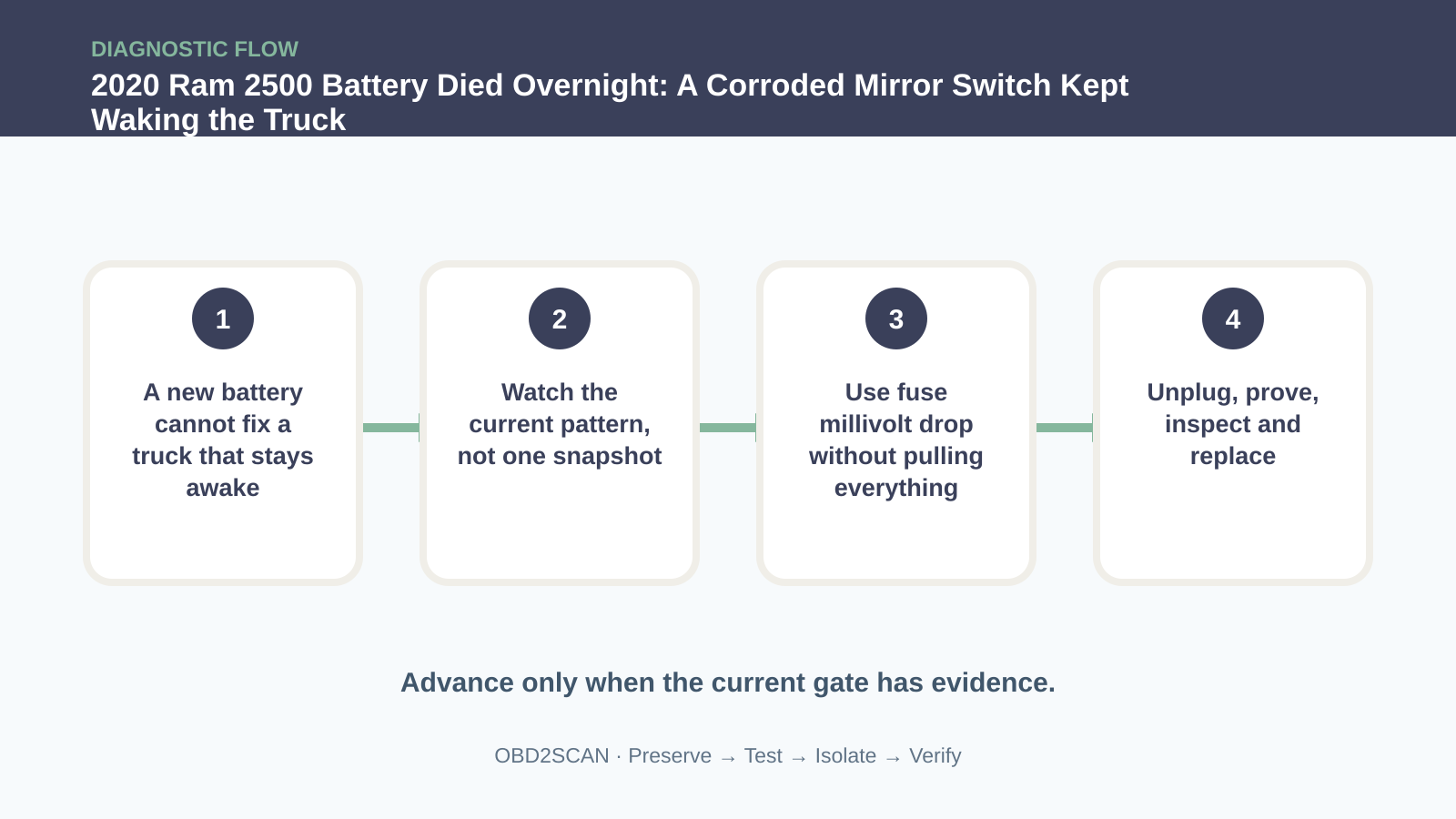
- A new battery cannot fix a truck that stays awake
- Prepare the vehicle for a real sleep test
- Watch the current pattern, not one snapshot
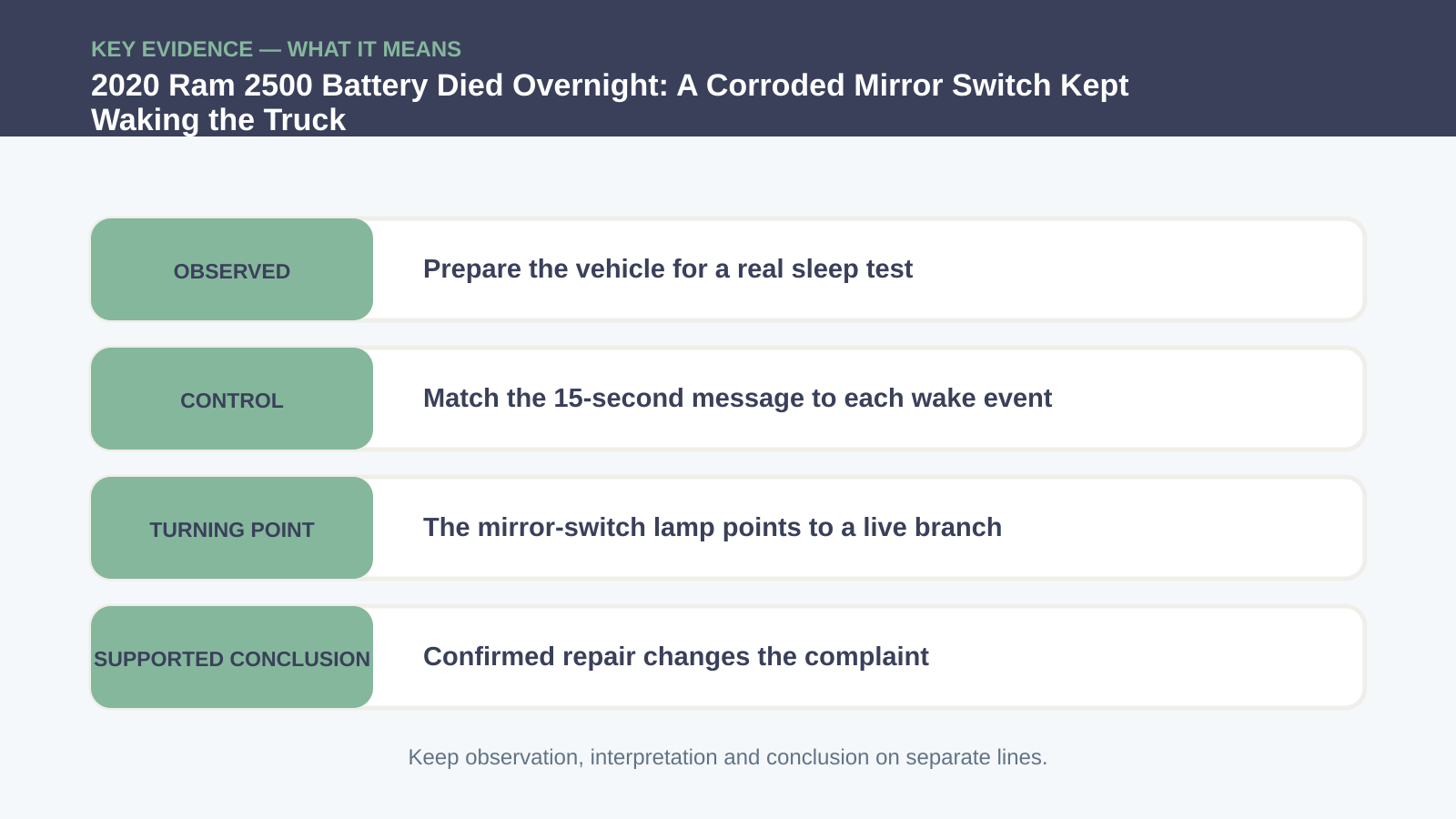
- Match the 15-second message to each wake event
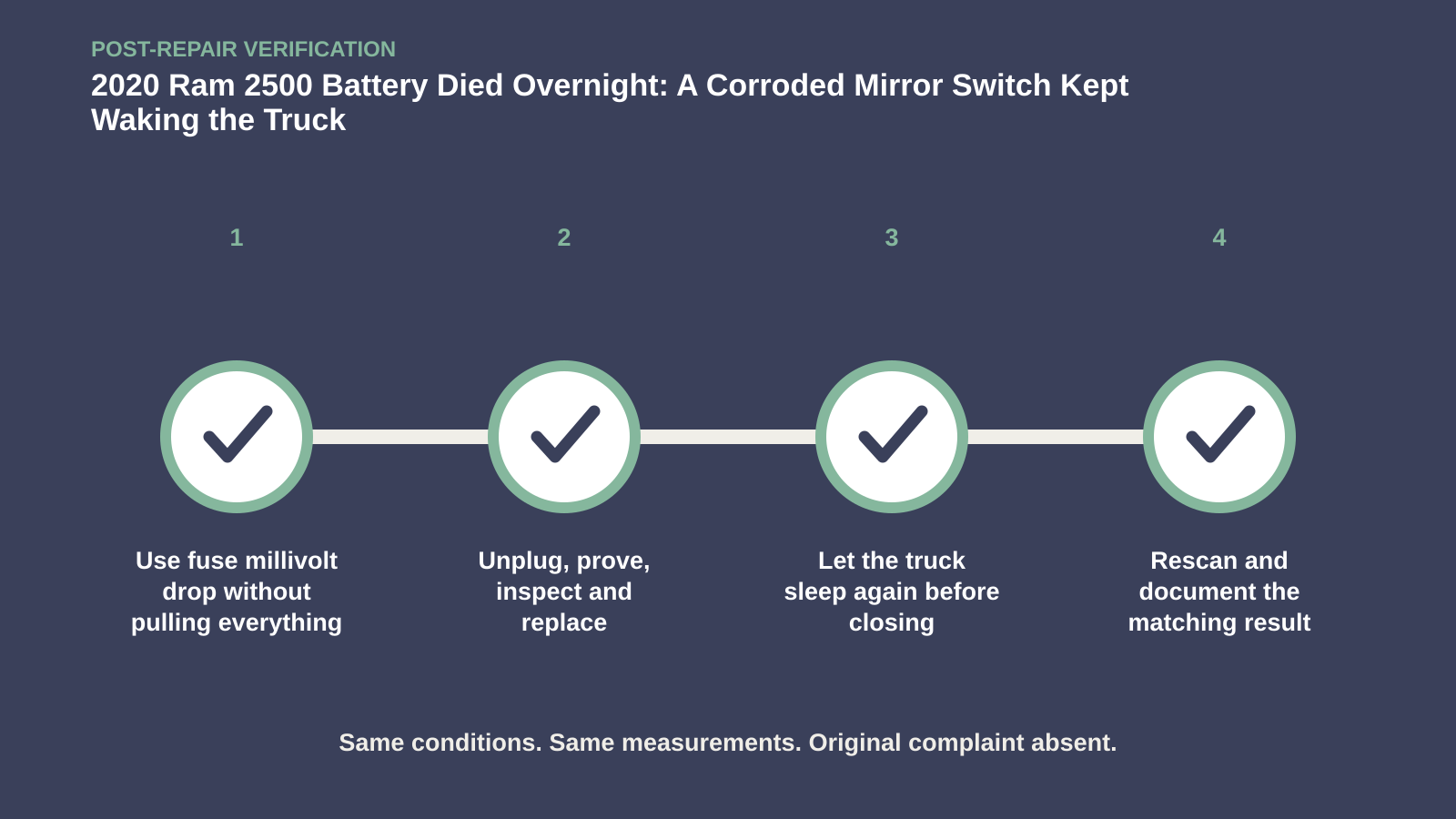
- Use fuse millivolt drop without pulling everything
- The mirror-switch lamp points to a live branch
- Unplug, prove, inspect and replace
- Let the truck sleep again before closing
A new battery cannot fix a truck that stays awake
Begin with a charged, tested battery so low voltage does not keep modules awake. Latch doors and hood, move keys away, disable scheduled accessories and wait the specified sleep period without disturbing the truck. Keep the vehicle in the failed state long enough to capture evidence, but never extend a test beyond the point where a stall, brake event, refrigerant release or moving component creates risk.
Prepare the vehicle for a real sleep test
Connect a properly zeroed low-amp clamp or fused series meter before sleep. Track current over time; the cycling 0.7-to-3.9-amp pattern mattered more than an arbitrary universal sleep-current threshold. Write down the conditions before disconnecting anything. That record is what lets a later change mean something instead of becoming another uncontrolled attempt.
Watch the current pattern, not one snapshot
Correlate each rise with lights, relays or messages. The cluster requested brake and start input about every 15 seconds even with no key nearby, proving the drain was an active wake event. Use service information for the exact engine, build and option set. A correct test on the wrong pin or configuration can produce a precise but useless answer.
Match the 15-second message to each wake event
Fuse millivolt-drop screening can identify branches carrying current without pulling fuses and waking modules. Use a fuse-type chart, stable temperature and confirm the result with a direct current change. This is the turning point in the documented case. It gains weight because earlier branches were tested and because the symptom changed with one controlled condition.
| Observation | What it supports | What it does not prove |
|---|---|---|
| Current cycles high | Truck is repeatedly awake | Battery is defective |
| Cluster wakes every 15 s | A repeating command exists | Key antenna failed |
| Switch lamp stays on | Mirror branch deserves focus | Switch is proved |
| Unplugging ends draw | Branch/component is causal | Water path is repaired |
Use fuse millivolt drop without pulling everything
The convex-mirror switch indicator remained illuminated while the rest of the cabin should have slept. That visual clue directed inspection, but the branch still needed an unplugging A/B test. Separate observation from inference: record what moved, opened, failed or remained stable, then state only the component or path that result actually narrows.
The mirror-switch lamp points to a live branch
Unplugging the switch ended the draw. Opening it revealed corrosion, supporting an internal conductive path; inspect the door and mirror area for water entry before installing a new switch. The repair must remove the demonstrated mechanism and restore mechanical support, sealing, torque or terminal fit—not merely make the symptom disappear once.
Unplug, prove, inspect and replace
Replace the switch and restore seals and trim. Recharge and retest the existing battery separately because repeated deep discharge can damage it even after the parasitic cause is removed. Reassemble to the original protection standard. Clear codes only after preserving the pre-repair record and confirming the relevant controller is online.
Let the truck sleep again before closing
Run a complete sleep cycle without touching the vehicle, log stable current and leave it overnight where practical. Confirm normal mirror operation and no repeated cluster wakeup the next morning. Use the customer’s original complaint as the final test specification. Matching conditions and a post-repair scan are stronger closure than a quiet bay or a cleared warning lamp.
For the owner or service adviser, the useful explanation has three parts: what was observed, why the decisive test narrowed the fault, and which original condition was repeated after repair. It should not promise that every similar vehicle needs the same component. This was one evidence chain on one vehicle, and the appropriate next step on another car may change with build data, prior work, safety condition and test results. That honest boundary makes the case easier to trust and more useful at the next diagnostic visit.
The battery was discharged by a truck waking every 15 seconds. Current trending, fuse screening and the lit mirror control isolated a corroded switch; replacement stopped the cycle. The reusable lesson is narrower and more valuable: Turn parasitic draw into a timed sleep/wake story, with one visible switch lamp as a human-readable clue.










Comments 0
Questions, fixes, and real-world diagnostic notes from readers.
Be the first to share a diagnostic result or ask a follow-up question.